Short i words help children hear and read the /ĭ/ sound in words like pig, pin, sit, lip, and big. This sound is often described as a quick “ih” sound. Once children can hear this middle vowel clearly, they can blend short i words more confidently instead of guessing from the first letter.
Children often mix short i with short e, especially in pairs like pin/pen, sit/set, and pig/peg. They also need to learn that silent e can change short i into long i, as in pin → pine, kit → kite, and bit → bite. That is why short i practice should begin with simple CVC words, then move step by step into word families, sound boxes, sorting activities, and simple sentences.
In This Page
What Is the Short I Sound in Words?
The short i sound is the vowel sound /ĭ/. You can hear it in words such as in, it, pig, pin, and sit.
In beginner phonics, short i often appears in the middle of a CVC word. A CVC word has a consonant-vowel-consonant pattern.
Examples:
- pig = p + i + g
- pin = p + i + n
- sit = s + i + t
- lip = l + i + p
- big = b + i + g
The middle vowel sound in these words is /ĭ/.
Simple short i examples:
- pig
- pin
- sit
- lip
- big
- dig
- win
- kid
- lid
- bib
First Short I Words Kids Should Read
The first short i words should be easy to hear, easy to blend, and easy to picture. Start with a small set instead of a long mixed list.
Good first short i words:
- pig
- pin
- sit
- lip
- big
- dig
- win
- kid
- lid
- bib
These words are useful because most of them are simple three-letter words. They also work well for flashcards, sound boxes, spelling practice, and short reading lessons.
First practice set:
- pig
- pin
- sit
- lip
- big
Second practice set:
- dig
- win
- kid
- lid
- bib
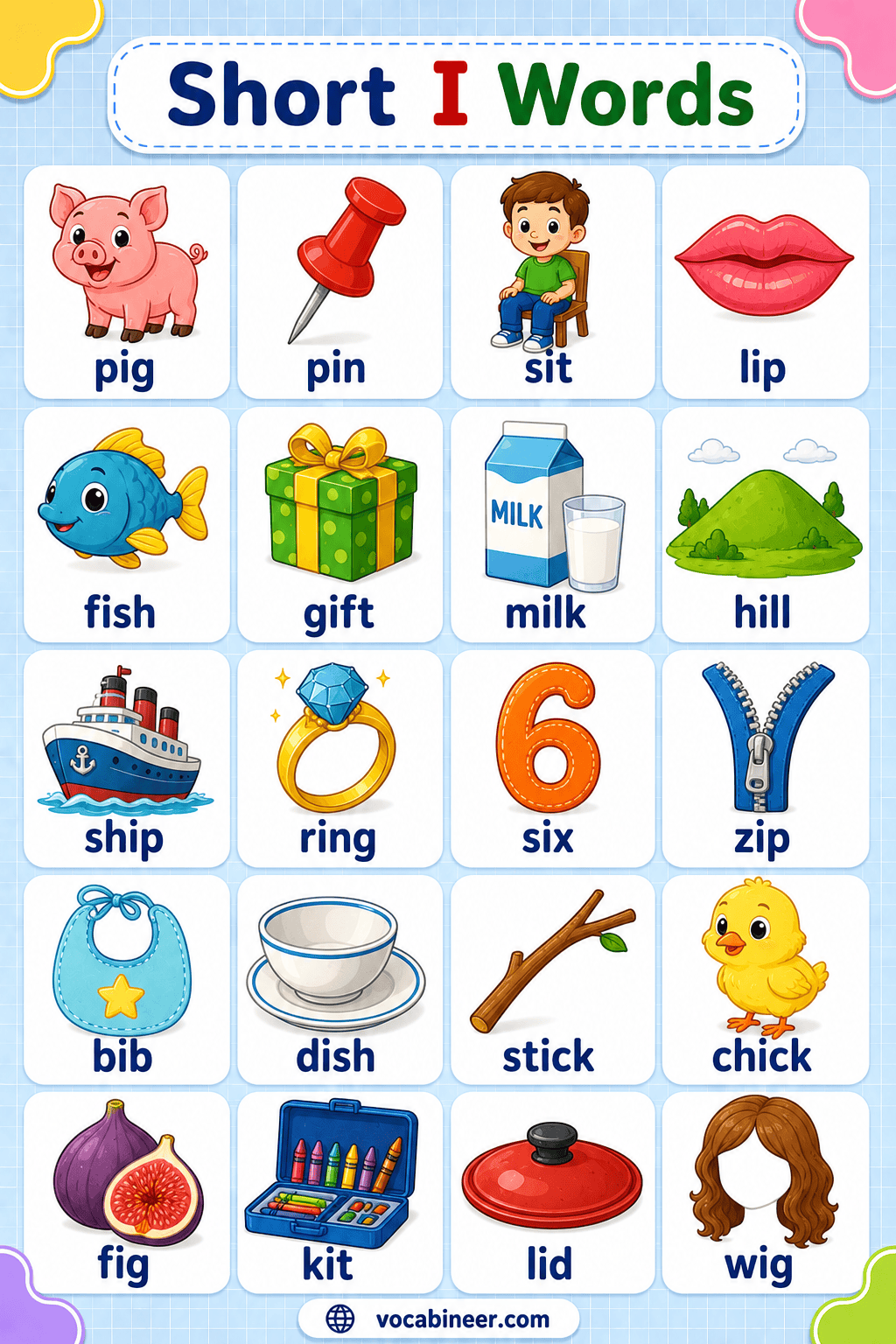
Short I Words Kids Can Blend Without Guessing
Some children guess a word after looking at only the first letter. Short i words should be taught with careful blending so children read all three sounds.
Use this routine:
- Look at the first letter.
- Say the first sound.
- Say the short i sound.
- Say the final sound.
- Blend the sounds together.
Blending examples:
- pig: /p/ /ĭ/ /g/ → pig
- pin: /p/ /ĭ/ /n/ → pin
- sit: /s/ /ĭ/ /t/ → sit
- lip: /l/ /ĭ/ /p/ → lip
- big: /b/ /ĭ/ /g/ → big
Good blending words:
- pig
- pin
- sit
- lip
- big
- dig
- win
- kid
Short I CVC Word Sets for Fast Reading
Short i CVC word sets help children practice the same vowel sound with different beginning and ending sounds. Use small sets for fast reading practice.
-ig words:
- big
- dig
- fig
- pig
- wig
-in words:
- bin
- fin
- pin
- tin
- win
-ip words:
- dip
- hip
- lip
- rip
- sip
- tip
- zip
-it words:
- bit
- fit
- hit
- kit
- pit
- sit
-id words:
- did
- hid
- kid
- lid
- rid
-im words:
- dim
- him
- rim
Short I Word Families That Build Reading Speed
Short i word families help children read related words more quickly. When a child can read pin, they can often read bin, fin, tin, and win by changing the first sound.
Useful short i word families:
- -ig: big, dig, fig, pig, wig
- -in: bin, fin, pin, tin, win
- -ip: dip, hip, lip, rip, sip, tip, zip
- -it: bit, fit, hit, kit, pit, sit
- -id: did, hid, kid, lid, rid
- -im: dim, him, rim
- -ix: fix, mix, six
Later short i families:
- -ill: hill, pill, will
- -ish: dish, fish, wish
- -ick: kick, lick, pick, sick, tick, stick
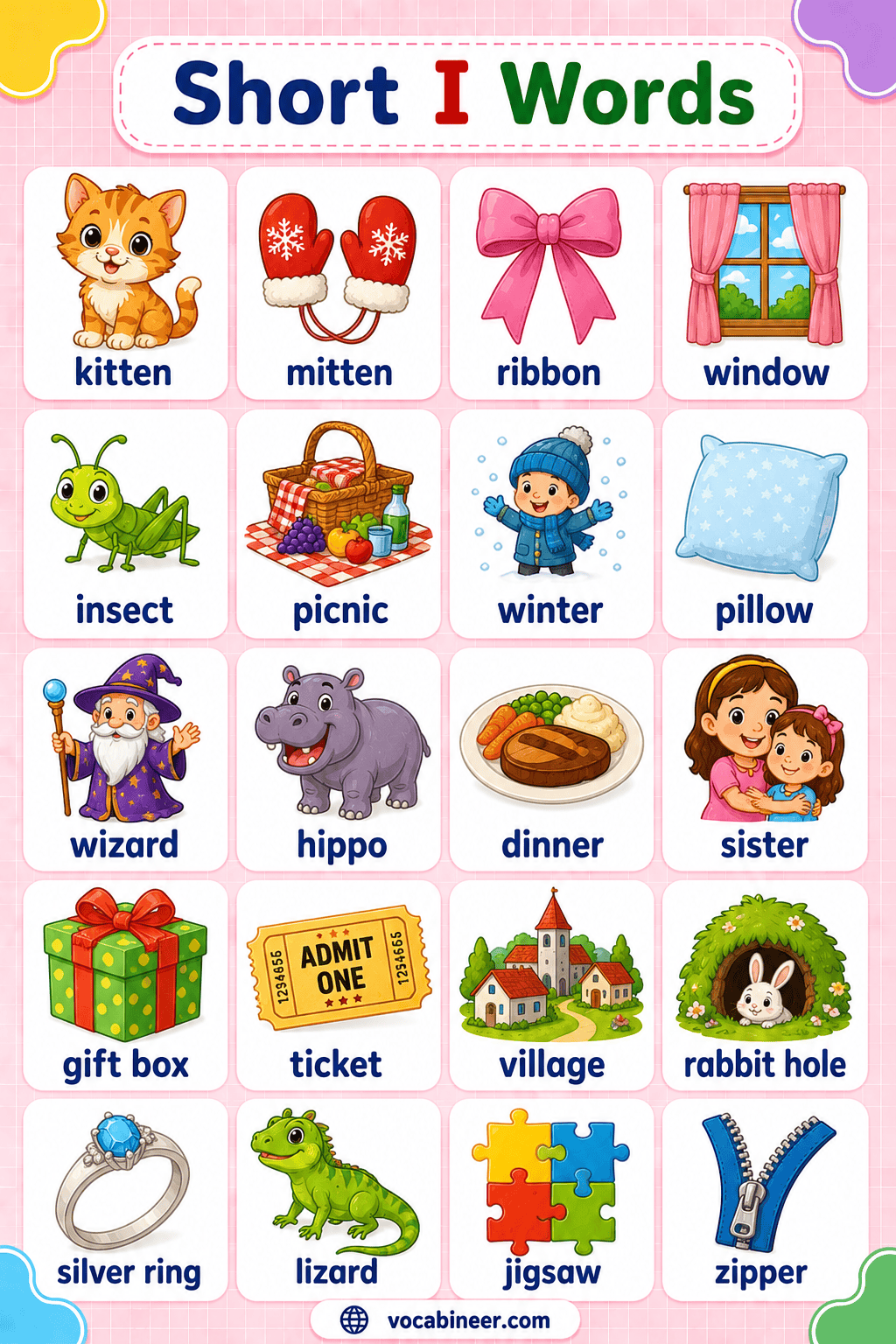
Short I Ending Sorts for -ig, -in, -ip, and -it
Ending sorts help children notice the final word pattern instead of guessing from the first letter. Use the four easiest short i endings first: -ig, -in, -ip, and -it.
Sorting words:
- -ig: big, dig, pig, wig
- -in: bin, fin, pin, win
- -ip: lip, rip, sip, zip
- -it: bit, fit, hit, sit
Simple ending-sort activity:
- Write pig, pin, lip, and sit as four starter words.
- Make four columns: -ig, -in, -ip, and -it.
- Add words like big, bin, zip, and hit.
- Ask children to place each word under the correct ending.
Picture-Friendly Short I Words Before Blends
Picture-friendly short i words help children connect sounds, spelling, and meaning. A safe order is to teach simple CVC picture words first, then introduce harder words such as ship, stick, and brick.
Easy picture-friendly short i words:
- pig — pig
- wig — wig
- pin — pin
- bin — bin
- fin — fish fin
- lip — lips
- bib — baby bib
- lid — lid
- kid — child
- zip — zipper
- six — number six
Harder picture words for later:
- fish — fish
- dish — dish
- ship — ship
- chip — chip
- stick — stick
- brick — brick
- gift — gift
- milk — milk
- hill — hill
Short I Words for Sound Boxes and Dictation
Sound boxes help children hear each sound in a word. Most beginner short i CVC words fit into three sound boxes.
Good sound-box words:
- pig
- pin
- sit
- lip
- big
- kid
- lid
- bib
Sound-box examples:
- pig: p | i | g
- pin: p | i | n
- sit: s | i | t
- lip: l | i | p
- big: b | i | g
- kid: k | i | d
Dictation words:
- pig
- pin
- sit
- lip
- big
- lid
Dictation routine:
- Say the word aloud.
- Ask the child to repeat it.
- Tap each sound.
- Write one letter for each sound.
- Read the word again.
Short I and Short E Word Pairs Kids Mix Up
Short i and short e can sound close to young readers. Children may read pin as pen or sit as set if they do not listen carefully to the middle vowel.
Common short i and short e pairs:
| Short I | Short E |
|---|---|
| pin | pen |
| pit | pet |
| bid | bed |
| tin | ten |
| sit | set |
| rid | red |
| bit | bet |
| pig | peg |
Practice idea:
- Say both words aloud.
- Point to the middle vowel.
- Stretch the vowel sound.
- Read the pair slowly.
- Use each word in a short phrase.
Examples:
- pin — the pin is in the bin
- pen — a red pen
- sit — sit down
- set — set it here
Short I Words That Change with Silent E: CVC vs CVCe
Silent e can change a short i word into a long i word. Children should understand short i CVC words before reading CVCe words.
Short i CVC words have the /ĭ/ sound:
- bit
- pin
- sit
- rid
- kit
- win
- fin
- dim
When silent e is added, the vowel often changes to long /ī/.
| Short I CVC | Long I CVCe |
|---|---|
| bit | bite |
| pin | pine |
| sit | site |
| rid | ride |
| kit | kite |
| win | wine |
| fin | fine |
| dim | dime |
In pin, the letter i says /ĭ/. In pine, silent e helps the i say its long sound /ī/.
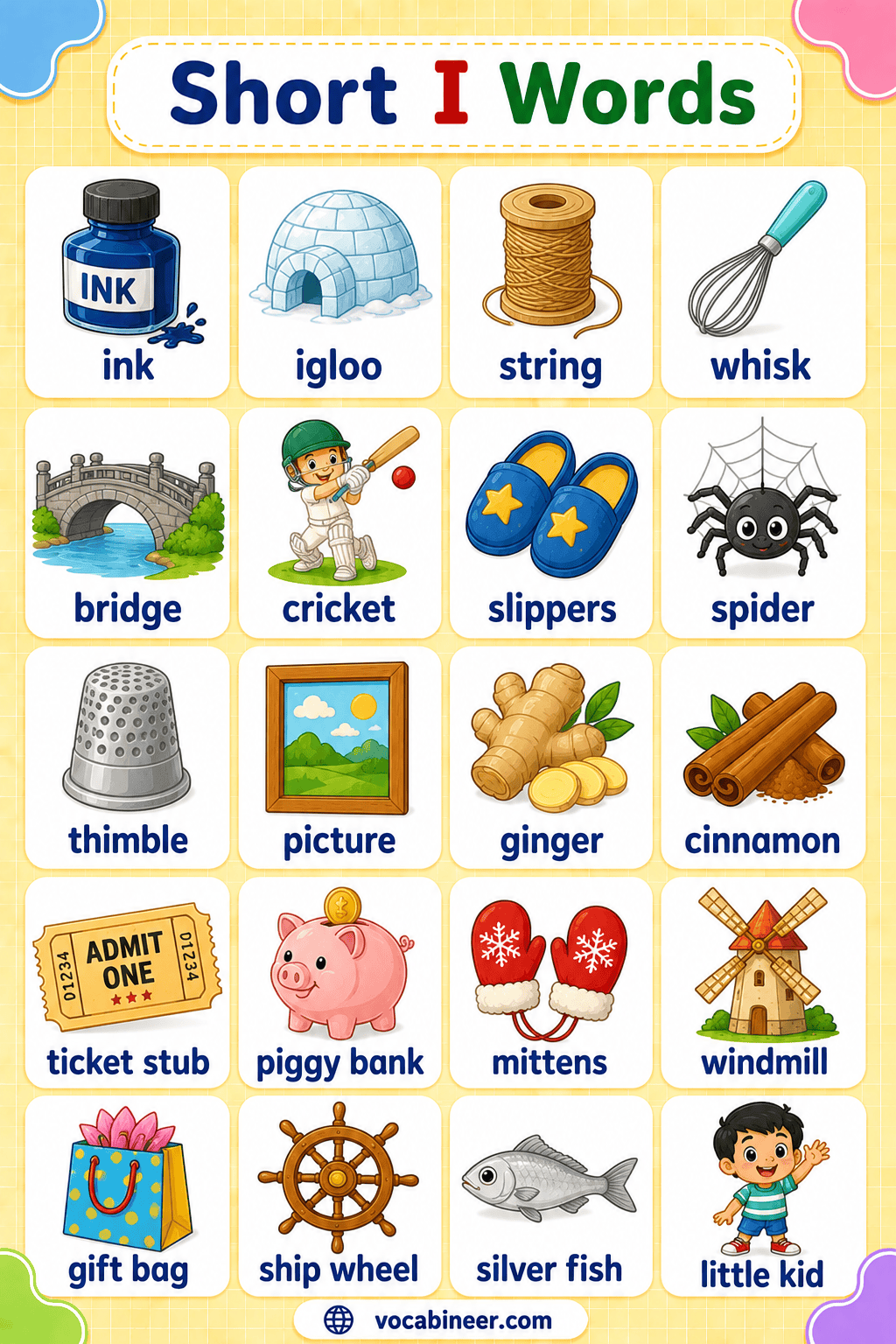
Short I Words with Blends and Digraphs
After children can read simple short i CVC words, they can move to short i words with blends and digraphs. These words still have the short i sound, but the consonant patterns are harder.
Short i words with blends:
- swim
- slip
- clip
- trip
- grin
- grip
- gift
- milk
- silk
- brick
- stick
Short i words with digraphs:
- fish
- dish
- wish
- ship
- chip
- thick
A blend has two consonant sounds that stay separate, as in slip or grin. A digraph has two letters that make one sound, as in sh in ship or ch in chip.
Simple Short I Sentences for Reading Practice
Simple sentences help children read short i words in context. Choose sentences that match the child’s phonics level.
Short i sentences:
- The pig is big.
- A pin is in the bin.
- The kid can sit.
- A lid is on the bin.
- The bib is big.
- The fish can swim.
- The ship is big.
- The dish is clean.
- The chip is thin.
- A stick is on the hill.
- The gift is big.
- The milk is in the cup.
- The wig is on.
- I can zip it.
- The kit is big.
Short sentence practice set:
- The pig is big.
- The kid can sit.
- A pin is in the bin.
- I can zip it.
Short I Worksheet and Sorting Ideas
A strong short i worksheet should help children hear, read, spell, sort, and use the /ĭ/ sound through missing vowels, picture matching, sound boxes, word sorting, and simple sentence practice.
Useful worksheet ideas:
- Match short i words to pictures.
- Fill in the missing vowel.
- Circle the word with the /ĭ/ sound.
- Choose between i and e in a missing-vowel word.
- Sort short i and short e words.
- Sort short i CVC and long i CVCe words.
- Match -ig, -in, -ip, and -it endings.
- Build short i words from letter tiles.
- Write short i words in sound boxes.
- Read a short i word and draw it.
- Complete a short i sentence.
- Choose the word that matches the picture.
Missing-vowel examples:
- p _ g → pig
- p _ n → pin
- s _ t → sit
- l _ p → lip
- b _ g → big
- k _ d → kid
- l _ d → lid
- b _ b → bib
Read-and-draw prompts:
- Draw a pig.
- Draw a pin.
- Draw a bib.
- Draw a fish.
- Draw a ship.
Tricky I Words to Teach Later
Some words have the letter i, but they are not good first examples for short i practice. They may have unusual spelling, pronunciation differences, or more advanced patterns.
Teach these later:
- give
- live
- been
- women
- build
- busy
- business
- pretty
- minute
- English
Why these words are tricky:
- give and live look like silent-e words but do not follow the regular long i pattern.
- women, busy, and pretty have unexpected spelling-sound patterns.
- been may vary by pronunciation.
- minute and English are not beginner short i words.
Words with I That Do Not Say Short I
Some words have the letter i, but the sound is not short /ĭ/. These words should not be mixed into beginner short i lists.
| Word | Why It Is Not Short I |
|---|---|
| ice | long i sound |
| bike | silent-e long i pattern |
| time | silent-e long i pattern |
| kite | silent-e long i pattern |
| line | silent-e long i pattern |
| nine | silent-e long i pattern |
| five | silent-e long i pattern |
| pie | long i sound |
| tie | long i sound |
| night | igh makes long i |
| light | igh makes long i |
| find | long i sound |
| kind | long i sound |
| wild | long i sound |
| child | long i sound |
| sign | long i sound |
How to Teach Short I Without Confusing It with E
Short i and short e should not be mixed too early. Teach short i clearly first, then compare it with short e after children can hear and read the /ĭ/ sound.
A safe teaching order:
- Start with the short i sound /ĭ/.
- Use easy words like pig, pin, sit, and lip.
- Practice one word family, such as -ig or -in.
- Add sound boxes for spelling.
- Read short i sentences.
- Compare short i and short e pairs.
- Add silent-e changes like pin → pine.
Good first lesson:
- Sound: /ĭ/
- Words: pig, pin, sit, lip
- Family: pin, bin, fin, win
- Sentence: A pin is in the bin.
Common Short I Reading and Spelling Mistakes
Short i words are simple, but children can still make reading and spelling mistakes if the practice is not clear.
Common mistakes:
- Mixing short i and short e too early: Teach pin clearly before comparing it with pen.
- Adding silent-e words too soon: Teach bit before bite.
- Using tricky words too early: Keep give, live, busy, and women for later.
- Starting with hard picture words: Teach pig before ship.
- Using too many endings at once: Start with -ig, -in, -ip, or -it.
- Skipping sound boxes: Let children tap and write each sound.
- Only using worksheets: Add flashcards, dictation, sorting, and sentence reading.
- Calling every i word short i: Words like ice, bike, time, and light are not short i words.
FAQs
Short i words are words where the letter i makes the /ĭ/ sound, like pig, pin, sit, lip, and big.
Short i makes the /ĭ/ sound, often described as a quick “ih” sound. You can hear it in in, it, pig, and pin.
Ten short i words are pig, pin, sit, lip, big, dig, win, kid, lid, and bib.
Short i CVC words are three-letter words with the short i sound in the middle, such as pig, pin, sit, lip, big, and kid.
Words like ice, bike, time, kite, line, night, light, find, and kind are not short i words because they use long i sounds or harder spelling patterns.
Read More
- CVC Rhyming Words for Kids
- Short Vowel Words for Kids
- Three Letter CVC Words
- Short A Words for Kids
- Short E Words for Kids