

Formal and informal words help you change your tone for different situations. Formal words are useful in essays, reports, business emails, applications, and professional conversations, while informal words are better for daily speech, friendly messages, chats, and casual writing.
In this guide, you will learn 300 unique formal and informal word pairs with clear examples. The list is arranged into useful groups, including common words, verbs, adjectives, nouns, email phrases, academic vocabulary, business English, speaking words, daily-use phrases, and transition words. This makes it easier to compare each pair and choose the best word for writing, speaking, or communication.
In This Page
What Are Formal and Informal Words?
Formal words are used in serious, professional, academic, or polite situations. You often use them in essays, reports, business emails, applications, presentations, and official writing.
Informal words are used in daily conversation, friendly messages, social media, chats, and relaxed speech. They are not wrong, but they may not fit serious writing.
For example:
| Informal | Formal |
|---|---|
| I need help. | I require assistance. |
| Can you check this? | Could you please review this? |
| We talked about the problem. | We discussed the issue. |
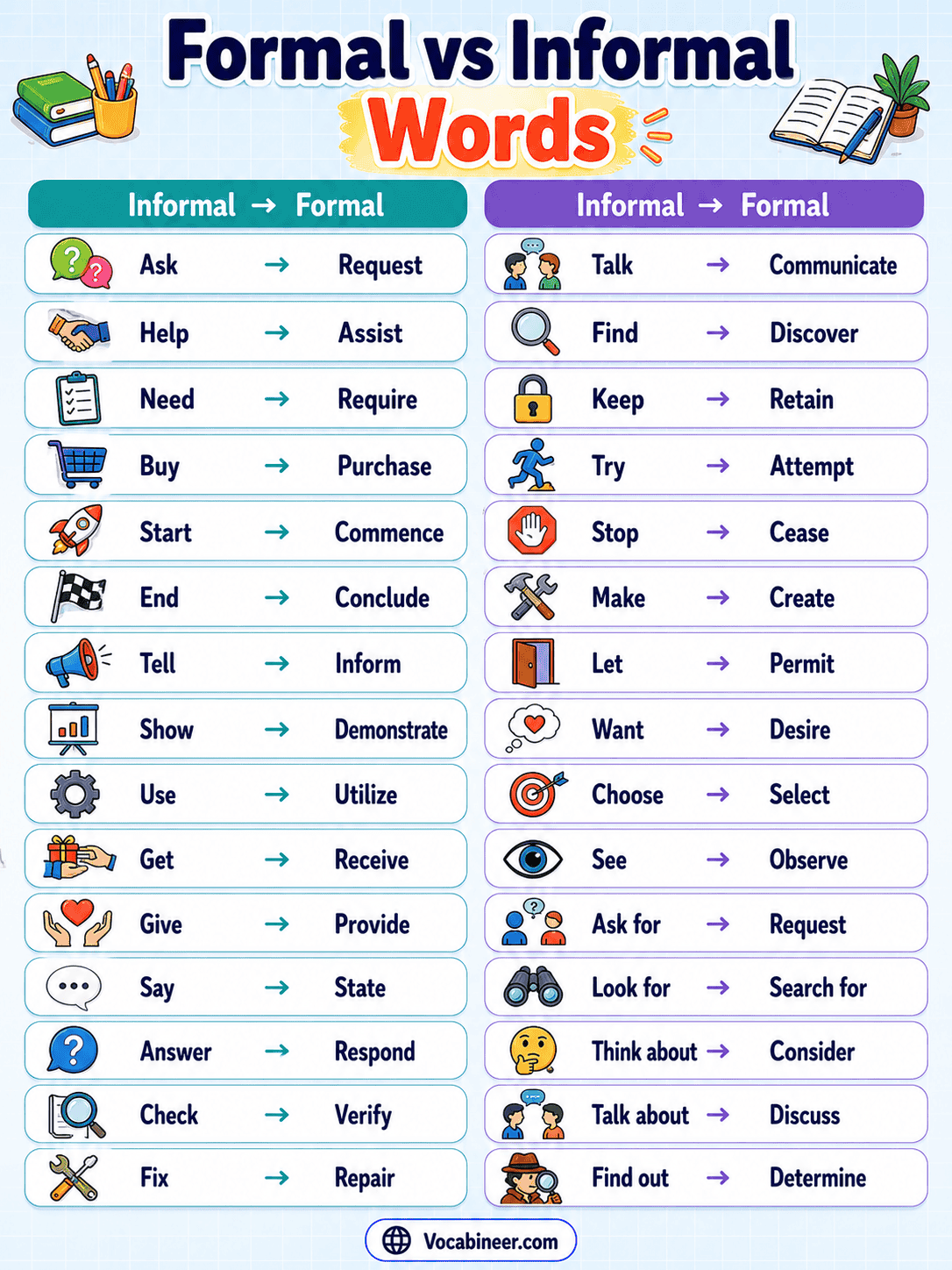
Formal vs Informal Words Chart
This quick chart shows common informal words with formal alternatives you can use in writing, emails, and professional situations.
| Informal Word | Formal Word |
|---|---|
| Ask | Request |
| Help | Assist |
| Need | Require |
| Buy | Purchase |
| Start | Commence |
| End | Conclude |
| Tell | Inform |
| Show | Demonstrate |
| Use | Utilize |
| Get | Receive |
| Give | Provide |
| Say | State |
| Answer | Respond |
| Check | Verify |
| Fix | Repair |
| Talk | Communicate |
| Find | Discover |
| Keep | Retain |
| Try | Attempt |
| Stop | Cease |
| Make | Create |
| Let | Permit |
| Want | Desire |
| Choose | Select |
| See | Observe |
| Ask for | Request |
| Look for | Search for |
| Think about | Consider |
| Talk about | Discuss |
| Find out | Determine |
Common Formal and Informal Words
These common word pairs are useful for daily English, school writing, business communication, and basic vocabulary improvement.
| Informal Word | Formal Word |
|---|---|
| Ask | Request |
| Help | Assist |
| Need | Require |
| Buy | Purchase |
| Start | Commence |
| End | Conclude |
| Tell | Inform |
| Show | Demonstrate |
| Use | Utilize |
| Get | Receive |
| Give | Provide |
| Say | State |
| Answer | Respond |
| Check | Verify |
| Fix | Repair |
| Talk | Communicate |
| Find | Discover |
| Keep | Retain |
| Try | Attempt |
| Stop | Cease |
| Make | Create |
| Let | Permit |
| Want | Desire |
| Choose | Select |
| See | Observe |
| Ask for | Request |
| Look for | Search for |
| Think about | Consider |
| Talk about | Discuss |
| Find out | Determine |
Formal and Informal Verbs
Verbs can quickly change the tone of a sentence, so formal verb choices make writing sound more polished and professional.
| Informal Verb | Formal Verb |
|---|---|
| Go | Depart |
| Come | Arrive |
| Put off | Postpone |
| Call off | Cancel |
| Deal with | Handle |
| Throw away | Discard |
| Give up | Quit |
| Bring up | Mention |
| Set up | Establish |
| Go on | Continue |
| Look into | Investigate |
| Fill in | Complete |
| Pick up | Collect |
| Put in | Insert |
| Take out | Remove |
| Go after | Pursue |
| Carry out | Conduct |
| Work out | Resolve |
| Look over | Review |
| Point out | Indicate |
| Put together | Assemble |
| Go down | Decrease |
| Go up | Increase |
| Make sure | Ensure |
| Take part | Participate |
| Put up with | Tolerate |
| Turn down | Reject |
| Go through | Experience |
| Bring about | Cause |
| Look after | Supervise |
Formal and Informal Adjectives
Adjectives describe people, things, and situations, so choosing formal alternatives can make descriptions clearer and more suitable for serious writing.
| Informal Adjective | Formal Adjective |
|---|---|
| Big | Large |
| Small | Minor |
| Good | Beneficial |
| Bad | Harmful |
| Smart | Intelligent |
| Rich | Wealthy |
| Cheap | Inexpensive |
| Tired | Exhausted |
| Lucky | Fortunate |
| Friendly | Amiable |
| Easy | Simple |
| Hard | Difficult |
| Wrong | Incorrect |
| Right | Correct |
| Old | Elderly |
| Young | Youthful |
| Fast | Rapid |
| Slow | Gradual |
| Happy | Pleased |
| Sad | Unhappy |
| Angry | Irritated |
| Brave | Courageous |
| Funny | Humorous |
| Clear | Evident |
| Sure | Certain |
| Nice | Pleasant |
| Poor | Underprivileged |
| Famous | Well-known |
| Busy | Occupied |
| Free | Available |
Formal and Informal Nouns
Some everyday nouns have more formal alternatives that fit better in reports, essays, emails, and professional English.
| Informal Noun | Formal Noun |
|---|---|
| Kid | Child |
| Dad | Father |
| Mom | Mother |
| Boss | Manager |
| Worker | Employee |
| Job | Position |
| Home | Residence |
| House | Property |
| Car | Vehicle |
| Food | Meal |
| Clothes | Clothing |
| Doctor | Physician |
| Problem | Issue |
| Chance | Opportunity |
| Idea | Concept |
| Plan | Strategy |
| Goal | Objective |
| Help | Assistance |
| Trip | Journey |
| Place | Location |
| Thing | Item |
| Stuff | Materials |
| Talk | Discussion |
| Fight | Conflict |
| Gift | Present |
| Rule | Regulation |
| Choice | Option |
| Result | Outcome |
| Reason | Factor |
| Use | Purpose |
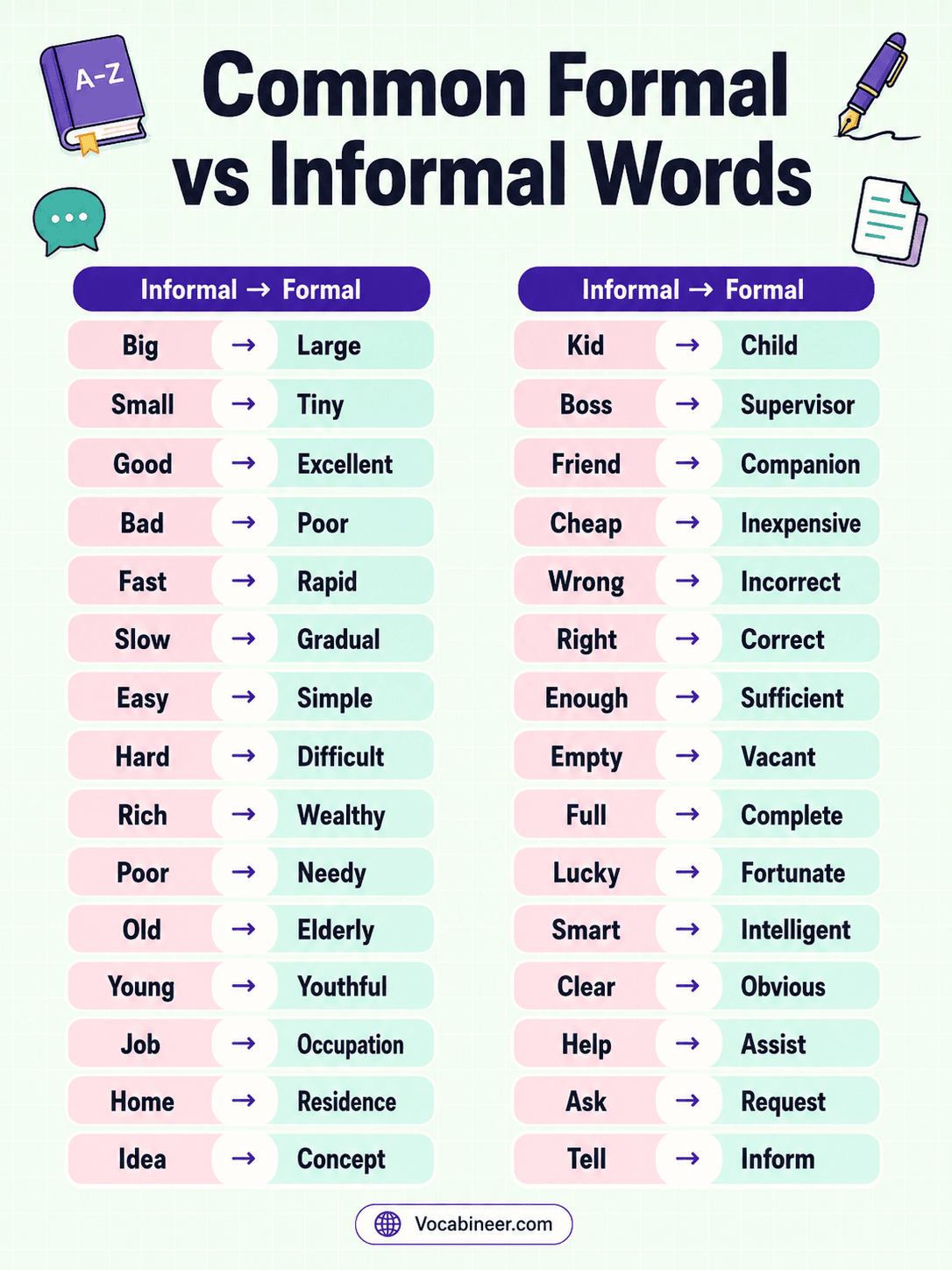
Formal and Informal Email Words
Email writing often needs polite and clear language, especially when you are writing to teachers, clients, managers, or officials.
| Informal Word or Phrase | Formal Word or Phrase |
|---|---|
| Hi | Dear |
| Thanks | Thank you |
| Sorry | I apologize |
| Can you | Could you please |
| I want | I would like |
| Let me know | Please inform me |
| Talk soon | I look forward to hearing from you |
| Need help | Require assistance |
| Send me | Please send me |
| About | Regarding |
| Tell me | Inform me |
| Get back to me | Respond to me |
| Okay | Acceptable |
| No problem | Certainly |
| Thanks a lot | Thank you very much |
| See attached | Please find attached |
| I got your email | I received your email |
| Just checking | I am following up |
| Is it okay? | Would this be acceptable? |
| I need | I require |
| I think | I believe |
| I’m writing about | I am writing regarding |
| Please reply | Please respond |
| Give me details | Provide details |
| Sorry for being late | I apologize for the delay |
| I can’t come | I am unable to attend |
| Tell us | Notify us |
| Talk later | Discuss later |
| Write back | Reply |
| See you | I look forward to meeting you |
Formal and Informal Academic Words
Academic writing uses formal vocabulary to explain ideas, evidence, arguments, results, and research in a clear and serious tone.
| Informal Word or Phrase | Formal Word or Phrase |
|---|---|
| Prove | Establish |
| Guess | Estimate |
| Look at | Analyze |
| Talk about | Discuss |
| Check | Examine |
| Good | Beneficial |
| Bad | Detrimental |
| Big | Significant |
| Small | Minor |
| Main | Primary |
| Last | Final |
| First | Initial |
| Clear | Apparent |
| True | Accurate |
| Wrong | Incorrect |
| Help | Contribute to |
| Cause | Lead to |
| Make | Produce |
| Change | Modify |
| Need | Necessitate |
| Try | Attempt |
| Study | Research |
| Result | Outcome |
| Idea | Concept |
| Reason | Factor |
| Point | Argument |
| Part | Component |
| Example | Illustration |
| Proof | Evidence |
| Topic | Subject |
Formal and Informal Business Words
Business English often uses professional words for work, meetings, money, clients, reports, plans, and company communication.
| Informal Word or Phrase | Formal Word or Phrase |
|---|---|
| Money | Funds |
| Sell | Market |
| Pay | Compensate |
| Deal | Agreement |
| Problem | Issue |
| Chance | Opportunity |
| Work together | Collaborate |
| Start a business | Establish a business |
| Make money | Generate revenue |
| Cut costs | Reduce expenses |
| Make better | Improve |
| Look into | Investigate |
| Give details | Provide information |
| Finish work | Complete the task |
| Keep records | Maintain records |
| Get results | Achieve results |
| New idea | Proposal |
| Business talk | Negotiation |
| Important client | Key client |
| Company rules | Company policy |
| Work report | Performance report |
| Team work | Collaboration |
| Work plan | Action plan |
| Sales number | Sales figure |
| Customer help | Customer support |
| Company money | Company funds |
| Business growth | Business expansion |
| Work problem | Operational issue |
| New product | Product launch |
| Job offer | Employment offer |
Formal and Informal Speaking Words
Spoken English can be casual, but knowing formal alternatives helps you adjust your tone for interviews, meetings, and presentations.
| Informal Word or Phrase | Formal Word or Phrase |
|---|---|
| Yeah | Yes |
| Nope | No |
| Wanna | Want to |
| Gonna | Going to |
| Gotta | Have to |
| Kinda | Somewhat |
| Sorta | Somewhat |
| Dunno | Do not know |
| Lemme | Let me |
| Gotcha | I understand |
| Hang on | Please wait |
| What’s up? | How are you? |
| No worries | That is acceptable |
| My bad | My mistake |
| Cool | Acceptable |
| Awesome | Excellent |
| Super | Very |
| Really | Highly |
| Pretty good | Satisfactory |
| A bit | Slightly |
| A bunch of | Several |
| Loads of | Many |
| Stuff | Items |
| Thing | Matter |
| Chat | Conversation |
| Help out | Assist |
| Come over | Visit |
| Drop by | Visit briefly |
| Hang out | Spend time together |
| Chill | Relax |
Formal and Informal Phrases
Many everyday phrases have formal versions that sound better in essays, reports, official letters, and professional communication.
| Informal Phrase | Formal Phrase |
|---|---|
| A lot of | Numerous |
| In the end | Finally |
| Right away | Immediately |
| Again and again | Repeatedly |
| For sure | Certainly |
| In fact | Indeed |
| To start with | To begin with |
| As soon as possible | At your earliest convenience |
| By the way | Incidentally |
| In my opinion | From my perspective |
| All in all | Overall |
| To sum up | To conclude |
| More and more | Increasingly |
| Step by step | Gradually |
| These days | Currently |
| Now | At present |
| Before | Previously |
| After that | Subsequently |
| In the meantime | Meanwhile |
| Lots of | Many |
| At once | Promptly |
| In short | In summary |
| On time | Punctually |
| Once in a while | Occasionally |
| Every now and then | Periodically |
| A little bit | Slightly |
| All the time | Constantly |
| No longer | Not anymore |
| In a hurry | Urgently |
| Out of date | Obsolete |
Formal and Informal Transition Words
Transition words connect ideas, so formal alternatives help essays, emails, and reports sound smoother, clearer, and more organized.
| Informal Transition | Formal Transition |
|---|---|
| So | Therefore |
| But | However |
| Also | Additionally |
| And | Furthermore |
| Plus | Moreover |
| Because | Since |
| Because of | Due to |
| Maybe | Perhaps |
| Anyway | Nevertheless |
| Still | Nonetheless |
| Then | Subsequently |
| First | Firstly |
| Next | Secondly |
| Last | Finally |
| In the end | Ultimately |
| To finish | To conclude |
| For example | For instance |
| Like | Such as |
| In short | In brief |
| All in all | Overall |
| Even so | Nevertheless |
| On top of that | In addition |
| That’s why | For this reason |
| As a result | Consequently |
| At the same time | Simultaneously |
| In fact | Indeed |
| Before | Previously |
| After | Following |
| Now | Currently |
| Soon | Shortly |
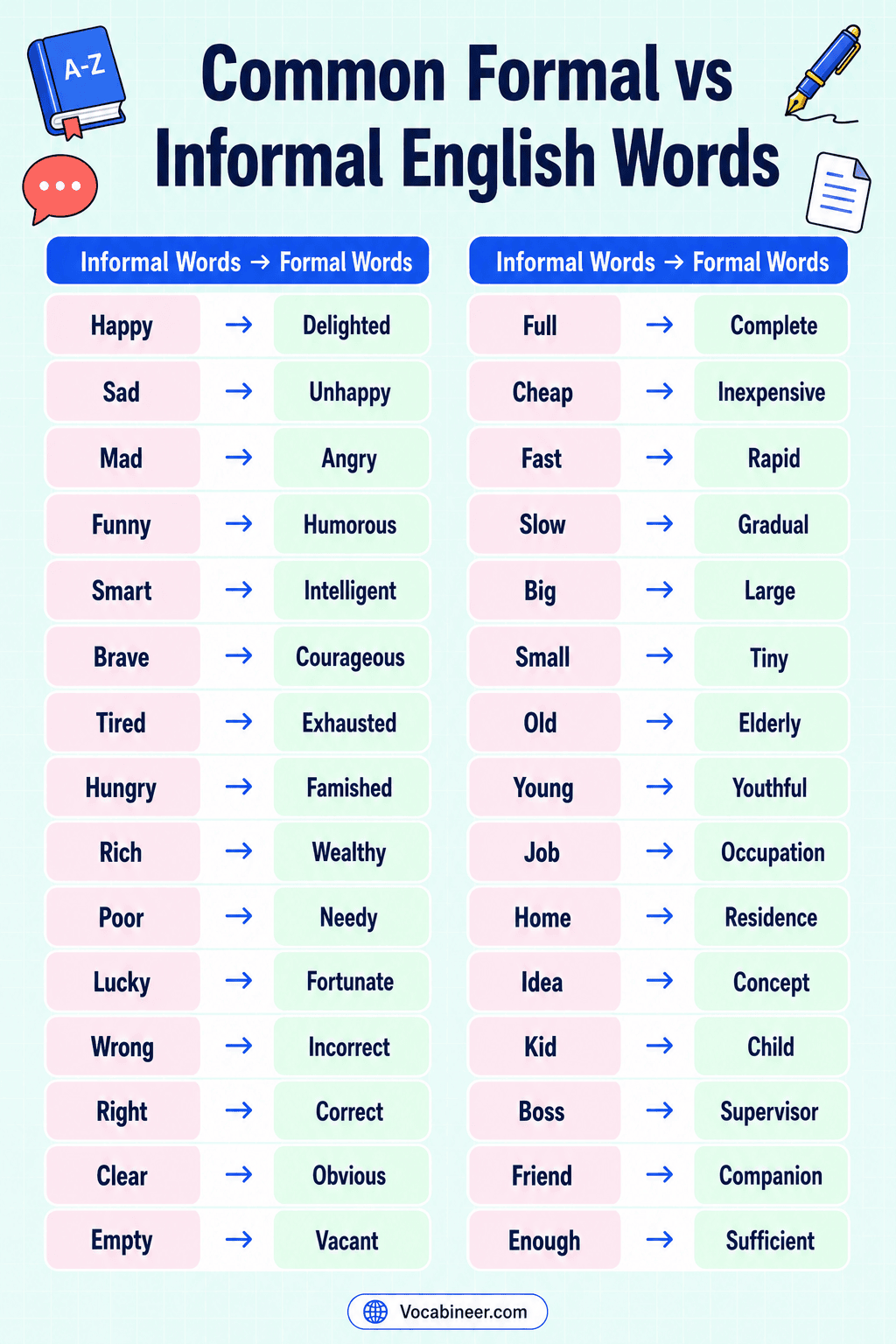
Formal and Informal Writing Words
Writing often needs precise vocabulary, especially when explaining, comparing, summarizing, supporting, or presenting ideas in a formal way.
| Informal Word or Phrase | Formal Word or Phrase |
|---|---|
| Write down | Record |
| Talk about | Address |
| Show clearly | Illustrate |
| Make clear | Clarify |
| Point out | Highlight |
| Sum up | Summarize |
| Go into detail | Elaborate |
| Leave out | Omit |
| Put simply | In simple terms |
| Make a list | Enumerate |
| Back up | Support |
| Go against | Contradict |
| Look the same | Resemble |
| Be about | Concern |
| Add to | Supplement |
| Cut down | Reduce |
| Make bigger | Expand |
| Make smaller | Minimize |
| Put forward | Present |
| Write again | Revise |
| Check again | Reassess |
| Give an example | Exemplify |
| Talk briefly | Mention briefly |
| Make a point | Assert |
| Give reasons | Justify |
| Look carefully | Inspect |
| Think again | Reconsider |
| Explain more | Elaborate further |
| Make easier | Simplify |
| Make stronger | Strengthen |
Formal and Informal Daily Use Words
Daily English includes many casual words, but formal alternatives are useful when speaking or writing in serious situations.
| Informal Word or Phrase | Formal Word or Phrase |
|---|---|
| Sick | Ill |
| Jobless | Unemployed |
| Poor people | Disadvantaged people |
| Old people | Elderly people |
| Bad behavior | Misconduct |
| Get better | Recover |
| Get worse | Deteriorate |
| Go away | Leave |
| Come back | Return |
| Be late | Arrive late |
| Be on time | Arrive punctually |
| Need food | Require food |
| Need money | Require funds |
| Help people | Support people |
| Use time | Spend time |
| Eat food | Consume food |
| Drink water | Consume water |
| Make food | Prepare food |
| Clean up | Organize |
| Look good | Appear attractive |
| Feel bad | Feel unwell |
| Feel better | Improve |
| Go home | Return home |
| Stay home | Remain at home |
| Get ready | Prepare |
| Go outside | Go outdoors |
| Come inside | Enter |
| Say sorry | Apologize |
| Say yes | Agree |
| Say no | Refuse |
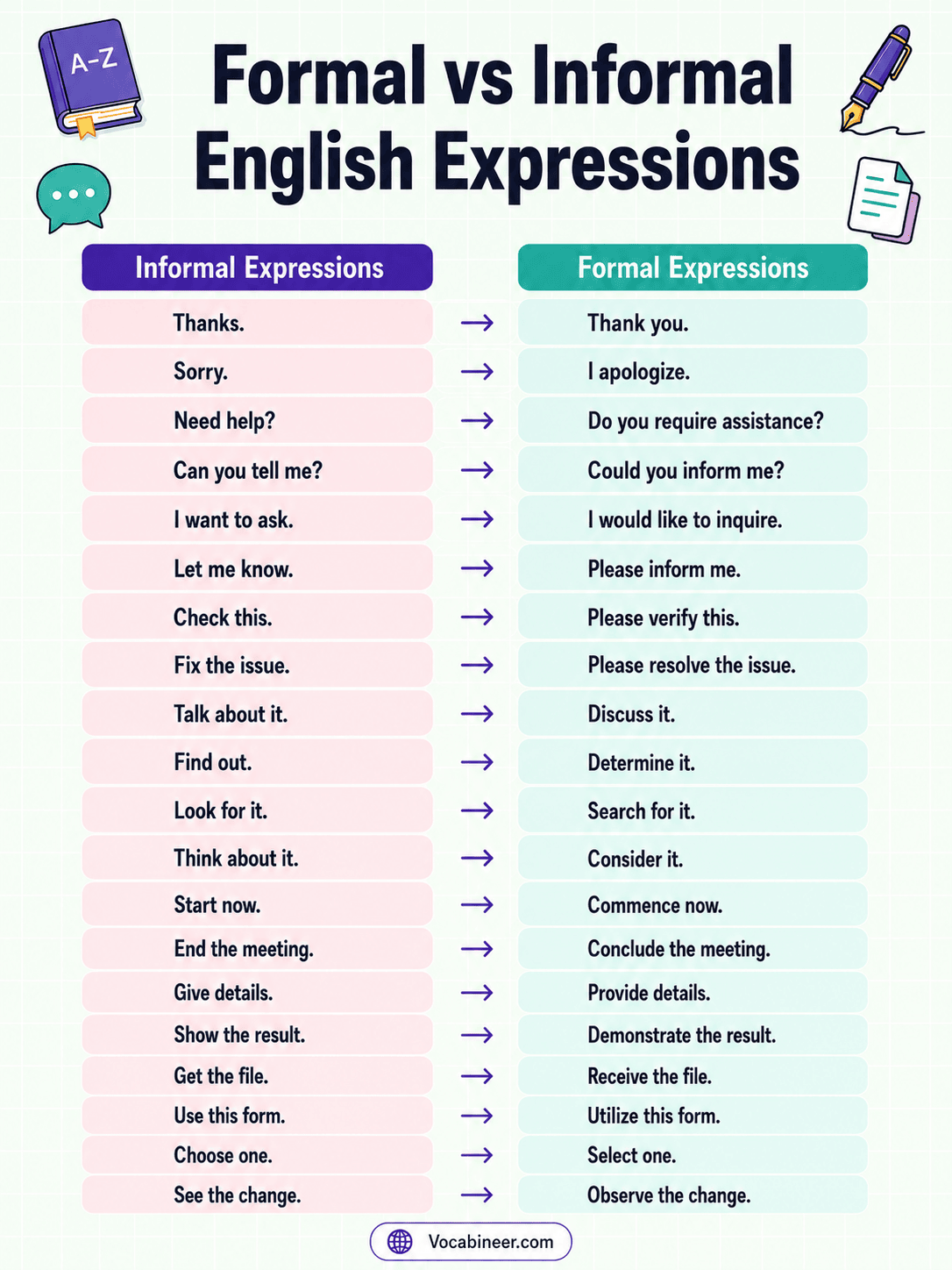
Formal and Informal Sentence Examples
Sentence examples show how formal and informal words work in real communication, not just as separate vocabulary pairs.
| Informal Sentence | Formal Sentence |
|---|---|
| I need your help. | I require your assistance. |
| Can you check this report? | Could you please review this report? |
| We talked about the issue. | We discussed the issue. |
| I got your email. | I received your email. |
| The meeting was called off. | The meeting was canceled. |
| Please send me the file. | Kindly provide the file. |
| I’m sorry for being late. | I apologize for the delay. |
| We need to fix the problem. | We need to resolve the issue. |
| Tell me what happened. | Please inform me what occurred. |
| I want more details. | I would like further details. |
| He gave up too quickly. | He quit too quickly. |
| We found out the reason. | We determined the reason. |
| They put off the event. | They postponed the event. |
| She looked over the document. | She reviewed the document. |
| The price went up. | The price increased. |
When to Use Formal Words
Use formal words in school essays, reports, business emails, applications, official letters, presentations, interviews, and professional communication. Formal language makes your writing sound more respectful and suitable for serious situations.
For example, “I require assistance” sounds more formal than “I need help.” However, formal writing should still sound clear and natural. Therefore, avoid using difficult words only to sound smarter.
When to Use Informal Words
Use informal words with friends, family, casual chats, social media posts, text messages, and everyday speaking. Informal language often sounds warmer, faster, and more natural in relaxed situations.
For example, “Thanks for your help” is fine in a friendly message. Meanwhile, “Thank you for your assistance” is better in a professional email.
Common Mistakes with Formal and Informal Words
One common mistake is thinking formal words are always better. They are not. Formal and informal words are both correct, but they belong in different situations.
Another mistake is using casual words in serious writing. For example, avoid wanna, gonna, stuff, lots of, kind of, and a bunch of in essays or professional emails. Instead, use want to, going to, materials, many, somewhat, and several when a formal tone is needed.
Also, do not replace every simple word with a difficult formal word. Clear English is always better than unnatural English.
FAQs
Formal words are used in serious, polite, academic, or professional situations. Informal words are used in casual speech, friendly messages, and everyday conversation.
Formal words sound more professional and polite, while informal words sound more casual and relaxed. For example, assist is more formal than help, and purchase is more formal than buy.
Examples of formal words include request, purchase, assist, require, inform, demonstrate, receive, verify, discuss, examine, therefore, and consequently.
Yes, informal words can be used in casual writing, personal messages, stories, chats, and friendly emails. However, they are usually avoided in academic writing, reports, official letters, and formal emails.
Formal words help you sound polite, professional, and clear in serious situations. They are useful for essays, emails, interviews, business writing, and academic communication.
Summary
Formal and informal words help you match your English to the right situation. Formal words are useful for essays, business emails, reports, applications, and professional communication. Informal words are better for daily conversation, chats, friendly messages, and social media. Learning these 300 formal and informal word pairs can improve your writing, speaking, emails, and overall English vocabulary.
Read More
- Basic vs Advanced English Words
- 1000 Daily Use English Words
- Rhyming Words in English
- 100+ Examples of Homophones
- Normal vs Advanced English Words