

Preschool children learn words by touching, seeing, hearing, naming, playing, singing, moving, and talking with people around them. A child may point to a ball, ask for milk, name a dog, say my turn, or tell a teacher, I am sad. These small words matter because they help children express needs, understand routines, join play, answer simple questions, and describe the world in everyday language.
Preschool vocabulary should feel familiar, visual, and useful. At this age, children are not expected to learn long spelling lists or formal reading words. Instead, they need words they can say, understand, match with pictures, hear in stories, act out in games, and use during daily routines at home or in class.
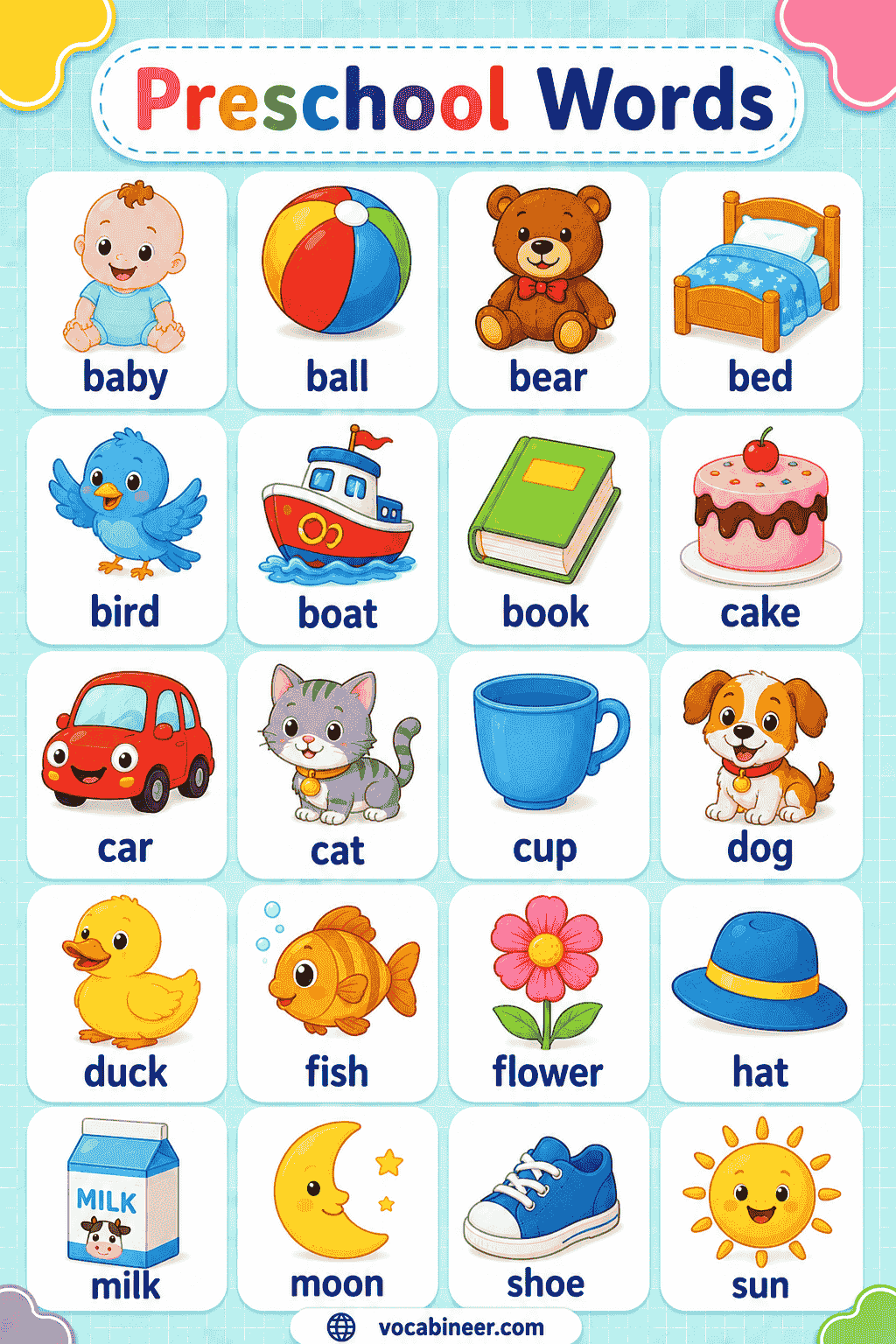
In This Page
What Preschool Vocabulary Really Means?
Preschool vocabulary means the words young children understand and use before formal school reading becomes the main focus. These words usually come from real life: family, food, toys, body parts, clothes, animals, colors, feelings, weather, home routines, and preschool classroom activities.
A strong preschool word list should support speaking, listening, naming, pointing, matching, sorting, pretend play, and simple sentence practice. Words like cup, shoe, jump, happy, rain, and teacher work well because children can connect them to things they see, do, feel, or need.
How Preschoolers Learn New Words Through Daily Life
Preschoolers learn new words best when language is connected to real experiences. A child understands spoon faster when holding a spoon, jump faster when jumping, and cold faster when touching something cold. That is why preschool vocabulary should be taught through play, songs, stories, pictures, movement, routines, and daily conversation.
Short repeated language is more helpful than long explanations. A parent or teacher can say red ball, big truck, wash hands, put shoes on, or drink water during real moments. Over time, children begin to understand the words, copy them, and use them in their own speech.
Preschool Vocabulary Word Bank
This word bank includes 300+ preschool vocabulary word examples grouped by familiar themes children meet at home, in class, during play, and in daily routines. The grouped format is easier to scan than long word lines and works well for speaking practice, picture cards, flashcards, classroom charts, matching games, worksheets, and pretend play.
First Words for Talking and Asking
These words help preschool children greet others, ask for help, answer simple questions, and take part in daily conversation.
- Self words: I, me, my, mine, you
- Answer words: yes, no, okay, maybe
- Greeting words: hi, bye, hello, good morning, good night
- Polite words: please, sorry, thanks, welcome
- Asking words: help, want, need, more, again
- Pointing words: this, that, here, there
People and Family Words
Children often learn people words early because family, caregivers, and familiar adults are part of their everyday world.
- Family words: mom, dad, baby, sister, brother
- Extended family: grandma, grandpa, aunt, uncle, cousin
- School people: teacher, friend, child, boy, girl
- Community helpers: doctor, nurse, driver, farmer, helper
- Group words: family, people, kids, parent, neighbor
Body Words for Songs and Routines
Body words are useful in songs, movement games, hygiene routines, dressing, and simple health conversations.
- Face words: eye, ear, nose, mouth, teeth
- Head words: head, hair, cheek, chin, neck
- Body parts: hand, arm, leg, foot, tummy
- Small parts: finger, thumb, toe, knee, back
- Routine actions: wash, brush, touch, clap, point
Food and Drink Words
Food and drink words help preschool children express needs, make choices, and talk during snack time or meals.
- Fruit words: apple, banana, orange, grapes, mango
- Simple foods: bread, rice, egg, cheese, cookie
- Vegetable words: carrot, potato, corn, peas, tomato
- Meal words: breakfast, lunch, dinner, snack, food
- Drink words: water, milk, juice, cup, bottle
- Taste words: hot, cold, sweet, yummy, full
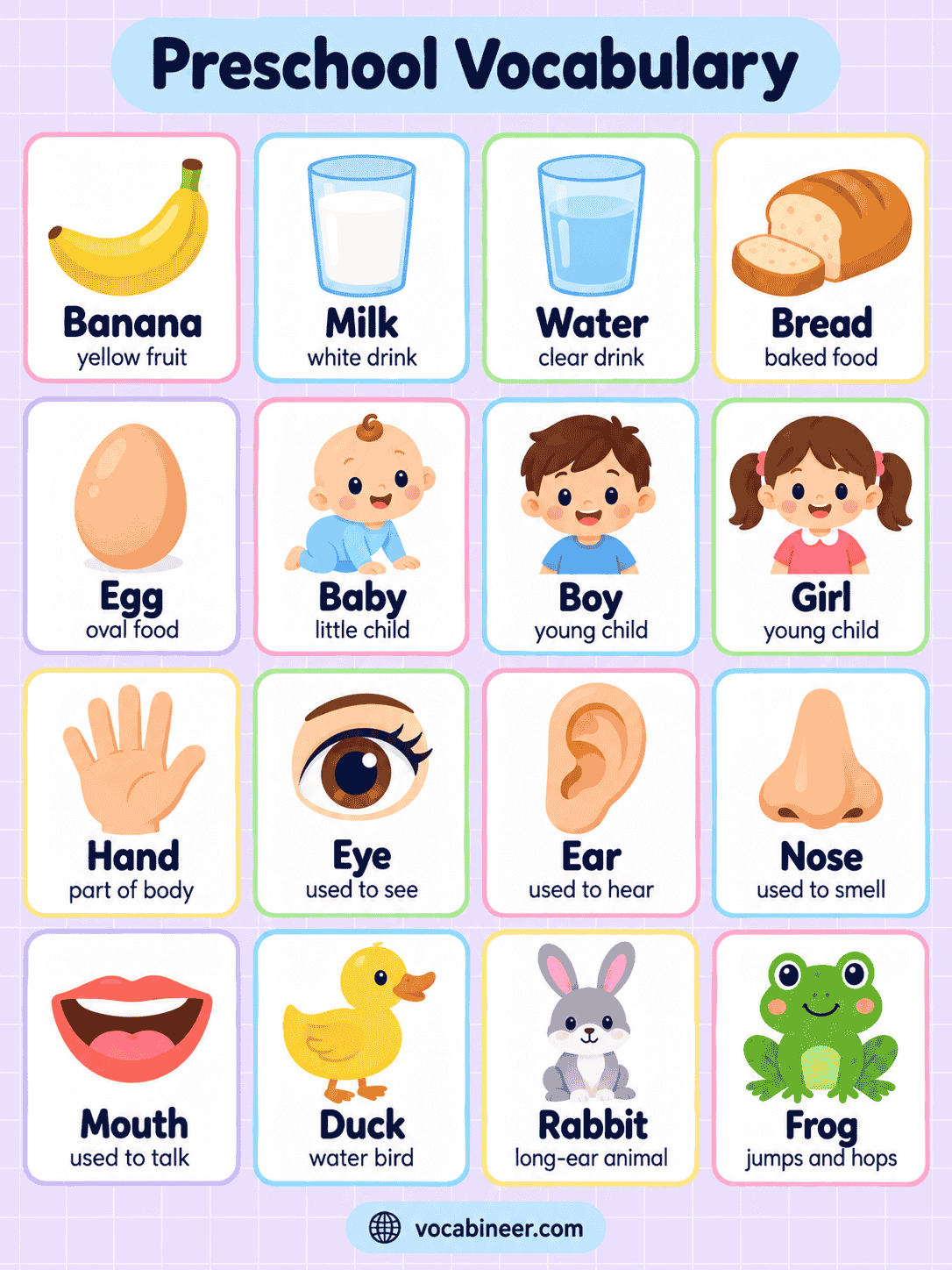
Toy and Play Words
Preschool children learn many words during play. These words are useful for sharing, pretend play, games, and classroom centers.
- Toy words: ball, doll, block, puzzle, teddy
- Vehicle toys: car, truck, train, bus, plane
- Play items: kite, drum, rope, bucket, shovel
- Play actions: build, roll, throw, catch, share
- Pretend play words: shop, cook, phone, house, costume
- Game words: turn, win, lose, start, stop
Home and Room Words
Home words help children name familiar rooms, objects, and places they see every day.
- Rooms: bedroom, bathroom, kitchen, living room, room
- Furniture: bed, chair, table, sofa, shelf
- Home objects: door, window, lamp, clock, basket
- Daily items: spoon, plate, bowl, towel, pillow
- Cleaning words: soap, broom, bin, trash, clean
- Place words: floor, wall, roof, stairs, yard
Clothes and Getting-Dressed Words
These words support self-help skills and daily routines such as dressing, washing, and getting ready.
- Clothes: shirt, pants, dress, coat, jacket
- Footwear: shoe, sock, boot, sandal, slipper
- Accessories: hat, cap, bag, belt, scarf
- Dressing words: wear, zip, button, pull, change
- Weather clothes: raincoat, gloves, sweater, shorts, uniform
Animal Words Preschoolers Love to Name
Animals are one of the strongest preschool vocabulary themes because they are easy to picture, act out, and use in songs, stories, and sounds.
- Pet animals: cat, dog, fish, bird, rabbit
- Farm animals: cow, goat, sheep, horse, duck
- Wild animals: lion, tiger, bear, monkey, elephant
- Small animals: frog, mouse, turtle, bee, butterfly
- Animal sounds: bark, meow, moo, quack, roar
Color, Shape, and Size Words
These words help preschool children describe objects, sort items, talk during art, and understand early math ideas.
- Colors: red, blue, green, yellow, black, white, orange, pink, purple, brown
- More color words: gray, gold, silver, light, dark
- Shapes: circle, square, triangle, rectangle, star, heart, oval
- Size words: big, small, tall, short, long
- Describing words: same, different, full, empty, new, old
Action Words for Movement and Games
Action words are powerful for preschool learning because children can act them out through movement, songs, games, and classroom play.
- Movement words: run, walk, jump, hop, skip, crawl
- Body actions: clap, wave, kick, bend, dance
- Play actions: throw, catch, push, pull, roll
- Classroom actions: draw, color, paint, cut, glue
- Daily actions: eat, drink, sleep, sit, stand
- Helping actions: open, close, carry, give, take
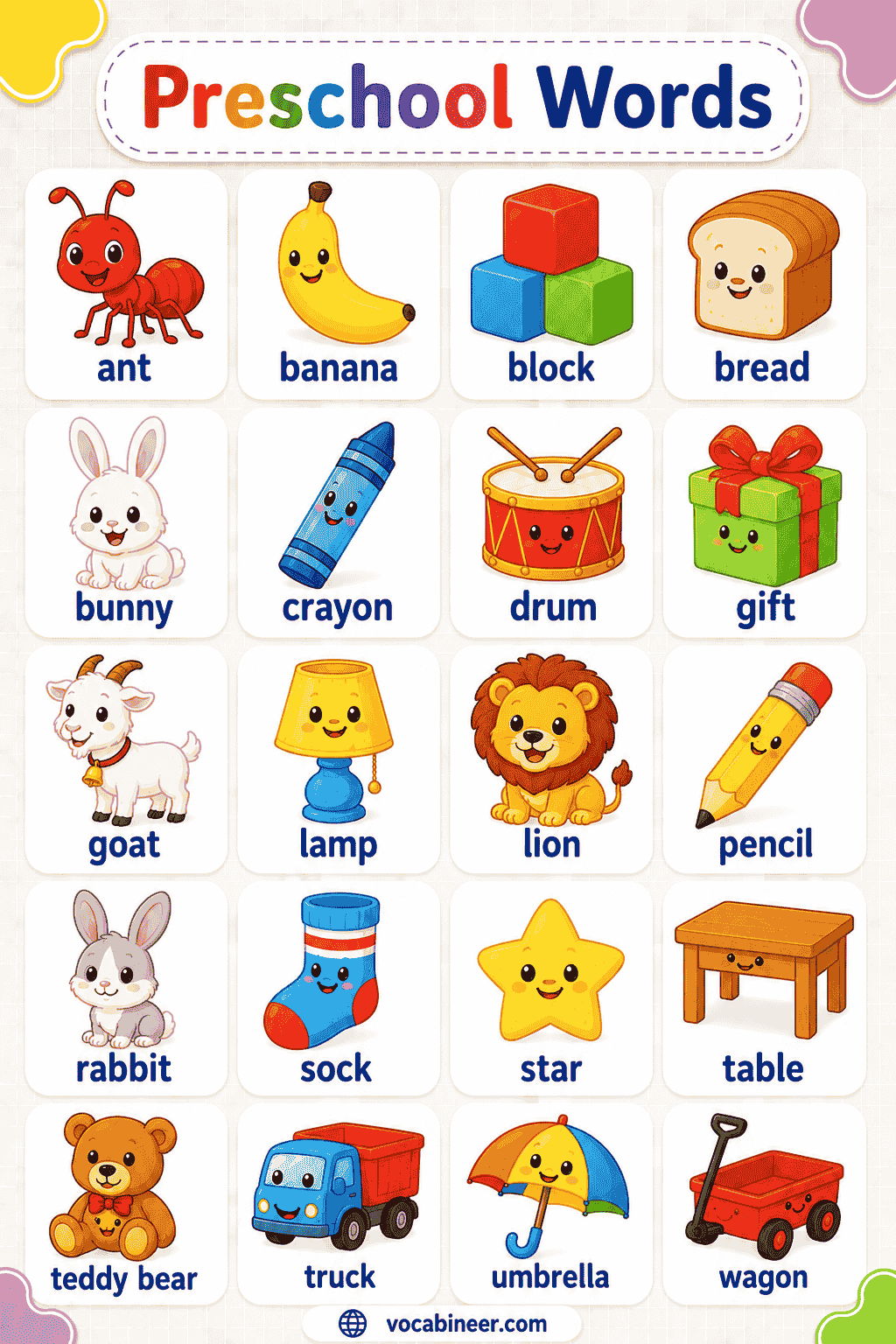
Feeling Words for Emotions and Needs
Feeling words help preschool children tell adults how they feel and what they need.
- Happy feelings: happy, excited, proud, brave, calm
- Hard feelings: sad, mad, angry, scared, shy
- Need words: hungry, thirsty, tired, sleepy, sick
- Safety words: hurt, safe, lost, worried, better
- Social words: kind, nice, mean, gentle, quiet
Nature and Weather Words
Nature and weather words help children talk about what they see outside, in books, during walks, and in classroom themes.
- Sky words: sun, moon, star, cloud, sky
- Weather words: rain, wind, snow, hot, cold
- Nature words: tree, leaf, flower, grass, rock
- Outdoor words: garden, park, sand, water, mud
- Living things: plant, seed, bug, bird, nest
Preschool Classroom and Routine Words
These words help children understand the preschool day and take part in group activities.
- Classroom words: class, teacher, friend, carpet, cubby
- Supply words: book, paper, crayon, marker, glue
- Routine words: line, turn, wait, clean, rest
- Activity words: story, song, game, circle, snack
- School actions: listen, look, sit, stand, share
Words for Questions, Answers, and Directions
These words help preschool children follow instructions, answer simple questions, and understand where things are.
- Question words: who, what, where, when, why, how
- Direction words: up, down, in, out, on, off
- Place words: under, over, near, far, inside, outside
- Simple response words: yes, no, maybe, okay, again
- Direction phrases: come here, go there, sit down, stand up
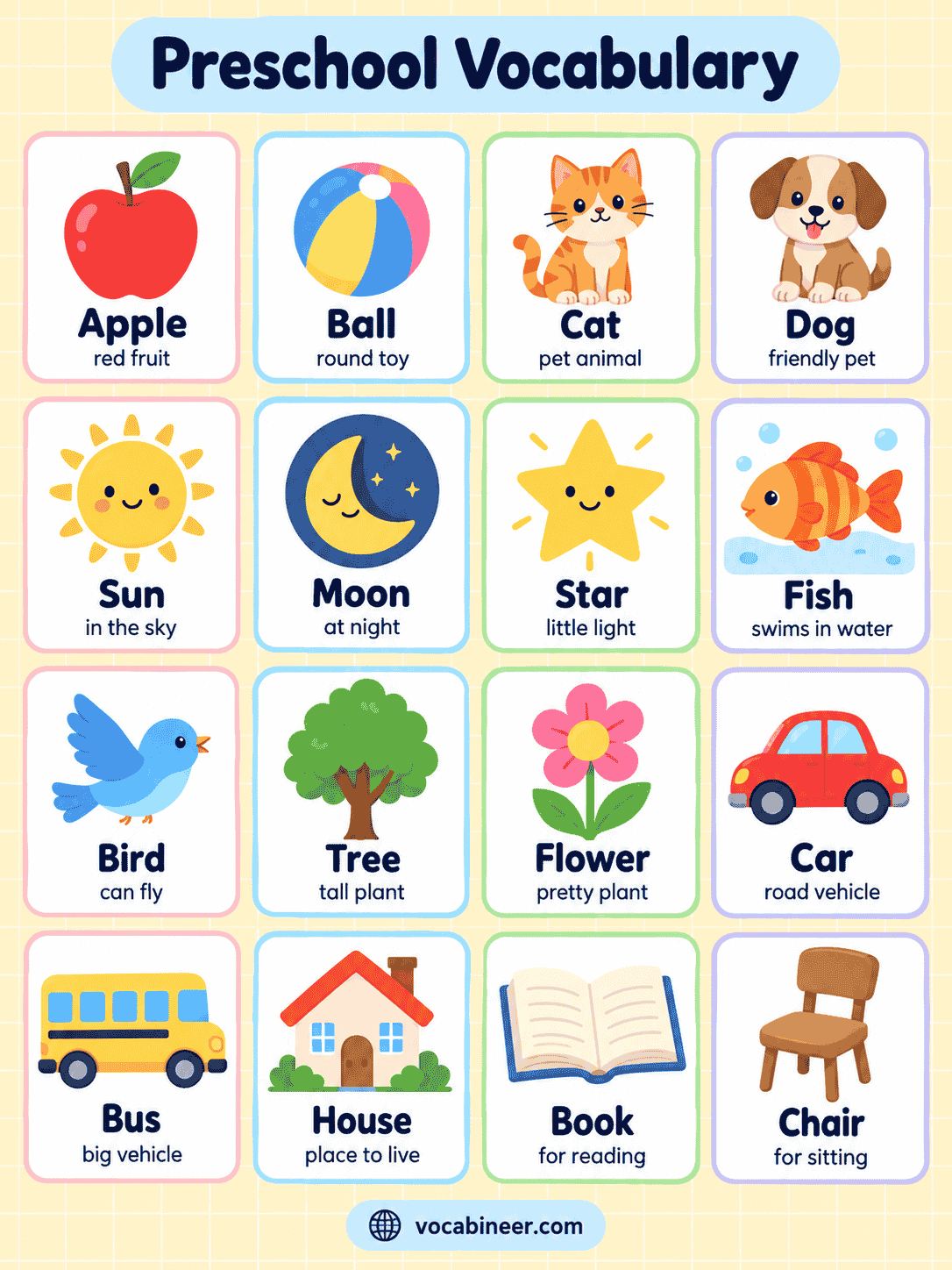
Preschool Words with Simple Meanings
Simple meanings help children connect words with real objects, actions, feelings, and routines. Use a few meanings at a time instead of teaching a long definition list all at once.
| Word | Simple Meaning |
|---|---|
| snack | a small food eaten between meals |
| share | to let someone use something with you |
| turn | a time when one person gets to do something |
| wait | to stay until it is time |
| cubby | a small place to keep school things |
| routine | things done in the same order |
| tired | needing rest or sleep |
| thirsty | needing a drink |
| safe | not in danger |
| worried | feeling unsure or afraid |
| same | not different |
| different | not the same |
| empty | having nothing inside |
| full | having no more space |
| inside | in something |
| outside | not inside |
| brave | trying even when something feels hard |
| proud | feeling happy about something you did |
Simple Preschool Sentences for Speaking Practice
Simple sentences help children use words in real conversation. Keep the sentences short, repeat them often, and change one word at a time.
- I want milk.
- This is my ball.
- I see a dog.
- The car is red.
- My hands are clean.
- I am hungry.
- The cat is sleeping.
- Please help me.
- I can jump.
- The cup is empty.
- We sit on the carpet.
- The ball is under the chair.
- I feel happy.
- It is raining.
- My shoes are on.
Speaking frames:
- I want ___.
- I see ___.
- This is my ___.
- I can ___.
- The ___ is big.
- The ___ is under ___.
How to Teach Preschool Vocabulary Through Play
Preschool children learn best when vocabulary feels active and real. Instead of asking children to memorize a long list, use words during play, routines, songs, movement, and everyday conversation.
- Point and name: point to a real object and say the word clearly.
- Match words to pictures: use cards for animals, food, toys, clothes, and body parts.
- Sort by theme: group words such as food, animals, clothes, and toys.
- Use pretend play: say words during play kitchen, doctor, shop, bus, or house games.
- Add action: act out words like jump, clap, sleep, run, and wash.
- Repeat naturally: use the same word in different short phrases during the day.
- Ask simple questions: use questions like What is this?, Where is the ball?, and Who is here?
Best Preschool Picture Words for Flashcards
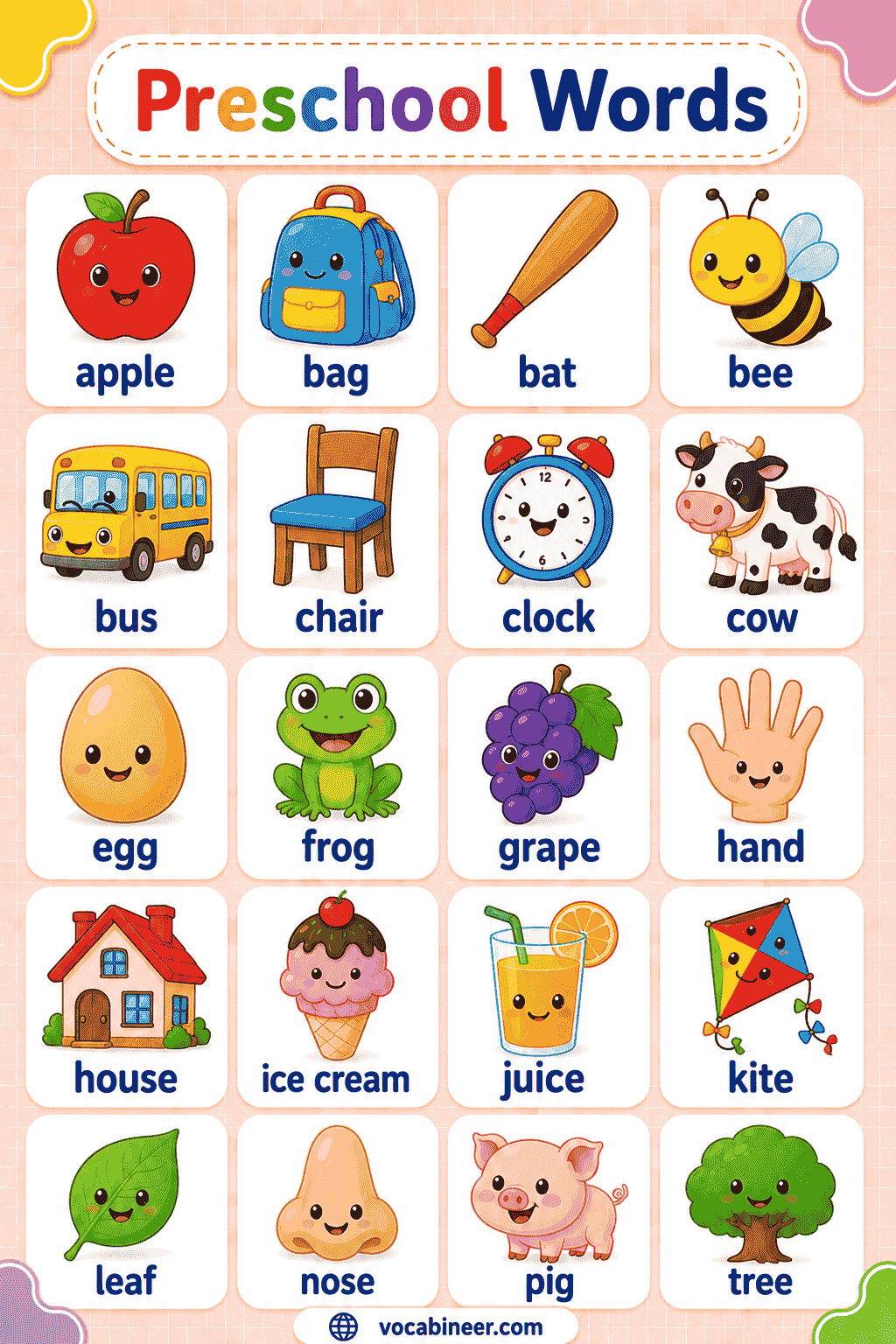
These are selected words from the main word bank that work especially well for flashcards, posters, worksheets, and matching games. Picture words should be easy to show with one clear image.
- Animals: cat, dog, cow, bird, rabbit, lion
- Food: apple, banana, egg, bread, milk, cookie
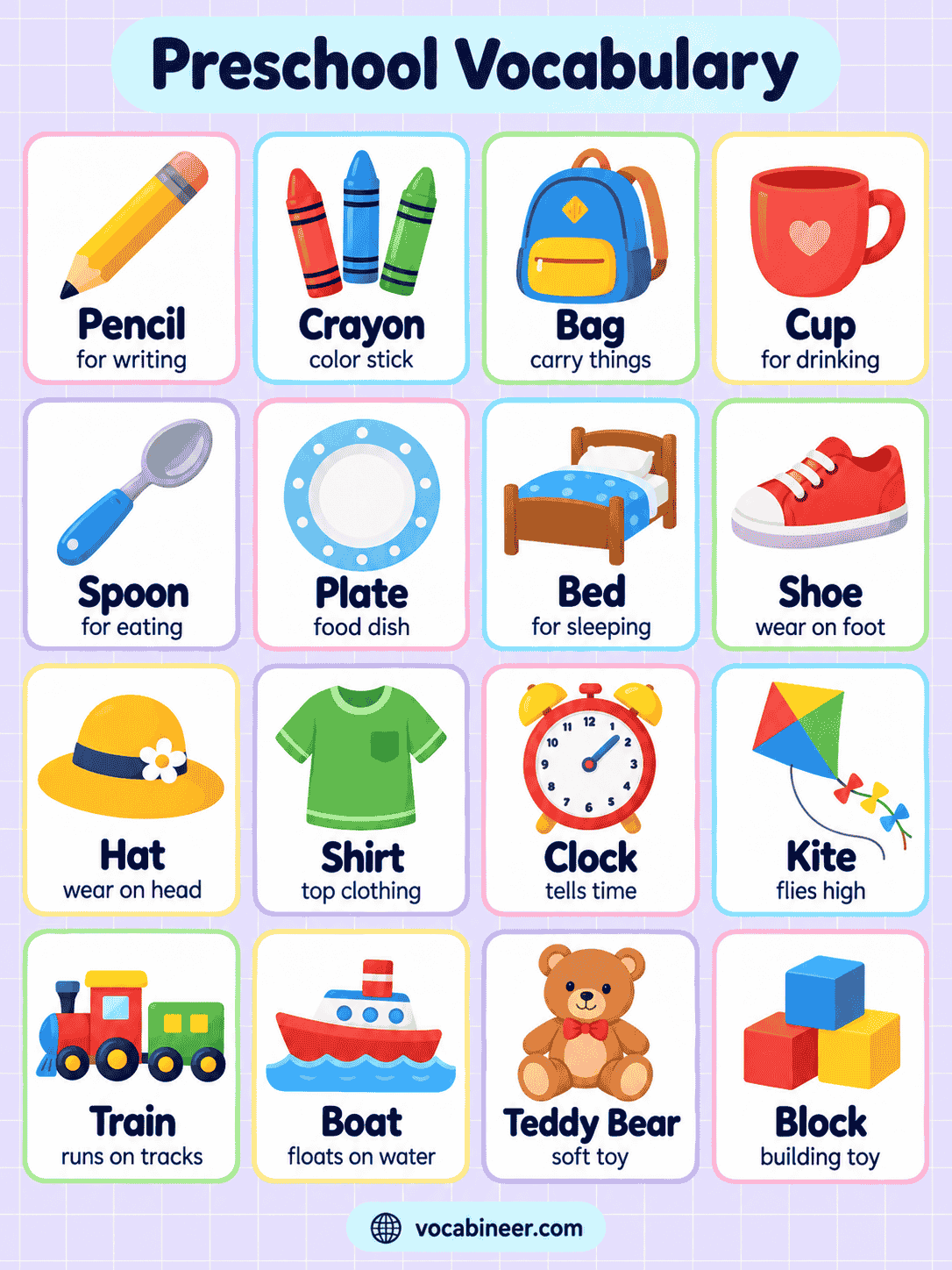
- Toys: ball, doll, block, car, truck, teddy
- Body: eye, ear, nose, hand, foot, mouth
- Clothes: shirt, shoe, sock, hat, coat, pants
- Nature: sun, moon, tree, flower, rain, cloud
- Home: bed, chair, table, door, lamp, cup
- Actions: jump, clap, wave, run, sleep, eat
Avoid words such as because, maybe, inside, different, and routine as beginner flashcards unless the picture clearly supports the meaning.
Preschool Vocabulary Activities
Simple activities help children understand and remember new words. Choose short activities that feel like play rather than tests.
- Picture matching: Place picture cards on a table. Say a word such as apple, dog, or shoe, then ask the child to find the matching picture.
- Point and say: Point to objects around the room and say their names together, such as door, chair, book, bag, cup, and lamp.
- Sorting game: Ask children to sort cards into simple groups such as animals, food, toys, clothes, and home things.
- Action game: Say an action word and let children act it out. Use words like jump, clap, wave, sleep, run, and dance.
- Mystery bag: Put safe objects in a bag. Let the child pull one out and name it, such as spoon, sock, block, or ball.
- Story talk: Read a short picture book and pause to name objects, actions, colors, and feelings in the pictures.
Words Preschoolers May Mix Up in Speaking
Some preschool words are close in meaning, sound, or use. Children may need repeated practice with real objects, pictures, actions, and short spoken examples.
| Word Pair | Why Children Mix Them Up |
|---|---|
| me / my | both talk about the child |
| this / that | both point to things |
| here / there | both show place |
| in / out | both describe position |
| on / off | often used with clothes, lights, and toys |
| up / down | opposite direction words |
| hot / cold | opposite describing words |
| big / small | opposite size words |
| happy / sad | feeling words |
| he / she | both talk about people |
Mistakes to Avoid When Teaching Preschool Vocabulary
Preschool vocabulary should stay simple, visual, and connected to real life. Children learn more when words are repeated in natural situations instead of taught as a long memorization task.
| Mistake | Better Choice |
|---|---|
| Giving too many words at once | Use small theme-based groups |
| Teaching only worksheet words | Use real objects, pictures, songs, and play |
| Choosing abstract words first | Start with concrete picture-friendly words |
| Making practice too quiet | Let children say, move, point, and act |
| Skipping daily routine words | Include words like wash, snack, wait, and help |
| Expecting perfect speech | Accept attempts and model the word again |
| Mixing preschool with kindergarten reading | Keep preschool vocabulary more oral and visual |
| Using flashcards only | Add stories, pretend play, sorting, and movement |
FAQs
Preschool vocabulary means the words young children understand and use before formal reading begins. These words usually come from daily life, family, food, toys, body parts, animals, routines, feelings, and play.
Children grow at different speeds, so there is no one exact number for every preschooler. A useful preschool word bank can include daily words, family words, food words, animal words, action words, feeling words, classroom words, and picture-friendly words.
Preschoolers should first learn useful words they hear and need often, such as mom, dad, milk, ball, shoe, help, more, no, yes, happy, sad, jump, and play.
Use real objects, picture books, songs, simple questions, pretend play, matching games, and daily routines. For example, name clothes while dressing, name food during snack time, and name toys during play.
No. Preschool vocabulary is more focused on speaking, listening, naming, pointing, play, and picture recognition. Kindergarten words often include more reading, writing, spelling, and sentence-building practice.
Read More
- CVC Rhyming Words for Kids
- Short Vowel Words for Kids
- Long Vowel Words for Kids
- 300+ Kindergarten Words