Kindergarten children use words all day to speak, listen, read, write, follow directions, and share ideas. Simple words like line, snack, book, jump, happy, red, mom, school, and please help children understand classroom routines, beginner books, simple sentences, feelings, actions, and the world around them.
At this stage, children are not only memorizing words. They are learning how words work in real life through talking, reading, pointing, tracing, labeling, and short sentence practice. A strong kindergarten word list should include daily-use words, classroom words, easy reading words, action words, feeling words, describing words, and picture-friendly words that children can recognize and use with confidence.
In This Page
What Are Kindergarten Words?
Kindergarten words are useful words children begin to understand, say, recognize, read, copy, spell, and use in short sentences. Some words are easy to sound out, such as cat, sun, and cup. Others, such as the, said, and was, appear often in books and need repeated practice.
| Word Type | How Children Use Them | Examples |
|---|---|---|
| Daily-use words | speaking and conversation | yes, no, please, sorry |
| Routine words | school and home routines | line, snack, wait, clean |
| Reading words | beginner books and phonics | cat, dog, sun, cup |
| School words | classroom supplies and places | book, pencil, desk, teacher |
| Feeling words | emotions and needs | happy, sad, tired, hurt |
| Sentence words | simple reading and writing | can, see, like, have |
300 Kindergarten Word Bank
This word bank includes 300 kindergarten word examples grouped by real classroom and home use. The compact lists are easier to scan than long comma lines and work well for reading practice, speaking practice, flashcards, worksheets, picture cards, labeling, and early sentence writing.
Everyday First Words
These words help children greet others, answer simple questions, talk about themselves, and join daily conversation.
- Self words: I, me, my, mine, you
- Answer words: yes, no, okay
- Greeting words: hi, bye, hello
- Polite words: please, sorry, thanks
- Pointing and place words: name, here, there, this, that, now
Daily Routine Words
These words appear during morning time, meals, cleanup, play, rest, and classroom transitions.
- Morning routine: wake, sleep, wash, brush, dress
- Food and rest: eat, drink, snack, lunch, rest
- School routine: clean, pack, line, wait, turn
- Social routine: share, help, play, read, home
Instruction Words
Instruction words help children follow directions during lessons, art, games, worksheets, story time, and classroom routines.
- Movement directions: come, go, stop, sit, stand
- Listening and looking: look, listen, point, touch, hold
- Object directions: open, close, put, take, give
- Worksheet directions: trace, color, draw, count, write
People, Places, and Things
Naming words help children talk about family, school, rooms, supplies, and objects they see every day.
- People: mom, dad, baby, sister, brother, grandma, grandpa, teacher, friend, child
- Places: school, class, room, door, window
- Things: table, chair, desk, bag, book, pencil, crayon, paper, toy, ball
Classroom Words
These school words are useful for classroom labels, supply charts, flashcards, and daily learning activities.
- Supplies: board, marker, eraser, glue, scissors, folder
- Classroom spaces: cubby, shelf, carpet, tray, bin, basket
- Time and signals: calendar, clock, bell
- Learning activities: lesson, story, song, game, puzzle
Easy Reading Words
These words are useful for early reading because many are short, common, and helpful in beginner books.
- Short vowel starters: am, an, at, as, if, in, is, it, on, up, us
- Short A words: cat, bat, hat, map, jam
- Short E words: bed, red, hen, ten
- Short I words: pig, pin, dig, lip
- Short O words: dog, log, pot, hot
- Short U words: sun, cup, bug, rug, cut, tub, mud
Sentence Helper Words
These small words appear often in beginner books and simple sentences. Some are easy to sound out, while others become familiar through repeated reading.
- Article and joining words: a, the, and
- Position and connection words: to, for, with
- People words: he, she, we, they
- Action helpers: can, see, like, have, has
- Common book words: was, are, do, said, little
Early Writing and Labeling Words
These words work well when children label drawings, copy short captions, or make simple picture-word pages.
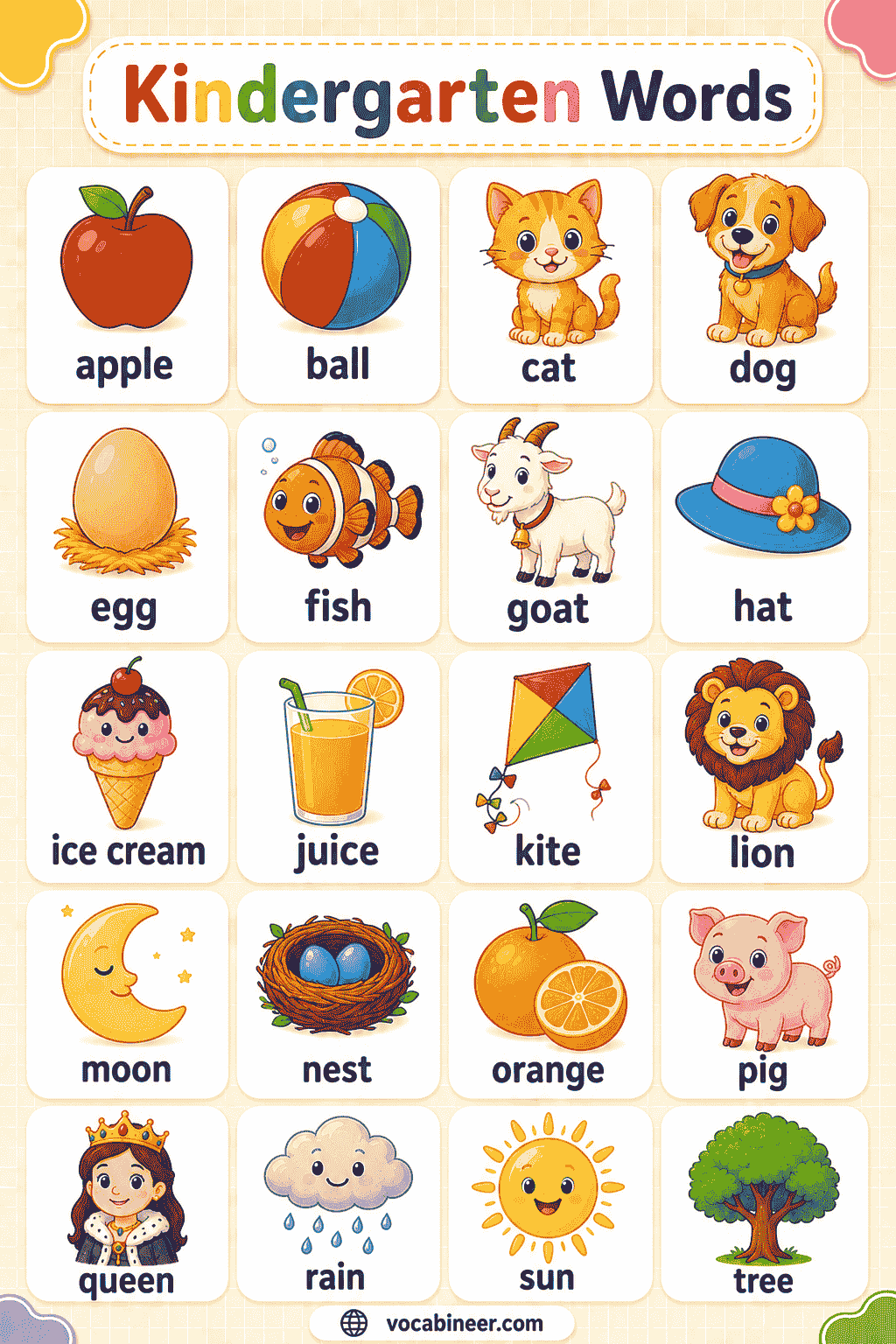
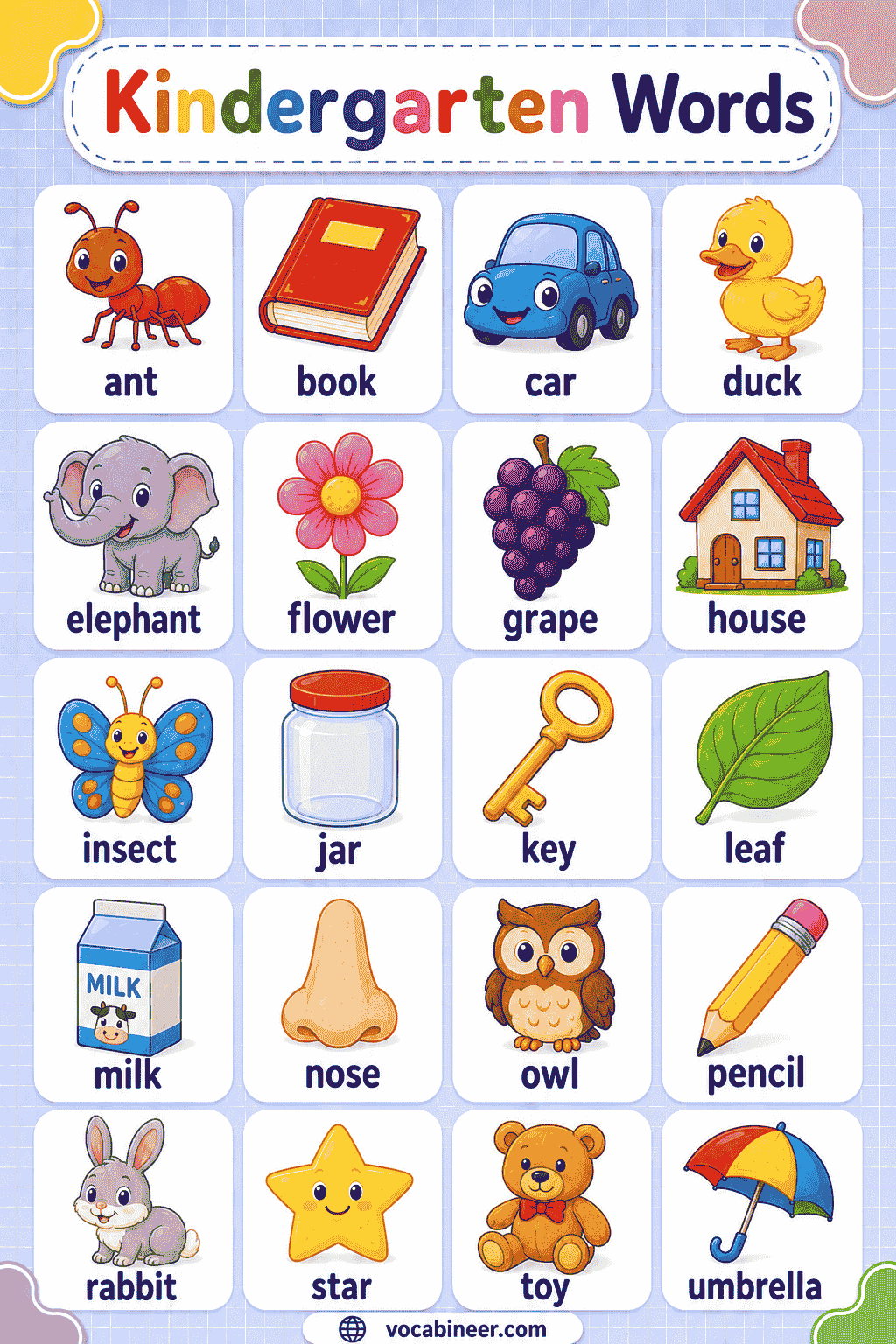
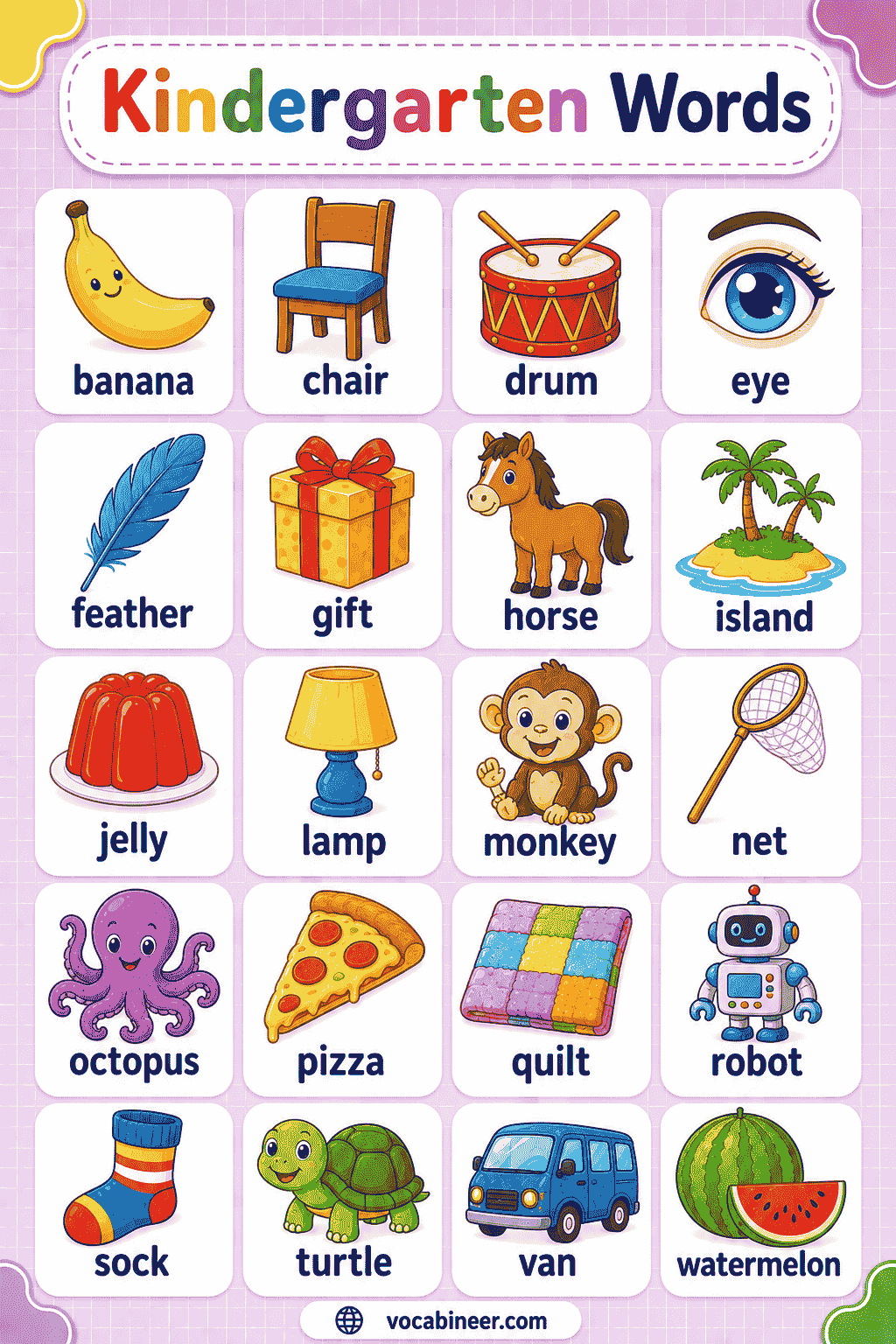
- Food words: apple, egg, milk, bread, cake
- Animal and nature words: cow, bird, flower, cloud, star, moon
- Object words: kite, bike, sock, shoe, shirt
- Body words: hand, foot, eye, nose
Feelings and Needs Words
Children use these words to talk about emotions, comfort, safety, and simple classroom needs.
- Feeling words: happy, sad, mad, scared, tired, worried, calm, angry, excited, shy
- Need words: hungry, thirsty, sick, hurt, safe, lost, warm, sleepy
- Behavior words: kind, brave
Colors, Numbers, Shapes, and Size Words
These words help children describe objects, count items, compare sizes, and complete early math or art activities.
- Colors: red, blue, green, yellow, black, white, orange, purple, pink, brown, gray
- Numbers: one, two, three, four, five, six, seven, eight, nine, ten
- Shapes: circle, square, triangle, rectangle, oval, diamond
- Size words: big, small, tall
Home, Food, Animals, and Play Words
These words come from a child’s everyday world and work well for topic vocabulary, picture cards, speaking practice, and beginner sentence writing.
- Home words: kitchen, bedroom, bathroom, sofa, lamp, spoon, plate, bowl
- Food words: rice, banana, cookie, water, juice, pizza, carrot
- Animal words: lion, bear, goat, horse, sheep, mouse, rabbit, turtle
- Play words: slide, swing, doll, train, truck, drum, rope
Action Words
Action words help children talk about movement, play, classroom activities, and things they can do.
- Movement words: jump, walk, hop, skip, swim, climb, crawl
- Play actions: kick, throw, catch, push, pull, roll
- Body and classroom actions: clap, sing, dance, bend, wave, smile, build
Question, Position, and Place Words
These words help children answer questions, follow classroom talk, and describe where things are.
- Question words: who, what, where, when, why, how
- Position words: under, over, near, far
Harder Words Kindergarten Kids May Hear
These words are common in stories, classroom talk, and conversations, but many children need help before they can read or spell them independently.
- Story and speaking words: because, again, people, about, favorite
- Teacher-supported reading words: could, would, should, before, after
How to Use These Kindergarten Words
A strong word list works best when children use the words in more than one way. Start with speaking and listening, then move to picture matching, tracing, reading, labeling, and short sentence practice.
- For speaking: ask children to say the word and use it in a short answer.
- For reading: choose short words such as cat, sun, cup, in, and on.
- For writing: begin with label-friendly words such as apple, book, shoe, and dog.
- For classroom routines: practice words such as line, wait, listen, share, and clean.
- For flashcards: use picture-friendly words such as ball, rabbit, flower, and chair.
- For sentences: use simple frames like I see ___, I can ___, and This is my ___.
Kindergarten Words with Simple Meanings
A short meanings section helps children understand useful words from the list without making the article too heavy. These meanings are simple enough for parents, teachers, and young learners.
| Word | Simple Meaning |
|---|---|
| line | a row of people or things |
| snack | a small food eaten between meals |
| share | to let someone use something with you |
| wait | to stay until it is your turn |
| trace | to write over a line, letter, or shape |
| class | children learning together |
| cubby | a small place to keep school things |
| calendar | a chart that shows days and months |
| safe | not in danger |
| worried | feeling afraid or unsure |
| near | close to something |
| far | not close |
| under | below something |
| over | above something |
| favorite | liked the most |
| before | earlier than something |
| after | later than something |
| kind | nice and caring |
Kindergarten Words in Simple Sentences
Simple sentences help children move from word reading to real language use. Start with short patterns, then change one word at a time.
- I am here.
- I see a cat.
- This is my book.
- The sun is up.
- We like to play.
- She has a red bag.
- The dog can run.
- My shoe is black.
- The ball is under the table.
- I feel happy.
- Please help me.
- I can write my name.
Sentence starters:
- I see ___.
- I like ___.
- I can ___.
- This is my ___.
- The ___ is big.
- My ___ is red.
Weekly Kindergarten Word Practice
Small weekly groups are easier than giving children a long list at once. Each group can include reading, speaking, tracing, picture matching, and sentence practice.
| Week | Focus | Practice Words |
|---|---|---|
| Week 1 | daily words | I, me, my, yes, no |
| Week 2 | school words | book, bag, desk, pencil, class |
| Week 3 | reading words | cat, dog, sun, cup, bed |
| Week 4 | action words | jump, clap, sing, build, wave |
| Week 5 | feeling words | happy, sad, mad, tired, hurt |
| Week 6 | picture words | apple, bird, flower, moon, kite |
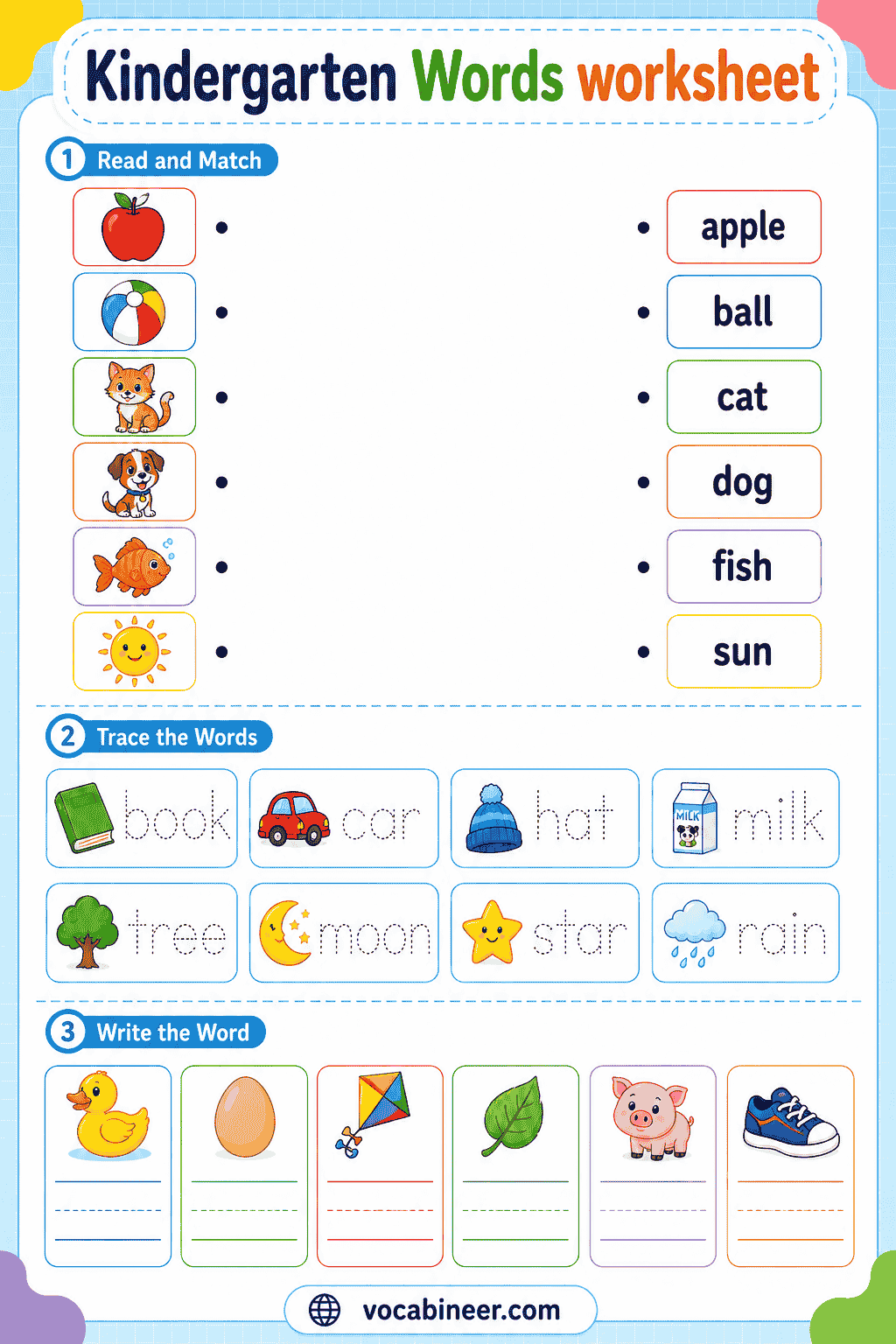
Practice activities:
- Read each word aloud.
- Match the word to a picture.
- Trace the word.
- Use the word in a sentence.
- Sort words by topic.
Kindergarten Words Kids Often Confuse
Some kindergarten words look similar, sound similar, or appear in similar sentence positions. These pairs need extra practice in reading, speaking, and writing.
| Word Pair | Why Children Mix Them Up |
|---|---|
| me / my | both talk about the self |
| he / she | similar sentence use |
| this / that | both point to things |
| here / there | both show place |
| in / on | both show position |
| up / down | opposite direction words |
| can / and | common early reading words |
| was / saw | same letters in a different order |
| no / not | both show negative meaning |
| to / too | same sound, different use |
Practice lines:
- This is my bag.
- That is your book.
- The cup is on the table.
- The toy is in the box.
- I can jump.
Picture Words for Cards, Charts, and Worksheets
These are selected picture-card words from the main list. They are not extra words; they are the easiest choices to show with one clear image.
- Animals: cat, dog, bird, cow, lion, rabbit
- Food: apple, egg, milk, bread, rice, banana
- School: book, pencil, bag, desk, crayon, paper
- Nature: sun, flower, cloud, star, moon, tree
- Home: bedroom, sofa, lamp, spoon, plate, bowl
- Actions: jump, clap, sing, dance, wave, build
Avoid hard-to-picture words like because, was, does, where, and said for image-based flashcards.
Mistakes to Avoid When Choosing Kindergarten Words
A good kindergarten word list should match a child’s real learning stage. Words should be useful for speaking, reading, writing, classroom routines, and simple practice.
| Mistake | Better Choice |
|---|---|
| Teaching only sight words | Include daily words, reading words, and vocabulary words |
| Giving too many words at once | Use small weekly groups |
| Mixing hard words with beginner words | Separate easy, common, and tricky words |
| Using only alphabetical lists | Group words by topic or purpose |
| Skipping speaking practice | Let children say words in sentences |
| Using abstract words for flashcards | Choose clear picture words |
| Treating all words as phonics words | Separate sound-out words from tricky words |
| Ignoring classroom routines | Include line, wait, listen, and share |
FAQs
Kindergarten words are simple words children begin to understand, say, read, write, and use in sentences. Examples include I, my, cat, book, jump, happy, red, and school.
There is no single fixed number for every child. A useful kindergarten word bank can include daily words, sight words, easy reading words, school words, action words, feeling words, and picture words.
No. Sight words are only one type of kindergarten word. Kindergarten children also need sound-out words, vocabulary words, routine words, feeling words, direction words, and simple sentence words.
Easy reading words include am, at, in, cat, bed, dog, sun, cup, the, and, can, see, and like.
Parents can use flashcards, picture matching, tracing, short sentences, read-alouds, word hunts, labeling drawings, and simple sentence frames like I can jump or I see a cat.
Read More
- CVC Rhyming Words for Kids
- Short Vowel Words for Kids
- Short A Words for Kids
- Short E Words for Kids
- Short I Words for Kids
- Short O Words for Kids
- Short U Words for Kids