
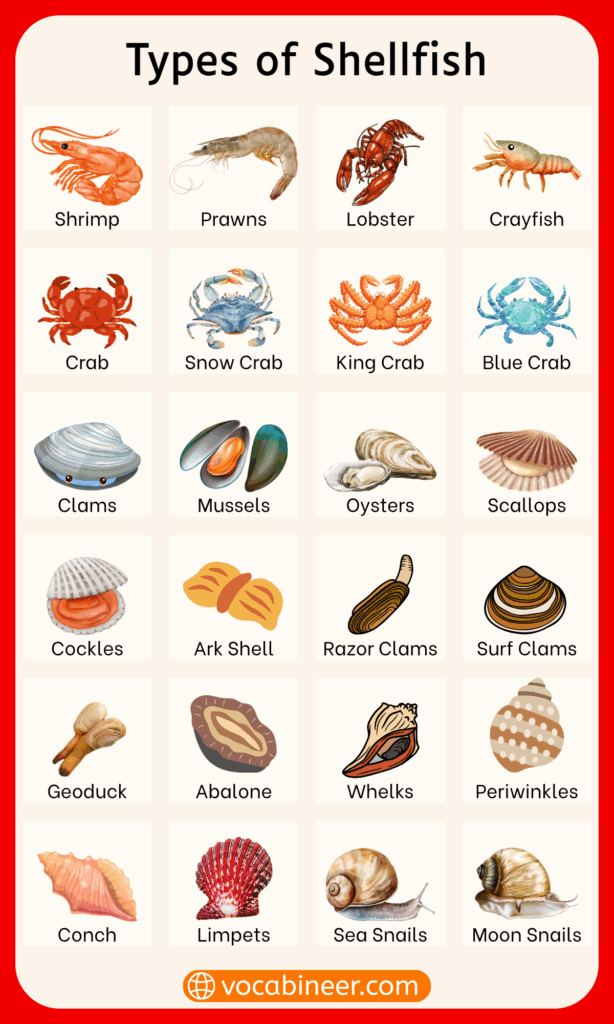
Shellfish are aquatic animals that usually have a shell or hard outer covering. In general, the main Types of Shellfish are crustaceans and mollusks, and each group includes many species with different body structures. For example, these shellfish names appear in seafood classification, market labels, and food listings.
Therefore, this article organizes types of shellfish in English using clear scientific categories and short descriptions. As a result, you will learn to identify common shellfish and understand how each group is classified.
In This Page
What Are Shellfish?
Shellfish are aquatic animals that usually have a shell or a hard outer covering. They live in oceans, seas, rivers, and coastal waters. The term “shellfish” does not refer to one single species but to a group of animals that share certain body features.
There are two main types of shellfish: crustaceans and mollusks. Crustaceans have hard outer shells and jointed legs, such as crab and shrimp. Mollusks have soft bodies and often live inside shells, such as clams and oysters. Shellfish are commonly grouped this way in biology and seafood classification.
Main Types of Shellfish
Shellfish are divided into major biological groups based on how their bodies are built. This is the easiest way to learn shellfish names because the grouping stays consistent across books and menus.
Below is a summary table of the main types of shellfish.
| Main Group | Key Body Feature | Common Shellfish Names |
|---|---|---|
| Crustaceans | Hard outer shell and jointed legs | Crab, Lobster, Shrimp, Prawn, Crayfish |
| Mollusks | Soft body, often protected by a shell | Clam, Mussel, Oyster, Scallop |
Crustaceans
Crustaceans are a major type of shellfish. They have a hard outer shell called an exoskeleton and jointed legs. Many crustaceans also have claws and segmented bodies. Some live in saltwater, and others live in freshwater. Below is a list of common crustacean shellfish names you should know:
- Crab: Side-walking shellfish with strong claws and a wide body.
- Lobster: Large shellfish with a long body, tail, and strong front claws.
- Shrimp: Small curved shellfish with long antennae, often cooked quickly.
- Prawn: Similar to shrimp, usually larger with a slightly different body shape.
- Crayfish: Freshwater shellfish that looks like a small lobster.
- Krill: Tiny ocean crustaceans, important in marine ecosystems and food chains.
- Mantis shrimp: Bright colored crustacean with powerful front limbs, often called a delicacy.
Crabs
Crabs are one of the most recognized crustacean shellfish. They have a broad, flat body and two strong claws. Unlike many other animals, crabs move sideways. Most crabs live in saltwater, though some species live in freshwater or near shorelines. Common crab types include:
- Blue crab: Found along Atlantic coasts, known for its blue-tinted claws.
- King crab: Large crab with long legs, often harvested in cold waters.
- Snow crab: Smaller than king crab, with thinner legs and sweet meat.
- Dungeness crab: Popular on the Pacific coast, with a wide shell.
- Mud crab: Found in estuaries and mangroves, known for strong claws.
- Stone crab: Recognized for its thick claws, often harvested for claw meat only.
Crabs are identified by their hard shell and powerful pincers.
Lobsters
Lobsters are large crustaceans with long bodies and muscular tails. Most species live on the ocean floor. Some lobsters have large front claws, while others do not. Well-known lobster types:
- American lobster: Also called Maine lobster, has two large claws.
- Spiny lobster: Has long antennae and no large front claws.
- Slipper lobster: Flat-bodied lobster without large claws.
- Rock lobster: Common name for several clawless lobster species.
Lobsters are recognized by their long antennae and strong tail.
Shrimp and Prawns
Shrimp and prawns are small crustaceans with curved bodies and long feelers. They are among the most common types of shellfish eaten worldwide. Although similar, prawns are usually larger and have slight differences in leg structure. Common varieties include:
- White shrimp: Light-colored shrimp often used in many dishes.
- Brown shrimp: Slightly darker shrimp found in coastal waters.
- Tiger prawn: Large prawn with striped shell pattern.
- Rock shrimp: Small shrimp with a harder shell texture.
- Pink shrimp: Mild-flavored shrimp found in warm waters.
- Giant river prawn: Freshwater prawn known for its large size.
Shrimp and prawns are known for their segmented bodies and flexible tails.
Crayfish
Crayfish are freshwater crustaceans that resemble small lobsters. They have a hard shell, two front claws, and a segmented tail. Unlike most crabs and lobsters, crayfish live in rivers, lakes, and streams. Common crayfish types include:
- Red swamp crayfish: Widely farmed and found in freshwater wetlands.
- Signal crayfish: Native to North America but introduced in other regions.
- Northern crayfish: Found in lakes and slow-moving rivers.
- White river crayfish: Known for its lighter shell color.
Crayfish are an important freshwater type of shellfish.
Mollusks
Mollusks form the second major group of shellfish. Unlike crustaceans, mollusks do not have jointed legs. Their bodies are soft, and many are protected by shells. Some mollusks have two shells, while others have one or none. Mollusks are divided into three main subgroups:
- Bivalves
- Cephalopods
- Gastropods
Each subgroup contains different types of shellfish with unique body features.
Bivalves
Bivalves are mollusks with two hinged shells that open and close. They usually live buried in sand or attached to rocks. Many bivalves filter water for food. Common bivalve shellfish include:
- Clam: Round shellfish that lives buried in sand.
- Hard clam: Thick-shelled clam found in coastal waters.
- Soft-shell clam: Clam with thinner shell and longer siphon.
- Razor clam: Long narrow shell that looks like a razor.
- Geoduck: Large clam with a long neck-like body.
- Mussel: Oval-shaped shellfish that attaches to rocks.
- Blue mussel: Dark-shelled mussel common in coastal areas.
- Green-lipped mussel: Mussel with green edge on shell.
- Oyster: Rough-shelled bivalve often eaten raw.
- Pacific oyster: Widely farmed oyster species.
- Atlantic oyster: Common oyster along the Atlantic coast.
- Scallop: Fan-shaped shellfish known for its round meat.
- Bay scallop: Smaller scallop species.
- Sea scallop: Larger scallop harvested offshore.
- Cockle: Small heart-shaped bivalve found in sandy areas.
Bivalves are one of the most common types of shellfish found in seafood markets.
Cephalopods
Cephalopods are mollusks without an external shell. They have soft bodies, large eyes, and tentacles. Unlike bivalves, they move freely in water instead of staying buried or attached to rocks. Cephalopods are intelligent marine animals and are considered part of the main types of shellfish in seafood classification. Common cephalopod shellfish include:
- Squid: Long-bodied shellfish with ten arms, often sliced into rings.
- Octopus: Eight-armed mollusk known for its flexible body.
- Cuttlefish: Similar to squid but has an internal shell called a cuttlebone.
- Bobtail squid: Small squid species found in shallow waters.
Cephalopods are recognized by their tentacles and soft bodies without hinged shells.
Gastropods
Gastropods are mollusks with a single spiral shell. They move slowly using a muscular foot. Most gastropods are sea snails, though some live in freshwater. Common gastropod shellfish include:
- Whelk: Sea snail with a spiral shell and firm meat.
- Abalone: Flat sea snail with a colorful inner shell.
- Sea snail: General name for edible marine snails.
- Periwinkle: Small sea snail found along rocky shores.
- Conch: Large sea snail with thick spiral shell.
Gastropods are another important group within mollusks.
List of Shellfish Names A to Z
Below is an organized list of shellfish names in English to strengthen recognition.
- Abalone
- Atlantic oyster
- Bay scallop
- Blue crab
- Blue mussel
- Brown shrimp
- Clam
- Cockle
- Conch
- Crab
- Crayfish
- Cuttlefish
- Dungeness crab
- Geoduck
- Giant river prawn
- Green-lipped mussel
- Hard clam
- King crab
- Krill
- Lobster
- Mantis shrimp
- Mussel
- Octopus
- Oyster
- Pacific oyster
- Prawn
- Razor clam
- Red swamp crayfish
- Rock shrimp
- Scallop
- Sea scallop
- Shrimp
- Signal crayfish
- Slipper lobster
- Snow crab
- Soft-shell clam
- Squid
- Tiger prawn
- Whelk
This alphabetical list covers common and lesser-known types of shellfish.
Shellfish by Habitat
Shellfish live in different water environments. Their habitat affects their size, shell thickness, and sometimes even taste. Learning shellfish by habitat helps you understand where each species naturally grows.
Saltwater Species
Most types of shellfish live in oceans and seas. These species usually prefer coastal waters, reefs, or deep sea floors. Common saltwater shellfish include:
- Lobster
- King crab
- Snow crab
- Blue crab
- Shrimp
- Tiger prawn
- Scallop
- Oyster
- Mussel
- Squid
- Octopus
- Cuttlefish
- Whelk
- Abalone
Freshwater Species
Some shellfish live in rivers, lakes, and ponds. These are less common than saltwater species but still important. Examples include:
- Crayfish
- Signal crayfish
- Red swamp crayfish
- Freshwater mussels
- Asian clams
- Giant river prawn
Estuarine Species
Estuaries are places where saltwater and freshwater mix. These areas support certain shellfish that adapt to both conditions.
Examples include:
- Soft-shell clam
- Blue crab
- Oyster
- Mud crab
Difference Between Crustaceans and Mollusks
Crustaceans and mollusks are the two main types of shellfish. They differ in body structure and movement.
| Feature | Crustaceans | Mollusks |
|---|---|---|
| Body Structure | Hard exoskeleton and segmented body | Soft body, often protected by shell |
| Legs | Jointed legs | No jointed legs |
| Movement | Walk or crawl with legs | Some burrow, some swim with tentacles |
| Examples | Crab, Lobster, Shrimp | Clam, Oyster, Squid |
This comparison helps you clearly separate the two main groups.
Most Common Edible Shellfish
Some types of shellfish are eaten more frequently around the world. These are often found in seafood markets and restaurants.
- Shrimp
- Prawn
- Crab
- Lobster
- Clam
- Oyster
- Mussel
- Scallop
- Squid
- Octopus
These shellfish are widely recognized and commonly used in many cuisines.
Rare and Unusual Shellfish
Some types of shellfish are less common or found only in certain regions. They may look different from typical crab or clam species and are sometimes considered specialty seafood.
- Geoduck: Large clam with a long, tube-like body extending from its shell.
- Mantis shrimp: Brightly colored crustacean known for powerful front claws.
- Abalone: Flat sea snail with a colorful inner shell surface.
- Whelk: Spiral-shelled sea snail with firm texture.
- Razor clam: Long, narrow bivalve with smooth shell.
- Periwinkle: Small sea snail found along rocky shores.
- Conch: Large sea snail with thick spiral shell.
These species are still part of the main types of shellfish, even if they are less familiar.
Shellfish Used in Cooking
Shellfish are prepared in different ways depending on region and culture. While classification focuses on biology, cooking groups them by preparation style. Common preparation styles include:
- Raw: Oysters, some clams, scallops.
- Steamed: Mussels, crab, lobster.
- Boiled: Shrimp, crab, crayfish.
- Grilled: Lobster tails, shrimp, scallops.
- Stir-fried: Shrimp, squid, cuttlefish.
- In soups: Clams, mussels, shrimp.
Cooking methods do not change classification, but they influence how shellfish are identified on menus.
FAQs About Types of Shellfish
The two main types of shellfish are crustaceans and mollusks. Crustaceans include crab, lobster, and shrimp. Mollusks include clams, oysters, and squid.
Shrimp and prawns are similar but have small anatomical differences. In cooking and menus, the terms are often used interchangeably.
Oysters and some clams are commonly eaten raw when they are fresh and properly handled.
Bivalves have two hinged shells, like clams and mussels. Cephalopods have tentacles and no external shell, like squid and octopus.
No. Some types of shellfish, such as crayfish and freshwater mussels, live in rivers and lakes.
Conclusion
The main types of shellfish include crustaceans and mollusks, each with distinct body structures and species. Crustaceans have hard exoskeletons and jointed legs, while mollusks have soft bodies and may have shells.
This structured overview covered crabs, lobsters, shrimp, prawns, crayfish, clams, mussels, oysters, scallops, squid, and more. Understanding these shellfish names helps you identify them accurately by group, habitat, and physical features.
Read More