

Shelves are flat storage or display surfaces used in homes, offices, shops, kitchens, bathrooms, garages, and living rooms. Some shelves attach to walls, while others stand on the floor, fit into corners, hang from ceilings, or become part of built-in furniture.
In this guide, you will learn common types of shelves with names, simple meanings, best uses, mounting styles, wall-mounted shelves, freestanding shelves, decorative shelves, shelf materials, room-based shelves, shelf shapes, heavy-duty shelf types, confusing shelf terms, and picture chart ideas.
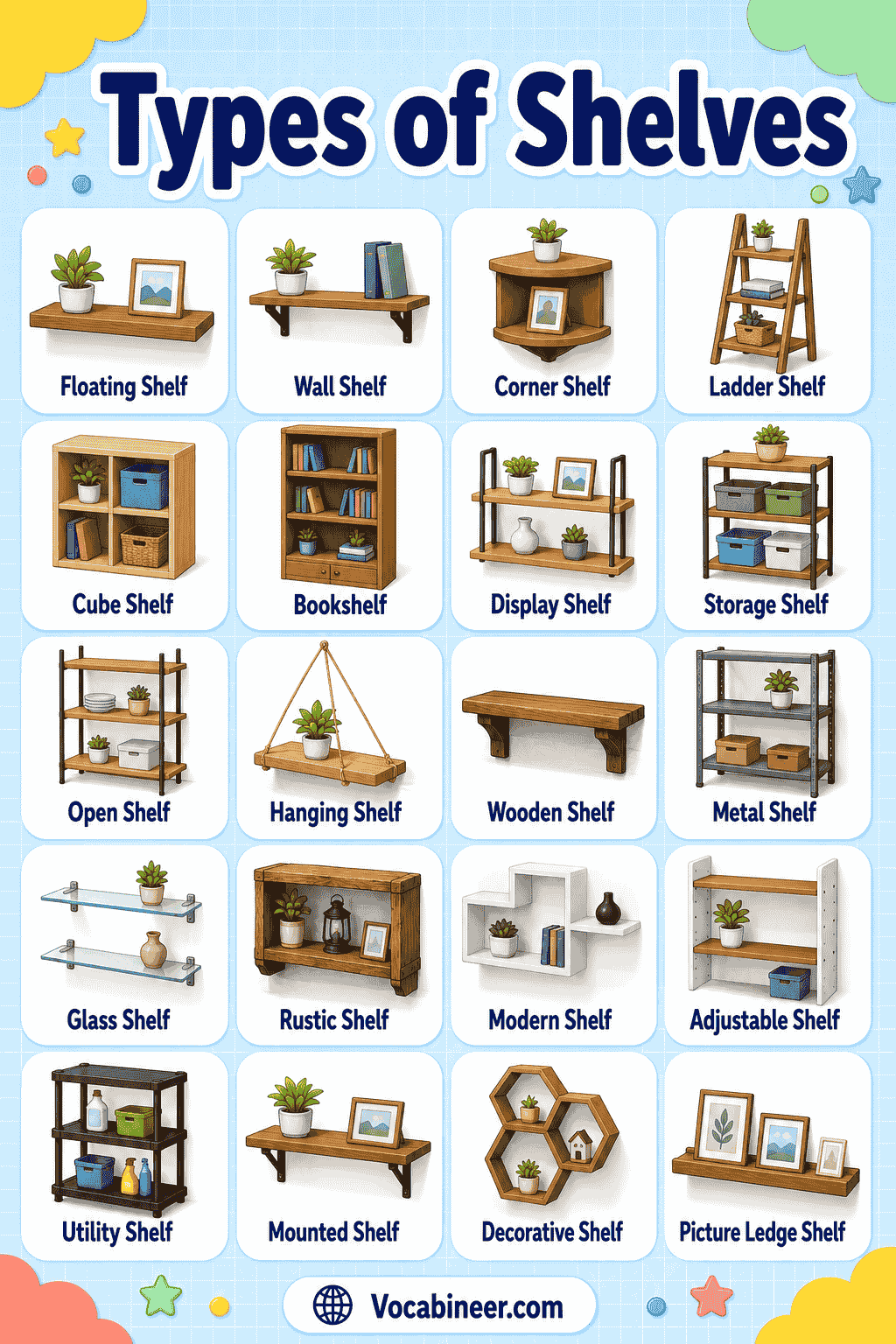
In This Page
Common Types of Shelves
These are the shelf types people commonly use for storage, display, decoration, books, plants, kitchen items, bathroom products, and home organization.
- Wall Shelf — a shelf attached to a wall for storage or display.
- Floating Shelf — a wall shelf with hidden supports.
- Corner Shelf — a shelf designed to fit into a room corner.
- Built-In Shelf — a shelf fixed into a wall, cabinet, or room structure.
- Bookshelf — a shelf or shelving unit used for books.
- Ladder Shelf — a leaning shelf shaped like a ladder.
- Cube Shelf — a shelf with square or cube-shaped compartments.
- Hanging Shelf — a shelf suspended by ropes, chains, or brackets.
- Freestanding Shelf — a movable shelf unit that stands on the floor.
- Adjustable Shelf — a shelf with movable height levels.
- Open Shelf — a shelf without doors or closed panels.
- Display Shelf — a shelf used to show decorative items, photos, plants, or collections.
Shelf Types and Their Simple Meanings
Simple meanings help readers understand shelf names before comparing materials, placement, design, or storage use.
| Shelf Type | Simple Meaning |
|---|---|
| Wall Shelf | A shelf fixed to a wall. |
| Floating Shelf | A wall shelf with hidden brackets or supports. |
| Corner Shelf | A shelf made for room corners. |
| Built-In Shelf | A shelf built into a wall, cabinet, or room design. |
| Bookshelf | A shelf used to hold books. |
| Ladder Shelf | A leaning shelf that looks like a ladder. |
| Cube Shelf | A shelf with square storage sections. |
| Hanging Shelf | A shelf that hangs from ropes, chains, or supports. |
| Freestanding Shelf | A shelf unit that stands on the floor. |
| Adjustable Shelf | A shelf with movable levels or positions. |
| Open Shelf | A shelf with visible storage and no doors. |
| Display Shelf | A shelf used to show decorative items. |
Shelf Types and Best Uses
Different shelf types work better for different rooms, items, wall spaces, and storage needs.
| Shelf Type | Best Use |
|---|---|
| Wall Shelf | Displaying books, photos, plants, and small decor. |
| Floating Shelf | Creating a clean modern wall display. |
| Corner Shelf | Using empty corners in small rooms. |
| Built-In Shelf | Permanent storage in living rooms, offices, or bedrooms. |
| Bookshelf | Organizing books, files, and study items. |
| Ladder Shelf | Decorative storage in bedrooms and living rooms. |
| Cube Shelf | Storing baskets, toys, books, and folded items. |
| Hanging Shelf | Light decor, plants, and small accessories. |
| Freestanding Shelf | Flexible storage that can move to another room. |
| Adjustable Shelf | Changing shelf height for different item sizes. |
| Garage Shelf | Holding tools, boxes, paint cans, and heavy supplies. |
| Pantry Shelf | Organizing food, jars, spices, and kitchen storage. |
Types of Shelves by Mounting Style
Mounting style explains how a shelf stays in place, whether it attaches to a wall, hangs from above, stands on the floor, or fits inside a structure.
- Wall-Mounted Shelf — attaches directly to a wall.
- Floating Shelf — mounts to the wall with hidden supports.
- Bracket Shelf — uses visible brackets under the shelf.
- Hidden Bracket Shelf — uses concealed brackets for a cleaner look.
- Hanging Shelf — hangs from ropes, chains, hooks, or ceiling supports.
- Freestanding Shelf — stands on the floor without wall mounting.
- Built-In Shelf — fixed into walls, cabinets, alcoves, or furniture.
- Recessed Shelf — set into a wall niche or recessed space.
- Over-the-Door Shelf — hangs or mounts over a door.
- Ceiling-Mounted Shelf — hangs from the ceiling for storage or display.
- Adhesive Shelf — sticks to a surface without drilling.
- Tension Shelf — stays in place using pressure between surfaces.
Wall-Mounted and Floating Shelf Types
Wall-mounted shelves save floor space and work well for books, decor, kitchen items, bathroom products, plants, and small storage.
- Floating Shelf — gives a clean look because the supports are hidden.
- Bracket Shelf — uses visible brackets for support and style.
- Picture Ledge Shelf — has a narrow ledge for frames, art, and small decor.
- Wall Cube Shelf — has cube-shaped compartments mounted on the wall.
- Box Shelf — a wall shelf shaped like an open box.
- Wall Display Shelf — used for photos, collectibles, candles, or plants.
- Heavy-Duty Wall Shelf — holds heavier items with stronger brackets and proper mounting.
- Kitchen Wall Shelf — stores plates, cups, jars, spices, or cookware.
- Bathroom Wall Shelf — holds towels, toiletries, soaps, or skincare products.
- Plant Wall Shelf — displays small indoor plants and pots.
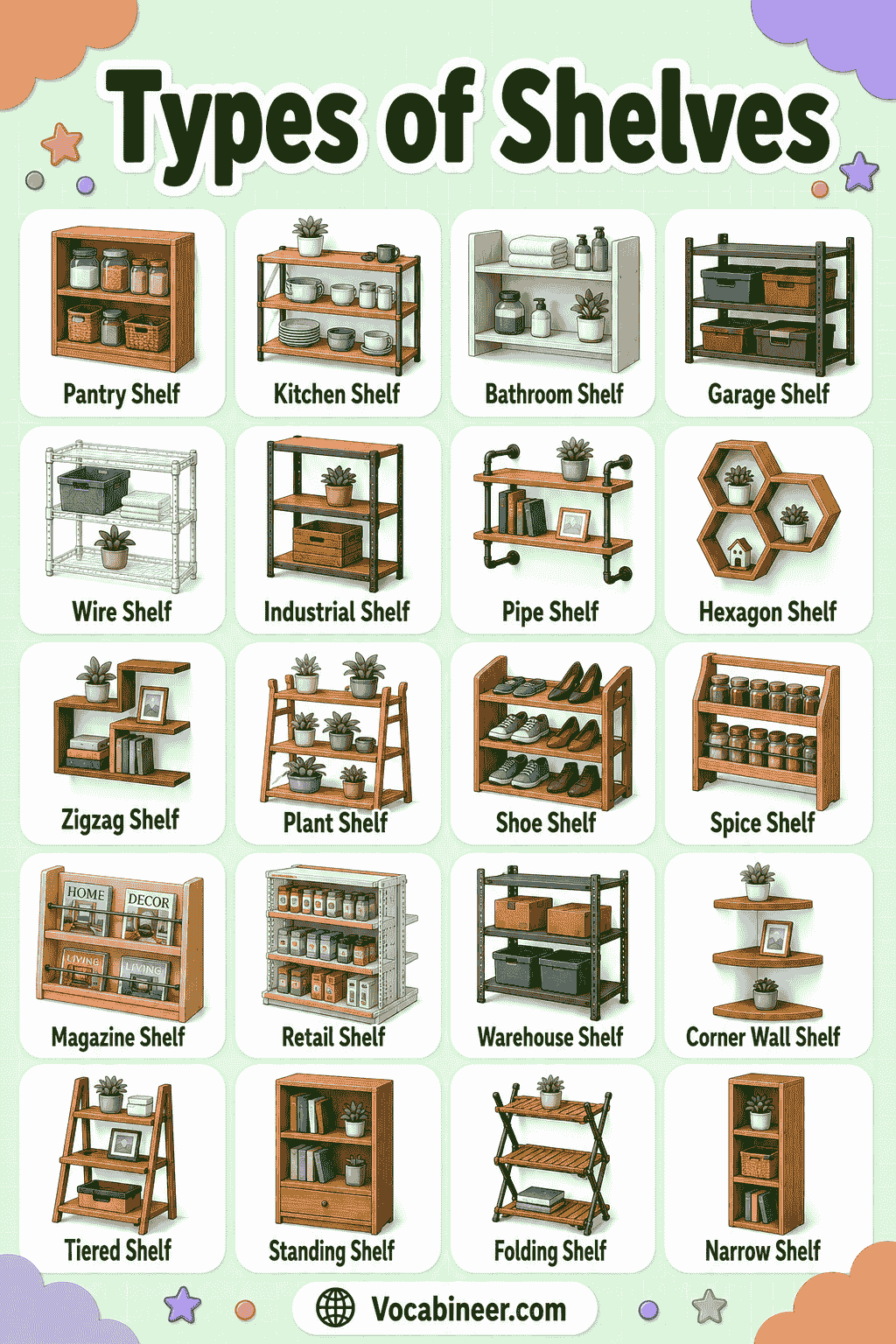
Freestanding and Storage Shelf Types
Freestanding shelves are useful when you need storage without drilling walls or making permanent changes.
- Freestanding Shelf — a shelf unit that stands on the floor.
- Bookcase Shelf — a large shelf unit used for books and decor.
- Storage Shelf — used for bins, baskets, boxes, and everyday items.
- Wire Shelving Unit — a metal wire shelf often used in kitchens, pantries, and garages.
- Metal Shelving Unit — strong shelving for tools, supplies, or heavy storage.
- Cube Storage Shelf — has square sections for baskets, books, toys, or folded clothes.
- Ladder Shelf — leans against a wall and offers decorative storage.
- Utility Shelf — practical shelf for laundry rooms, garages, and storage areas.
- Garage Shelf — heavy storage shelf for boxes, tools, paint, and equipment.
- Pantry Shelf — used for food storage, jars, cans, spices, and kitchen supplies.
- Shoe Shelf — stores shoes near doors, closets, or bedrooms.
- Toy Shelf — organizes toys, games, books, and children’s items.
Decorative Shelf Types for Home Display
Decorative shelves help display beautiful items while also adding shape, color, and style to a room.
- Display Shelf — shows decor, collectibles, candles, plants, or photos.
- Picture Ledge Shelf — displays frames, art, and small decorative pieces.
- Plant Shelf — holds indoor plants and flower pots.
- Floating Display Shelf — creates a clean display area on the wall.
- Hexagon Shelf — a decorative shelf with a geometric hexagon shape.
- Zigzag Shelf — a wall shelf with a zigzag design.
- Ladder Shelf — adds height and style while holding decor.
- Box Shelf — creates a framed display space on the wall.
- Corner Display Shelf — uses corners for small decor or plants.
- Media Shelf — holds speakers, remotes, game consoles, or small electronics.
Shelf Materials and Where They Work Best
Shelf material affects strength, style, weight capacity, moisture resistance, cleaning, and where the shelf should be used.
- Wooden Shelf — warm, strong, and suitable for living rooms, bedrooms, offices, and books.
- Solid Wood Shelf — durable and strong for long-term storage or display.
- Metal Shelf — sturdy and useful for garages, kitchens, offices, and industrial-style rooms.
- Glass Shelf — sleek and decorative for bathrooms, living rooms, and display areas.
- Acrylic Shelf — clear, lightweight, and useful for modern displays.
- MDF Shelf — affordable and common in furniture and wall shelves.
- Wire Shelf — breathable and practical for pantries, closets, kitchens, and garages.
- Bamboo Shelf — natural-looking and useful for bathrooms, kitchens, and eco-style rooms.
- Plastic Shelf — lightweight and easy to clean for bathrooms, closets, and children’s areas.
- Stainless Steel Shelf — strong, clean-looking, and useful for kitchens, laundry rooms, and utility spaces.
Shelves for Different Rooms
Room-based shelves help organize specific items, from kitchen jars and bathroom towels to books, shoes, tools, and decor.
- Kitchen Shelf — stores dishes, mugs, jars, spices, cookbooks, or pantry items.
- Bathroom Shelf — holds towels, toiletries, soaps, skincare, and cleaning products.
- Bedroom Shelf — displays books, photos, perfumes, lamps, or personal items.
- Living Room Shelf — holds decor, books, plants, frames, and media accessories.
- Pantry Shelf — organizes food, cans, jars, boxes, and dry goods.
- Garage Shelf — stores tools, storage bins, paint cans, and equipment.
- Office Shelf — holds files, books, stationery, printers, and work supplies.
- Laundry Room Shelf — stores detergents, baskets, towels, and cleaning items.
- Entryway Shelf — holds keys, bags, shoes, mail, and small decor.
- Closet Shelf — organizes folded clothes, shoes, bags, boxes, and accessories.
Shelf Shapes and Design Styles
Shelf shapes make picture guides more useful because many shelves are named by their form or visual design.
- Cube Shelf — has square compartments for storage or display.
- Box Shelf — looks like an open box mounted on a wall or placed in a unit.
- Ladder Shelf — has a tall leaning design with shelves at different levels.
- Tiered Shelf — has multiple layers stacked above one another.
- Corner Shelf — fits into a room corner.
- Hexagon Shelf — has a six-sided geometric shape.
- Zigzag Shelf — has angled shelf sections in a zigzag style.
- U-Shaped Shelf — has a simple U-like design for small wall display.
- L-Shaped Shelf — forms an L shape, often used in corners or work areas.
- Modular Shelf — can be rearranged or combined with other shelf units.
- Round Shelf — has a circular frame with shelf sections inside.
- Asymmetrical Shelf — has uneven sections for modern decoration.
Heavy-Duty and Adjustable Shelf Types
Heavy-duty and adjustable shelves are useful for garages, pantries, offices, shops, laundry rooms, warehouses, and utility areas.
- Heavy-Duty Shelf — holds heavier items such as tools, boxes, and equipment.
- Adjustable Shelf — lets users move shelf levels up or down.
- Utility Shelf — practical shelf for storage rooms and work areas.
- Garage Shelving — strong storage for tools, bins, paint, and hardware.
- Metal Storage Shelf — durable shelf for heavier storage needs.
- Wire Shelving — open metal shelf that allows airflow and visibility.
- Industrial Shelf — strong shelf with metal or wood materials and a rugged style.
- Boltless Shelf — storage shelf assembled without many screws or bolts.
- Modular Shelving Unit — shelf system that can expand or change shape.
- Stud-Mounted Shelf — wall shelf fixed into wall studs for stronger support.
- Warehouse Shelf — large shelf used for bulk storage and supplies.
- Adjustable Closet Shelf — shelf system with movable levels for clothes and accessories.
Confusing Shelf Terms Explained
Some shelf words sound similar, but they describe different storage styles, furniture pieces, or mounting methods.
| Shelf Terms | Difference |
|---|---|
| Shelf vs Rack | A shelf usually has flat surfaces for storage or display, while a rack often has bars, rails, hooks, or open frames. |
| Shelf vs Cabinet | A shelf is usually open, while a cabinet has enclosed storage with doors or drawers. |
| Floating Shelf vs Wall Shelf | A floating shelf hides its supports, while a wall shelf may use visible brackets. |
| Bookshelf vs Bookcase | A bookshelf can mean a shelf for books, while a bookcase is usually a larger furniture piece. |
| Open Shelf vs Closed Cabinet | Open shelves display items, while closed cabinets hide items. |
| Built-In Shelf vs Freestanding Shelf | A built-in shelf is fixed into the room structure, while a freestanding shelf can move. |
| Bracket Shelf vs Floating Shelf | A bracket shelf shows its supports, while a floating shelf hides them. |
Types of Shelves Chart with Pictures
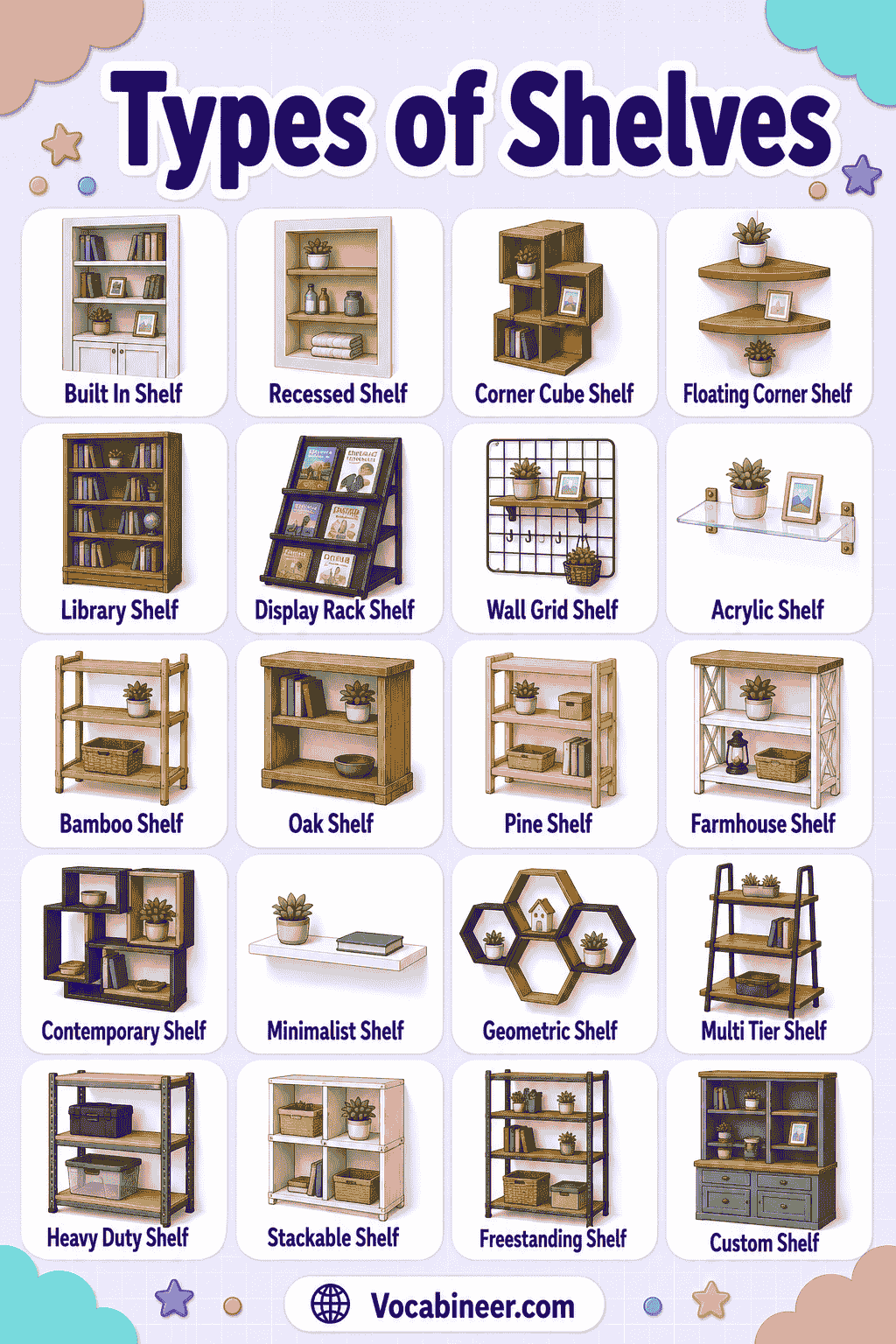
A shelf chart helps readers compare shelf groups quickly by purpose, placement, and common examples.
| Shelf Group | Details |
|---|---|
| Wall Shelves | Best for: saving floor space and wall displayExamples: floating shelf, bracket shelf, picture ledge |
| Freestanding Shelves | Best for: movable storage and flexible room useExamples: bookcase shelf, ladder shelf, cube shelf |
| Storage Shelves | Best for: organizing household items and suppliesExamples: pantry shelf, garage shelf, utility shelf |
| Decorative Shelves | Best for: home display and room styleExamples: hexagon shelf, display shelf, plant shelf |
| Material-Based Shelves | Best for: matching strength, style, and room needsExamples: wooden shelf, metal shelf, glass shelf |
| Room-Based Shelves | Best for: organizing specific areasExamples: kitchen shelf, bathroom shelf, closet shelf |
| Heavy-Duty Shelves | Best for: tools, boxes, equipment, and bulk storageExamples: metal storage shelf, wire shelf, industrial shelf |
How to Choose the Right Type of Shelf
Choosing the right shelf depends on the room, wall space, material, weight capacity, installation method, storage need, and style. A floating shelf works well for clean wall display, while a bracket shelf gives visible support. For small rooms, corner shelves, wall shelves, and over-the-door shelves can save space.
Storage needs also matter. A wooden shelf or bookcase works well for books and decor, while metal, wire, or heavy-duty shelves are better for garages, pantries, and utility rooms. For bathrooms and kitchens, choose materials that handle moisture and cleaning well, such as metal, glass, bamboo, plastic, or stainless steel. Before installing wall shelves, check the wall type, brackets, anchors, and weight of the items you want to store.
FAQs
The main types of shelves include wall shelves, floating shelves, corner shelves, built-in shelves, bookshelves, ladder shelves, cube shelves, hanging shelves, freestanding shelves, adjustable shelves, open shelves, and display shelves.
Floating shelves, corner shelves, wall-mounted shelves, over-the-door shelves, and narrow ladder shelves are useful for small spaces because they save floor space and use empty walls or corners.
A floating shelf hides its supports, while a wall shelf may use visible brackets or other mounting hardware. Both types attach to a wall, but floating shelves usually look cleaner and more modern.
Metal shelves and solid wood shelves are usually strong choices for heavy storage. However, strength also depends on shelf thickness, brackets, wall support, and installation quality.
Bookshelves, bookcases, solid wood shelves, metal shelves, cube shelves, and heavy-duty wall shelves work well for books because they offer strong, stable support.
Read More
- Household Items Names
- Different Types of Blankets
- Baby Care Items Names
- First Aid Kit Items Names
- Living Room Items Names