

Lie and lay are easy to confuse because their forms overlap. The present form lay means “put or place something,” but lay is also the past form of lie, meaning “recline, remain, or be located.” Therefore, choosing the correct word requires more than remembering a single definition.
The clearest rule concerns the direct object: lie does not take a direct object, while lay normally does. This guide explains that rule, compares every important form, and shows how to choose among lie, lies, lying, lay, lays, laying, laid, lain, and lied in natural sentences.
In This Page
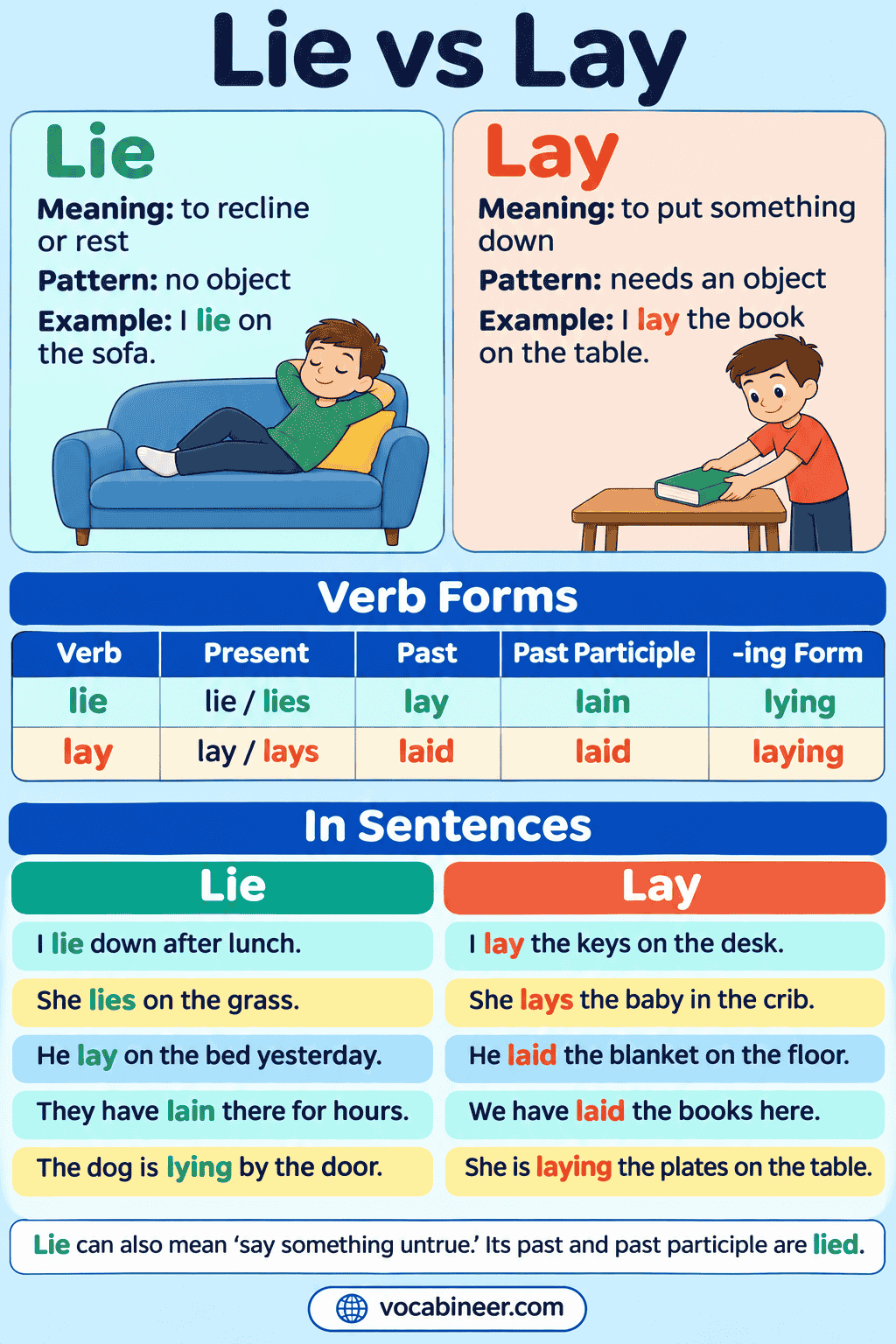
Lie and Lay at a Glance
Use lie when the subject reclines, rests, remains, or occupies a location independently. In contrast, use lay when the subject puts or places a person or thing somewhere.
| Verb | Main meaning | Direct object | Example |
|---|---|---|---|
| Lie | Recline, rest, remain, or be located | No | The cat lies on the sofa. |
| Lay | Put or place someone or something | Yes | Sara lays the book on the desk. |
| Lie | Say something untrue | Usually no | He lied about his age. |
The relationship becomes clearer when lay means “cause someone or something to lie.” For example, “The baby lies in the crib” describes the baby’s position, while “The mother lays the baby in the crib” describes an action performed on the baby.
Complete Forms of Lie and Lay
| Meaning | Base form | Third-person singular | Present participle | Past form | Past participle |
|---|---|---|---|---|---|
| Recline, remain, or be located | lie | lies | lying | lay | lain |
| Put or place something | lay | lays | laying | laid | laid |
| Say something untrue | lie | lies | lying | lied | lied |
The word lay causes most of the confusion because it has two identities:
- It is the base and present form of lay: “I lay the keys on the counter.”
- It is the past form of lie: “Yesterday, I lay on the sofa.”
Lie for Reclining, Remaining, and Location
The intransitive verb lie does not act on a direct object. Instead, it describes the subject’s position, state, or location.
Reclining or Resting
- I lie down after lunch.
- She lies on the sofa every afternoon.
- Yesterday, he lay on the grass.
- The dog has lain by the fire all morning.
- The children are lying on the floor.
Remaining in a Position or State
The subject does not need to be a person or animal:
- The papers lie untouched on the desk.
- The equipment lay unused for years.
- The letter has lain unopened since Monday.
- Snow is lying on the mountain peaks.
Describing Physical or Abstract Location
Lie can show where a place, object, answer, responsibility, or difficulty exists:
- The village lies beyond the hills.
- The island lies south of the coast.
- The answer lies in the final paragraph.
- Responsibility lies with the manager.
- Several challenges lie ahead.
- The main problem lay in the design.
These uses follow the same rule: nothing receives the action, so no direct object follows lie.
Lay for Putting or Placing
The transitive verb lay describes an action performed on someone or something. Therefore, it normally requires a direct object.
- Lay the blanket on the bed.
- She lays the keys on the counter every evening.
- He laid the baby in the crib.
- Workers have laid the pipes underground.
- They are laying new flooring in the kitchen.
Object and Destination
In “She laid the book on the table,” the book is the direct object because it receives the action. The phrase on the table identifies the destination; it is not the object of laid.
| Sentence part | Function |
|---|---|
| She | Subject performing the action |
| laid | Verb meaning “placed” |
| the book | Direct object being placed |
| on the table | Phrase showing the destination |
Nouns, Pronouns, and Reflexive Objects
The object of lay can take several forms:
- Lay the child on the bed.
- Lay him on the bed.
- Please lay it here.
- He laid himself down carefully.
“Lay yourself down” is grammatically possible because yourself functions as the direct object. However, “lie down” usually sounds more natural when someone reclines independently.
Transitive and Intransitive Uses
| Lie | Lay |
|---|---|
| Intransitive | Transitive |
| Does not take a direct object | Normally takes a direct object |
| The subject reclines, remains, or occupies a location | The subject places someone or something |
| The child lies on the bed. | The parent lays the child on the bed. |
| The files lie on the desk. | Sara lays the files on the desk. |
The sentence may contain a prepositional phrase after lie, but that phrase does not become a direct object. For example, on the bed in “The child lies on the bed” describes location.
The Direct-Object Test
Use this test whenever the intended meaning involves position or placement:
- Find the verb.
- Ask what? or whom? after it.
- If the sentence names something being placed, use a form of lay.
- If the subject reclines, remains, or occupies a location independently, use a form of lie.
Compare these examples:
- She laid what? — the blanket. Therefore, laid is correct.
- The dog lay what? — no answer. Therefore, lay, the past form of lie, is correct.
- They are laying what? — new tiles. Therefore, laying is correct.
- The tiles are lying what? — no answer. Therefore, lying is correct.
The Place Substitution Test
Another quick method is to replace a form of lay with the corresponding form of place.
| Form of lay | Form of place | Example |
|---|---|---|
| lay | place | Lay the keys here. → Place the keys here. |
| lays | places | She lays the keys here. → She places the keys here. |
| laid | placed | She laid the keys here. → She placed the keys here. |
| laying | placing | She is laying the keys here. → She is placing the keys here. |
| has laid | has placed | She has laid them here. → She has placed them here. |
If the matching form of place does not express the intended meaning, choose a form of lie instead:
- I need to lie down.
- “I need to place down” does not make sense in the same way.
The tense must match during this test. Compare laid with placed, not with the present form place.
Present Forms of Lie and Lay
| Subject | Recline or be located | Put or place |
|---|---|---|
| I | lie | lay |
| You | lie | lay |
| We | lie | lay |
| They | lie | lay |
| He, she, it | lies | lays |
Examples with lie:
- I lie down after work.
- The books lie on the shelf.
- The town lies near the border.
Examples with lay:
- I lay the files on the desk.
- The workers lay bricks every day.
- She lays the baby in the crib.
Lies and Lays
| Lies | Lays |
|---|---|
| Means reclines, remains, exists, or says something untrue | Means puts or places something |
| Does not take an object in the position sense | Requires an object |
| The dog lies by the door. | The dog lays its head on my foot. |
| The solution lies in better planning. | She lays the plans on the table. |
Past Forms of Lie and Lay
| Intended meaning | Present form | Past form | Example |
|---|---|---|---|
| Recline, remain, or be located | lie | lay | She lay on the sofa yesterday. |
| Put or place something | lay | laid | She laid the blanket on the sofa. |
| Say something untrue | lie | lied | She lied about the incident. |
Lay and Laid
| Lay | Laid |
|---|---|
| Can be the present form meaning “put or place” | Is the past and past participle of placing lay |
| Can also be the past form of reclining lie | Requires an object when used actively |
| I lay the keys here each day. | I laid the keys here yesterday. |
| Yesterday, I lay on the grass. | She laid the blanket on the grass. |
Time expressions often help. Usually or every day may signal a present form, while yesterday or last night commonly signals a past form.
Past Participles of Lie and Lay
Past participles commonly follow have, has, or had.
| Meaning | Past participle | Example |
|---|---|---|
| Recline, remain, or be located | lain | The cat has lain there all day. |
| Put or place something | laid | She has laid the book on the desk. |
| Say something untrue | lied | He has lied before. |
Lain and Laid
| Lain | Laid |
|---|---|
| Past participle of reclining or location lie | Past and past participle of placing lay |
| Does not take a direct object | Normally takes a direct object |
| The dog has lain by the door. | She has laid the mat by the door. |
| The documents had lain untouched. | He had laid the documents on the desk. |
Lain remains the standard form in careful English, although it can sound formal or uncommon in everyday conversation. Speakers sometimes avoid it by rewriting the sentence: “The dog has been lying there all day.”
Lying and Laying
| Lying | Laying |
|---|---|
| Present participle of lie | Present participle of lay |
| Describes reclining, remaining, location, or dishonesty | Describes putting or placing an object |
| The baby is lying in the crib. | The parent is laying the baby in the crib. |
| The papers are lying on the desk. | She is laying the papers on the desk. |
| He is lying about his age. | They are laying new pipes. |
Spelling of Lying
When -ing follows a verb ending in -ie, the final ie changes to y:
- lie → lying
- die → dying
- tie → tying
Therefore, lieing is incorrect. By contrast, lay simply adds -ing: lay → laying.
Lie Down and Lay Down
| Lie down | Lay down |
|---|---|
| The subject reclines | The subject places an object |
| Does not require an object | Normally requires an object |
| Lie down and rest. | Lay the bag down. |
| She lay down yesterday. | She laid the bag down yesterday. |
| She has lain down. | She has laid the bag down. |
In informal speech, people often say “I’m going to lay down.” However, formal and edited English generally prefers “I’m going to lie down” because the speaker is reclining rather than placing an object.
Lie for Saying Something Untrue
The separate verb lie, meaning “say something false,” follows a regular past-tense pattern.
| Form | Word | Example |
|---|---|---|
| Base | lie | People sometimes lie. |
| Third-person singular | lies | He lies frequently. |
| Present participle | lying | He is lying to us. |
| Past | lied | He lied yesterday. |
| Past participle | lied | He has lied before. |
Do not use lay for this meaning:
- Correct: He lied about his age.
- Incorrect: He lay about his age.
Questions, Negatives, and Commands
After do, does, or did, use the base form:
| Structure | Lie | Lay |
|---|---|---|
| Present question | Do you lie down after lunch? | Do you lay the baby down after lunch? |
| Past question | Did she lie down? | Did she lay the book there? |
| Present negative | He does not lie there. | He does not lay the tools there. |
| Past negative | She did not lie down. | She did not lay the blanket there. |
Commands use the base form:
- Lie down and rest.
- Lay the bag on the floor.
- Don’t lie to me.
- Don’t lay the phone near the water.
Active and Passive Patterns
Intransitive lie does not normally form a passive construction because it has no direct object. Transitive lay, however, can become passive.
| Intransitive lie | Transitive lay |
|---|---|
| The book lay on the table. | Sara laid the book on the table. |
| Describes the book’s location | Describes Sara’s action on the book |
| Has no direct object | Takes the book as its direct object |
| Does not create a corresponding passive | The book was laid on the table. |
Common Expressions with Lie
Lie down
Move into a reclining position: “I need to lie down.”
Lie awake
Remain awake while resting: “She lay awake for hours.”
Lie low
Avoid attention: “They decided to lie low for a few days.”
Lie ahead
Exist in the future: “Several challenges lie ahead.”
Lie in wait
Hide while waiting to surprise someone: “The animal lay in wait.”
Let sleeping dogs lie
Avoid disturbing a settled situation: “It is better to let sleeping dogs lie.”
Lie through one’s teeth
Tell an obvious or deliberate falsehood: “He was lying through his teeth.”
Common Expressions with Lay
Lay the table
Arrange dishes and cutlery for a meal: “Please lay the table.”
Lay an egg
Produce an egg: “The hen laid an egg.”
Lay a foundation
Create a physical or figurative base: “The course lays a strong foundation.”
Lay the blame on someone
Assign responsibility: “They laid the blame on the supplier.”
Lay down the law
State rules firmly: “The manager laid down the law.”
Lay something aside
Put something away or reserve it: “She laid the book aside.”
Lay eyes on
See someone or something: “It was the first time I had laid eyes on the building.”
Lay someone off
End someone’s employment, often because work is unavailable: “The company laid several workers off.”
Although these expressions may have figurative meanings, most still contain an object after lay.
Laid and the Incorrect Form Layed
The standard past and past-participle form of lay is laid, not layed.
- Correct: She laid the documents on the desk.
- Correct: She has laid the documents on the desk.
- Incorrect: She layed the documents on the desk.
The same spelling appears in phrasal and figurative uses: laid down, laid aside, laid off, and laid the foundation.
Common Mistakes with Lie and Lay
| Incorrect | Correct | Explanation |
|---|---|---|
| I need to lay down. | I need to lie down. | The subject reclines; no object appears. |
| She is laying on the sofa. | She is lying on the sofa. | Use lying when the subject rests. |
| He laid on the bed yesterday. | He lay on the bed yesterday. | Lay is the past form of reclining lie. |
| She lay the book on the desk. | She laid the book on the desk. | The past form of placing lay is laid. |
| The dog has laid there all day. | The dog has lain there all day. | Use lain after has for remaining or reclining. |
| She has lain the blanket down. | She has laid the blanket down. | The blanket is an object being placed. |
| He is lieing to me. | He is lying to me. | Change final ie to y before -ing. |
| They layed the floor yesterday. | They laid the floor yesterday. | The standard past form is laid. |
| He lay about his age. | He lied about his age. | The falsehood meaning uses lied. |
| Did she laid the book there? | Did she lay the book there? | Use the base form after did. |
A Simple Method for Choosing the Correct Form
Use this process whenever lie and lay cause uncertainty:
- Identify the meaning. Decide whether the subject reclines, something occupies a location, someone places an object, or someone says something untrue.
- Check for a direct object. If someone puts or places a person or thing, choose the lay–laid–laid–laying family.
- Check the time. Words such as usually, now, yesterday, and last night help identify the required tense.
- Look for an auxiliary. Use lain or laid after have, has, or had. Use lying or laying after a continuous form of be.
- Apply the place test. If the matching form of place fits, use a form of lay.
- Use the falsehood pattern separately. Choose lie–lied–lied–lying when the meaning involves untrue information.
The following formula offers a quick final check:
| Intended meaning | Verb family |
|---|---|
| Recline, remain, or be located | lie–lay–lain–lying |
| Put or place an object | lay–laid–laid–laying |
| Say something untrue | lie–lied–lied–lying |
FAQs
A person is normally lying in bed because the person is reclining rather than placing an object. Use laying only when the person is putting something somewhere, as in “She is laying the baby in bed.”
Use lie down when the subject reclines: “I need to lie down.” Use lay down when someone places an object: “Lay the book down.”
The past form of reclining lie is lay: “Yesterday, she lay on the sofa.” The past form of placing lay is laid: “She laid the blanket on the sofa.” The past form of falsehood lie is lied.
Lain is the past participle of lie and does not take a direct object: “The dog has lain there all day.” Laid is the past participle of lay and normally takes an object: “She has laid the mat by the door.”
Not in ordinary modern usage. The standard past and past-participle form of lay is laid. Therefore, write “She laid the book down,” not “She layed the book down.
Final Summary
Use lie when a person or thing reclines, remains, or occupies a location without acting on a direct object. Its main forms are lie, lies, lying, lay, and lain. Use lay when someone puts or places an object. Its forms are lay, lays, laying, and laid. Meanwhile, lie meaning “say something untrue” forms its past and past participle as lied.
The fastest way to choose correctly is to look for an object and check the tense. If place, placed, or placing fits, use the corresponding form of lay. Otherwise, when the subject reclines, remains, or exists in a location, choose the correct form of lie.
Read More