

Rare color names are uncommon shade words that many people do not use in everyday speech. Some sound elegant, such as cerulean, celadon, and amaranth, while others feel more artistic or historical, like sinopia, zaffre, and Tyrian purple.
These names are useful for writers, artists, designers, students, and anyone who wants to describe colors more clearly. Instead of using only basic words like blue, green, red, or brown, rare color names help you talk about exact shades with more style and detail.
In This Page
What Makes a Color Name Rare?
A color name becomes rare when it is not commonly used in daily conversation. Many rare color names come from flowers, minerals, old pigments, fabrics, places, historical dyes, or artistic traditions.
For example, cerulean is a rich sky-blue shade, bistre is a dark brown color, and isabelline is a pale gray-yellow shade. These names are real color words, but they are less familiar than simple names like blue, brown, or yellow.
Rare Color Names vs Common Color Names
Rare and common color names both describe colors, but they work at different levels of detail.
| Feature | Common Color Names | Rare Color Names |
|---|---|---|
| Meaning | Everyday color words | Less common or advanced shade names |
| Examples | Red, blue, green, brown | Zaffre, bistre, celadon, glaucous |
| Best for | Kids, beginners, daily speech | Writing, art, design, fashion |
| Detail level | Simple | More specific |
| Use | Basic description | Stylish or exact description |
Beautiful Rare Color Names to Know
Some rare color names sound elegant and creative. They are useful for art, writing, branding, fashion, and color vocabulary.
- Amaranth
- Cerulean
- Celadon
- Aureolin
- Malachite
- Periwinkle
- Coquelicot
- Tyrian purple
- Nattier blue
- Isabelline
- Verdigris
- Zaffre
- Falu red
- Payne’s gray
- Smaragdine
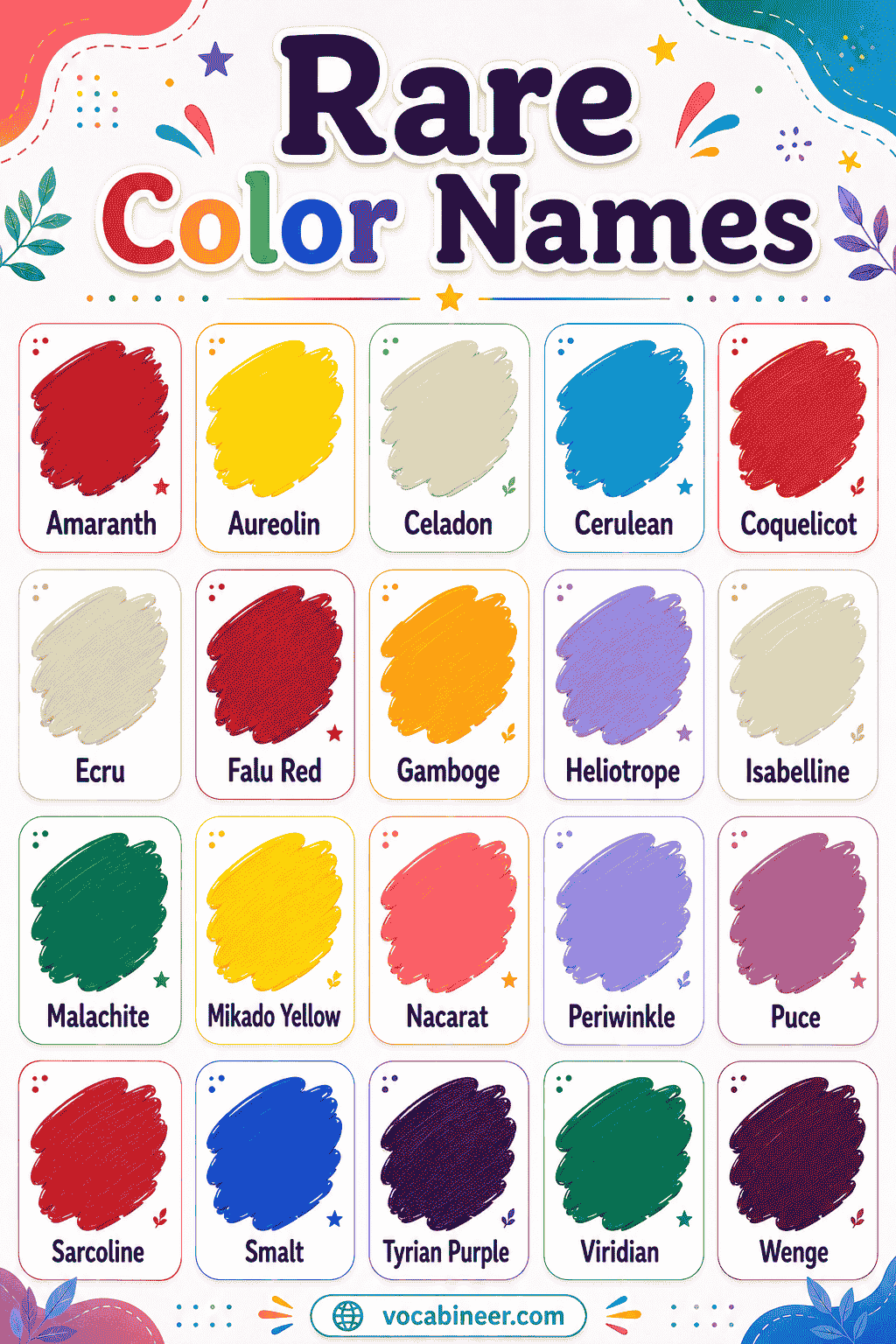
Rare Color Names with Pictures
These rare color names work well for picture cards, visual vocabulary, and color charts. Each name includes a short meaning.
- Amaranth
A reddish-pink color named after the amaranth flower. - Aureolin
A bright yellow shade often linked with art pigments. - Bistre
A dark brown color that looks earthy and old-fashioned. - Celadon
A soft pale green shade often connected with ceramic glaze. - Cerulean
A clear blue color that reminds people of sky and water. - Coquelicot
A bright orange-red shade named after the poppy flower. - Eburnean
An ivory-white color with a soft and creamy look. - Falu Red
A deep red shade linked with traditional Swedish paint. - Feldgrau
A muted green-gray color once used for military uniforms. - Fulvous
A dull yellow-brown shade similar to tawny fur. - Glaucous
A pale blue-green or gray-green color seen on some plants. - Isabelline
A pale gray-yellow or creamy beige shade. - Malachite
A rich green color inspired by the malachite mineral. - Nattier Blue
A soft medium blue shade named after painter Jean-Marc Nattier. - Payne’s Gray
A dark blue-gray shade used in painting. - Periwinkle
A soft blue-purple color named after the periwinkle flower. - Puce
A dark reddish-brown or purple-brown color. - Sarcoline
A flesh-toned shade with pinkish or beige warmth. - Sinopia
A reddish-brown color linked with old drawing pigments. - Smaragdine
A bright emerald-green color. - Tyrian Purple
A deep purple shade linked with ancient dye. - Verdigris
A blue-green color inspired by aged copper. - Wenge
A very dark brown shade inspired by tropical wood. - Xanadu
A muted green-gray color with a calm look. - Zaffre
A strong deep blue pigment color.
Rare Blue Color Names
Rare blue names are useful for describing skies, water, fabrics, stones, shadows, and digital designs.
- Cerulean
- Zaffre
- Nattier blue
- Smalt
- Glaucous
- Payne’s gray
- Lapis
- Steel blue
Rare Green Color Names
Rare green names often come from minerals, plants, ceramics, and natural surfaces.
- Celadon
- Malachite
- Smaragdine
- Verdigris
- Glaucous
- Xanadu
- Feldgrau
- Skobeloff
Rare Red and Pink Color Names
Rare red and pink shades can feel bold, floral, historical, or artistic.
- Amaranth
- Coquelicot
- Falu red
- Puce
- Dragon’s blood
- Carmine
- Alizarin
- Razzmatazz
Rare Purple Color Names
Rare purple names are useful for flowers, fabrics, luxury themes, fantasy writing, and historical color references.
- Tyrian purple
- Heliotrope
- Phlox
- Periwinkle
- Mauve
- Byzantium
- Thistle
- Pomp and Power
Rare Yellow and Orange Color Names
Rare yellow and orange names often feel warm, bright, earthy, or pigment-based.
- Aureolin
- Gamboge
- Fulvous
- Citrine
- Mikado
- Ochre
- Saffron
- Xanthic
Rare Brown and Neutral Shades
Rare brown and neutral shades work well for wood, fabric, soil, old paper, shadows, and soft design palettes.
- Bistre
- Wenge
- Isabelline
- Eburnean
- Drab
- Taupe
- Sepia
- Bone
Rare Dark and Moody Color Names
Dark rare names are useful for dramatic designs, gothic themes, shadows, night scenes, and deep color palettes.
- Payne’s gray
- Eigengrau
- Caput mortuum
- Wenge
- Bistre
- Liver
- Charcoal
- Jet
Rare Color Names with Meanings
This table gives quick meanings for useful rare color names.
| Rare Color Name | Simple Meaning |
|---|---|
| Amaranth | Reddish-pink |
| Aureolin | Bright yellow |
| Bistre | Dark brown |
| Celadon | Pale green |
| Cerulean | Sky blue |
| Coquelicot | Orange-red |
| Eburnean | Ivory-white |
| Falu red | Deep red |
| Feldgrau | Green-gray |
| Fulvous | Yellow-brown |
| Glaucous | Pale blue-green or gray-green |
| Isabelline | Pale gray-yellow |
| Malachite | Rich green |
| Nattier blue | Soft medium blue |
| Payne’s gray | Dark blue-gray |
| Periwinkle | Soft blue-purple |
| Puce | Dark reddish-brown |
| Sarcoline | Flesh-toned |
| Sinopia | Reddish-brown |
| Smaragdine | Emerald green |
| Tyrian purple | Deep purple |
| Verdigris | Blue-green |
| Wenge | Very dark brown |
| Xanadu | Green-gray |
| Zaffre | Deep blue |
Rare Color Names with Hex Codes
Hex codes help designers, artists, and digital creators use rare colors in visual projects.
| Rare Color Name | Hex Code |
|---|---|
| Amaranth | #E52B50 |
| Aureolin | #FDEE00 |
| Bistre | #3D2B1F |
| Celadon | #ACE1AF |
| Cerulean | #007BA7 |
| Coquelicot | #FF3800 |
| Eburnean | #FFFFF0 |
| Falu Red | #801818 |
| Feldgrau | #4D5D53 |
| Fulvous | #E48400 |
| Glaucous | #6082B6 |
| Isabelline | #F4F0EC |
| Malachite | #0BDA51 |
| Nattier Blue | #A4DDED |
| Payne’s Gray | #536878 |
| Periwinkle | #CCCCFF |
| Puce | #CC8899 |
| Sarcoline | #FFDDAA |
| Sinopia | #CB410B |
| Smaragdine | #50C878 |
| Tyrian Purple | #66023C |
| Verdigris | #43B3AE |
| Wenge | #645452 |
| Xanadu | #738678 |
| Zaffre | #0014A8 |
Rare Color Names from Nature
Many rare color names come from flowers, minerals, plants, stones, and natural materials.
| Rare Color Name | Natural Source |
|---|---|
| Amaranth | Flower |
| Coquelicot | Poppy flower |
| Malachite | Mineral |
| Periwinkle | Flower |
| Verdigris | Aged copper surface |
| Wenge | Tropical wood |
| Celadon | Pale green ceramic glaze |
| Citrine | Yellow gemstone |
| Rufous | Reddish-brown fur or feathers |
| Glaucous | Waxy plant surfaces |
Rare Color Names from Art and History
Some rare color names come from old pigments, painting traditions, historical dyes, or cultural use.
| Rare Color Name | Art or History Link |
|---|---|
| Tyrian purple | Ancient purple dye |
| Falu red | Traditional Swedish paint |
| Payne’s gray | Named after artist William Payne |
| Zaffre | Cobalt-based blue pigment |
| Aureolin | Yellow pigment name |
| Sinopia | Earth pigment used in art |
| Smalt | Blue glass pigment |
| Caput mortuum | Historical brownish-purple pigment |
| Alizarin | Red dye and pigment |
| Gamboge | Yellow pigment from resin |
Rare Color Names for Creative Writing
Rare color names can make writing more exact and vivid.
- Cerulean for clear skies, water, or glass.
- Bistre for old ink, shadows, or antique paper.
- Celadon for soft green ceramics, walls, or fabric.
- Wenge for dark wood, furniture, or rich interiors.
- Tyrian purple for royal clothing or historical scenes.
- Glaucous for leaves, mist, eyes, or pale natural surfaces.
- Amaranth for flowers, dresses, or romantic details.
- Payne’s gray for storm clouds, shadows, or quiet rooms.
Rare Color Names for Fashion and Branding
Rare color names can make a style, product, or brand palette feel more premium and memorable.
- Clothing collections
- Nail colors
- Makeup shades
- Brand palettes
- Product packaging
- Interior design
- Website themes
- Wedding palettes
- Stationery designs
- Mood boards
Rare Color Palette Ideas
Rare colors work well when paired with simple supporting shades.
| Palette Name | Colors | Best For |
|---|---|---|
| Soft Heritage | Celadon, Eburnean, Bistre, Gold | Branding, stationery |
| Royal Depth | Tyrian purple, Wenge, Pearl, Silver | Luxury design |
| Artist’s Table | Sinopia, Aureolin, Payne’s gray, Cream | Art blogs, posters |
| Rare Garden | Amaranth, Malachite, Periwinkle, Ivory | Floral designs |
| Antique Blue | Cerulean, Nattier blue, Bone, Charcoal | Interiors, websites |
| Earth and Dye | Falu red, Verdigris, Drab, Sand | Historical themes |
Rare Color Names in Example Sentences
These sentences show how rare color names can work in simple writing.
- The vase had a soft celadon glaze.
- Her dress was a rich amaranth shade.
- The painter used aureolin for the bright sunlight.
- A cerulean sky stretched over the sea.
- The old paper had a warm bistre tone.
- His jacket was a deep Tyrian purple.
- The gate had a verdigris coating.
- She chose periwinkle curtains for the room.
- The table had a dark wenge finish.
- The clouds turned Payne’s gray before the rain.
- A malachite pattern decorated the box.
- The artist mixed sinopia into the sketch.
Rare vs Unique and Weird Color Names
Rare, unique, and weird color names are related, but they do not always mean the same thing.
| Term | Meaning | Examples |
|---|---|---|
| Rare color names | Uncommon or less-known color names | Zaffre, bistre, isabelline |
| Unique color names | Creative or distinctive color names | Periwinkle, malachite, amaranth |
| Weird color names | Strange or surprising color names | Puce, smaragdine, eigengrau |
| Unusual color names | Broad term for less common names | Glaucous, celadon, fulvous |
Are Rare Color Names Still Used Today?
Many rare color names are still used in art, design, fashion, writing, and color reference charts. Names like cerulean, periwinkle, malachite, Payne’s gray, and Tyrian purple still appear in creative and visual fields.
Some rare names are more historical or specialized. Words like zaffre, sinopia, caput mortuum, and smalt may appear more often in art history, pigment studies, or advanced color vocabulary.
FAQs
Rare color names are uncommon or less familiar names for specific shades. Examples include zaffre, bistre, celadon, glaucous, amaranth, and Tyrian purple.
Some rare color names are aureolin, coquelicot, eburnean, feldgrau, fulvous, isabelline, malachite, sinopia, smaragdine, verdigris, and wenge.
Beautiful rare color names include cerulean, celadon, amaranth, periwinkle, malachite, aureolin, and Tyrian purple. These names sound elegant and describe attractive shades.
Many rare color names are real color terms used in art, design, history, fashion, and color reference systems. Some names may vary slightly by source.
Rare color names are uncommon or less known, while unique color names feel creative, distinctive, or stylish. A name can be both rare and unique.
Summary
Rare color names help describe uncommon shades with more detail and style. Names like cerulean, celadon, amaranth, bistre, zaffre, malachite, and Tyrian purple are useful in writing, art, fashion, design, and branding. By learning rare color meanings, families, hex codes, origins, and examples, you can build a richer and more creative color vocabulary.
Read More
- Colours Names in English
- Gold Colored Things
- Weird Color Names
- Types of Cool Colors
- Types of Dark Colors
- Pastel Colors Names
- Bright Color Names