

Sight words are some of the most common words children meet again and again when they begin reading. Words like the, and, to, you, was, said, and come appear so often in books that young readers need to recognize them quickly. When children can read these words without stopping every time, their reading becomes smoother, faster, and more meaningful.
However, sight words should not be taught as random words to memorize by shape. Many sight words have parts children can sound out, while others have tricky letters or unusual spellings that need extra practice. A strong sight word lesson helps children notice the sounds, understand the tricky parts, read the word in sentences, and see the word often in real books.
In This Page
What Sight Words Really Are?
Sight words are words children learn to recognize quickly while reading. When a word becomes familiar enough that a child can read it without slow sounding out, it becomes a sight word for that child.
Some sight words are easy to read, such as am, in, it, and on. Other words, such as said, one, was, and does, need more practice because the spelling may not match the sounds children expect.
Common sight words include:
- the
- and
- to
- you
- said
- was
- come
- here
- little
- where
Why Common Words Matter in Early Reading
Common words matter because they appear again and again in beginner books, classroom texts, worksheets, and simple sentences. If a child has to stop at every common word, reading becomes slow and frustrating.
Quick recognition helps children focus on the meaning of the sentence. For example, in the sentence “I can see the dog,” the words I, can, see, and the are common sight words. When children know those words well, they can spend more effort reading the new or decodable word, such as dog.
Sight words help with:
- reading fluency
- sentence reading
- early confidence
- book practice
- word recognition
- reading comprehension
Sight Words, High-Frequency Words, and Tricky Words
These terms are related, but they do not mean exactly the same thing.
| Term | Simple Meaning | Examples |
|---|---|---|
| Sight words | Words a child recognizes quickly while reading | said, was, come, here |
| High-frequency words | Words that appear often in reading | the, and, to, of |
| Tricky words | Words with parts that are harder to sound out | one, two, does, said |
Many sight words are also high-frequency words. However, not every high-frequency word is difficult. Some common words, such as in, at, and up, are easy to sound out. Others, such as said and was, need extra attention because they have tricky spellings.
Dolch and Fry Sight Word Lists Explained
Two common sight word lists are the Dolch word list and the Fry word list. Both are used to help children practice common words, but they are organized differently.
| List | What It Is | Best Use |
|---|---|---|
| Dolch sight words | A classic list of common early-reading words, often grouped by level | Good for preschool, kindergarten, and early elementary practice |
| Fry sight words | A larger list of high-frequency words often grouped in sets of 100 | Good for broader reading fluency practice |
| Teacher-made lists | Lists created for a class, book, or reading program | Good for targeted weekly practice |
Dolch words are often used for early readers because the list is smaller and easier to organize by level. Fry words are useful for longer-term fluency because the list is much larger.
Best Sight Words to Start With
The best first sight words are short, common, and useful in simple sentences. Start with words children will see often in beginner books and classroom reading.
Good first sight words include:
- I
- a
- the
- and
- to
- is
- in
- it
- you
- me
- my
- we
- can
- see
- go
- up
- on
- at
- am
- like
Begin with a small group of 5 to 10 words. Children need repeated reading, sentence use, and short review before adding many new words.
220+ Sight Words by Reading Stage
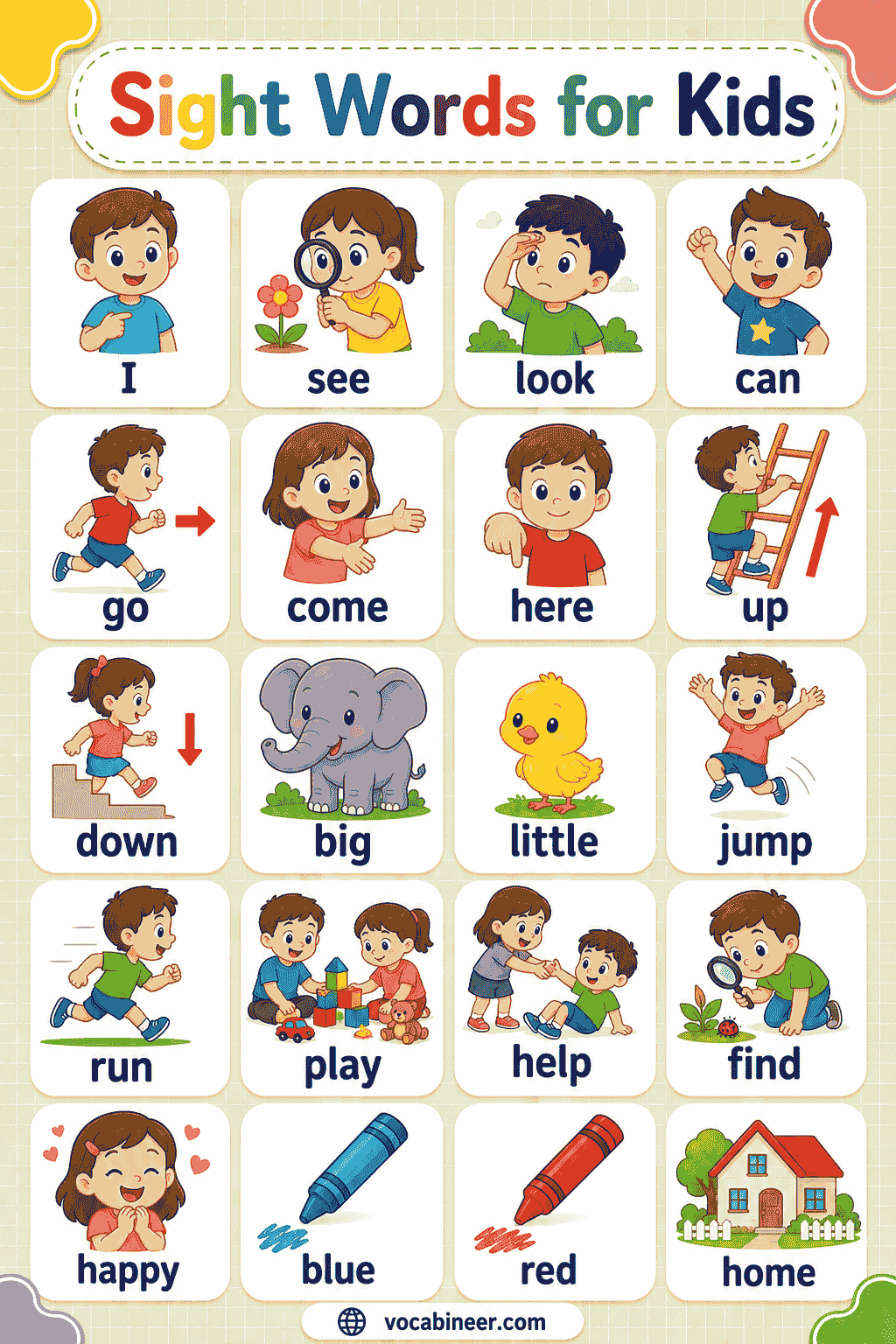
The word bank below includes 220+ sight word examples grouped by reading stage. Use these lists for reading practice, flashcards, worksheets, word walls, sentence building, and short daily review.
Pre-K Sight Words
These are useful first words for children who are beginning to notice print, match words, and read very short sentences.
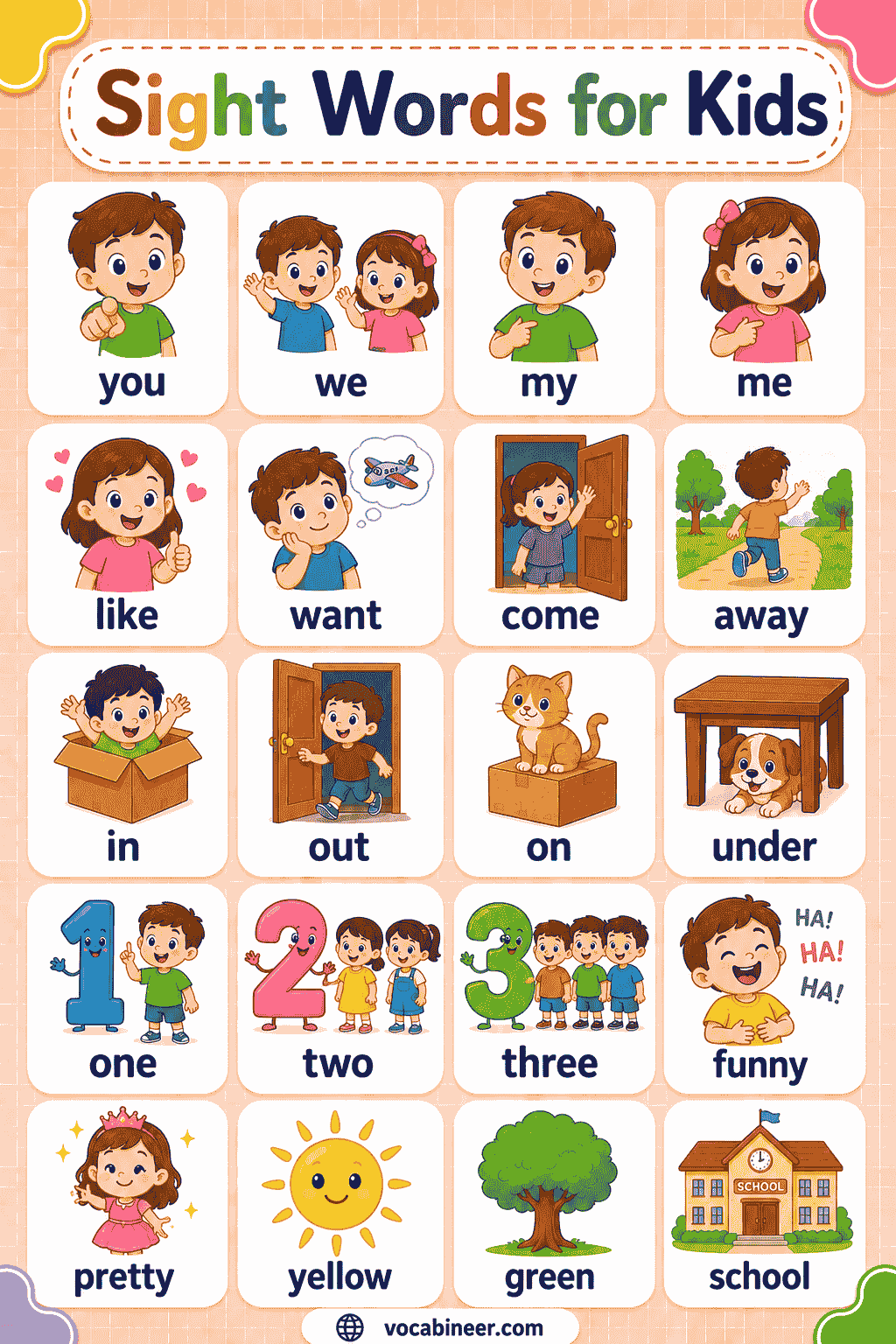
- Self and people words: I, me, my, you, we, he, she, they
- Short sentence words: a, am, is, it, in, on, at, up
- Action helpers: go, see, can, like, look, play
- Answer and daily words: yes, no, not, here, come, away
- Simple book words: the, to, and, big, little, red, blue, one, two, three
Kindergarten Sight Words
Kindergarten sight words help children read simple books, classroom sentences, labels, and beginner worksheets.
- Common book words: the, said, of, have, are, was, for, with, his, her
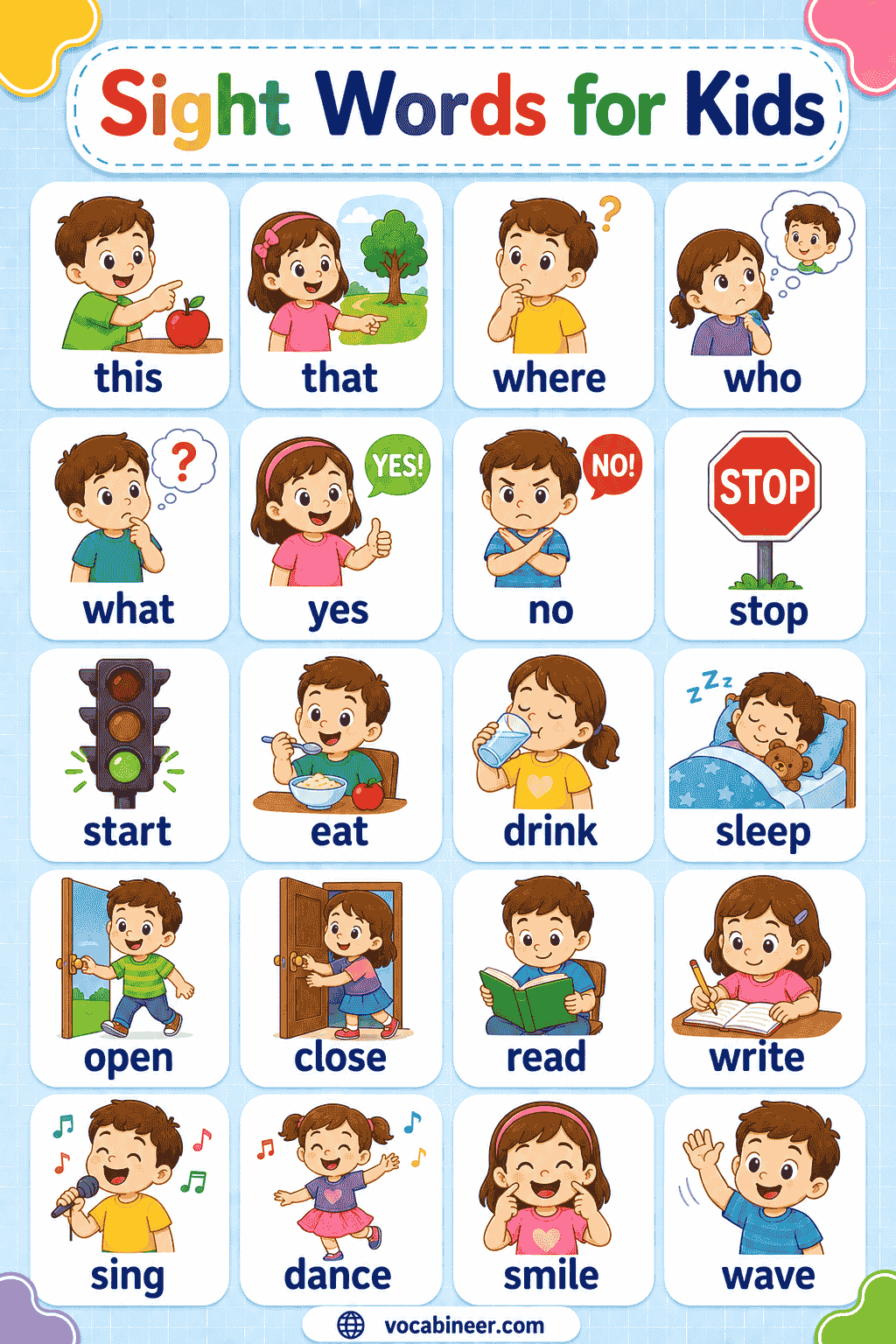
- Question words: what, where, who, why, how
- People words: boy, girl, mom, dad, friend
- Action words: make, run, jump, help, find, went, came, get, give, take
- Place and direction words: down, out, into, over, under, by, from, there, then, this
First Grade Sight Words
First grade sight words include more high-frequency words that help children read longer sentences and early storybooks.
- Common reading words: about, after, again, all, any, ask, back, because, been, before
- Time and order words: day, first, last, next, now, once, soon, today, when, yesterday
- Action and helping words: could, would, should, did, does, done, going, know, let, live
- Describing words: new, old, good, best, many, much, only, other, right, same
- Story words: around, every, funny, just, keep, kind, long, open, thank, very
Second Grade Sight Words
Second grade sight words support longer reading passages, stories, nonfiction texts, and classroom directions.
- Reading and thinking words: always, answer, both, carry, change, different, enough, found, grow, learn
- Place and movement words: above, below, between, inside, outside, near, far, through, toward, across
- Common story words: bring, buy, call, clean, draw, fall, fast, gave, goes, laugh
- Time and sequence words: early, late, never, often, sometimes, together, until, while, year, night
- Useful high-frequency words: another, better, each, own, pretty, read, small, start, their, these
Third Grade Sight Words
Third grade sight words include longer and less picture-friendly words that appear often in chapter books, instructions, and classroom texts.
- Longer common words: almost, also, being, country, example, important, large, sentence, several, usually
- Thinking words: believe, remember, understand, thought, idea, reason, problem, question, answer, study
- Reading words: chapter, story, page, paragraph, title, author, paper, letter, word, meaning
- Describing words: beautiful, careful, certain, difficult, different, enough, favorite, special, strong, young
- School and life words: family, group, morning, number, picture, place, school, teacher, world, write
Easy Sight Words Children Can Sound Out
Not all sight words are irregular or difficult. Many common words are easy to sound out once children know basic letter sounds.
Easy sight words include:
- am
- an
- at
- in
- it
- is
- on
- up
- us
- as
- if
- can
- red
- big
- not
These words are useful because children can practice both phonics and quick recognition at the same time.
Tricky Sight Words That Need Extra Practice
Some sight words have tricky parts. Children may be able to sound out part of the word, but one part may not follow the pattern they expect.
| Tricky Word | Tricky Part |
|---|---|
| said | sounds like “sed” |
| was | the a does not sound like short /a/ |
| one | does not start with the expected /o/ sound |
| two | has a silent w |
| does | vowel sound is unexpected |
| come | final e does not make the vowel long |
| have | final e does not make the vowel long |
| where | spelling is harder for beginners |
| could | ould pattern is tricky |
| would | ould pattern is tricky |
A helpful method is to say the word, stretch the sounds, point out the tricky part, and then read the word in a sentence.
Sight Words with Simple Meanings
Some sight words are hard to explain because they are function words, not picture words. A short meanings section can help children understand how these words work in sentences.
| Sight Word | Simple Meaning |
|---|---|
| the | points to a specific thing |
| and | joins words or ideas |
| to | shows direction or purpose |
| with | together or using something |
| here | in this place |
| there | in that place |
| because | tells why |
| before | earlier than something |
| after | later than something |
| again | one more time |
| could | might be able to |
| would | used to talk about what might happen |
| should | tells what is a good idea |
| same | not different |
| different | not the same |
Sight Words in Short Reading Sentences
Sight words become stronger when children read them in short, meaningful sentences. Keep sentences short at first and repeat familiar patterns.
- I can go.
- I see the cat.
- We like to play.
- The dog is big.
- She has a red bag.
- He went to school.
- Come here, please.
- This is my book.
- Where is the ball?
- They are going home.
- I said thank you.
- We can read together.
- The little boy can jump.
- She went into the room.
- I will try again.
Sentence frames:
- I see ___.
- I can ___.
- This is ___.
- We like ___.
- The ___ is ___.
- Where is ___?
How to Teach Sight Words the Right Way
Sight words should be taught through reading, sound attention, repeated exposure, and sentence use. Avoid teaching children to guess words only by shape or memorize long lists without reading practice.
A better routine is:
- Say the word clearly.
- Read the word in a short sentence.
- Notice the sounds and letters.
- Mark any tricky part.
- Read the word again.
- Use the word in a new sentence.
- Review the word in a real book or short passage.
For example, with said, show that the word is pronounced like /sed/. Then let the child read it in a sentence such as “Mom said yes.”
A Simple Weekly Sight Word Practice Routine
Short daily practice works better than one long session. Use 5 to 8 words per week for beginners.
| Day | Practice |
|---|---|
| Day 1 | Introduce the words and read each one aloud |
| Day 2 | Find the words in simple sentences |
| Day 3 | Build sentences with the words |
| Day 4 | Play a quick sight word game |
| Day 5 | Read a short passage using the words |
Weekly practice can include:
- word cards
- sentence strips
- word hunts
- tracing
- matching
- read-and-cover practice
- short book reading
Sight Word Games That Build Reading Fluency
Games make practice more active and less stressful. Choose games that make children read the words, not only match shapes.
- Word hunt: ask children to find a sight word in a book, chart, or sentence strip.
- Read and cover: show a word, read it, cover it, then ask the child to say it again.
- Sight word match: match two cards with the same word and read the word aloud.
- Sentence builder: give word cards and let children build short sentences.
- Find and read: place cards around the room and have children read each one.
- Word wall pointing: say a word and let the child point to it on the wall.
- Quick read: show 5 known words and let the child read them smoothly.
Sight Word Flashcards, Worksheets, and Word Walls
Flashcards, worksheets, and word walls can be useful when they are used with reading, not as isolated memorization.
Use flashcards for:
- quick daily review
- read-and-cover practice
- matching games
- sentence building
- small-group reading
Use worksheets for:
- tracing a sight word
- circling the word in a sentence
- filling in a missing word
- matching words to sentences
- writing one short sentence
Use word walls for:
- repeated classroom exposure
- daily pointing practice
- sentence writing support
- finding words during reading
- reviewing tricky spellings
Sight Words Children Often Mix Up
Some sight words look similar, sound similar, or appear in similar sentence positions. These pairs need extra practice in real sentences.
| Word Pair | Why Children Mix Them Up |
|---|---|
| was / saw | same letters in a different order |
| on / no | same letters reversed |
| of / for | both are short function words |
| to / too | same sound, different use |
| there / their | similar sound and spelling |
| then / them | only one letter changes |
| were / where | similar spelling |
| he / she | both are people words |
| this / that | both point to things |
| can / came | similar beginning letters |
Practice these words inside sentences so children learn meaning and use, not only spelling.
Words Not to Teach Too Early
Some sight words are useful, but they may be too abstract, too long, or too tricky for the earliest readers. Save these for later practice when children can already read short common words with confidence.
Words to save for later:
- because
- different
- important
- thought
- through
- enough
- beautiful
- favorite
- usually
- example
Better early choices:
- Start with so before because.
- Start with same before different.
- Start with big or needed before important.
- Start with pretty before beautiful.
- Start with best before favorite.
Common Sight Word Teaching Mistakes
Sight word practice should help children read better, not only memorize cards. These mistakes can make practice harder than it needs to be.
| Mistake | Better Choice |
|---|---|
| Teaching too many words at once | Use 5 to 8 words per week |
| Asking children to memorize word shapes only | Connect sounds, letters, and tricky parts |
| Practicing cards without reading | Use words in sentences and books |
| Mixing easy and very hard words too early | Start with short and common words |
| Skipping review | Revisit words throughout the week |
| Using worksheets only | Add games, reading, and sentence practice |
| Ignoring tricky parts | Show the part that does not sound regular |
| Testing more than teaching | Model, practice, read, and review |
FAQs
Sight words are words children learn to recognize quickly while reading. Many are common words, such as the, and, to, you, was, and said.
They are related but not exactly the same. High-frequency words appear often in reading. Sight words are words a child can recognize quickly without stopping to decode each time.
Children should learn sight words gradually. Beginners can start with 5 to 10 words, while early readers may practice larger level-based lists over time.
Children do need quick recognition, but they should not only memorize word shapes. It is better to teach the sounds, letters, tricky parts, and word use in sentences.
Good first sight words include I, a, the, and, to, is, in, it, you, me, my, we, can, see, and go.
Read More
- CVC Rhyming Words for Kids
- Preschool Vocabulary Words
- Short Vowel Words for Kids
- 300+ Kindergarten Words