

A child may know the sounds /c/, /a/, and /t/ but still struggle to read cat. That missing step is called blending. Blending teaches children how to join separate sounds smoothly so they can hear, say, and read a complete word.
This skill is one of the most important parts of early phonics because it connects letter sounds to real reading. Children usually begin with oral blending, then move to simple CVC words like map, sun, and dog. After that, they can practice word families, consonant blends, digraphs, short sentences, and decodable reading passages.
In This Page
What Is Blending in Phonics?
Blending in phonics means joining individual sounds together to read a word.
For example:
- /c/ /a/ /t/ → cat
- /m/ /a/ /p/ → map
- /s/ /u/ /n/ → sun
At first, children may say each sound separately. With practice, they learn to slide the sounds together until the full word becomes clear.
A simple way to explain blending is:
Say the sounds. Stretch the sounds. Read the word.
Examples:
- /p/ /i/ /g/ → pig
- /d/ /o/ /g/ → dog
- /r/ /u/ /g/ → rug
- /h/ /e/ /n/ → hen
Blending is the bridge between knowing letter sounds and reading words.
Blending Words vs Consonant Blends
Many people confuse blending words with consonant blends, but they are not the same thing.
| Term | Meaning | Example |
|---|---|---|
| Blending words | Joining sounds together to read a word | /c/ /a/ /t/ → cat |
| Consonant blends | Two or more consonants where each sound can still be heard | bl, st, fr, tr |
In this article, blending words means words children practice reading by joining sounds together.
Examples:
- cat
- map
- sun
- dog
- pin
Consonant blend words are harder and should come later.
Examples:
- flag
- stop
- frog
- tree
- spin
A beginner should usually learn to blend simple words like cat and sun before reading harder blend words like flag, stop, and frog.
Blending vs Segmenting
Blending and segmenting are opposite phonics skills.
| Blending | Segmenting |
|---|---|
| Joining sounds together | Breaking a word into sounds |
| Helps with reading | Helps with spelling |
| /c/ /a/ /t/ → cat | cat → /c/ /a/ /t/ |
When children blend, they hear separate sounds and say the whole word.
Example:
- /m/ /a/ /t/ → mat
When children segment, they hear a word and break it into sounds.
Example:
- mat → /m/ /a/ /t/
Both skills matter in early literacy. Blending supports reading, while segmenting supports spelling.
Oral Blending Before Reading
Oral blending means children blend sounds they hear, without looking at written letters.
For example, an adult says:
/s/ /u/ /n/
The child says:
sun
This kind of listening practice helps children understand how sounds come together before printed letters become part of the task.
Good oral blending examples include:
- /c/ /a/ /t/ → cat
- /d/ /o/ /g/ → dog
- /m/ /a/ /p/ → map
- /p/ /i/ /g/ → pig
- /b/ /u/ /s/ → bus
- /h/ /a/ /t/ → hat
- /r/ /u/ /g/ → rug
- /f/ /a/ /n/ → fan
Parents and teachers can practice oral blending during daily routines:
- “Touch your /h/ /a/ /t/.”
- “Find the /c/ /u/ /p/.”
- “Point to the /d/ /o/ /g/.”
- “Can you see the /s/ /u/ /n/?”
Easy Sounds and Tricky Sounds to Blend
Some sounds are easier to stretch than others.
| Easier Stretchy Sounds | Tricky Stop Sounds |
|---|---|
| m | b |
| s | d |
| f | g |
| n | p |
| r | t |
| l | k |
Stretchy sounds can be held longer.
Examples:
- mmmm
- ssss
- ffff
- nnnn
Stop sounds end quickly.
Examples:
- /b/
- /d/
- /g/
- /p/
- /t/
That is why some children blend mat more easily than bat. The sound /m/ can be stretched, but /b/ stops quickly.
Good early blending words with stretchy sounds include:
- mat
- sat
- fan
- sun
- run
- ram
- lip
- net
How to Blend Words Step by Step
A clear routine helps children know exactly what to do when they see a new word.
Use this simple method:
- Point to each letter.
- Say each sound.
- Stretch the sounds together.
- Read the whole word.
- Say the word naturally.
Example with mat:
| Step | Action |
|---|---|
| 1 | Point to m-a-t |
| 2 | Say /m/ /a/ /t/ |
| 3 | Stretch mmmm-aaa-t |
| 4 | Blend into mat |
| 5 | Read: mat |
More examples:
- /s/ /a/ /t/ → sat
- /f/ /a/ /n/ → fan
- /p/ /i/ /n/ → pin
- /h/ /o/ /p/ → hop
- /r/ /u/ /g/ → rug
Begin slowly, then make the sounds smoother as the child gains confidence.
Best Words to Blend First
The best first blending words are short, regular, and easy to sound out.
Good beginner words usually have:
- three sounds
- short vowels
- simple consonants
- clear pronunciation
- no tricky spelling
Start with words like:
- sat
- mat
- map
- fan
- pin
- sit
- dog
- hop
- sun
- rug
Avoid words like one, said, come, shoe, and light at the beginning because they do not follow the simplest sound-by-sound pattern.
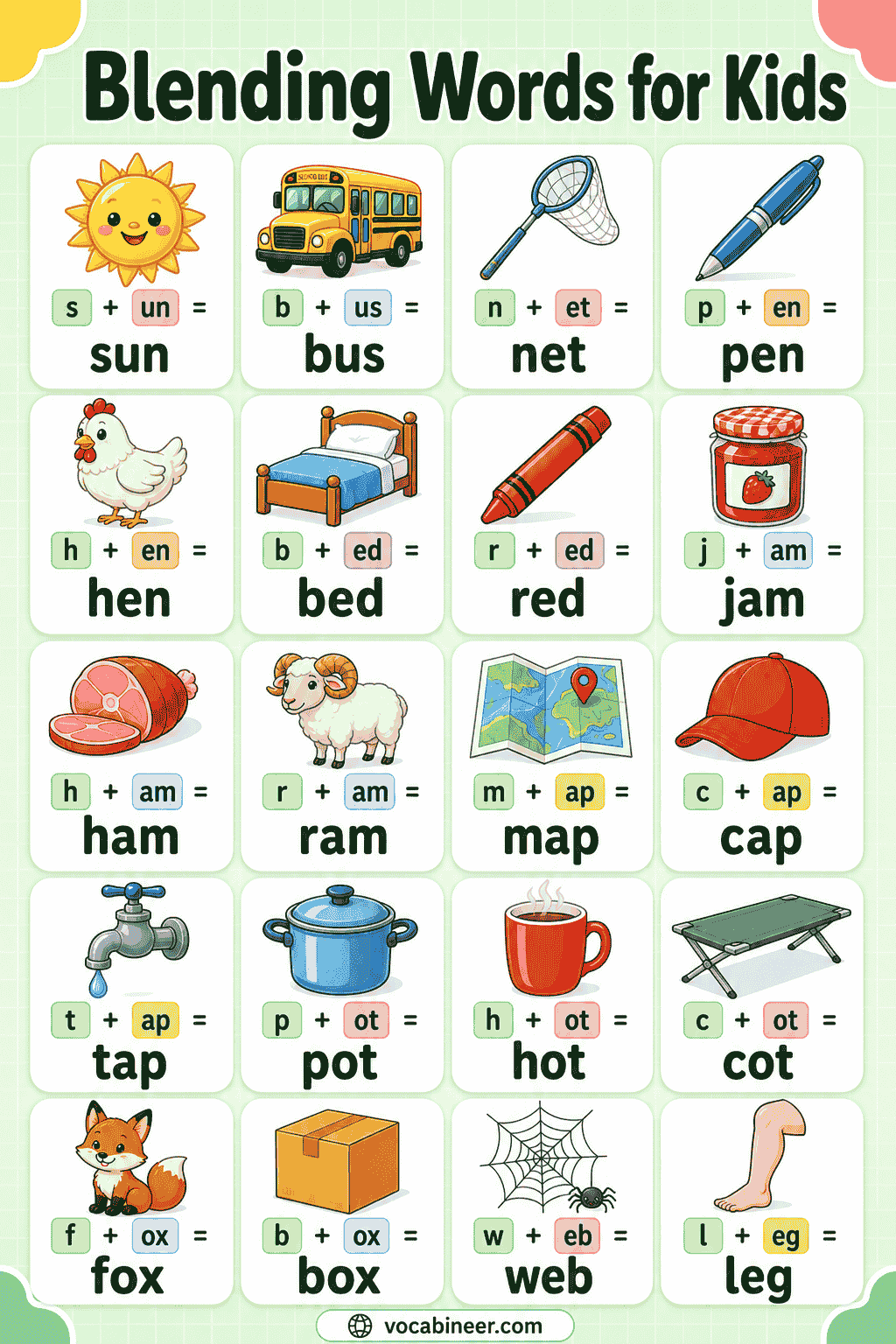
CVC Blending Words
CVC words are consonant-vowel-consonant words. They are often the best words for early blending practice.
Examples:
- cat
- bed
- pig
- dog
- sun
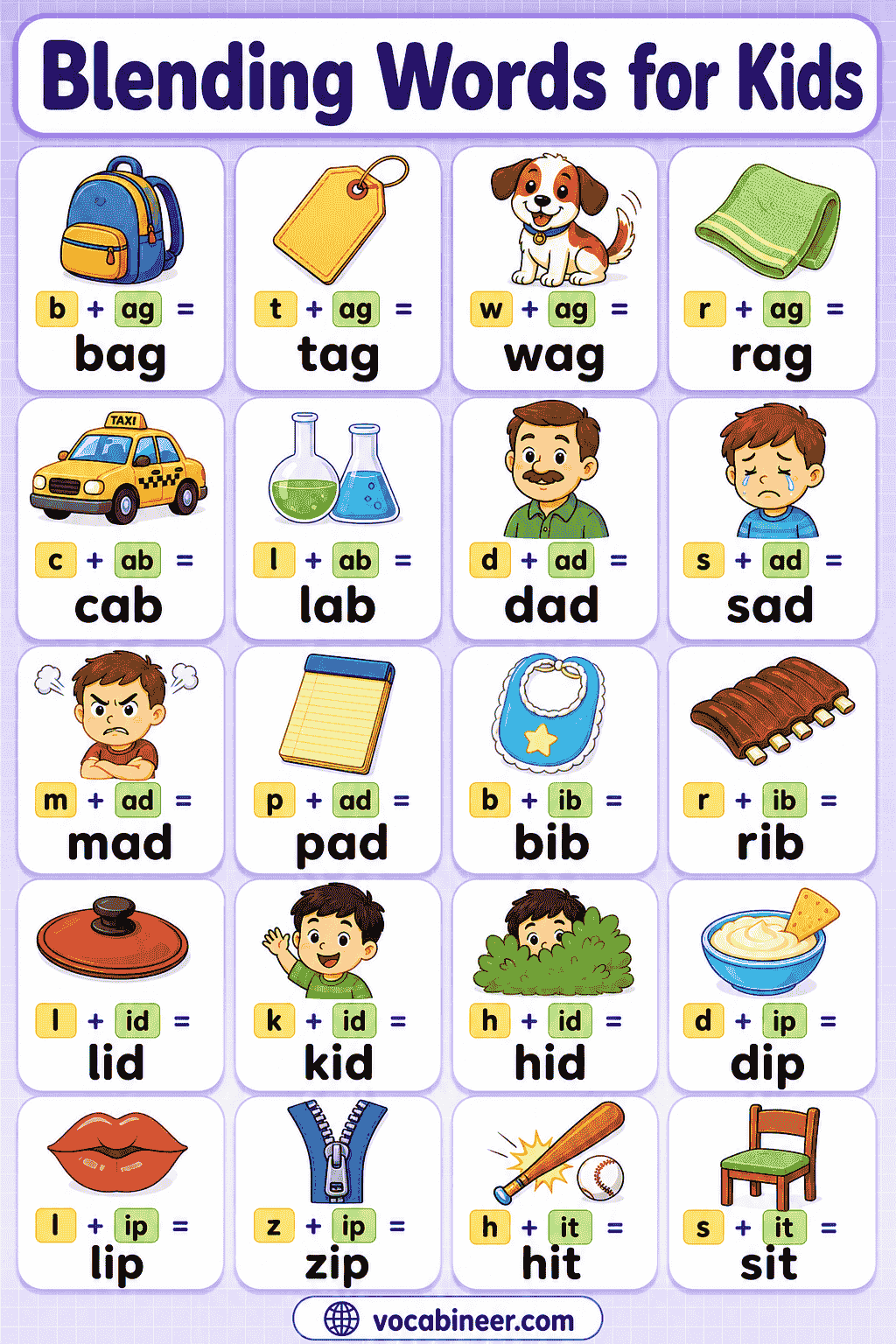
Short A Blending Words
Short A blending words are often a strong starting point because the vowel sound is clear.
- -at words: cat, bat, hat, mat, pat, rat, sat
- -an words: can, fan, man, pan, ran, tan
- -ap words: cap, lap, map, nap, tap
- -am words: ham, jam, ram, Sam
- -ag words: bag, rag, tag, wag
- -ad words: bad, dad, had, mad, sad
Practice:
- /c/ /a/ /t/ → cat
- /m/ /a/ /p/ → map
- /f/ /a/ /n/ → fan
- /s/ /a/ /t/ → sat
Short E Blending Words
Short E words help children listen carefully to the middle vowel sound.
- -et words: bet, get, jet, let, met, net, pet, wet
- -en words: Ben, den, hen, men, pen, ten
- -ed words: bed, fed, led, red
- -eg words: beg, leg, peg
- -ell words: bell, fell, sell, tell, well
Practice:
- /b/ /e/ /d/ → bed
- /h/ /e/ /n/ → hen
- /j/ /e/ /t/ → jet
- /p/ /e/ /n/ → pen
Short I Blending Words
Short I words are useful for quick blending because many are short and decodable.
- -it words: bit, fit, hit, kit, lit, pit, sit
- -ig words: big, dig, fig, pig, wig
- -in words: bin, fin, pin, tin, win
- -ip words: dip, hip, lip, rip, sip, zip
- -id words: bid, did, hid, kid, lid
Practice:
- /p/ /i/ /n/ → pin
- /s/ /i/ /t/ → sit
- /p/ /i/ /g/ → pig
- /l/ /i/ /p/ → lip
Short O Blending Words
Short O words help children practice rounded vowel sounds.
- -og words: dog, fog, hog, log
- -op words: hop, mop, pop, top
- -ot words: cot, dot, hot, lot, pot
- -ob words: cob, job, rob, sob
- -ox words: box, fox, ox
Practice:
- /d/ /o/ /g/ → dog
- /h/ /o/ /p/ → hop
- /p/ /o/ /t/ → pot
- /l/ /o/ /g/ → log
Short U Blending Words
Short U words are helpful for building early reading confidence.
- -un words: bun, fun, run, sun
- -ug words: bug, dug, hug, mug, rug
- -up words: cup, pup, up
- -ut words: but, cut, hut, nut
- -ub words: cub, rub, sub, tub
Practice:
- /s/ /u/ /n/ → sun
- /b/ /u/ /g/ → bug
- /c/ /u/ /p/ → cup
- /r/ /u/ /n/ → run
Smooth Sound Blending
Smooth sound blending helps children avoid choppy sound reading.
Instead of saying:
/m/ /a/ /t/
Children stretch the sounds:
mmmm-aaaa-t → mat
This works well with words that begin with stretchy sounds.
Good smooth blending words include:
- mat
- sat
- sun
- fan
- fin
- run
- rug
- lip
- lot
- net
Try this practice:
- mmmm-aaa-t → mat
- ssss-uuu-n → sun
- ffff-aaa-n → fan
- rrrr-uuu-g → rug
Smooth blending is especially helpful for children who can say the sounds but cannot hear the whole word.
Blending One Sound at a Time
Some children forget the first sound before they finish the word. For them, blending one sound at a time can help.
Example with sat:
- /s/ + /a/ = sa
- sa + /t/ = sat
More examples:
- /m/ + /a/ = ma
- ma + /t/ = mat
- /p/ + /i/ = pi
- pi + /g/ = pig
- /r/ + /u/ = ru
- ru + /g/ = rug
This method is useful for struggling readers because they do not have to hold three separate sounds in memory at once.
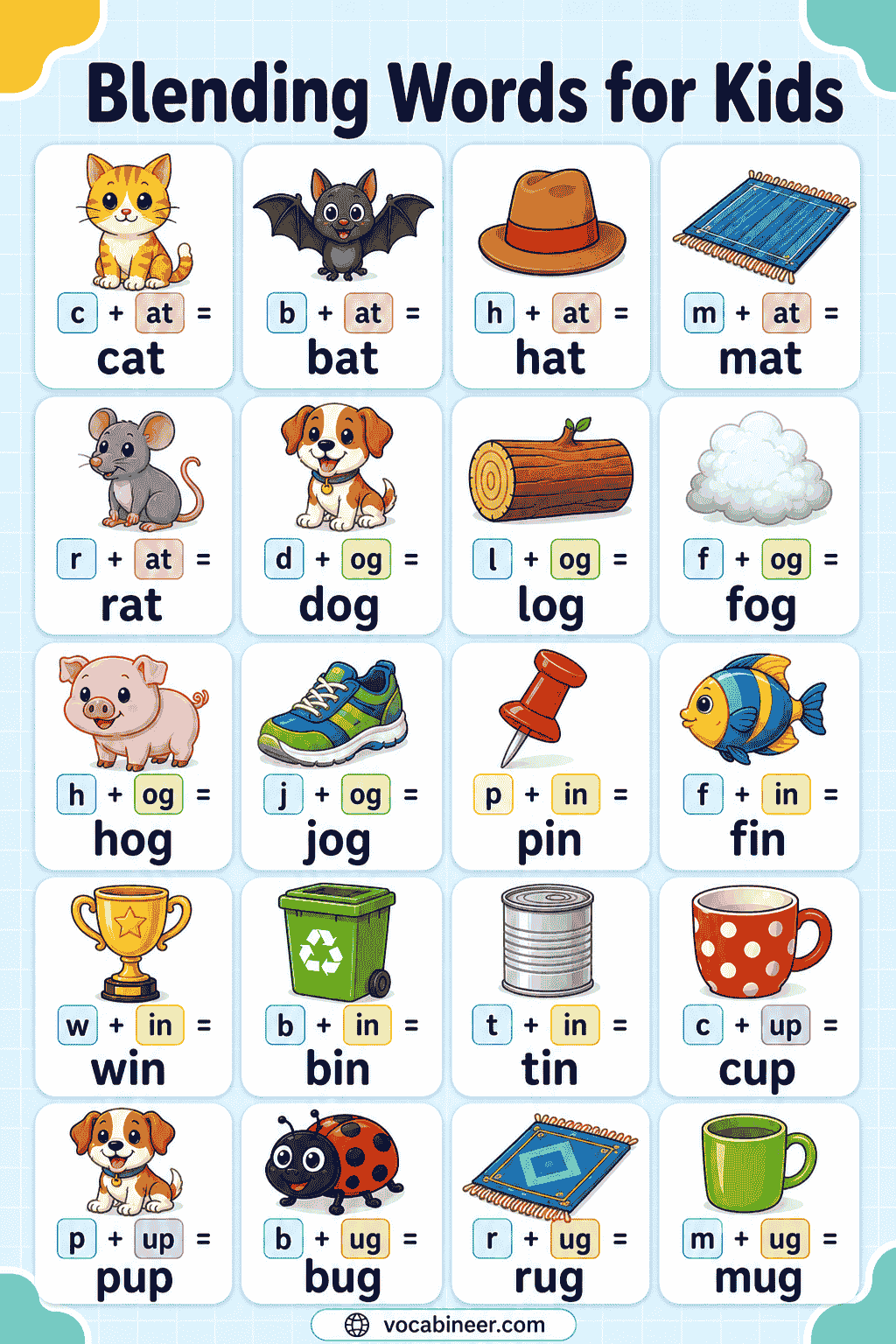
Word Family Blending
Word families make blending easier because the ending pattern stays the same.
Example:
- c + at = cat
- b + at = bat
- h + at = hat
- m + at = mat
- s + at = sat
Once children know -at, they can blend many words by changing the first sound.
More word-family blending examples:
- -an: can, fan, man, pan, ran
- -ap: cap, lap, map, nap, tap
- -ig: big, dig, pig, wig
- -op: hop, mop, pop, top
- -ug: bug, hug, mug, rug
Word-family blending connects reading, spelling, and phonics patterns in a simple way.
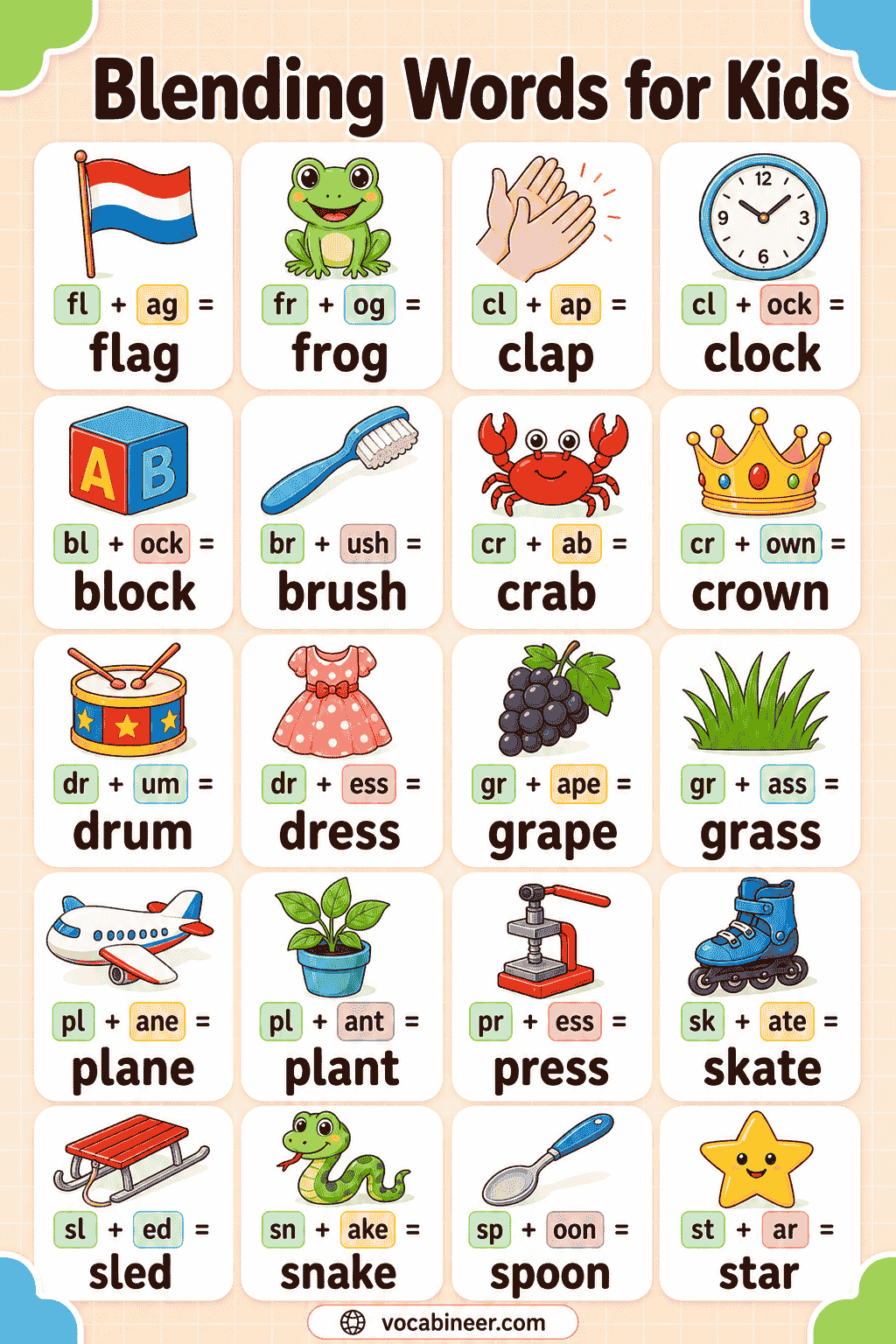
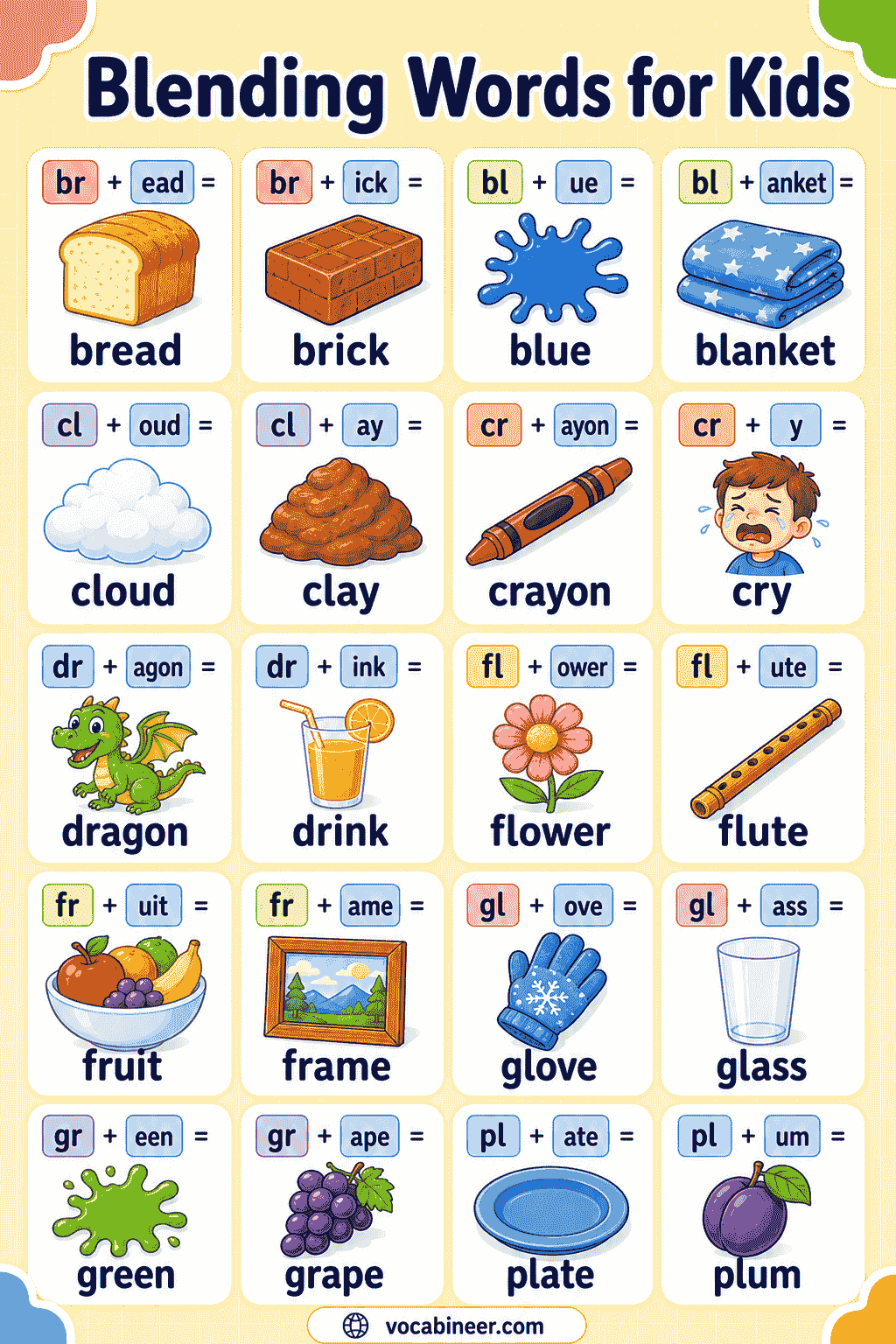
Consonant Blend Words
Move to consonant blends after children can blend simple CVC words like cat, sun, dog, pin, and rug without heavy support. If a child still struggles to join three sounds, continue with CVC blending before adding words like flag, stop, and frog.
Consonant blend words have two or more consonants together, and each consonant sound can still be heard.
Examples:
- bl in black
- st in stop
- fr in frog
- tr in tree
Beginning Blend Words
Beginning blends appear at the start of words.
- bl words: black, blink, block, blend
- cl words: clap, clip, clock, club
- fl words: flag, flat, flip, flop
- gl words: glad, glass, glow, glue
- pl words: plan, plug, plum, plus
- sl words: sled, slip, slow, slug
- br words: brag, brick, brush, brim
- cr words: crab, crib, crop, crack
- dr words: drip, drop, drum, dress
- fr words: frog, fresh, frost, frill
- gr words: grab, grin, grass, grow
- tr words: trap, trip, tree, truck
- st words: step, stop, stem, stick
- sp words: spin, spot, spell, spoon
- sk words: skip, skin, skid, skate
Ending Blend Words
Ending blends appear at the end of words.
- -nt words: ant, tent, plant
- -mp words: camp, jump, lamp
- -st words: best, fast, nest
- -nd words: hand, sand, pond
- -ft words: gift, lift, soft
- -lk words: milk, silk
Ending blends can be harder because children may skip the final sound. Ask them to tap each sound slowly before reading the word.
Three-Letter Blend Words
Three-letter blends are more advanced and should come after two-letter blends.
- str words: strap, strip, string
- spr words: spray, spring, sprint
- spl words: splash, split, splat
- scr words: scrub, scrap, scram
These words are better for first grade or later readers who already blend CVC words confidently.
Blends vs Digraphs
Blends and digraphs are different.
| Blends | Digraphs |
|---|---|
| Each sound can still be heard | Two letters make one sound |
| bl, st, fr, tr | sh, ch, th, wh |
| flag, stop, frog | ship, chip, thin |
In flag, the f and l sounds can both be heard.
In ship, the letters sh work together to make one sound.
This difference matters because children should not try to split a digraph into two separate sounds.
Digraph Words for Blending Practice
Digraph words are useful after children understand simple blending and know common digraph sounds.
- sh words: ship, shop, shell, shut, fish
- ch words: chip, chop, chat, chin, much
- th words: thin, bath, path, moth
- wh words: when, whip, whiz
Practice:
- /sh/ /o/ /p/ → shop
- /ch/ /i/ /p/ → chip
- /th/ /i/ /n/ → thin
- /f/ /i/ /sh/ → fish
Treat sh, ch, th, and wh as single sound units during blending.
Blending Words by Reading Level
Blending practice should match the child’s reading stage. A preschool child, a kindergarten reader, and a first-grade student do not need the same word list.
Preschool Sound Blending
Preschool blending should be mostly oral. Children can listen to sounds and say the full word.
Good preschool practice:
- /c/ /a/ /t/ → cat
- /d/ /o/ /g/ → dog
- /s/ /u/ /n/ → sun
- /h/ /a/ /t/ → hat
- /m/ /a/ /p/ → map
Helpful activities include picture matching, rhyming games, clapping sounds, and “guess the word” games.
Kindergarten Blending Words
Kindergarten children can begin blending printed CVC words.
Good kindergarten blending words:
- Short A: cat, map, fan, sat, bag
- Short E: bed, hen, jet, pen, red
- Short I: pin, sit, pig, lip, win
- Short O: dog, hop, pot, log, fox
- Short U: sun, bug, cup, run, rug
Practice should stay simple, visual, and consistent.
First Grade Blending Words
First-grade readers can practice longer words, blends, digraphs, and decodable sentences.
Good first-grade blending words:
- Blend words: flag, stop, frog, tree, spin
- Digraph words: ship, chip, thin, shop
- Ending blend words: hand, jump, tent, best
- Longer words: picnic, rabbit, sunset, magnet
At this stage, children should blend words in sentences, not only from word lists.
Blending Words in Simple Sentences
Short sentences help children use blending words in real reading.
Examples:
- Sam sat.
- The cat ran.
- I see a red hat.
- The dog can hop.
- The bug is in the cup.
- The pig is in the pen.
- The fox ran to the box.
- A frog can jump.
- The ship is big.
- The crab is on the sand.
Keep sentences decodable when possible. If a sentence has too many hard words, the child may guess instead of blending.
Short Decodable Reading Practice
Decodable practice gives children repeated chances to blend familiar words.
Practice 1
Sam sat.
Sam had a hat.
The cat ran.
Sam ran to the cat.
Practice 2
A bug is in the cup.
The bug can run.
The pup can jump.
The bug ran to the rug.
Practice 3
The dog is on the log.
The fox is in the box.
The frog can hop.
The dog can not hop.
Practice 4
The ship is red.
The crab is on the sand.
The fish can swim.
The shell is in the shop.
How to Teach Blending
Teach blending with a short, repeatable routine.
A simple lesson can follow this order:
- Say the sounds.
- Stretch the sounds.
- Blend the sounds.
- Read the word.
- Use the word in a sentence.
Example:
- Show m-a-t
- Say /m/ /a/ /t/
- Stretch mmmm-aaa-t
- Read mat
- Use it: The mat is red.
For children who struggle, use fewer words in each lesson. Three to five words are enough for focused practice.
Blending Activities That Build Reading
Good blending activities should connect sounds, letters, and reading.
- Sound stretch: Stretch sounds smoothly to read the word.
- Tap and blend: Tap one time for each sound, then say the word.
- Slide the sounds: Move a finger under the letters while blending.
- Build a word: Use letter cards to build and read simple words.
- Picture match: Blend the word and match it to the correct picture.
- Sound boxes: Place one sound in each box, then read the word.
- Word ladders: Change one sound to make a new word, such as cat → mat → map.
- Roll and read: Roll a dice and read a word from that row.
- Sentence strips: Read simple sentences with blending words.
- Reading goal check: Use each activity for one clear goal, such as hearing sounds, blending sounds, reading the word, or using the word in a sentence.
Blending Worksheets and Flashcards
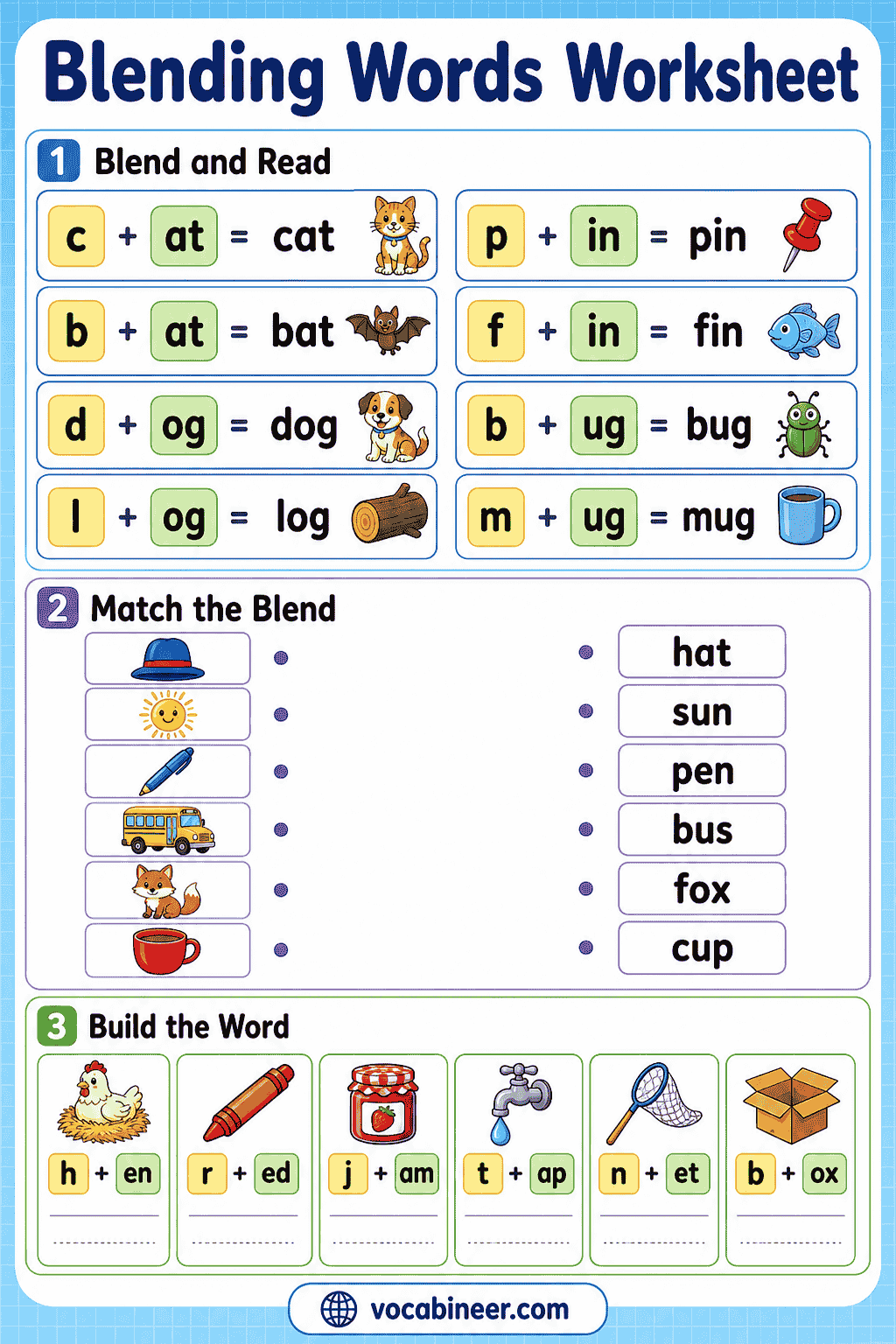
Worksheets and flashcards are useful when they give children focused reading practice.
Good blending worksheet ideas include:
- match sounds to words
- fill in the missing sound
- blend and circle the word
- read and draw
- sort short vowel words
- build CVC words
- match words to pictures
- read decodable sentences
Useful flashcard sets include:
- CVC blending cards
- short vowel word cards
- word-family cards
- beginning blend cards
- ending blend cards
- digraph word cards
- simple sentence cards
- small review decks with only one or two patterns at a time
Common Blending Problems and Fixes
Some children know letter sounds but still struggle to blend. The problem is usually not laziness; they may need a clearer strategy.
| Problem | What It Looks Like | Helpful Fix |
|---|---|---|
| Child says sounds but not the word | /c/ /a/ /t/ but cannot say cat | Use smooth blending |
| Child forgets the first sound | Says only the last part | Try one-sound-at-a-time blending |
| Child guesses from first letter | Says “car” for cat | Point to every sound |
| Child says letter names | “see-ay-tee” | Practice letter sounds, not names |
| Child adds extra vowel sounds | /buh/ /a/ /tuh/ | Keep consonant sounds short |
| Child blends too slowly | Sounds are too far apart | Slide the sounds faster |
| Child skips final sounds | Says “ca” for cat | Tap each sound |
| Child confuses blends and digraphs | Splits sh into /s/ /h/ | Teach digraphs as one sound |
| Practice words are too hard | Child gets frustrated quickly | Return to simple CVC words |
| Lessons are too long | Child loses focus | Use short daily practice |
FAQs
Blending words are words children read by joining sounds together. For example, /c/ /a/ /t/ blends into cat.
Children should usually start with simple CVC words such as cat, map, sun, dog, pin, and rug.
Blending means joining sounds to read a word. Segmenting means breaking a word into sounds. Blending helps with reading, while segmenting helps with spelling.
No. Blending is the reading skill of joining sounds. Consonant blends are letter patterns like bl, st, fr, and tr, where each consonant sound can still be heard.
Start with oral blending, use stretchy sounds, model smooth blending, and practice a few simple CVC words each day. If the child forgets the first sound, try blending one sound at a time.
Read More
- CVC Rhyming Words for Kids
- Preschool Vocabulary Words
- Short Vowel Words for Kids
- Long Vowel Words for Kids
- 300+ Kindergarten Words
- Sight Words for Kids