A child who can read cat can often learn bat, hat, mat, rat, and sat much faster because the ending pattern stays the same. This simple sound-and-spelling pattern is the heart of word-family learning.
Word families help children connect phonics, blending, spelling, rhyming, and early reading fluency. Instead of treating every new word as completely different, children begin to notice patterns they can reuse. That makes word families especially useful for preschool sound play, kindergarten phonics, first-grade reading, homeschool practice, and classroom word work.
In This Page
What Are Word Families in Phonics?
Word families are groups of words that share the same ending sound and spelling pattern.
For example:
- cat
- bat
- hat
- mat
- rat
- sat
These words belong to the -at word family because they all end with -at. The first sound changes, but the ending pattern stays the same.
In phonics, this matters because children start reading word chunks instead of sounding out every single letter from the beginning each time. After a child learns cat, the same pattern can help them read bat, hat, mat, and sat.
How Word Family Patterns Work
A word-family pattern usually has two parts: a changing beginning sound and a fixed ending chunk.
| Beginning Sound | Word Family Chunk | Word |
|---|---|---|
| c | -at | cat |
| b | -at | bat |
| h | -at | hat |
| m | -at | mat |
| s | -at | sat |
The ending -at stays the same. Only the first sound changes.
This pattern makes reading less overwhelming. Children can focus on one change at a time:
- c + at = cat
- b + at = bat
- h + at = hat
- m + at = mat
Once the pattern feels familiar, children can read more words with less guessing.
Onset and Rime Made Simple
In phonics, many word-family words can be split into onset and rime.
| Part | Meaning | Example in “cat” |
|---|---|---|
| Onset | The beginning sound before the vowel | c |
| Rime | The vowel and the letters after it | at |
In cat, the onset is c, and the rime is at.
In bat, the onset changes to b, but the rime stays at.
Children do not need to memorize these terms before practicing word families. However, parents and teachers can use the idea to show that the first sound changes while the ending chunk stays the same.
Why Word Families Help Reading
Word families help children read because they make patterns easy to see, hear, and spell.
Instead of learning these as separate words:
- cat
- bat
- hat
- mat
- rat
- sat
Children notice one repeated chunk:
- -at
That repeated chunk supports:
- Decoding: reading unfamiliar words
- Blending: joining sounds together
- Spelling: remembering common letter patterns
- Fluency: reading familiar patterns faster
- Confidence: feeling successful with new words
A child who knows pan can often use the same pattern to read fan, man, ran, tan, and van. Because of this, word families give early readers a practical way to read more words without starting from zero each time.
Word Families vs Rhyming Words
Word families and rhyming words are connected, but they are not always the same.
| Word Families | Rhyming Words |
|---|---|
| Share the same ending spelling pattern | Share the same ending sound |
| Help with phonics and spelling | Help with sound awareness |
| Example: cat, bat, hat | Example: blue, shoe, too |
The words cat, bat, and hat rhyme and belong to the same word family because they share the spelling pattern -at.
However, blue, shoe, and too rhyme, but they do not belong to one simple word family because their ending spellings are different. This is an important difference for children who are learning to read and spell.
Word Families vs CVC Words
A CVC word has a consonant-vowel-consonant pattern. Examples include cat, dog, pin, sun, and bed.
A word family is a group of words with the same ending pattern.
| Term | Meaning | Example |
|---|---|---|
| CVC word | A three-letter word with a consonant-vowel-consonant pattern | cat |
| Word family | A group of words with the same ending sound and spelling | cat, bat, hat |
Many beginner word-family words are also CVC words.
For example:
- cat
- bat
- hat
- mat
These are all CVC words, and they all belong to the -at word family.
Best Word Families to Teach First
Start with short, clear word families that children can hear, blend, and read easily.
Good first word families include:
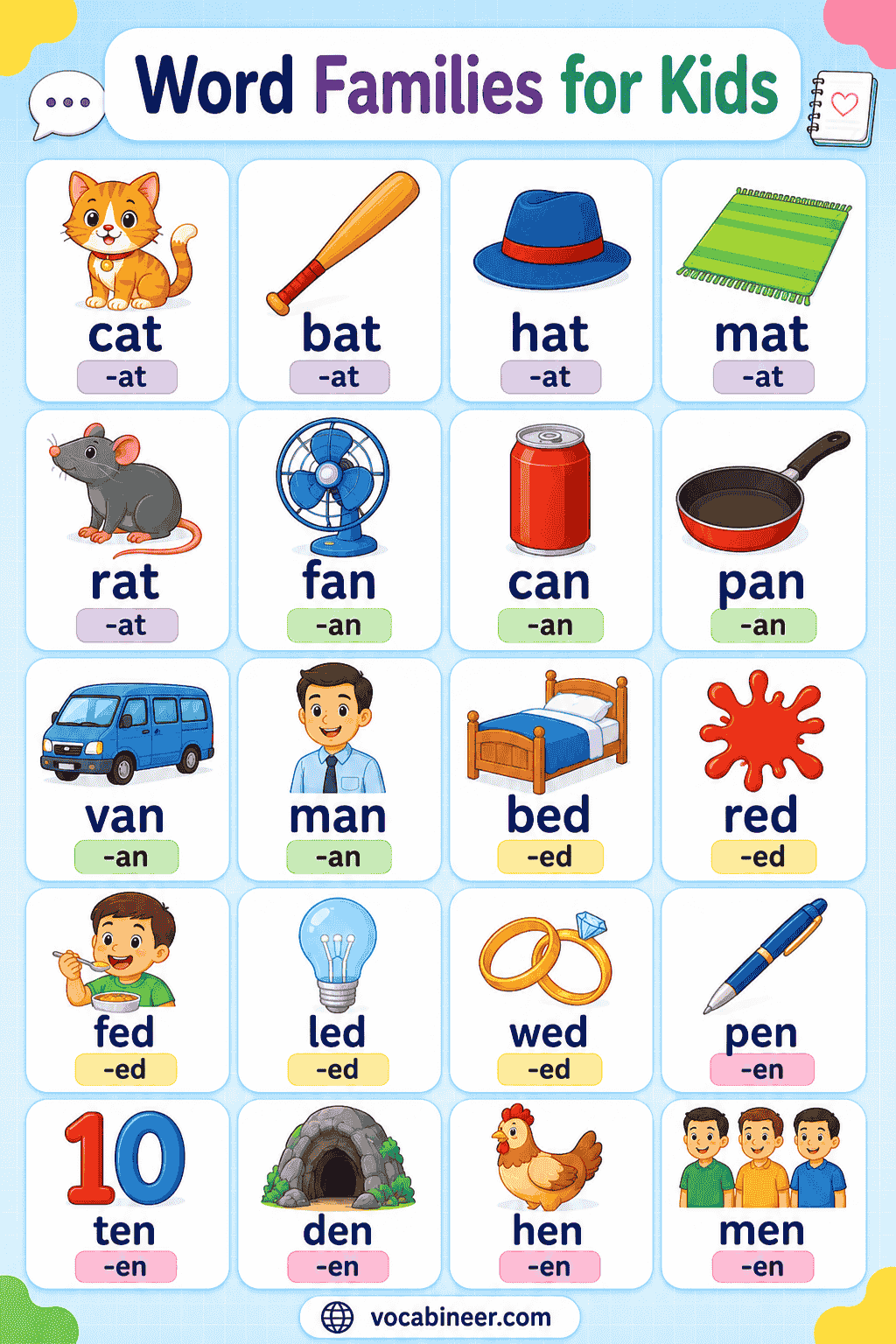
- -at: cat, bat, hat, mat, sat
- -an: can, fan, man, pan, ran
- -ap: cap, map, nap, tap
- -am: ham, jam, ram, Sam
- -it: bit, fit, hit, sit
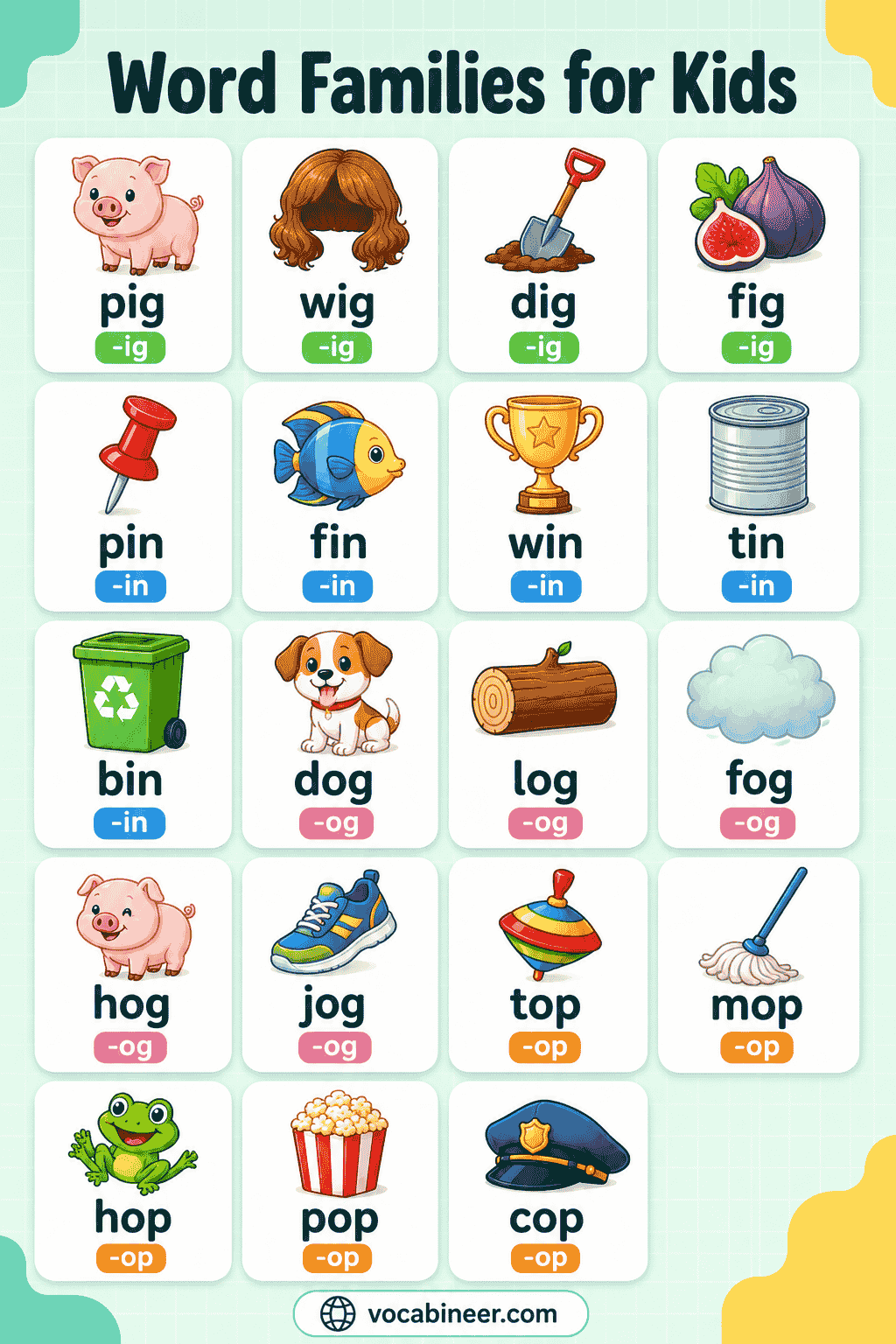
- -ig: big, dig, pig, wig
- -op: hop, mop, pop, top
- -ug: bug, hug, mug, rug
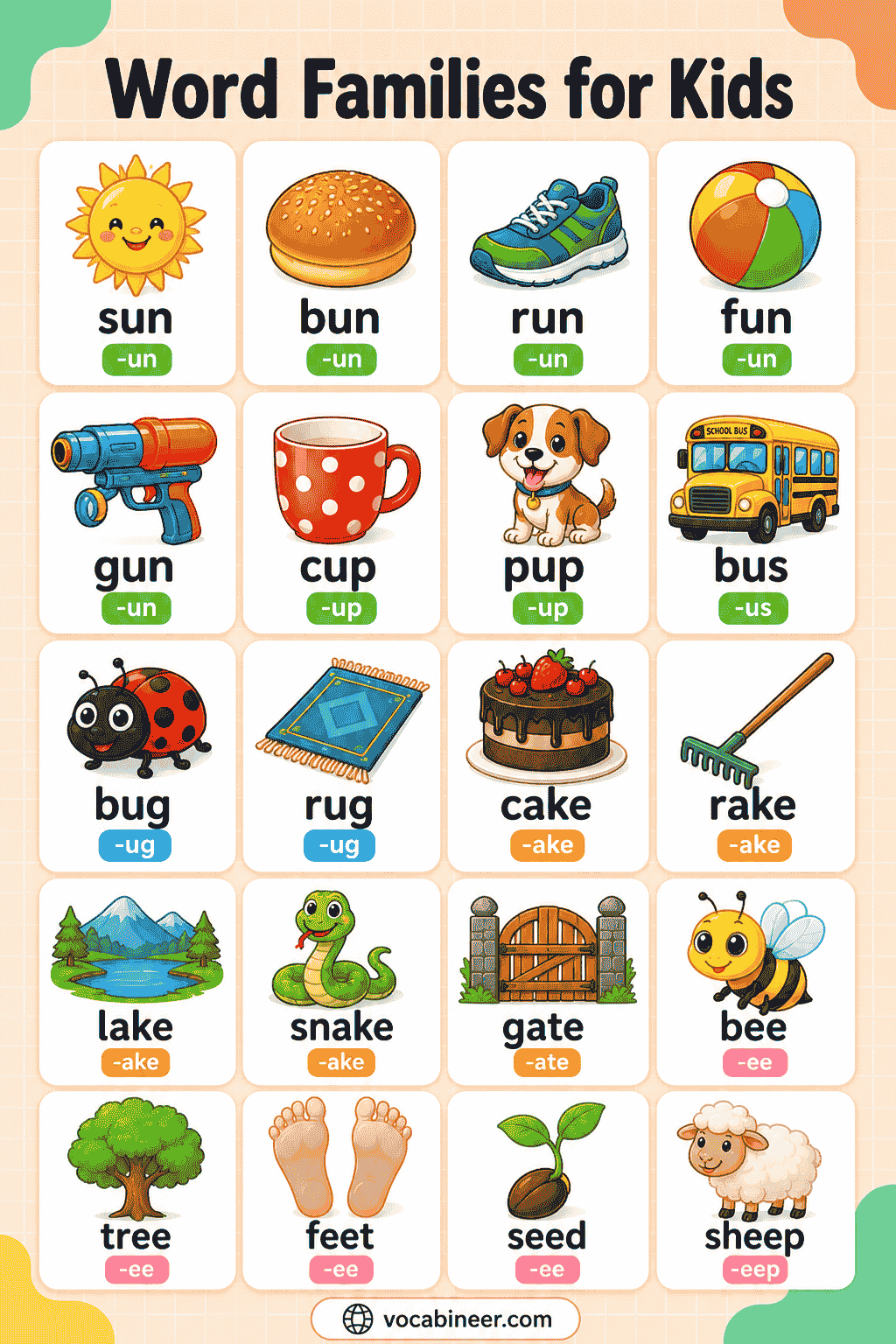
- -un: bun, fun, run, sun
Short A families like -at, -an, -ap, and -am are often a strong starting point because the vowel sound is clear and many words can be shown with pictures.
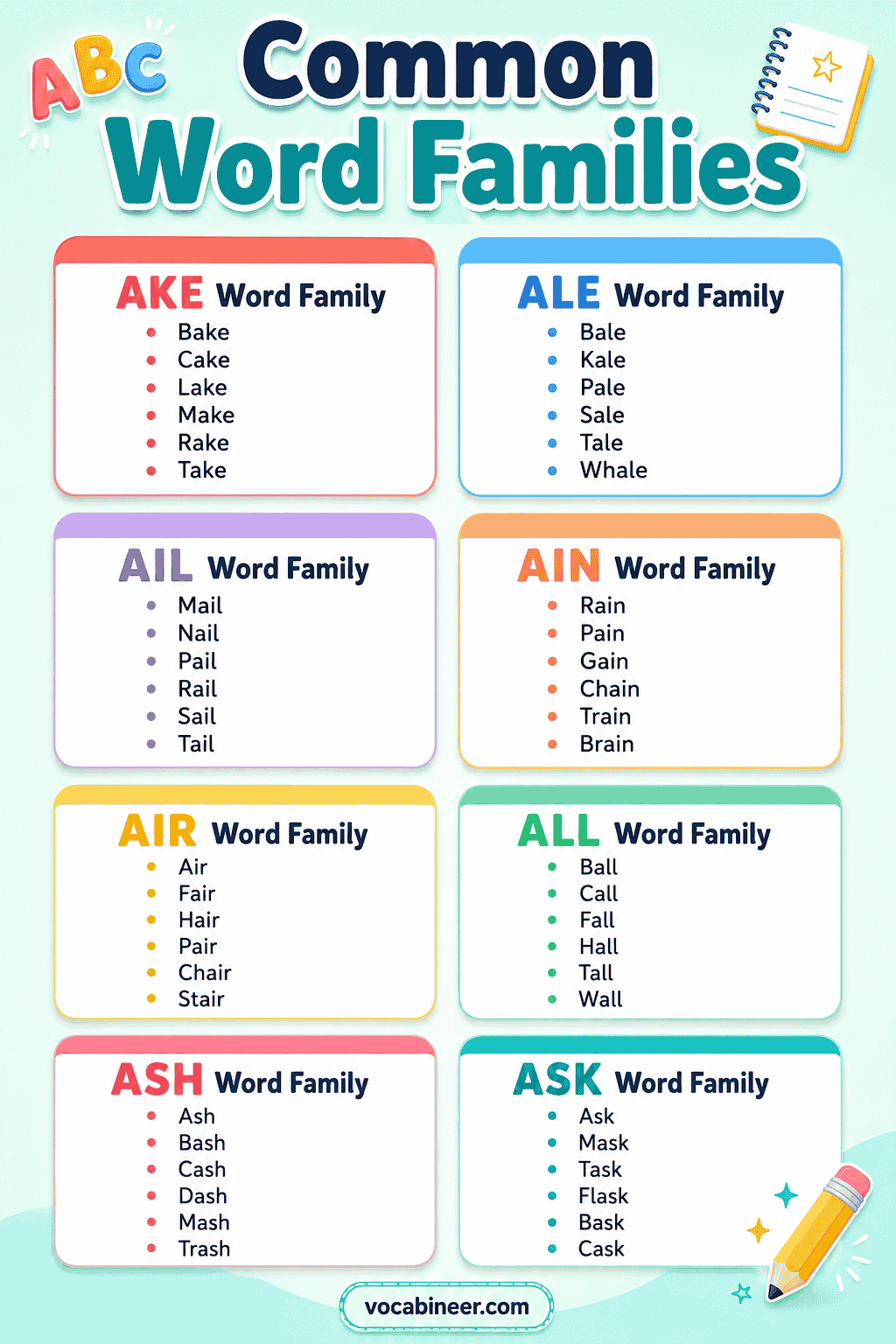
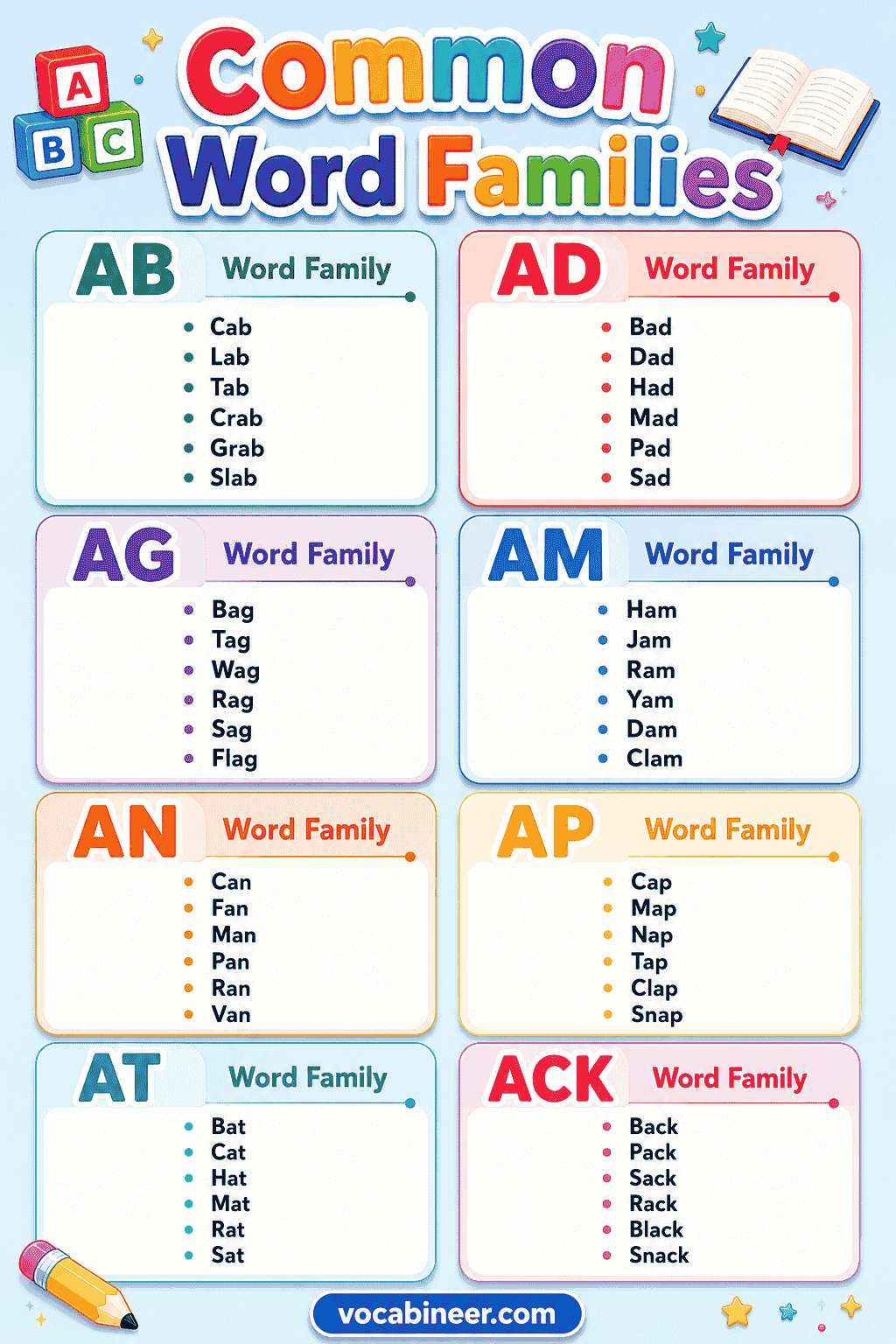
Complete Word Family Directory
Use this directory as a quick guide to common word-family patterns. Begin with short vowel families, then move to longer patterns when children are ready.
| Word Family Group | Common Patterns |
|---|---|
| Short A Families | -at, -an, -ap, -am, -ad, -ag, -ack, -all, -ash, -ank |
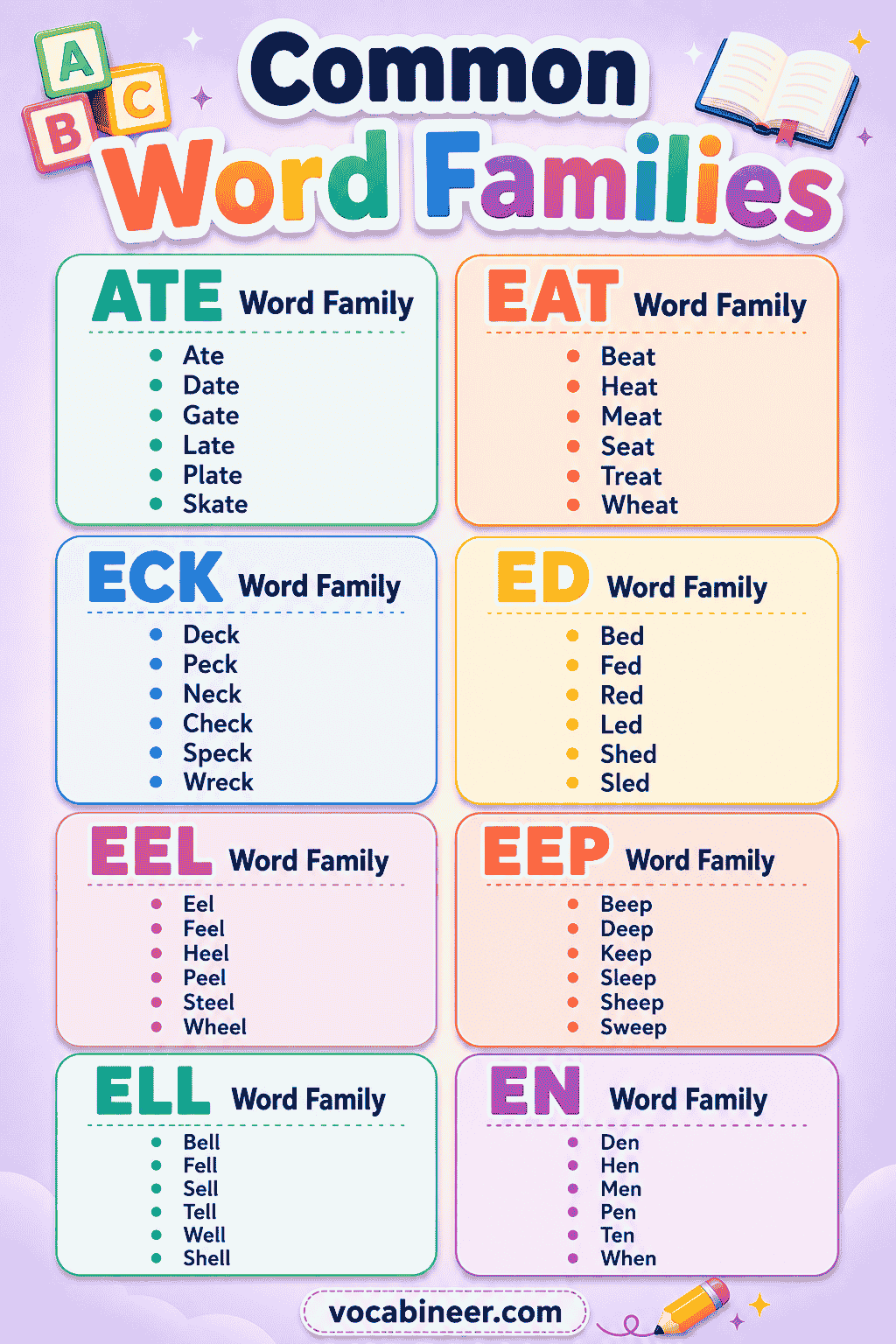
| Short E Families | -et, -en, -ed, -eg, -ell, -est, -end, -ess |
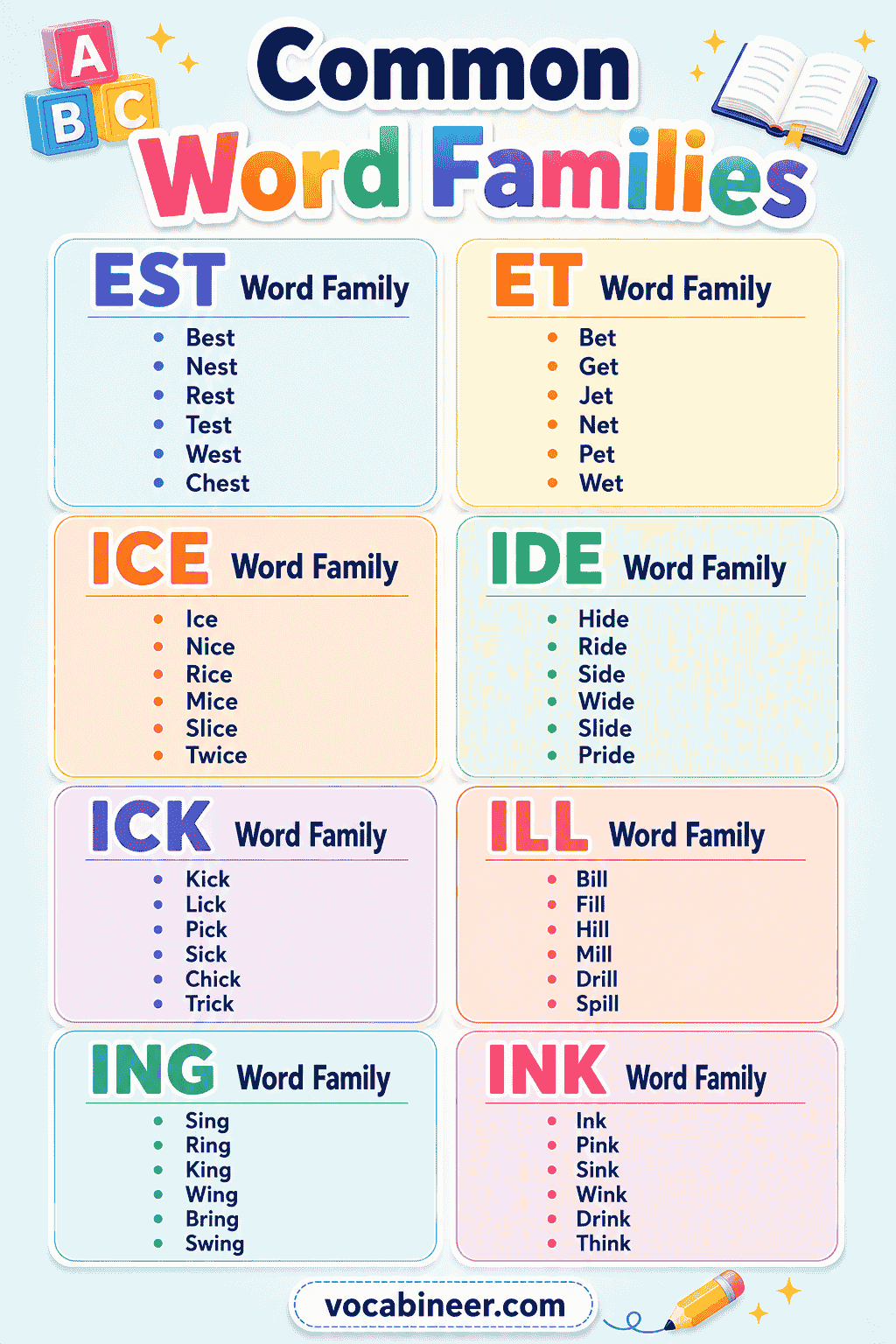
| Short I Families | -it, -ig, -in, -ip, -id, -ick, -ill, -ing, -ink |
| Short O Families | -op, -ot, -og, -ob, -od, -ock, -ox |
| Short U Families | -ug, -un, -ut, -ub, -up, -uck, -ump, -ush |
| Long Vowel Families | -ake, -ame, -ain, -ay, -ee, -eat, -ine, -ight, -oke, -ube |
| R-Controlled Families | -ar, -art, -ark, -ir, -or, -ore, -urn |
| Blend and Digraph Families | -ack, -ash, -ick, -ock, -uck, -ang, -ing, -ong, -ank, -ink |
Short Vowel Word Families
Short vowel word families are the most useful starting point for early readers. These patterns include many simple, decodable words that children can read, sort, spell, and use in short sentences.
Short A Families
Short A word families are often taught first because many examples are simple and easy to picture.
- -at family: cat, bat, fat, hat, mat, pat, rat, sat
- -an family: can, fan, man, pan, ran, tan, van
- -ap family: cap, gap, lap, map, nap, tap
- -am family: ham, jam, ram, Sam, yam
- -ad family: bad, dad, had, mad, pad, sad
- -ag family: bag, flag, rag, tag, wag
- -ack family: back, pack, rack, sack, tack
- -all family: ball, call, fall, hall, tall, wall
- -ash family: cash, dash, rash
- -ank family: bank, tank, sank
Simple practice sentence: The cat sat on the mat.
Short E Families
Short E families help children hear the /e/ sound clearly in the middle of words.
- -et family: bet, get, jet, let, met, net, pet, wet
- -en family: Ben, den, hen, men, pen, ten
- -ed family: bed, fed, led, red
- -eg family: beg, leg, peg
- -ell family: bell, fell, sell, tell, well
- -est family: best, nest, rest, test, west
- -end family: bend, end, lend, send
- -ess family: less, mess, press
Simple practice sentence: The hen is in the pen.
Short I Families
Short I families give children many small words for blending practice.
- -it family: bit, fit, hit, kit, lit, pit, sit
- -ig family: big, dig, fig, pig, wig
- -in family: bin, fin, pin, tin, win
- -ip family: dip, hip, lip, rip, sip, zip
- -id family: bid, did, hid, kid, lid
- -ick family: kick, lick, pick, sick
- -ill family: bill, fill, hill, mill, pill, will
- -ing family: king, ring, sing, wing
- -ink family: ink, pink, sink, wink
Simple practice sentence: The pig has a wig.
Short O Families
Short O families are helpful for reading simple nouns and action words.
- -op family: cop, hop, mop, pop, top
- -ot family: cot, dot, hot, lot, not, pot
- -og family: dog, fog, hog, log
- -ob family: Bob, cob, job, rob, sob
- -od family: cod, nod, pod, rod
- -ock family: dock, lock, rock, sock
- -ox family: box, fox, ox
Simple practice sentence: The dog sat on the log.
Short U Families
Short U families help children practice the /ŭ/ sound in words they can read and spell.
- -ug family: bug, dug, hug, jug, mug, rug
- -un family: bun, fun, run, sun
- -ut family: but, cut, hut, nut
- -ub family: cub, rub, sub, tub
- -up family: cup, pup, up
- -uck family: buck, duck, luck
- -ump family: bump, jump, lump, pump
- -ush family: brush, hush, rush
Simple practice sentence: The bug is on the rug.
Word Families for Later Practice
Some word families are better after children understand short vowel patterns. These later patterns often include silent e, vowel teams, r-controlled vowels, blends, or digraphs.
Long Vowel Families
Long vowel families help children move beyond short vowel CVC words.
- Long A: cake, make, lake, rain, train, day, play
- Long E: bee, see, tree, eat, seat, heat
- Long I: bike, like, fine, line, light, night
- Long O: boat, coat, home, rope, snow, grow
- Long U: cube, tube, blue, clue
Teach these after children can already read simple short vowel families like -at, -an, -ig, -op, and -ug.
R-Controlled Families
R-controlled families are more advanced because the vowel sound changes when followed by r.
- -ar family: car, far, jar, star
- -art family: cart, dart, part
- -ark family: bark, dark, park
- -ir family: bird, dirt, shirt
- -or family: corn, horn, born
- -ore family: core, more, store
- -urn family: burn, turn, churn
These patterns work well for growing readers who already understand short vowels and basic blends.
Blend and Digraph Families
Blend and digraph families include more complex beginning or ending sounds.
- -ack family: back, pack, sack, black
- -ash family: cash, dash, rash
- -ick family: kick, lick, pick, sick
- -ock family: lock, rock, sock
- -uck family: duck, luck, buck
- -ang family: bang, hang, rang, sang
- -ing family: king, ring, sing, wing
- -ong family: long, song
- -ank family: bank, tank, thank
- -ink family: ink, pink, sink, wink
Use these patterns after children can blend simple short vowel words confidently.
Word Families by Grade Level
Children can practice word families at different levels, but the difficulty should match their reading stage.
Preschool Sound Play
Preschool children are usually not ready for long written word-family lists. Instead, they benefit from listening, rhyming, picture matching, and oral sound play.
Good preschool practice includes:
- hearing rhymes like cat, hat, bat
- matching pictures that sound alike
- clapping word parts
- saying simple rhyming pairs
- pointing to pictures such as cat, cap, or dog
A few easy families can be introduced through pictures:
- -at: cat, bat, hat
- -an: can, fan, man
- -op: hop, pop, top
- -ug: bug, mug, rug
Kindergarten Word Families
Kindergarten children can begin reading and building short word-family words.
Good kindergarten families include:
- Short A: -at, -an, -ap, -am
- Short I: -it, -ig, -in, -ip
- Short O: -op, -ot, -og
- Short U: -ug, -un, -ut
Practice should include building words, reading word cards, matching pictures, and reading short sentences.
First Grade Word Families
First-grade readers can handle more patterns, longer words, blends, digraphs, and simple long vowel families.
Useful first-grade patterns include:
- Short vowel review: -ack, -ill, -ock, -uck
- Long vowel families: -ake, -ame, -ight, -ine
- R-controlled families: -ar, -or, -ore
- Blend families: -ank, -ink, -ump
At this stage, children should also read word-family words in sentences and short decodable stories.
Reading New Words with Word Families
Word families help children read new words by keeping one part familiar.
Look at this pattern:
- cat
- bat
- hat
- mat
- rat
- sat
Once children know cat, they can cover the first letter, notice -at, and change only the beginning sound.
A simple teaching model:
- Read the known word: cat
- Find the family chunk: -at
- Add a new first sound: b
- Blend the parts: b + at = bat
- Repeat with hat, mat, rat, and sat
This method works because children focus on one change instead of learning every word as a brand-new shape.
Blending Word Family Words
Blending means joining sounds together to read a word.
| Step | Example |
|---|---|
| Say the first sound | /m/ |
| Say the family chunk | /at/ |
| Blend the parts | m-at |
| Read the word | mat |
More blending examples:
- /c/ + /an/ = can
- /f/ + /an/ = fan
- /p/ + /ig/ = pig
- /d/ + /og/ = dog
- /r/ + /ug/ = rug
For beginners, use one family at a time. After children feel comfortable, mix two families for sorting and review.
Spelling with Word Families
Word families also support spelling because children learn repeated letter chunks.
If a child can spell cat, the -at pattern can help with:
- bat
- hat
- mat
- pat
- rat
- sat
Good spelling prompts include:
- “What sound comes first?”
- “Which family chunk do you hear?”
- “Can you write the ending pattern?”
- “Now add the first letter.”
This approach helps children spell by sound and pattern, not by memorizing random word lists.
Word Family Sentences for Practice
Short sentences help children read word-family words in context, not just in a list.
- The cat sat on the mat.
- The man ran to the van.
- I can tap the map.
- The hen is in the pen.
- The pig has a big wig.
- The dog sat on the log.
- The bug is on the rug.
- The duck has good luck.
- The king has a ring.
- The fox is in the box.
For beginners, one or two word-family words in a sentence are enough. Longer sentences can come later when children read with more confidence.
Short Word Family Stories
Short stories give children repeated practice with familiar patterns. They also help children build fluency because the same family words appear again and again.
-at Story
A cat sat on a mat.
A rat ran past the cat.
The cat had a hat.
The rat sat on the mat.
-an Story
Dan has a fan.
The fan is in a van.
A man ran to the van.
Dan can see the man.
-ug Story
A bug is on a rug.
The bug has a mug.
The pup sees the bug.
The bug runs under the rug.
-op Story
Pop can hop.
A frog can hop.
They hop to the shop.
Then they stop.
Word Family Charts for Review
Charts help children see patterns quickly. They work well for classroom walls, reading folders, homeschool binders, and quick review.
| Family | Words |
|---|---|
| -at | cat, bat, hat, mat |
| -an | can, fan, man, pan |
| -ig | big, dig, pig, wig |
| -op | hop, mop, pop, top |
| -ug | bug, hug, mug, rug |
A small chart is often better than a crowded one. Young readers can focus more easily when they see one vowel sound or one family group at a time.
Word Family Sorting Practice
Sorting helps children compare patterns instead of memorizing isolated words.
A simple two-family sort:
| -at Words | -an Words |
|---|---|
| cat | can |
| bat | fan |
| hat | man |
| mat | pan |
| sat | ran |
A vowel-sound sort can also help:
| Short A | Short I | Short O |
|---|---|---|
| cat | pig | dog |
| fan | sit | hop |
| map | big | log |
Ask children to read each word aloud before placing it in a group. That keeps the activity connected to sound, not just visual matching.
Word Family Patterns Kids Often Confuse
Some word families look or sound similar, so children may mix them up.
| Confusing Families | Why Kids Mix Them Up | Practice Words |
|---|---|---|
| -at / -an | Both use short A | cat, can, mat, man |
| -it / -ig | Same vowel, different ending sound | sit, pig, fit, big |
| -op / -ot | Same vowel, close final sounds | hop, hot, mop, dot |
| -ug / -un | Same vowel, different final consonant | bug, bun, rug, run |
| -ack / -ick | Similar spelling after different vowels | back, pick, sack, sick |
Practice one confusing pair at a time. Too many patterns in one lesson can make early reading harder.
How to Teach Word Families
Teach word families through sound, spelling, and reading practice.
A simple lesson can follow this order:
- Say the word-family sound.
- Show the ending pattern.
- Read one example word.
- Change the first sound.
- Blend the new word.
- Read the word in a sentence.
- Sort it with other words from the same family.
Example lesson:
- Show -at
- Read cat
- Change c to b
- Read bat
- Change b to m
- Read mat
- Read: The cat sat on the mat.
This keeps the lesson focused and easy to repeat with other families.
Home and Classroom Practice Plan
A short, steady plan works better than a long lesson once in a while.
| Day | Practice Focus |
|---|---|
| Day 1 | Introduce one word family |
| Day 2 | Build words by changing the first sound |
| Day 3 | Read a short word list |
| Day 4 | Sort two word families |
| Day 5 | Read sentences or a mini story |
Example weekly focus:
- Monday: introduce -at words
- Tuesday: build -at words
- Wednesday: read -at sentences
- Thursday: sort -at and -an words
- Friday: read a short -at story
Keep the routine short, clear, and repeatable.
Word Family Activities for Kids
Good word-family activities should help children hear the sound, notice the spelling pattern, and read the word in context.
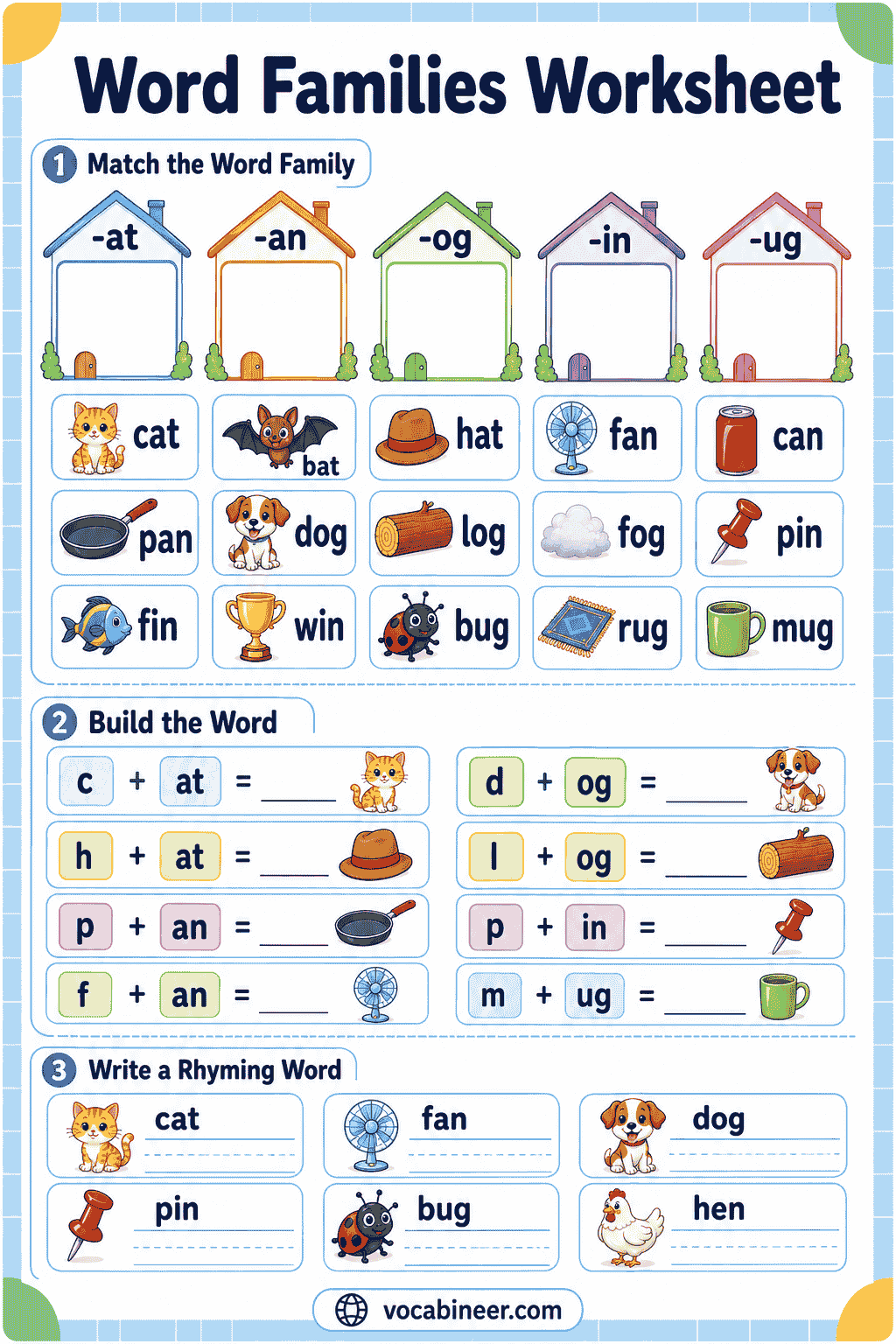
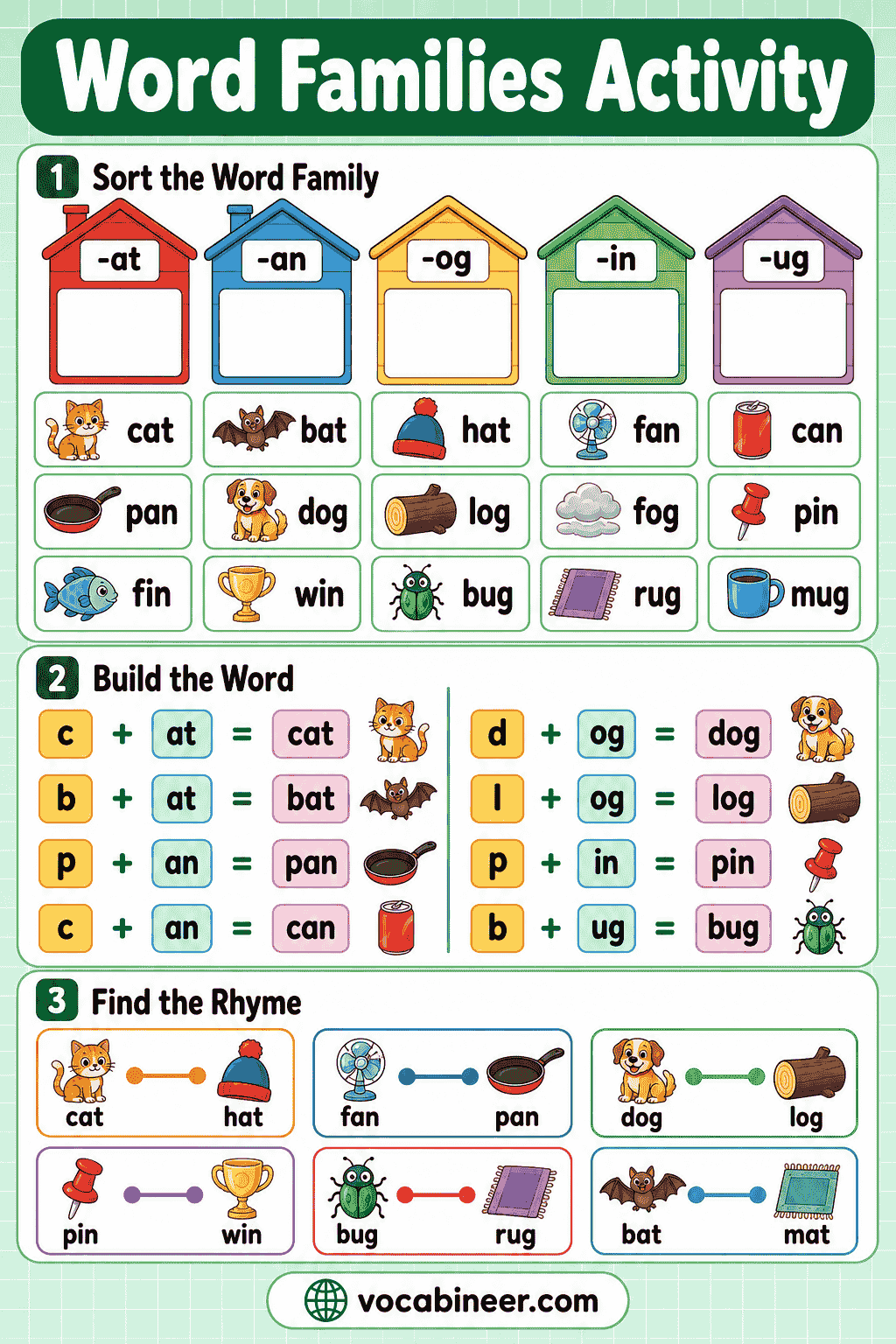
- Word family houses: Write the family ending on a house and place matching words inside it.
- Sound swap: Start with cat, then swap the first sound to make bat, hat, mat, and sat.
- Word wheels: Turn the wheel to create new words from one ending pattern.
- Picture match: Match a picture to a word-family word, such as cat or dog.
- Read and cover: Read a word, cover it, then spell it from memory.
- Family sort: Sort cards into groups such as -at, -an, and -ap.
- Sentence build: Use word cards to make simple sentences.
- Mini book: Create a small book using one word family on each page.
Activities should not become random games. Each one should connect sound, spelling, and reading.
Word Family Worksheets and Flashcards
Worksheets and flashcards are most useful when they support real reading practice.
Useful worksheet ideas include:
- fill in the beginning sound
- circle the matching family word
- sort words by family
- match words to pictures
- complete a sentence
- read and draw
- cut and paste family words
- write three more words from the same family
Good flashcard sets should include:
- one word family per set
- clear, readable words
- picture cards for beginners
- sentence cards for extra practice
- review cards from older families
Avoid giving children a large mixed stack too early. Smaller sets help them notice the pattern faster.
Mistakes That Make Word Families Harder
Some teaching choices can make word families confusing instead of helpful.
| Mistake | Better Choice |
|---|---|
| Teaching too many families at once | Start with one or two families |
| Asking children to memorize every word | Teach the pattern and blending |
| Mixing hard patterns too early | Begin with simple CVC families |
| Skipping sentence practice | Use short reading lines |
| Treating rhymes and word families as always the same | Explain spelling patterns clearly |
| Moving too fast | Review old families often |
| Using only worksheets | Add speaking, sorting, and reading |
Children learn word families best when they hear the pattern, build the word, read it aloud, and use it in a sentence.
FAQs
A word family is a group of words that share the same ending sound and spelling pattern. For example, cat, bat, hat, mat, and sat belong to the -at word family.
Children usually do well with simple short vowel families such as -at, -an, -ap, -am, -it, -ig, -op, -ug, and -un.
No. Word-family words share the same ending spelling pattern, while rhyming words share the same ending sound. Cat, bat, and hat are word-family words. Blue, shoe, and too rhyme, but their spellings are different.
Word families help children notice repeated patterns. When they learn one pattern like -at, they can read many words by changing the first sound.
Yes. Word families are useful for kindergarten because they support phonics, blending, spelling, rhyming, and simple sentence reading.
Read More
- CVC Rhyming Words for Kids
- Preschool Vocabulary Words
- Short Vowel Words for Kids
- Long Vowel Words for Kids
- 300+ Kindergarten Words
- Sight Words for Kids