

Daily use English sentences help you speak more naturally in everyday situations. You can use them at home, in school, at work, in shops, on phone calls, while traveling, and during normal conversations. These sentences are short, practical, and easy to remember, so they help beginners improve spoken English step by step.
In this guide, you will learn 2000 daily use English sentences for speaking English, grouped by real-life situations. Instead of learning random lines, you can practice useful sentences for greetings, questions, answers, requests, thanks, apologies, shopping, travel, work, school, family, friends, and more.
In This Page
What Are Daily Use English Sentences?
Daily use English sentences are common sentences that people use in everyday speaking. They help you ask questions, give answers, make requests, share feelings, talk about routines, and handle simple conversations in English.
For example, sentences like How are you?, Please help me, I am on my way, and Can you call me later? are daily use sentences. When you practice these sentences regularly, you learn natural sentence patterns and speak with more confidence.
How to Practice These 2000 Sentences?
Use this list one section at a time. First, choose a topic you need in real life, such as greetings, home, school, work, shopping, travel, or phone calls. Then, read the sentences aloud and repeat them until they sound natural.
For better practice, learn 10 to 20 sentences daily and use them in your own conversations. Also, try changing small words in each sentence to make new examples. For example, you can change I am going home to I am going to school or I am going to work. This simple method helps you build speaking fluency faster.
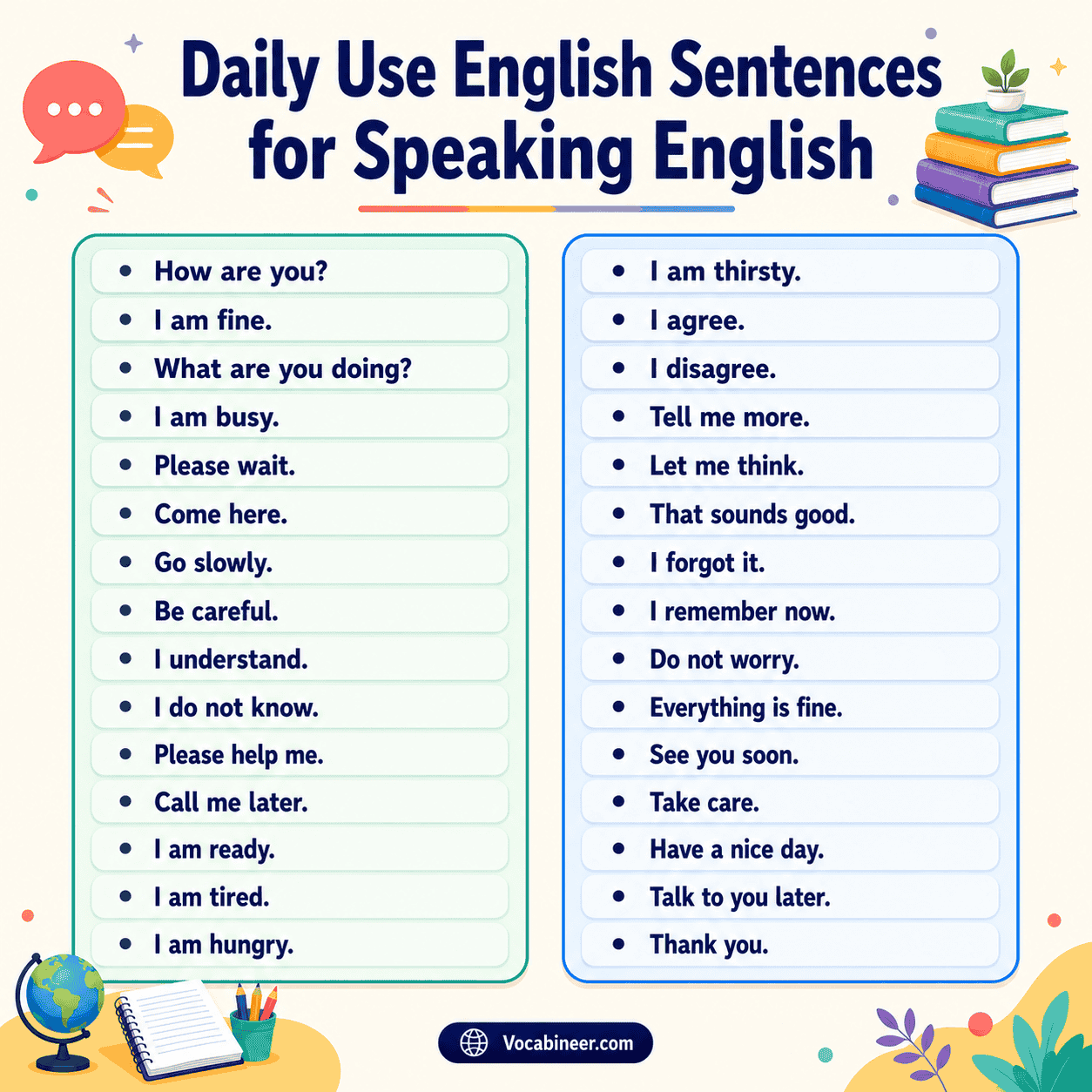
Most Common English Sentences Used Every Day
Use these sentences in normal daily conversations, quick replies, and simple speaking practice.
- How are you?
- I am fine, thank you.
- What are you doing?
- I am busy right now.
- Please wait a minute.
- I will call you later.
- I do not know.
- I understand now.
- I am sorry.
- Thank you so much.
- You are welcome.
- Please help me.
- I need your help.
- Can you repeat that?
- Please speak slowly.
- I am getting ready.
- I am on my way.
- I will be there soon.
- That sounds good.
- I agree with you.
- I do not agree.
- What do you mean?
- I have a question.
- Please tell me.
- Let me think.
- I forgot about it.
- I remember now.
- I am hungry.
- I am thirsty.
- I am tired.
- I feel better now.
- Please come here.
- Go slowly.
- Be careful.
- Do not worry.
- Everything is fine.
- I am happy.
- I am not sure.
- See you later.
- Have a nice day.
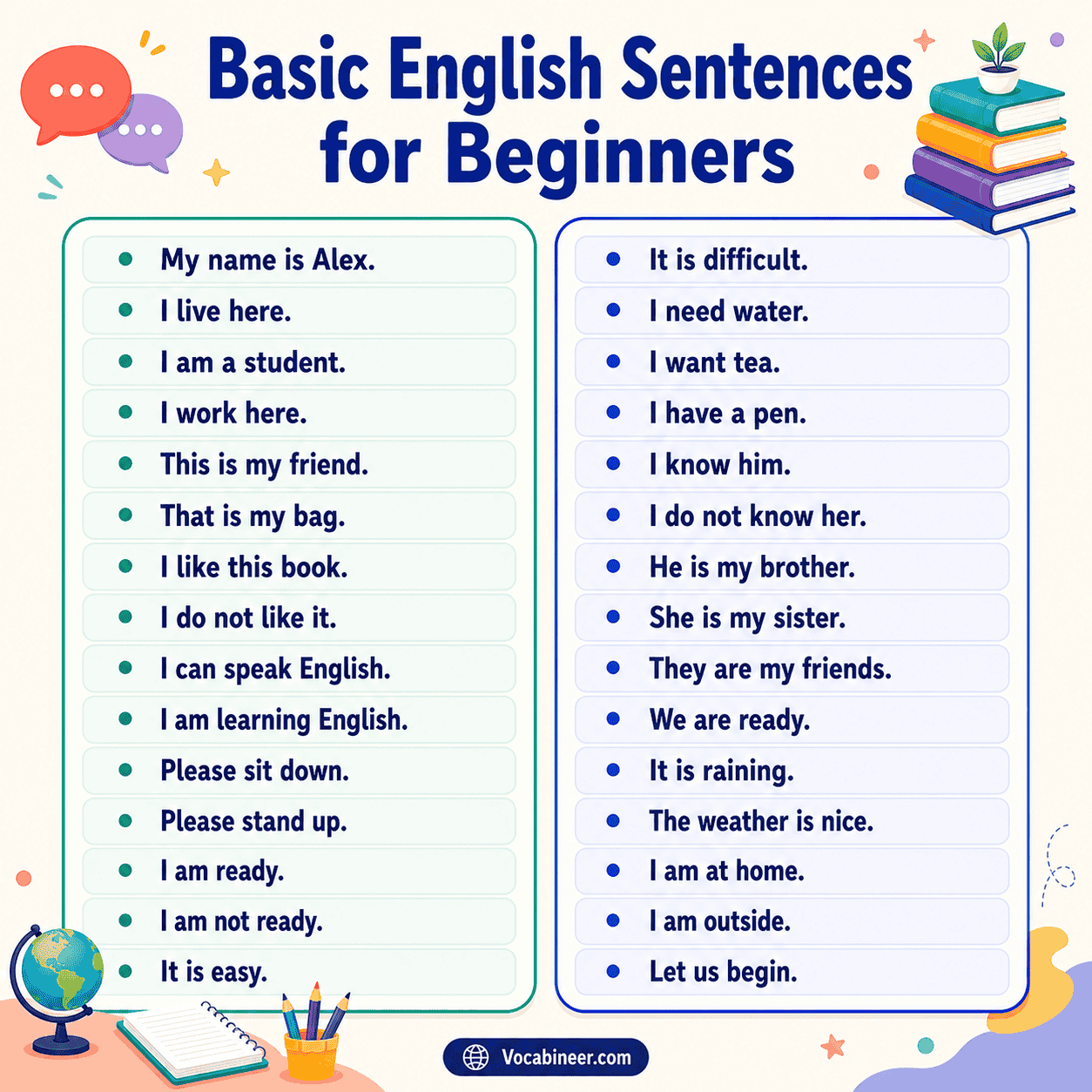
Basic English Sentences for Beginners
These beginner sentences help you talk about yourself, your needs, and simple daily actions.
- My name is Alex.
- I live in this city.
- I am a student.
- I work here.
- This is my friend.
- That is my bag.
- I like this book.
- I do not like it.
- I can speak English.
- I am learning English.
- Please sit down.
- Please stand up.
- Open the door.
- Close the window.
- Listen carefully.
- Look at this.
- Come with me.
- Stay here.
- I am ready.
- I am not ready.
- It is easy.
- It is difficult.
- This is important.
- That is not true.
- I need water.
- I want tea.
- I have a pen.
- I lost my phone.
- I found my keys.
- I know him.
- I do not know her.
- He is my brother.
- She is my sister.
- They are my friends.
- We are ready.
- It is raining.
- The weather is nice.
- I am at home.
- I am outside.
- Let us start.
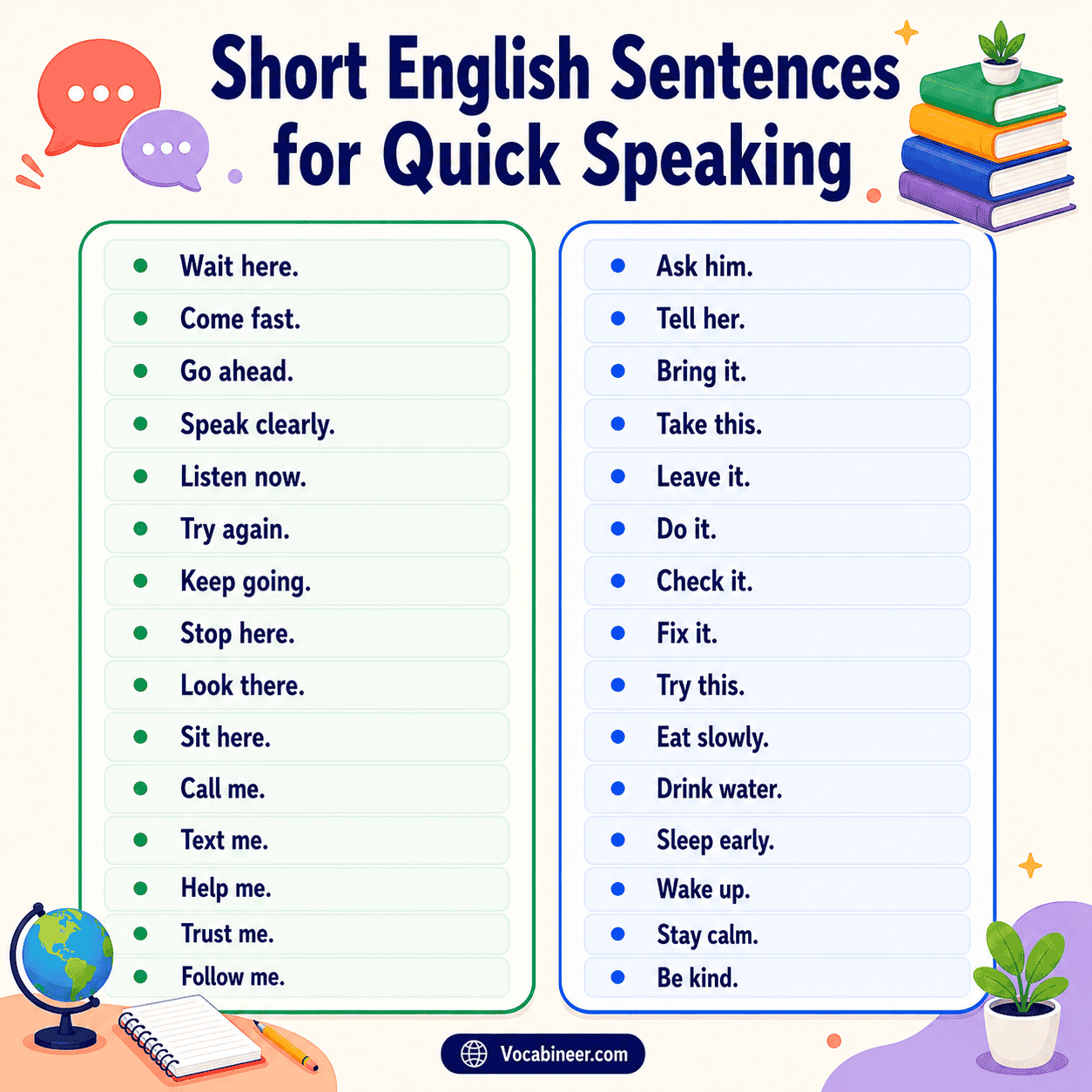
Short English Sentences for Quick Speaking
Use these short sentences when you need quick, simple, and natural English.
- Wait here.
- Come fast.
- Go ahead.
- Speak clearly.
- Listen now.
- Try again.
- Keep going.
- Stop here.
- Look there.
- Sit here.
- Call me.
- Text me.
- Help me.
- Trust me.
- Follow me.
- Ask him.
- Tell her.
- Bring it.
- Take this.
- Leave it.
- Do it.
- Check it.
- Fix it.
- Try this.
- Eat slowly.
- Drink water.
- Sleep early.
- Wake up.
- Stay calm.
- Be kind.
- Be honest.
- Be ready.
- Be quiet.
- Be careful.
- Hurry up.
- Slow down.
- Move aside.
- Come back.
- Stay safe.
- Take care.
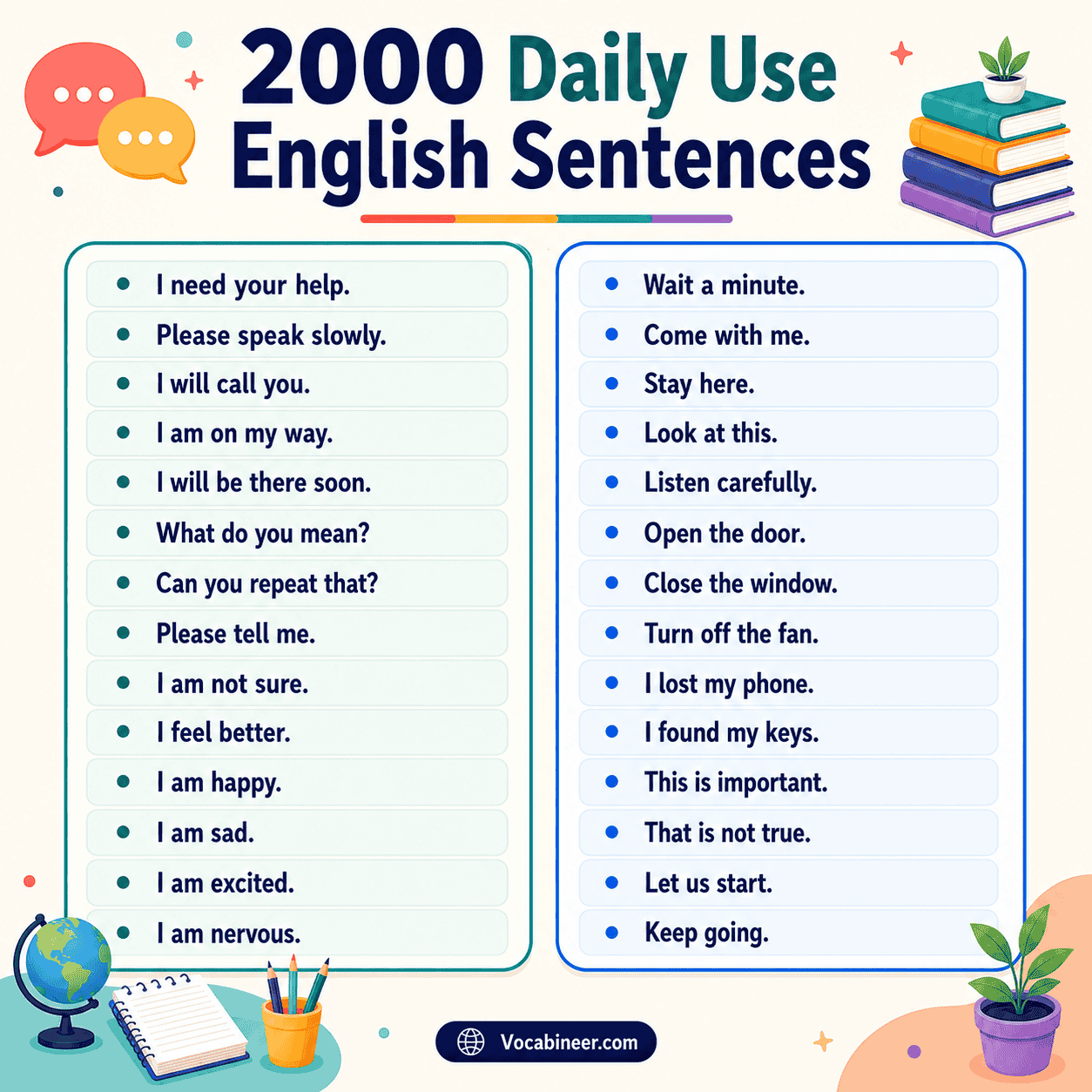
Greeting Sentences Used in Daily Life
Use these sentences when you meet someone, start a conversation, or say goodbye politely.
- Good morning.
- Good afternoon.
- Good evening.
- Hello, how are you?
- Hi, nice to see you.
- How is your day going?
- How have you been?
- I am glad to see you.
- Long time no see.
- Welcome back.
- Nice to meet you.
- It is good to meet you.
- How is everything?
- How are things?
- What is new?
- I hope you are well.
- I hope you had a good day.
- Have a great day.
- Have a wonderful evening.
- See you soon.
- See you tomorrow.
- Talk to you later.
- Take care.
- Goodbye for now.
- Have a safe trip.
- Enjoy your day.
- It was nice talking to you.
- I am happy to meet you.
- Let us meet again.
- I will see you later.
- Please stay in touch.
- Send my regards.
- Say hello to your family.
- I hope we meet soon.
- Thanks for coming.
- Thanks for visiting.
- You look happy today.
- You look great.
- I missed you.
- Welcome to our home.
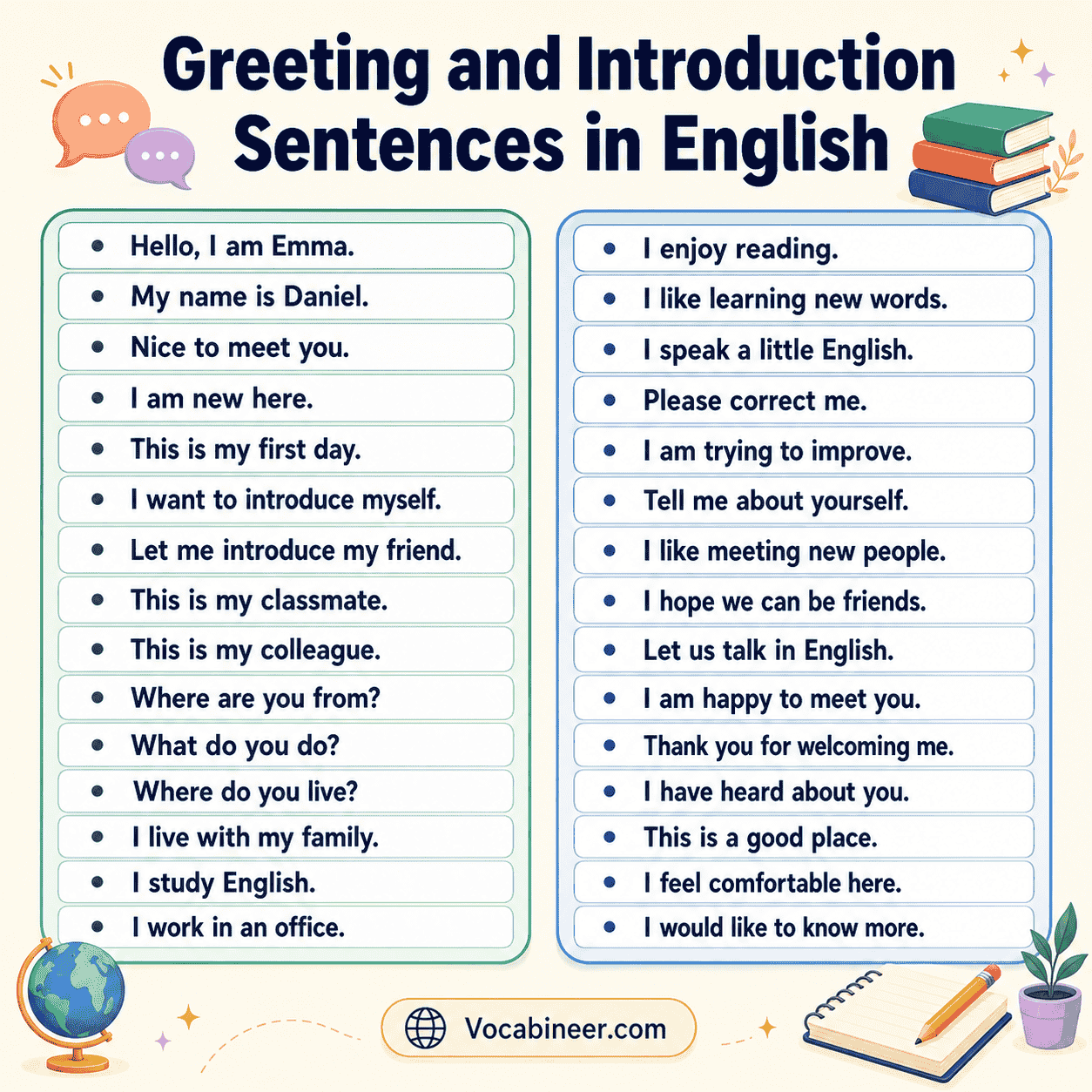
Introduction Sentences for Daily Conversation
Use these sentences when you introduce yourself or meet someone new.
- My name is Emma.
- I am from a small town.
- I live near the city center.
- I study English.
- I work in an office.
- I am a teacher.
- I am a student.
- I am new here.
- This is my first day.
- I want to introduce myself.
- Let me introduce my friend.
- This is my brother.
- This is my classmate.
- This is my colleague.
- Nice to meet you.
- I have heard about you.
- I am happy to meet you.
- What is your name?
- Where are you from?
- What do you do?
- Where do you live?
- Do you study here?
- Do you work nearby?
- I live with my family.
- I enjoy reading books.
- I like learning new words.
- My favorite subject is English.
- I want to improve my speaking.
- I speak a little English.
- Please correct me if I make a mistake.
- I am trying to speak better.
- I hope we can be friends.
- Let us talk in English.
- I would like to know more about you.
- Tell me about yourself.
- I am interested in learning.
- I like meeting new people.
- This is a good place.
- I feel comfortable here.
- Thank you for welcoming me.
Small Talk Sentences
Use these sentences for light and friendly conversations about weather, plans, daily life, and simple topics.
- The weather is nice today.
- It is very hot today.
- It looks like rain.
- The day feels pleasant.
- How was your weekend?
- Did you sleep well?
- What are your plans today?
- Are you busy these days?
- How is your family?
- How is your work going?
- How are your studies going?
- Did you watch the match?
- That was a good game.
- This place is beautiful.
- The food smells good.
- I like this weather.
- I do not like too much heat.
- Traffic was heavy today.
- The road was crowded.
- I came a little late.
- I left home early.
- I had a busy day.
- I need some rest.
- I am enjoying the conversation.
- That is interesting.
- Tell me more.
- I did not know that.
- That sounds fun.
- I hope things get better.
- Everything will be fine.
- You seem happy today.
- You look tired.
- Did you eat lunch?
- Have you finished your work?
- What did you do today?
- I stayed at home.
- I went outside for a walk.
- I met an old friend.
- Let us sit for a while.
- It was nice talking to you.
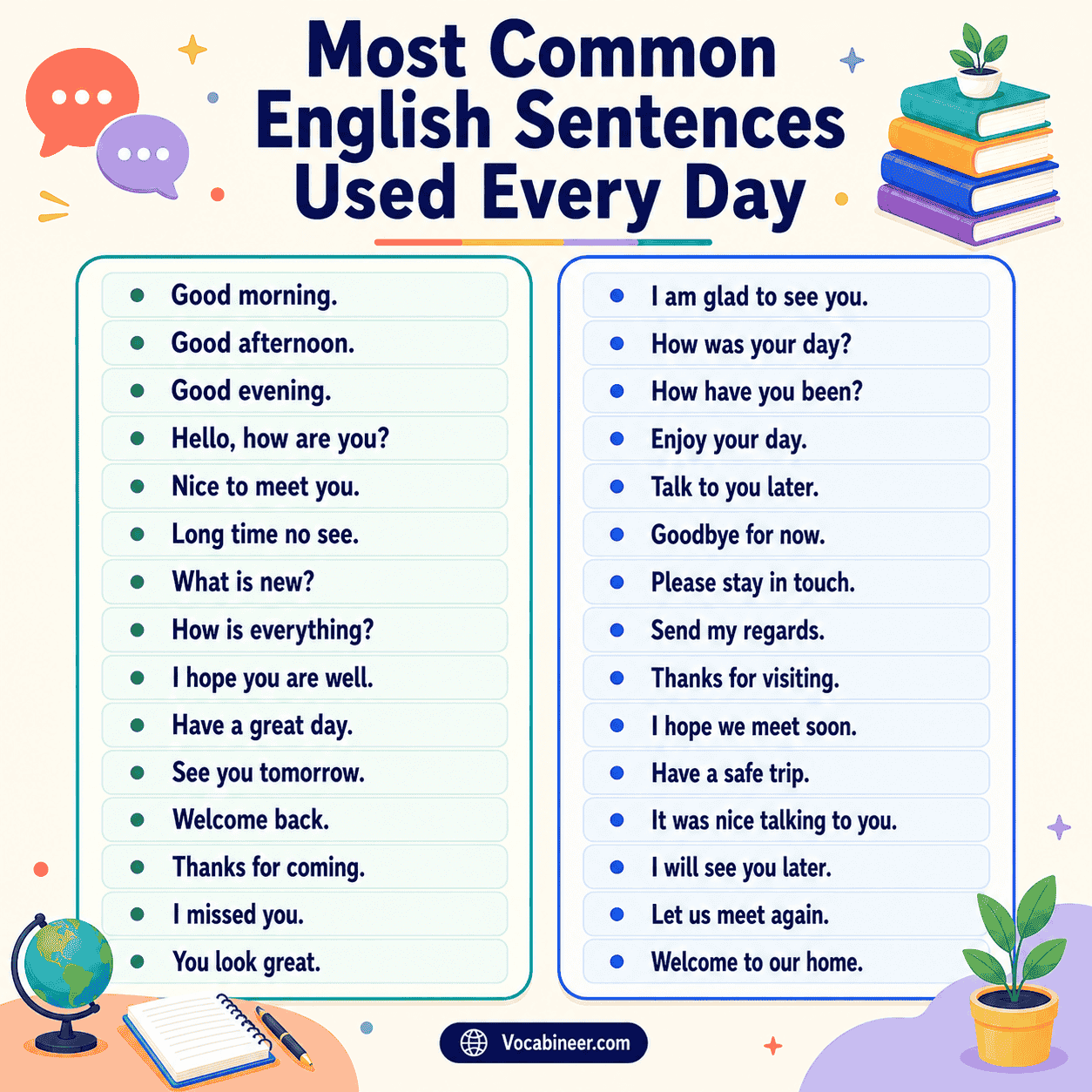
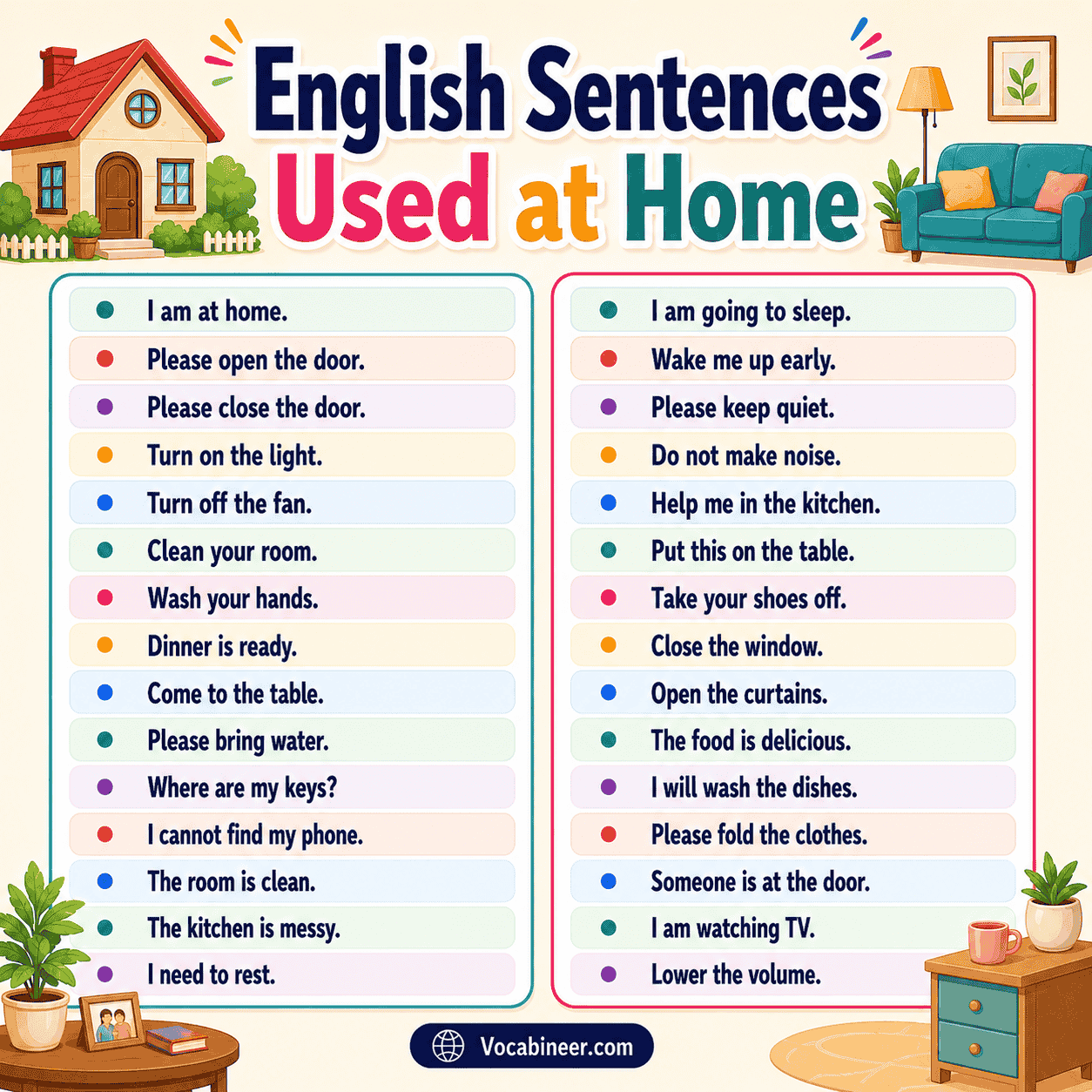
English Sentences Used at Home
Use these sentences for daily home conversations, chores, meals, and family routines.
- I am at home.
- Please open the door.
- Please close the door.
- Turn on the light.
- Turn off the fan.
- Clean your room.
- Wash your hands.
- Dinner is ready.
- Come to the table.
- Please bring water.
- Where are my keys?
- I cannot find my phone.
- The room is clean.
- The kitchen is messy.
- I need to rest.
- I am going to sleep.
- Wake me up early.
- Please keep quiet.
- Do not make noise.
- Help me in the kitchen.
- Put this on the table.
- Take your shoes off.
- Close the window.
- Open the curtains.
- The food is delicious.
- I will wash the dishes.
- Please fold the clothes.
- The doorbell is ringing.
- Someone is at the door.
- I am watching TV.
- Lower the volume.
- Raise the volume.
- I need a towel.
- The water is cold.
- The water is hot.
- Please clean the floor.
- Keep your things properly.
- Do not waste food.
- Let us eat together.
- Home feels peaceful today.
Morning Routine Sentences
Use these sentences to talk about waking up, getting ready, and starting the day.
- I wake up early.
- I get out of bed at six.
- I brush my teeth.
- I wash my face.
- I take a shower.
- I comb my hair.
- I get dressed.
- I make my bed.
- I drink a glass of water.
- I eat breakfast.
- I drink tea.
- I check my phone.
- I pack my bag.
- I prepare my lunch.
- I leave home early.
- I go to school.
- I go to work.
- I wait for the bus.
- I walk to the stop.
- I am getting late.
- I need to hurry.
- I forgot my notebook.
- I have everything ready.
- I wear my shoes.
- I lock the door.
- I say goodbye to my family.
- I start my day with a smile.
- I read the news.
- I make a to-do list.
- I plan my day.
- I check my schedule.
- I feel fresh today.
- I need more sleep.
- I woke up late today.
- I missed my alarm.
- I will be on time.
- I am ready to go.
- Let us start the day.
- I hope today goes well.
- I want to stay focused today.
Night Routine Sentences
Use these sentences to talk about evening habits, rest, sleep, and bedtime.
- I am going to bed.
- I feel sleepy.
- I need to sleep early.
- Please turn off the light.
- I will set the alarm.
- I have finished my work.
- I brushed my teeth.
- I washed my face.
- I changed my clothes.
- I am tired today.
- I had a long day.
- I want to rest now.
- Good night.
- Sleep well.
- Sweet dreams.
- See you in the morning.
- Do not stay up late.
- I will wake up early.
- I need a blanket.
- The room is cold.
- The room is warm.
- I will read before sleeping.
- I checked the door.
- I locked the window.
- I put my phone on charge.
- I am turning off the TV.
- Please speak softly.
- Everyone is sleeping.
- I cannot sleep.
- I had a busy day.
- I feel relaxed now.
- Tomorrow will be better.
- I need peaceful sleep.
- Let me rest.
- I will finish this tomorrow.
- Do not forget the alarm.
- I am going to sleep now.
- Please wake me at seven.
- I hope you sleep well.
- Good night, take care.
Family Conversation Sentences
Use these sentences when you talk with parents, siblings, relatives, or family members.
- How is everyone?
- Where is Dad?
- Mom is in the kitchen.
- My brother is studying.
- My sister is sleeping.
- Please call your uncle.
- Let us visit our grandparents.
- I miss my family.
- We should eat together.
- Family time is important.
- Please help your mother.
- Talk politely to elders.
- Respect your parents.
- Listen to your father.
- Ask your brother for help.
- Where is my cousin?
- My aunt is coming today.
- My uncle called me.
- We will meet on Sunday.
- Let us plan a family dinner.
- I need your advice.
- Please sit with me.
- Tell me what happened.
- Do not argue.
- Let us solve this calmly.
- I care about you.
- You are important to me.
- I am proud of you.
- You did a good job.
- Please take care of yourself.
- Call me when you reach.
- Eat your food properly.
- Do your homework.
- Keep your room clean.
- Help your younger brother.
- Do not worry about it.
- We are here for you.
- Everything will be okay.
- Let us spend time together.
- I love my family.
Talking with Friends in English
Use these sentences for casual conversations, plans, support, and friendly replies.
- What are you doing?
- Are you free today?
- Let us go outside.
- I want to meet you.
- Call me when you are free.
- I missed your call.
- Where are you now?
- I am waiting for you.
- Do not be late.
- Come quickly.
- Let us have tea.
- Let us watch a movie.
- That was funny.
- You made me laugh.
- I trust you.
- You are my best friend.
- Do not worry, I am here.
- Tell me the truth.
- What happened yesterday?
- Why are you upset?
- I am happy for you.
- Congratulations, my friend.
- You deserve it.
- I need your opinion.
- Can you help me?
- I will help you.
- Let us study together.
- Send me the notes.
- Share your location.
- I will pick you up.
- We should meet soon.
- I enjoyed your company.
- Do you remember that day?
- That was a great time.
- Let us plan something.
- I am busy today.
- Maybe tomorrow.
- Stay in touch.
- Take care, friend.
- See you soon.
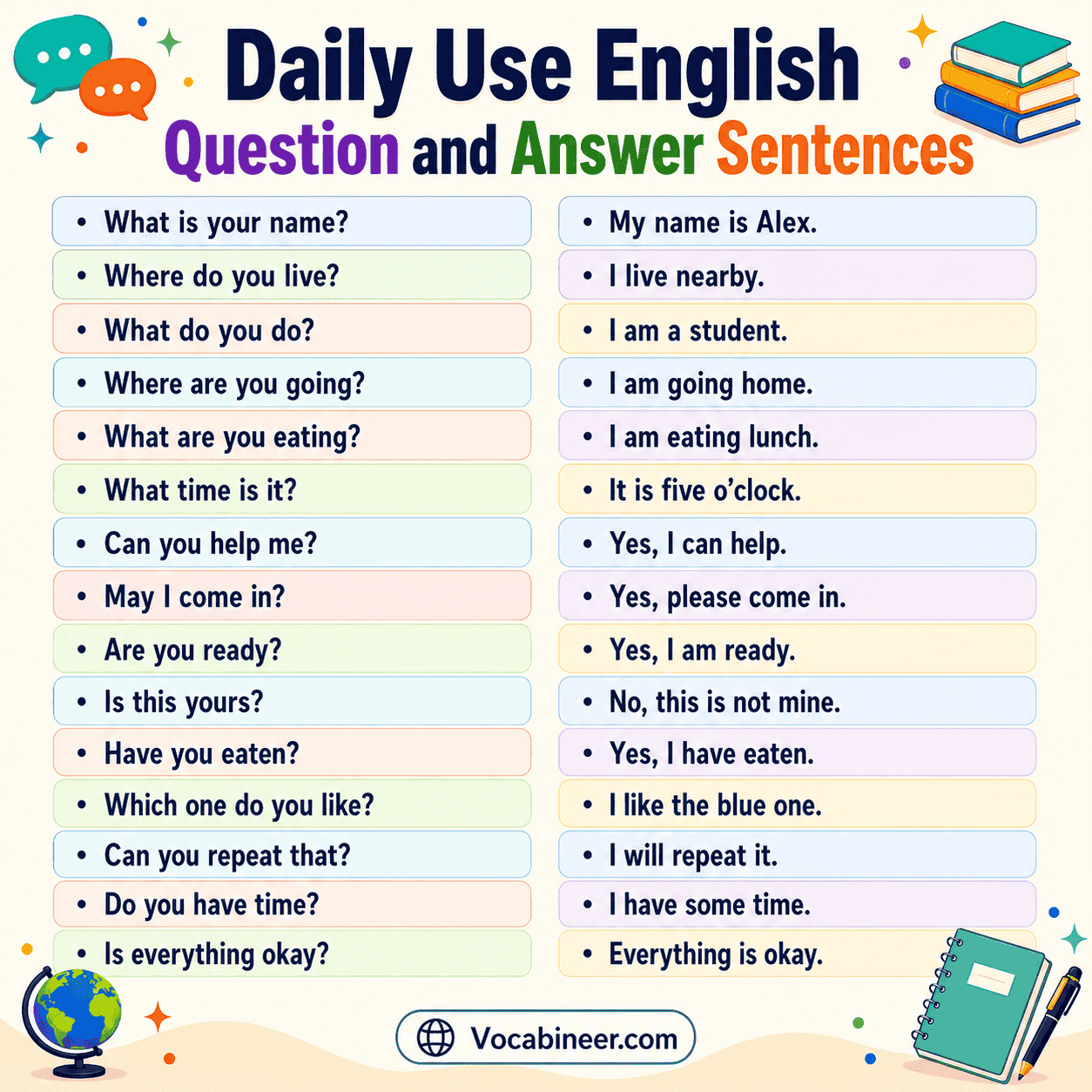
Asking Questions in Daily English
Use these sentences when you need information, help, permission, or clarification.
- What is your name?
- Where do you live?
- How old are you?
- What do you do?
- Where are you going?
- What are you eating?
- What time is it?
- Who is calling?
- Why are you late?
- How did this happen?
- Can you help me?
- May I come in?
- Do you understand?
- Are you ready?
- Is this yours?
- Did you finish your work?
- Have you eaten?
- Where is my bag?
- How much does it cost?
- Which one do you like?
- When will you come?
- Why are you sad?
- Who told you that?
- Can I ask you something?
- What do you mean?
- How can I help you?
- Do you need anything?
- Are you feeling better?
- Did you sleep well?
- What is the problem?
- Can you repeat that?
- Could you speak slowly?
- Where can I sit?
- May I use your phone?
- Do you have time?
- Should I call you later?
- Can we talk now?
- What should I do?
- Is everything okay?
- Can you explain this?
Giving Answers in Daily English
Use these sentences to answer common daily questions clearly and naturally.
- My name is Daniel.
- I live nearby.
- I am a student.
- I work in a store.
- I am going home.
- I am eating lunch.
- It is five o’clock.
- My friend is calling.
- I was stuck in traffic.
- It happened suddenly.
- Yes, I can help you.
- Yes, please come in.
- I understand now.
- Yes, I am ready.
- No, this is not mine.
- I finished my work.
- Yes, I have eaten.
- Your bag is on the chair.
- It costs ten dollars.
- I like the blue one.
- I will come tomorrow.
- I feel sad today.
- My friend told me.
- Yes, ask me anything.
- I mean this one.
- You can help me with this.
- I need some water.
- I feel better now.
- Yes, I slept well.
- The problem is small.
- I will repeat it.
- I will speak slowly.
- You can sit here.
- Yes, you may use my phone.
- I have some time.
- Please call me later.
- We can talk now.
- You should stay calm.
- Everything is okay.
- I will explain it.
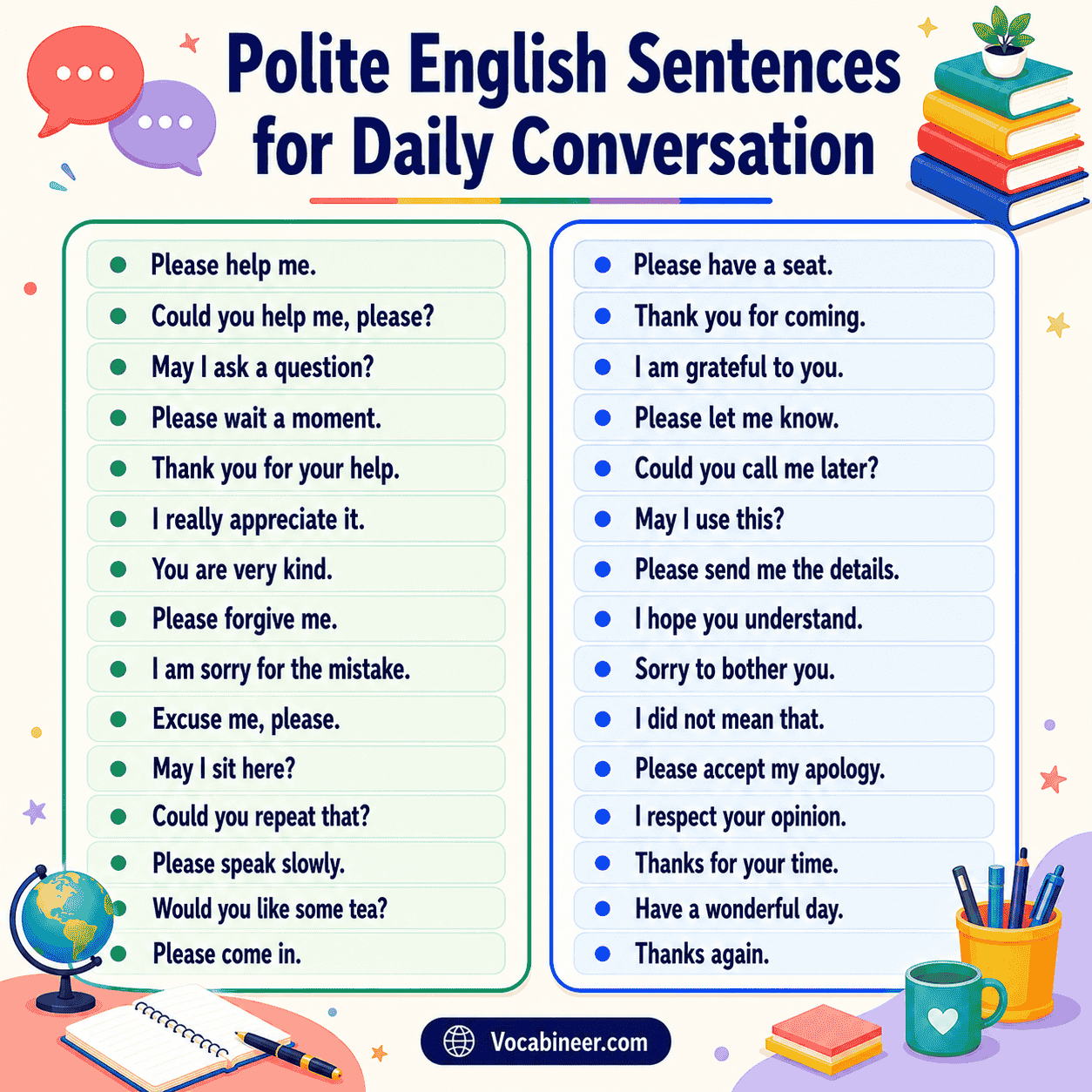
Polite English Sentences
Use these sentences when you want to sound respectful, soft, and well-mannered.
- Please help me.
- Could you help me, please?
- May I ask a question?
- Please wait for a moment.
- Thank you for your help.
- I really appreciate it.
- You are very kind.
- Please forgive me.
- I am sorry for the mistake.
- Excuse me, please.
- May I sit here?
- Could you repeat that?
- Please speak slowly.
- Would you like some tea?
- Please come in.
- Please have a seat.
- Thank you for coming.
- I am grateful to you.
- Please let me know.
- Could you call me later?
- May I use this?
- Please send me the details.
- I hope you understand.
- Sorry to bother you.
- I did not mean that.
- Please accept my apology.
- I respect your opinion.
- That is very helpful.
- Thanks for your time.
- I would like to ask something.
- Please correct me.
- I hope you do not mind.
- Could you explain this?
- Please give me a minute.
- I am thankful for your support.
- Please take care.
- It was nice meeting you.
- I hope to see you again.
- Have a wonderful day.
- Thanks again.
Asking for Help in English
Use these sentences when you need support, guidance, or assistance.
- Can you help me?
- I need your help.
- Please help me with this.
- Could you explain this?
- Can you show me the way?
- Please carry this bag.
- I cannot do this alone.
- I need some advice.
- Could you guide me?
- Please check this for me.
- Can you fix this?
- Please call a doctor.
- Can you open this?
- I need help with my homework.
- Please teach me this lesson.
- Can you lend me a pen?
- Please help me find my phone.
- Can you come with me?
- I need help urgently.
- Please stay with me.
- Can you translate this?
- Please speak slowly.
- I do not understand this.
- Could you repeat the question?
- Can you help me practice English?
- Please help me choose one.
- Can you read this for me?
- Please tell me what to do.
- Can you help me move this?
- I need help at the office.
- Can you send me the file?
- Please check my message.
- Could you call him for me?
- Can you explain the rule?
- Please help me fill this form.
- Can you wait for me?
- Please support me.
- I need your suggestion.
- Can you solve this problem?
- Thank you for helping me.
Offering Help in English
Use these sentences when you want to help someone kindly.
- Can I help you?
- Do you need help?
- Let me help you.
- I can carry this for you.
- I will explain it.
- I can show you the way.
- Let me check it.
- I will call him for you.
- I can solve this.
- Let me try.
- I will support you.
- You can ask me anytime.
- I am here to help.
- Do not worry, I will help.
- I can teach you.
- I will send the notes.
- Let me open the door.
- I can bring water.
- I will wait for you.
- I can guide you.
- Tell me what you need.
- I will help you study.
- I can share my book.
- Let me carry your bag.
- I will talk to him.
- I can help with the project.
- I will check your work.
- Let me know if you need anything.
- I can come with you.
- I will take care of it.
- I can arrange everything.
- I will give you a ride.
- Let me fix this.
- I will help you practice.
- You are not alone.
- I can manage this.
- I will handle it.
- Let me make it easier.
- I am happy to help.
- Please feel free to ask.
Making Requests in English
Use these sentences when you want to ask for something politely.
- Please give me water.
- Please pass the salt.
- Could you open the window?
- Please close the door.
- Can you call me later?
- Please send me the address.
- Could you wait for me?
- Please speak a little louder.
- Please speak more slowly.
- Can you bring my bag?
- Please turn off the light.
- Please turn on the fan.
- Could you help me now?
- Please give me some time.
- Can you explain this again?
- Please check my work.
- Could you move aside?
- Please keep quiet.
- Can you lower the volume?
- Please send the file.
- Could you lend me your book?
- Please write it down.
- Can you repeat the sentence?
- Please show me the way.
- Could you come early?
- Please meet me tomorrow.
- Can you wait outside?
- Please clean the table.
- Could you bring tea?
- Please leave a message.
- Can you take a picture?
- Please save my number.
- Could you share your notes?
- Please call me after lunch.
- Can you guide me?
- Please give me a chance.
- Could you listen to me?
- Please do not be angry.
- Can you help me today?
- Please reply soon.
Saying Thank You in English
Use these sentences when you want to show gratitude in daily life.
- Thank you.
- Thank you so much.
- Thanks a lot.
- Thanks for your help.
- Thank you for coming.
- Thanks for calling me.
- Thank you for your time.
- I really appreciate it.
- I appreciate your support.
- Thanks for understanding.
- Thank you for explaining.
- Thanks for waiting.
- Thank you for everything.
- I am grateful to you.
- You helped me a lot.
- That was very kind of you.
- Thanks for the gift.
- Thank you for the advice.
- Thanks for listening.
- Thank you for reminding me.
- I appreciate your kindness.
- Thanks for sharing.
- Thank you for your message.
- Thanks for being there.
- I cannot thank you enough.
- You made my day.
- Thanks for your patience.
- Thank you for helping me.
- I am thankful for this.
- Thanks for your cooperation.
- Thank you for inviting me.
- Thanks for the information.
- I appreciate your effort.
- Thank you for your trust.
- Thanks for believing in me.
- You are very helpful.
- Thank you once again.
- I truly appreciate it.
- Thanks, that means a lot.
- I will remember your help.
Saying Sorry in English
Use these sentences when you want to apologize or fix a mistake.
- I am sorry.
- I am really sorry.
- Sorry for the mistake.
- Sorry for being late.
- Sorry for disturbing you.
- I did not mean that.
- Please forgive me.
- I apologize for this.
- I made a mistake.
- It was my fault.
- I should not have said that.
- I am sorry for hurting you.
- Sorry for the delay.
- Sorry, I forgot.
- I am sorry for the confusion.
- Please accept my apology.
- I will be careful next time.
- I did not do it on purpose.
- I misunderstood you.
- Sorry for the trouble.
- I regret my words.
- I should have listened.
- I am sorry for the inconvenience.
- I hope you understand.
- Sorry, I was busy.
- I missed your call.
- Sorry, I could not come.
- I was wrong.
- Please do not be upset.
- Let us forget this.
- I will fix it.
- I will not repeat it.
- I respect your feelings.
- I am sorry for my behavior.
- You are right.
- I should have told you.
- Sorry, I spoke too fast.
- Sorry, I did not notice.
- I hope you forgive me.
- Let me make it right.
Giving Advice in Daily Conversation
Use these sentences when you want to guide someone in a helpful way.
- You should rest.
- You should drink water.
- You should study daily.
- You should sleep early.
- You should eat healthy food.
- You should stay calm.
- You should talk politely.
- You should listen carefully.
- You should save money.
- You should be patient.
- You should try again.
- You should not give up.
- You should call him.
- You should ask your teacher.
- You should check your work.
- You should wear warm clothes.
- You should avoid junk food.
- You should practice speaking.
- You should read every day.
- You should write new words.
- You should plan your time.
- You should focus on your goal.
- You should keep learning.
- You should be honest.
- You should respect others.
- You should help your parents.
- You should take medicine.
- You should visit a doctor.
- You should drive carefully.
- You should think before speaking.
- You should not waste time.
- You should keep your room clean.
- You should apologize.
- You should tell the truth.
- You should stay positive.
- You should exercise daily.
- You should speak with confidence.
- You should ask for help.
- You should trust yourself.
- You should do your best.
Sharing Opinions in English
Use these sentences when you want to share what you think or feel.
- I think this is good.
- I believe you are right.
- I feel this is important.
- In my opinion, this is better.
- I like your idea.
- I do not like this plan.
- I agree with your point.
- I see it differently.
- I think we should wait.
- I think we should start now.
- This looks fine to me.
- That seems difficult.
- I prefer the first option.
- I would choose this one.
- I do not think so.
- I think it will work.
- I think it may fail.
- This idea sounds useful.
- That plan sounds risky.
- I feel happy about it.
- I am not sure about this.
- I need more time to decide.
- I have another idea.
- I want to share my view.
- My opinion is different.
- I respect your opinion.
- Let us discuss it.
- I think we can improve it.
- This is a smart choice.
- That is not a good idea.
- I support this decision.
- I disagree with this point.
- I think you explained it well.
- I believe we can do it.
- I feel confident about it.
- I do not feel comfortable with this.
- I think this is enough.
- I think we need more practice.
- I like the way you think.
- This is my honest opinion.
Agreeing and Disagreeing Politely
Use these sentences when you want to agree or disagree without sounding rude.
- I agree with you.
- You are right.
- That is true.
- I think so too.
- I feel the same way.
- I completely agree.
- That makes sense.
- I support your idea.
- You explained it well.
- I like your point.
- I agree with this plan.
- That sounds reasonable.
- I can understand your view.
- Yes, that is correct.
- I was thinking the same thing.
- I do not agree.
- I see it differently.
- I respect your view, but I disagree.
- I am not sure about that.
- I do not think so.
- That may not work.
- I have a different opinion.
- I understand, but I disagree.
- I think we need another idea.
- That is not exactly right.
- I disagree with this point.
- I think there is a better way.
- I understand your point.
- However, I see another side.
- That sounds possible, but I am unsure.
- I agree partly.
- I agree with some points.
- I do not fully agree.
- Let us think again.
- We can discuss this calmly.
- I respect your choice.
- Maybe you are right.
- Maybe we should check again.
- Let us compare both ideas.
- We can find a better solution.
Feelings and Emotions Sentences
Use these sentences to express moods, emotions, and personal feelings.
- I am happy today.
- I feel sad.
- I am excited.
- I am nervous.
- I feel tired.
- I am worried.
- I feel relaxed.
- I am proud of you.
- I feel angry.
- I am confused.
- I feel lonely.
- I am scared.
- I feel better now.
- I am disappointed.
- I feel lucky.
- I am surprised.
- I feel comfortable.
- I am not feeling well.
- I feel sleepy.
- I am bored.
- I am thankful.
- I feel confident.
- I am stressed.
- I feel peaceful.
- I am upset.
- I feel embarrassed.
- I am hopeful.
- I feel safe here.
- I am uncomfortable.
- I feel fresh.
- I am in a good mood.
- I am not in the mood.
- I feel weak.
- I am strong enough.
- I feel proud of myself.
- I am happy for you.
- I feel sorry for him.
- I am excited about tomorrow.
- I feel calm now.
- I hope things get better.
Health and Sickness Sentences
Use these sentences when you talk about health, pain, medicine, or doctor visits.
- I am not feeling well.
- I have a headache.
- I have a fever.
- I have a cough.
- My throat hurts.
- My stomach hurts.
- I feel weak.
- I feel dizzy.
- I need medicine.
- I should see a doctor.
- Please call a doctor.
- I need some rest.
- I have a cold.
- I have the flu.
- I cannot sleep well.
- I feel better today.
- I am recovering now.
- I need warm water.
- I need to take medicine.
- I forgot my medicine.
- I have back pain.
- My leg hurts.
- My arm hurts.
- I need a checkup.
- I have an appointment.
- The doctor is busy.
- Please check my temperature.
- I need a glass of water.
- I should eat healthy food.
- I should avoid oily food.
- I need more sleep.
- I feel tired all day.
- I am allergic to this.
- I need a bandage.
- I hurt my hand.
- I cut my finger.
- Please be careful.
- Health is important.
- I feel normal now.
- I hope you get well soon.
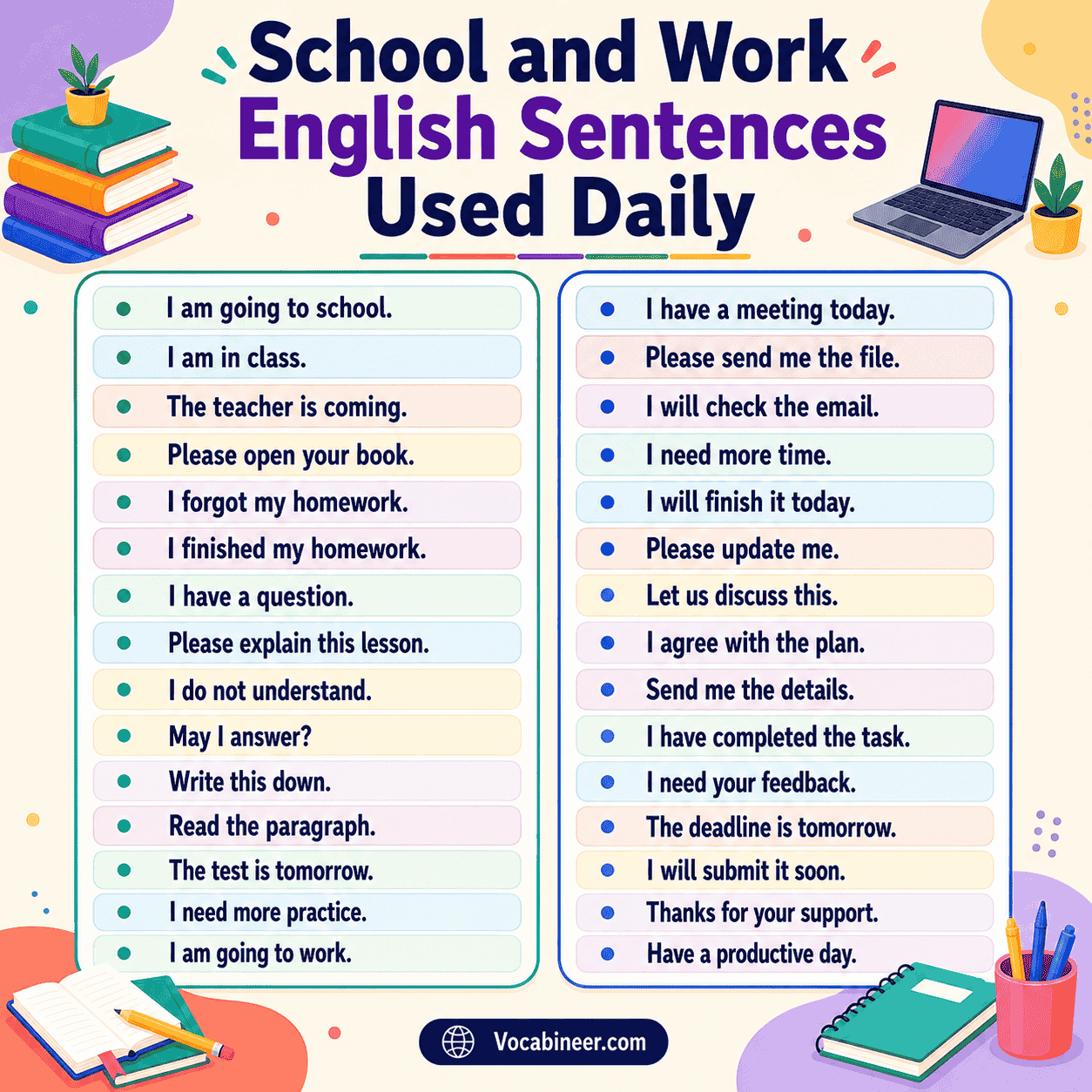
School and Classroom Sentences
Use these sentences in class, during lessons, or while talking with classmates.
- I am going to school.
- I am in class.
- The teacher is coming.
- Please open your book.
- Please close your notebook.
- I forgot my homework.
- I finished my homework.
- I need a pencil.
- Can I borrow your pen?
- Please explain this lesson.
- I do not understand.
- I have a question.
- May I answer?
- May I go out?
- May I come in?
- Please listen carefully.
- Write this down.
- Read the paragraph.
- Repeat after me.
- Speak loudly.
- Do not make noise.
- Pay attention.
- The class has started.
- The bell is ringing.
- The test is tomorrow.
- I am preparing for the exam.
- I passed the test.
- I need more practice.
- This subject is difficult.
- This lesson is easy.
- I like English class.
- I enjoy reading stories.
- Please check my answer.
- I made a mistake.
- Correct my sentence.
- I will try again.
- I forgot my book.
- I will bring it tomorrow.
- School is over.
- See you tomorrow.
Teacher and Student Conversation Sentences
Use these sentences for classroom interaction between teachers and students.
- Good morning, teacher.
- May I come in?
- Sorry, I am late.
- I did not understand the topic.
- Could you explain it again?
- I have completed my homework.
- I forgot my notebook.
- Please check my work.
- Can I ask a question?
- What is the meaning of this word?
- How do we pronounce this?
- Please write it on the board.
- I need more time.
- I am ready to answer.
- I do not know the answer.
- I will try my best.
- Please correct my mistake.
- Thank you, teacher.
- You explained it clearly.
- I will practice at home.
- Please submit your notebooks.
- Open your books.
- Read the next sentence.
- Listen carefully.
- Do not talk during class.
- Raise your hand.
- Speak in English.
- Repeat the sentence.
- Write five examples.
- Learn this by tomorrow.
- Finish your work.
- Sit properly.
- Pay attention to the lesson.
- You did well.
- Try again.
- Improve your handwriting.
- Bring your book tomorrow.
- The class is over.
- Have a good day.
- See you in the next class.
Office and Work Sentences
Use these sentences in offices, workplaces, and professional conversations.
- I am going to the office.
- I have a meeting today.
- I reached the office early.
- I am working on a report.
- Please send me the file.
- I will check the email.
- The meeting starts at ten.
- I need more time.
- I will finish it today.
- Please update me.
- I am busy right now.
- Let us discuss this.
- I agree with the plan.
- We need a better idea.
- Please call the client.
- I will join the call.
- Send me the details.
- I have completed the task.
- I need your feedback.
- Please review this document.
- I will make the changes.
- The deadline is tomorrow.
- I will submit it soon.
- Let us take a short break.
- I need a cup of coffee.
- I am leaving for lunch.
- I will be back soon.
- Please schedule the meeting.
- I missed your message.
- I will reply shortly.
- The project is going well.
- We need teamwork.
- I appreciate your help.
- Thanks for your support.
- I learned a lot today.
- I will report to the manager.
- Please share the agenda.
- I am done for today.
- See you tomorrow.
- Have a productive day.
Meeting Sentences in English
Use these sentences when you join, lead, or discuss something in a meeting.
- Let us start the meeting.
- Thank you for joining.
- Please take your seats.
- We have three points today.
- Let us discuss the first point.
- Please share your opinion.
- I agree with this idea.
- I have a suggestion.
- Could you explain this?
- Let us check the report.
- The deadline is close.
- We need a clear plan.
- Who will handle this task?
- I can take this task.
- Please note this point.
- Let us move to the next topic.
- We need more details.
- This needs improvement.
- That sounds practical.
- I have a concern.
- Let us solve this issue.
- Please keep it short.
- We are running out of time.
- Let us make a decision.
- I will send the summary.
- Please follow up tomorrow.
- The meeting went well.
- We should meet again.
- Let us fix another time.
- Thank you for your input.
- I appreciate your ideas.
- Please review the action points.
- We need everyone’s support.
- This plan looks good.
- Let us finalize it.
- I will update the document.
- Please confirm your availability.
- We can close the meeting now.
- Thanks for your time.
- Have a good day.
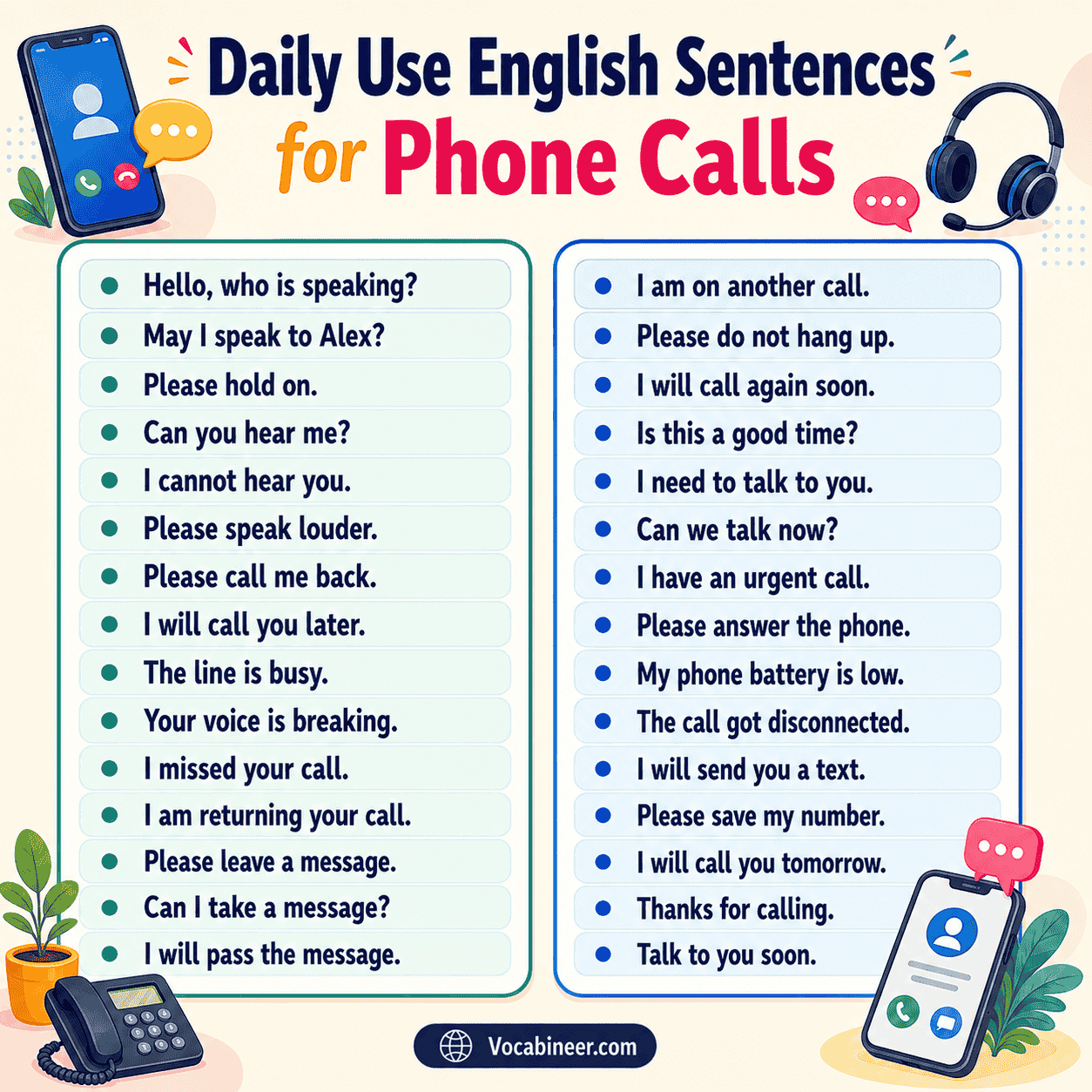
Phone Call Sentences
Use these sentences when you talk on the phone or handle calls.
- Hello, who is speaking?
- May I speak to Alex?
- Please hold on.
- I will call you back.
- Can you hear me?
- Your voice is not clear.
- Please speak louder.
- Please speak slowly.
- The line is breaking.
- I missed your call.
- Sorry, I was busy.
- Why did you call?
- I called to ask something.
- Can we talk now?
- I will call later.
- Please call me after dinner.
- Send me a message.
- I am in a meeting.
- I cannot talk right now.
- Please leave a message.
- Who gave you my number?
- I saved your number.
- I will send the location.
- Can you repeat that?
- I did not hear you.
- Please call again.
- I am driving now.
- I will talk later.
- Thank you for calling.
- It was nice talking to you.
- I need some information.
- Can you connect me to him?
- He is not available.
- She will call you soon.
- I called by mistake.
- Sorry, wrong number.
- Please do not cut the call.
- Stay on the line.
- Talk to you soon.
- Goodbye.
Text Message and Chat Sentences
Use these sentences in texting, online chatting, and quick digital conversations.
- Hi, are you free?
- Please reply soon.
- I saw your message.
- I will text you later.
- Send me the details.
- Share your location.
- Call me when free.
- I am busy now.
- I will be late.
- I am on my way.
- I reached home.
- Did you get my message?
- Please check your inbox.
- I sent the file.
- I forgot to reply.
- Sorry for the late reply.
- No problem.
- That is okay.
- Let me know.
- Keep me updated.
- What happened?
- Are you okay?
- I will explain later.
- Send me a picture.
- Please do not worry.
- I am fine.
- Thanks for texting.
- I will join soon.
- Please wait.
- I am almost there.
- Talk later.
- See you soon.
- Good night.
- Good morning.
- Happy birthday.
- Congratulations.
- Take care.
- I miss you.
- Stay blessed.
- Thanks again.
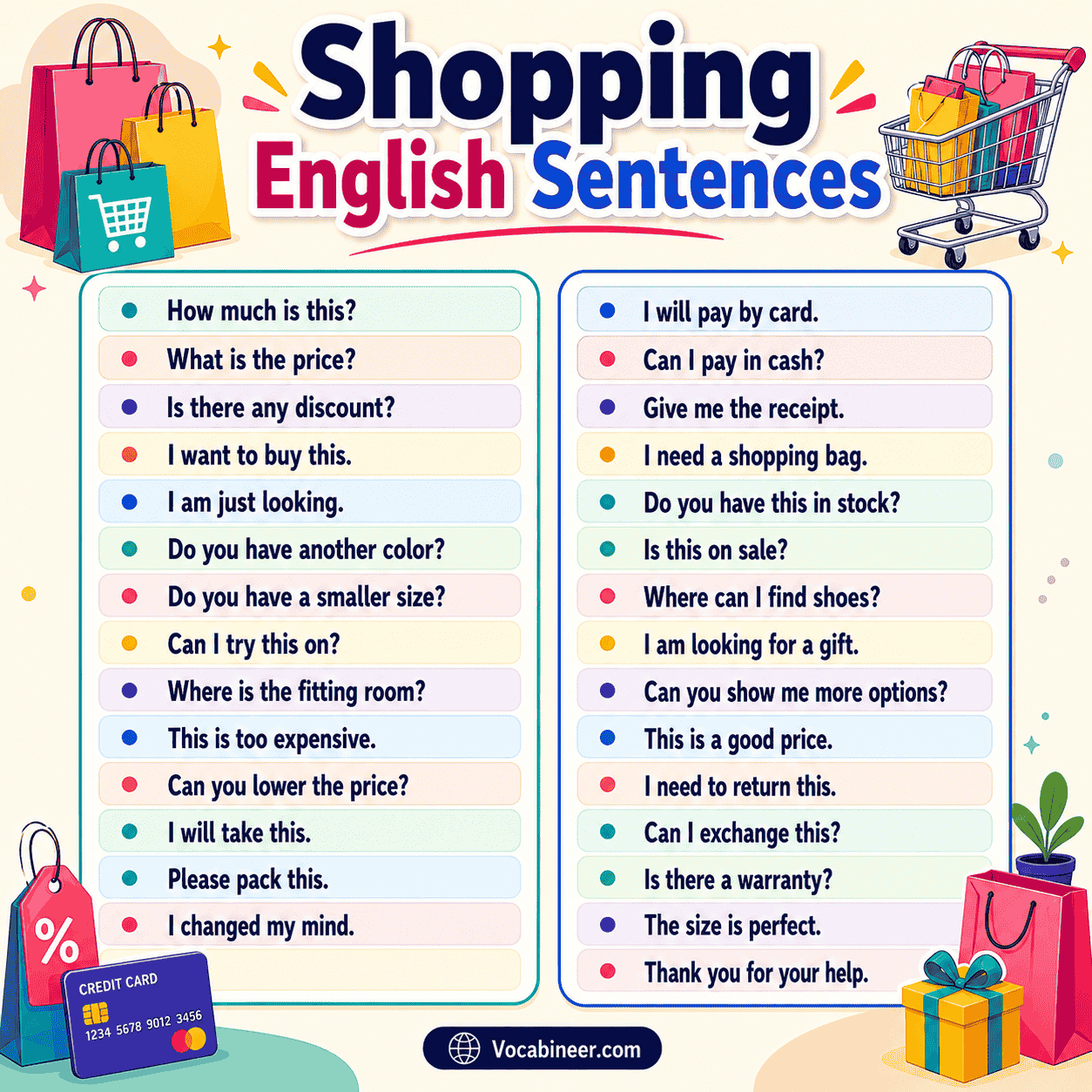
Shopping Sentences Used in Daily Life
Use these sentences when you buy clothes, shoes, gifts, or general items.
- How much is this?
- What is the price?
- Is there any discount?
- I want to buy this.
- I am just looking.
- Do you have another color?
- Do you have a smaller size?
- Do you have a larger size?
- Can I try this?
- Where is the trial room?
- This is too expensive.
- This is affordable.
- Please pack this.
- I will pay by card.
- I will pay in cash.
- Do you accept cards?
- Give me the receipt.
- Can I return this?
- Is this on sale?
- I need a shopping bag.
- Show me something better.
- I like this one.
- I do not like this design.
- This fits me well.
- This is too tight.
- This is too loose.
- I will come back later.
- Please reduce the price.
- What is your final price?
- I want two pieces.
- Please show me more options.
- Is this original?
- Does it have a warranty?
- Where is the billing counter?
- I need help.
- Can you check the stock?
- I will take this.
- I changed my mind.
- Thank you for your help.
- Have a good day.
Market and Grocery Store Sentences
Use these sentences when you buy food, vegetables, fruits, and household items.
- I need some vegetables.
- I want fresh fruit.
- How much are the apples?
- Give me one kilo of potatoes.
- Are these tomatoes fresh?
- Please weigh this.
- I need rice.
- I need flour.
- Do you have milk?
- Where is the sugar?
- I need cooking oil.
- Give me a dozen eggs.
- Is this bread fresh?
- I want chicken.
- I need fish.
- Please cut it into pieces.
- Do you have spices?
- I need tea leaves.
- Please give me a bag.
- I forgot my list.
- The price is high.
- Please give me fresh items.
- I will pay now.
- Do you have change?
- Keep the change.
- Please give me the receipt.
- I need soap.
- I need toothpaste.
- Where is the water section?
- This packet is damaged.
- I want another one.
- Is this expired?
- Check the date, please.
- I need a small packet.
- I need a large packet.
- Please add this too.
- That is all.
- Thank you.
- I will come again.
- Have a nice day.
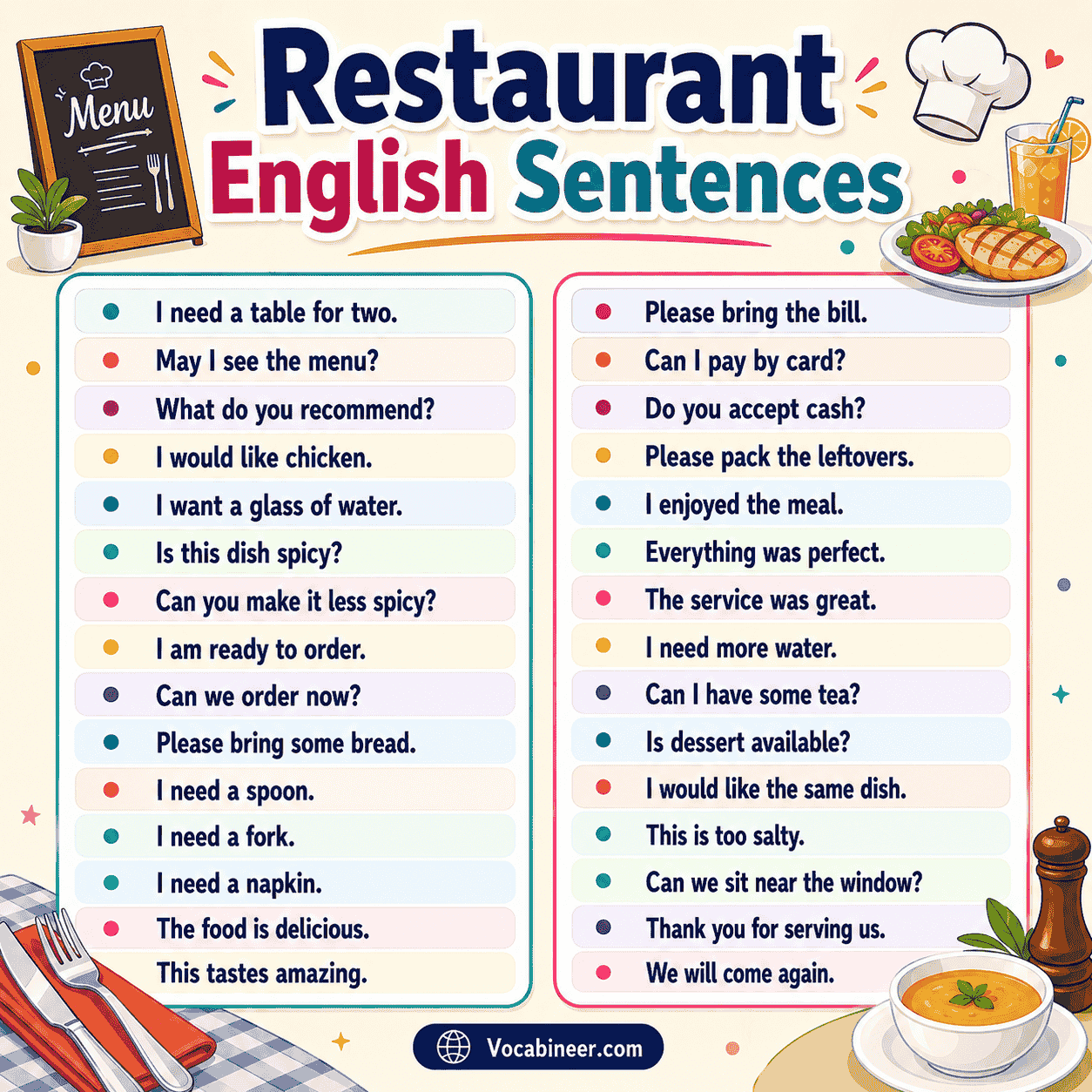
Restaurant and Food Sentences
Use these sentences when you order food, ask questions, or talk to restaurant staff.
- I need a table for two.
- May I see the menu?
- What do you recommend?
- I would like chicken.
- I want a glass of water.
- Please bring tea.
- Is this dish spicy?
- Can you make it less spicy?
- I am vegetarian.
- I do not eat meat.
- I want rice with this.
- Please bring the bill.
- The food is delicious.
- The soup is hot.
- The service is good.
- I need a spoon.
- I need a fork.
- Please bring extra napkins.
- Can we order now?
- I want to change my order.
- This is not what I ordered.
- Please pack the leftovers.
- I would like dessert.
- Do you have fresh juice?
- I want coffee.
- Is this available?
- How long will it take?
- We are waiting.
- The food is too salty.
- The food tastes great.
- I enjoyed the meal.
- Thank you for serving us.
- Can I pay by card?
- Keep the change.
- I made a reservation.
- We need another chair.
- Please clean the table.
- I will come again.
- The place is nice.
- Everything was perfect.
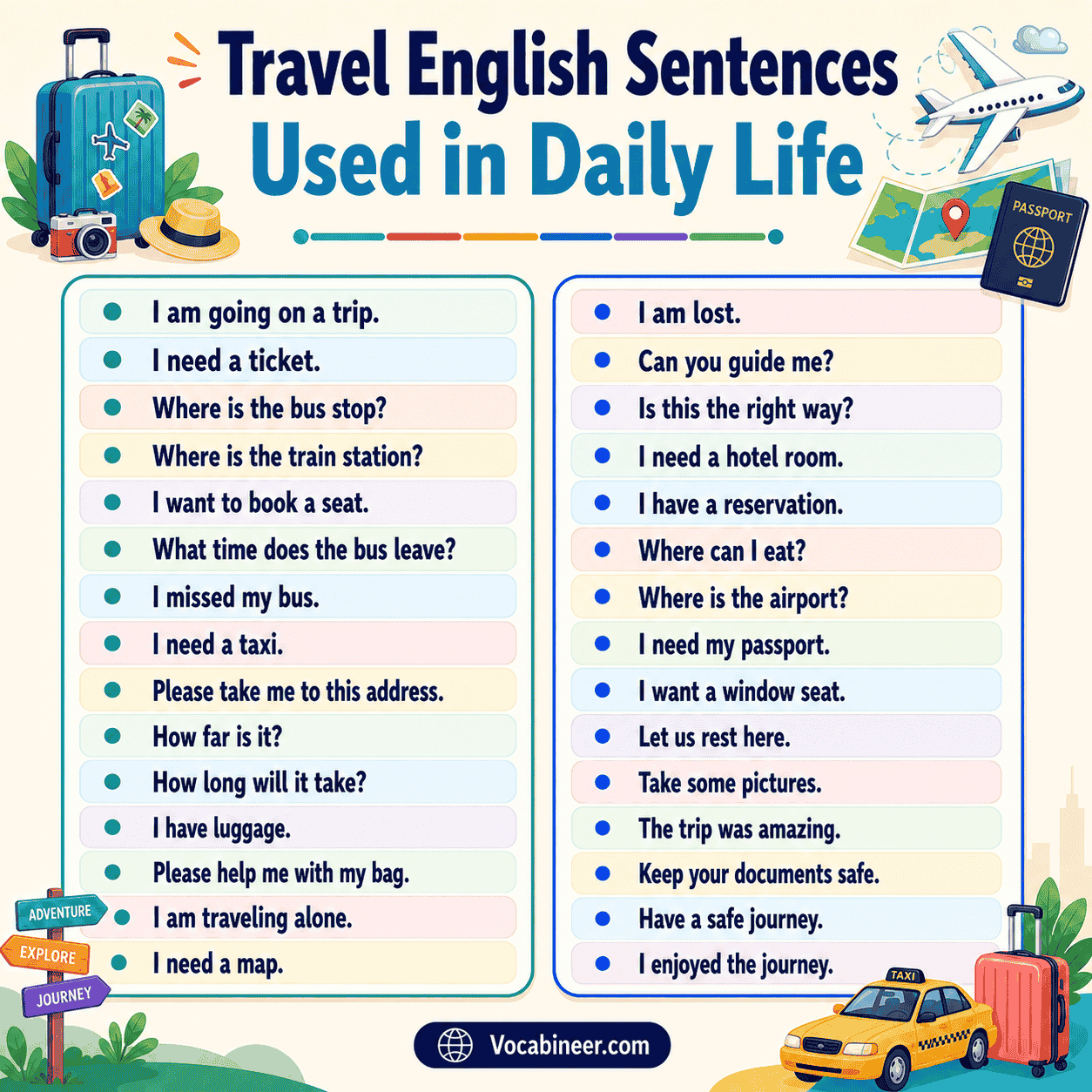
Travel Sentences Used in Daily Life
Use these sentences when you travel, book tickets, ask for help, or visit new places.
- I am going on a trip.
- I need a ticket.
- Where is the bus stop?
- Where is the train station?
- I want to book a seat.
- What time does the bus leave?
- What time does the train arrive?
- I missed my bus.
- I need a taxi.
- Please take me to this address.
- How far is it?
- How long will it take?
- I have luggage.
- Please help me with my bag.
- I am traveling alone.
- I am traveling with family.
- I need a map.
- I am lost.
- Can you guide me?
- Is this the right way?
- I want to visit this place.
- This place is beautiful.
- I need a hotel room.
- I have a reservation.
- Where can I eat?
- Where is the airport?
- I need my passport.
- I forgot my ticket.
- Please check my booking.
- I want a window seat.
- I feel tired.
- Let us rest here.
- We should leave early.
- Take some pictures.
- I enjoyed the journey.
- The trip was amazing.
- I will travel again.
- Be careful with your bags.
- Keep your documents safe.
- Have a safe journey.
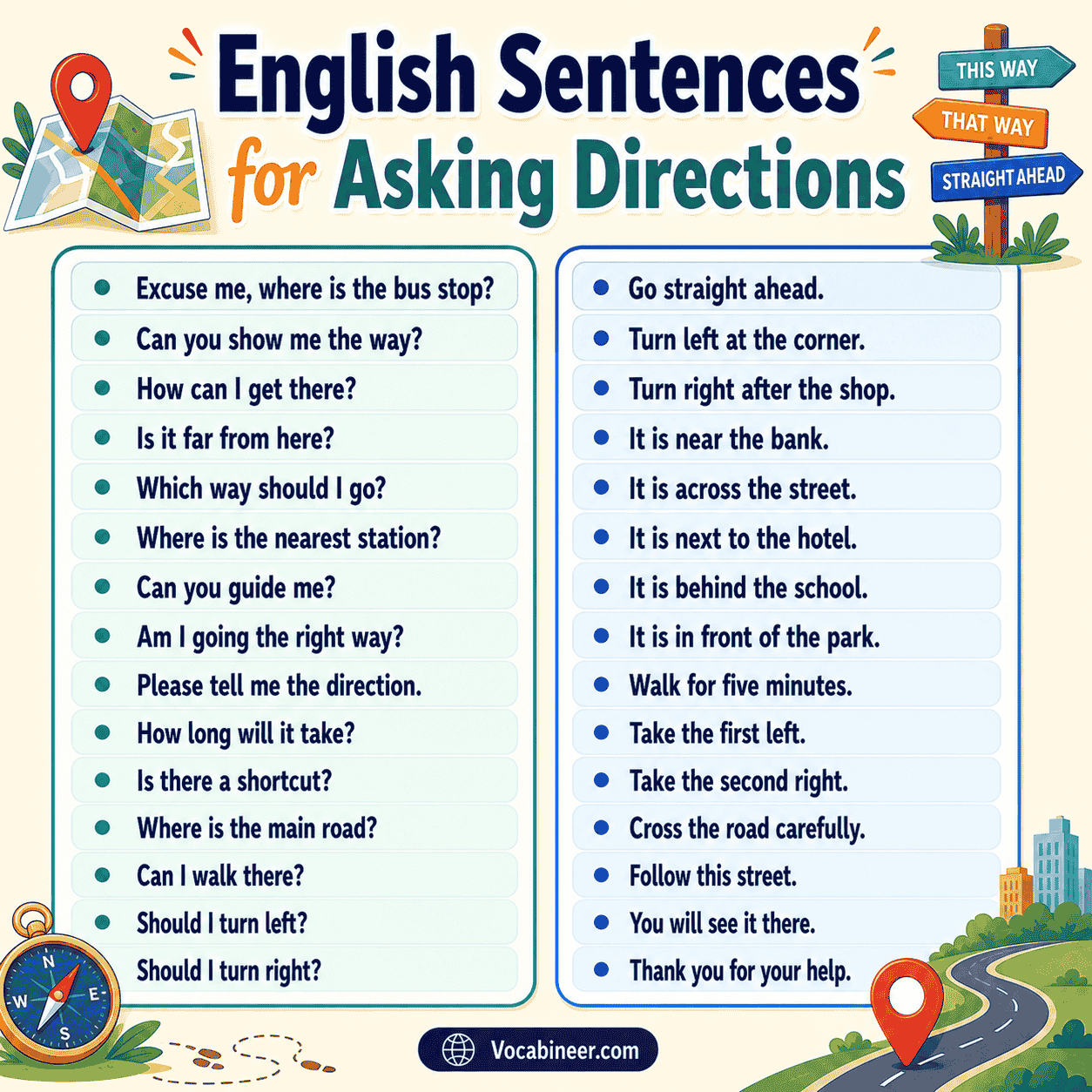
Asking Directions in English
Use these sentences when you need directions in a new place.
- Excuse me, where is the bank?
- How can I reach the market?
- Is this road correct?
- Which way should I go?
- Turn left.
- Turn right.
- Go straight.
- Cross the road.
- Take the next turn.
- Walk for five minutes.
- It is near the school.
- It is beside the hospital.
- It is opposite the park.
- It is behind the building.
- It is in front of the library.
- You are going the wrong way.
- You are close to it.
- It is far from here.
- Can you show me on the map?
- Please guide me.
- I am new here.
- I do not know this area.
- Where is the nearest bus stop?
- Where is the nearest shop?
- How far is the station?
- Can I walk there?
- Do I need a taxi?
- Which bus goes there?
- Is there a shortcut?
- The road is blocked.
- Take another route.
- Follow this street.
- Stop at the signal.
- Ask the guard.
- It is on the second floor.
- Go upstairs.
- Go downstairs.
- Thank you for helping me.
- I found the place.
- You are very kind.
Public Transport Sentences
Use these sentences on buses, trains, taxis, rides, and stations.
- I need a bus ticket.
- Where does this bus go?
- Does this bus stop here?
- I want to go downtown.
- What is the fare?
- Please stop here.
- I missed the bus.
- The bus is crowded.
- The train is late.
- The taxi is waiting.
- I need a ride.
- Please drive slowly.
- Please take the main road.
- How much is the fare?
- Keep the change.
- I need a seat.
- Is this seat free?
- Please move a little.
- I will get off here.
- Tell me when we reach.
- Is this the last stop?
- Where is platform two?
- The train has arrived.
- The train has left.
- I need to change trains.
- The ticket counter is there.
- Please show your ticket.
- I have a monthly pass.
- The road is busy.
- Traffic is heavy.
- We are stuck in traffic.
- Please open the window.
- Please close the window.
- I feel sick.
- I need fresh air.
- The ride was comfortable.
- The driver was helpful.
- I reached safely.
- Thanks for the ride.
- Have a safe journey.
Hotel and Reservation Sentences
Use these sentences when you book a room, check in, or talk to hotel staff.
- I need a room.
- I have a reservation.
- My booking is under my name.
- Do you have any rooms available?
- I need a single room.
- I need a double room.
- What is the room rate?
- Is breakfast included?
- Can I see the room?
- I will stay for two nights.
- I need an extra pillow.
- Please clean the room.
- The air conditioner is not working.
- The Wi-Fi is slow.
- I need the Wi-Fi password.
- Can I check in now?
- What time is checkout?
- I want to extend my stay.
- Please call a taxi.
- I need room service.
- Please send some water.
- Where is the elevator?
- Where is the dining area?
- I lost my key.
- Please give me another key.
- The room is comfortable.
- The room is noisy.
- I need a quieter room.
- Can you change my room?
- I want to cancel my booking.
- Please print my bill.
- I will pay by card.
- Thank you for your service.
- The staff is helpful.
- The hotel is clean.
- I enjoyed my stay.
- I will check out tomorrow.
- Please keep my luggage.
- I need directions.
- Have a good day.
Weather Conversation Sentences
Use these sentences for simple weather talk and daily small talk.
- The weather is nice today.
- It is very hot.
- It is very cold.
- It is raining.
- It may rain later.
- The sky is cloudy.
- The sun is shining.
- The wind is strong.
- It is humid today.
- The weather feels pleasant.
- I like this weather.
- I do not like hot weather.
- It is getting colder.
- It is getting warmer.
- Take an umbrella.
- Wear a jacket.
- The rain has stopped.
- The roads are wet.
- The weather changed suddenly.
- I heard thunder.
- The storm is coming.
- It is foggy outside.
- Drive carefully.
- The weather is perfect for a walk.
- It is too hot to go out.
- It is too cold to stay outside.
- I hope it does not rain.
- The forecast says rain.
- The temperature is high.
- The temperature is low.
- The air feels fresh.
- I enjoy rainy weather.
- I prefer winter.
- I prefer summer.
- The evening is beautiful.
- The morning is cool.
- The sun is too bright.
- Let us stay indoors.
- Let us go outside.
- What is the weather like?
Time and Daily Plan Sentences
Use these sentences when you talk about time, schedules, and plans.
- What time is it?
- It is eight o’clock.
- I am getting late.
- I will come at five.
- Please be on time.
- Do not be late.
- I have a plan today.
- I am free tomorrow.
- I am busy this evening.
- Let us meet after lunch.
- I will call you at night.
- I need to check my schedule.
- I have work to do.
- I will finish it soon.
- I need more time.
- I have no time now.
- Time is running fast.
- Let us start now.
- We can do it later.
- I will do it tomorrow.
- Today is a busy day.
- Tomorrow is important.
- I have an appointment.
- I need to leave early.
- I will reach on time.
- I missed the meeting.
- I forgot the time.
- Please remind me.
- Set an alarm.
- I wake up at six.
- I sleep at ten.
- I work from nine to five.
- I study in the evening.
- I go shopping on Sunday.
- I visit my family on weekends.
- Let us make a plan.
- This plan looks good.
- I changed my plan.
- Everything is planned.
- Let us follow the schedule.
Invitation Sentences
Use these sentences when you invite someone to a meal, meeting, event, or visit.
- Please come to my house.
- You are invited.
- I would like to invite you.
- Please join us for dinner.
- Come to my birthday party.
- We are having a small gathering.
- Can you come tomorrow?
- Are you free this weekend?
- Let us have lunch together.
- Would you like to come with us?
- Please bring your family.
- I hope you can come.
- We will be happy to see you.
- The party starts at seven.
- Please arrive on time.
- Do not forget to come.
- I am inviting all my friends.
- Let us celebrate together.
- You must join us.
- It will be fun.
- Please confirm your availability.
- Can you attend the event?
- I will send you the address.
- Please save the date.
- We are planning a picnic.
- Would you like to join?
- Let us meet for coffee.
- Come over when you are free.
- You are always welcome.
- I hope you say yes.
- Please come if possible.
- Bring your children too.
- We will wait for you.
- Let me know your answer.
- I want you to be there.
- It will not be the same without you.
- Join us for tea.
- Come and enjoy with us.
- I hope to see you there.
- Thanks for accepting my invitation.
Accepting and Refusing Sentences
Use these sentences when you accept or politely decline an invitation, offer, or request.
- Yes, I will come.
- I would love to join.
- Thank you for inviting me.
- I will be there.
- That sounds great.
- I am happy to come.
- Count me in.
- I will join you.
- I accept your invitation.
- I am excited about it.
- Sure, I can come.
- Yes, I am free.
- I will try to come.
- I will confirm later.
- That works for me.
- Sorry, I cannot come.
- I am busy that day.
- I have another plan.
- Maybe next time.
- I wish I could come.
- Thank you, but I cannot join.
- I am not available.
- I have some work.
- I will miss this event.
- Please enjoy without me.
- I hope you understand.
- I am sorry to refuse.
- I cannot make it.
- I have to stay home.
- I need to attend a meeting.
- I will come another day.
- Let us plan again.
- I appreciate the invitation.
- Please invite me next time.
- I wanted to come.
- Something came up.
- I hope the event goes well.
- Have a great time.
- Send me pictures.
- Thanks for understanding.
Compliment and Praise Sentences
Use these sentences when you want to appreciate someone or say something kind.
- You look great.
- You did a great job.
- I like your dress.
- Your work is excellent.
- You are very talented.
- You speak English well.
- Your idea is brilliant.
- You are very kind.
- You have a nice smile.
- This food is delicious.
- Your handwriting is beautiful.
- You are improving a lot.
- I am proud of you.
- You handled it well.
- That was impressive.
- You are very helpful.
- Your house looks beautiful.
- You have good taste.
- You are a fast learner.
- You are doing well.
- Keep up the good work.
- You made a smart choice.
- Your presentation was clear.
- You explained it well.
- You are very responsible.
- You deserve success.
- You are hardworking.
- You look confident.
- Your voice is clear.
- You are a good friend.
- You are very polite.
- Your English is getting better.
- You solved it nicely.
- You are creative.
- This is a wonderful idea.
- You made everyone happy.
- I appreciate your effort.
- You are doing your best.
- Well done.
- I believe in you.
Problem and Complaint Sentences
Use these sentences when something goes wrong and you need to explain the problem clearly.
- I have a problem.
- Something is wrong.
- This is not working.
- I need help with this.
- The light is not working.
- The fan is making noise.
- The internet is slow.
- My phone is not charging.
- I lost my wallet.
- I cannot find my keys.
- The food is cold.
- This order is wrong.
- The room is dirty.
- The bill is incorrect.
- I did not receive my package.
- Please check this issue.
- I want to complain.
- I am not satisfied.
- This is not acceptable.
- Please solve this problem.
- I need a replacement.
- I want a refund.
- The service was poor.
- The product is damaged.
- This item is broken.
- I bought this yesterday.
- It stopped working.
- Please talk to the manager.
- I need an explanation.
- This is unfair.
- I waited too long.
- Nobody helped me.
- Please fix it quickly.
- I am disappointed.
- I hope you understand.
- Let us solve this calmly.
- I do not want to argue.
- Please take action.
- I need a proper answer.
- Thank you for listening.
Emergency Sentences in English
Use these sentences when you need urgent help or need to warn someone.
- Help!
- Call the police.
- Call an ambulance.
- Call the fire brigade.
- I need help immediately.
- Someone is injured.
- There has been an accident.
- Please come quickly.
- I am in danger.
- Stay away.
- Do not panic.
- Stay calm.
- Where is the hospital?
- I need a doctor.
- He is not breathing.
- She is bleeding.
- I lost my child.
- I lost my way.
- My bag was stolen.
- My phone was stolen.
- There is a fire.
- Please leave the building.
- Use the stairs.
- Do not use the elevator.
- Is everyone safe?
- Check the room.
- Lock the door.
- Open the gate.
- I need water.
- I feel dizzy.
- I cannot walk.
- Please call my family.
- I need your phone.
- Send me your location.
- I am stuck here.
- The road is blocked.
- There is too much smoke.
- Please help the child.
- Everything will be okay.
- Help is coming.
Formal English Sentences Used in Daily Life
Use these sentences in offices, emails, meetings, and respectful conversations.
- I would like to ask a question.
- Could you please assist me?
- I appreciate your time.
- Thank you for your cooperation.
- Please let me know your decision.
- I look forward to your reply.
- Could you share the details?
- I would like to confirm the meeting.
- Please accept my apology.
- I apologize for the inconvenience.
- I will review the document.
- I will update you soon.
- Kindly send the report.
- Please find the attachment.
- I hope you are doing well.
- Thank you for your message.
- I will get back to you shortly.
- Could we discuss this later?
- I would appreciate your guidance.
- Please consider my request.
- I am available at your convenience.
- Let us schedule a meeting.
- I agree with your suggestion.
- I respect your opinion.
- We should proceed carefully.
- Please provide more information.
- I need clarification on this point.
- This matter requires attention.
- I will handle this task.
- We can finalize it tomorrow.
- Thank you for informing me.
- I will take the necessary steps.
- Please keep me informed.
- I appreciate your feedback.
- Could you explain the process?
- I will contact you soon.
- Thank you for your patience.
- I hope this helps.
- Please feel free to ask.
- Have a productive day.
Informal English Sentences Used in Daily Life
Use these sentences in relaxed conversations with friends, classmates, or people you know well.
- What’s up?
- How’s it going?
- I’m good.
- No worries.
- That’s cool.
- Sounds good.
- See you soon.
- Talk later.
- I’m busy.
- I’m tired.
- Let’s go.
- Come on.
- Hurry up.
- Chill out.
- Don’t worry.
- It’s okay.
- I got it.
- I forgot.
- I’m hungry.
- I’m sleepy.
- I’m bored.
- That’s funny.
- You’re right.
- My bad.
- I’ll call you.
- Text me.
- Wait a sec.
- Give me a minute.
- I’m on my way.
- I’ll be there.
- Let’s eat.
- Let’s meet.
- I don’t know.
- I don’t care.
- That’s awesome.
- Are you serious?
- Really?
- No way!
- I’m just kidding.
- Take care.
Daily Use English Question Sentences
Use these question sentences to ask about people, things, time, place, and actions.
- What is your name?
- Where do you live?
- What do you do?
- Where are you going?
- What are you doing?
- How are you feeling?
- What time is it?
- When will you come?
- Why are you late?
- Who is with you?
- Which one do you want?
- How much is this?
- Can you help me?
- May I come in?
- Do you understand?
- Are you ready?
- Have you eaten?
- Did you sleep well?
- Can I sit here?
- May I use this?
- Do you need help?
- What happened?
- Why are you upset?
- Are you okay?
- Can you repeat that?
- Could you explain it?
- Should I wait?
- Should we go now?
- Is this correct?
- Is this yours?
- Where is the restroom?
- Where is the nearest shop?
- How can I reach there?
- What should I do?
- Do you have time?
- Can we talk?
- Will you come tomorrow?
- Did you call me?
- Can you send it?
- Is everything fine?
Daily Use English Negative Sentences
Use these negative sentences when you want to say no, deny something, or explain what did not happen.
- I do not know.
- I do not understand.
- I do not like this.
- I do not want it.
- I cannot come today.
- I cannot help right now.
- I am not ready.
- I am not free.
- I am not feeling well.
- I am not sure.
- This is not mine.
- That is not true.
- He is not here.
- She is not available.
- They are not ready.
- We are not going.
- It is not working.
- The door is not open.
- The phone is not charging.
- I did not see him.
- I did not call you.
- I did not forget.
- I did not understand the question.
- I did not finish my work.
- I have not eaten.
- I have not slept well.
- I have not decided yet.
- I have no idea.
- I have no time.
- I never said that.
- I never do this.
- I cannot believe it.
- I cannot find my bag.
- I cannot hear you.
- I will not go there.
- I will not repeat this.
- Please do not worry.
- Do not touch this.
- Do not be late.
- Do not make noise.
Daily Use English Sentences for Giving Instructions
Use these sentences when you want to guide someone, explain a step, or give clear directions.
- Please read this carefully.
- Write your name here.
- Fill in the form.
- Check your answer.
- Follow the instructions.
- Do not skip this step.
- Turn the page.
- Click this button.
- Save the file.
- Open the app.
- Close the window.
- Put your phone away.
- Keep your bag here.
- Stand in line.
- Wait for your turn.
- Speak one by one.
- Listen to the announcement.
- Read the message again.
- Choose the correct option.
- Mark the answer clearly.
- Bring the document tomorrow.
- Submit your work on time.
- Clean the table.
- Wash your hands first.
- Use this carefully.
- Do not touch that.
- Keep the door closed.
- Turn off the light.
- Switch on the fan.
- Write it in your notebook.
- Repeat the sentence aloud.
- Practice this daily.
- Check the spelling.
- Ask if you need help.
- Finish this before lunch.
- Send the file today.
- Save my number.
- Follow this route.
- Call me when you arrive.
- Keep this with you.
Example Conversations with Daily Use Sentences
These short conversations show how daily use English sentences work in real situations.
- A: Hello, how are you?
- B: I am fine, thank you.
- A: How is your day going?
- B: It is going well.
- A: That is good to hear.
- A: Can you help me?
- B: Sure, what do you need?
- A: Please explain this sentence.
- B: Of course, I will explain it.
- A: Thank you for your help.
- A: How much is this shirt?
- B: It is twenty dollars.
- A: Do you have another color?
- B: Yes, we have blue and black.
- A: I will take the blue one.
- A: May I see the menu?
- B: Yes, here it is.
- A: What do you recommend?
- B: The grilled chicken is popular.
- A: I would like to order that.
- A: Hello, can you hear me?
- B: Yes, I can hear you.
- A: I will call you later.
- B: Okay, talk to you later.
- A: Goodbye.
- A: Where is the nearest station?
- B: Go straight and turn left.
- A: Is it far from here?
- B: No, it is nearby.
- A: Thank you for your help.
- A: I need a room for one night.
- B: Do you have a reservation?
- A: Yes, my booking is under my name.
- B: Please show your ID.
- A: Here it is.
- A: I am not feeling well.
- B: Do you need a doctor?
- A: Yes, please call a doctor.
- B: Stay calm, I will help you.
- A: Thank you so much.
FAQs
Daily use English sentences are common sentences people use in everyday conversations. They help you greet others, ask questions, make requests, give answers, and talk about daily activities in simple English.
You can learn them by practicing one category at a time. First, read the sentences aloud. Then, repeat them daily and use them in real conversations. Also, write your own examples so the sentences become easier to remember.
Beginners can start with 50 to 100 common sentences. After that, they can learn more by category, such as home, school, work, shopping, travel, phone calls, and polite conversation.
Yes, daily sentences can improve spoken English because they give you ready-made sentence patterns. When you practice them often, you speak faster, understand others better, and feel more confident.
The best way is to read the sentences aloud, repeat them, and use them in short conversations. In addition, choose 10 sentences from one category each day and try to use them naturally while speaking.
Summary
Daily use English sentences help learners speak naturally in real-life situations. You can use them at home, school, work, shops, restaurants, hotels, public transport, phone calls, text messages, and many other places. Start with short and common sentences, then learn category-based sentences for stronger speaking practice.
This article covered practical English sentences for greetings, introductions, small talk, routines, family, friends, questions, answers, requests, thanks, apologies, advice, opinions, emotions, health, school, work, travel, shopping, restaurants, emergencies, formal English, informal English, negative sentences, instruction sentences, and example conversations. With regular practice, these sentences can help you build fluency and confidence step by step.
Read More
