Formal pronouns are pronouns used in careful, polite, academic, or professional English. They help sentences sound clear, respectful, and grammatically correct. These pronouns are common in essays, reports, business emails, speeches, exams, and official communication.
In English, most pronouns can be used in both formal and informal writing. The difference usually comes from choosing the correct pronoun form, avoiding casual patterns, and using clearer sentence structure. For example, “John and I attended the meeting” sounds more formal than “Me and John attended the meeting.”
In This Page
What Are Formal Pronouns?
Formal pronouns are pronouns that fit standard grammar rules and sound suitable for essays, reports, letters, speeches, exams, and professional communication.
English does not have a large separate set of formal pronouns like some languages. Instead, formal English uses pronouns carefully and correctly.
For example:
| Informal / Casual | Formal / Correct |
|---|---|
| Me and Ali went to school. | Ali and I went to school. |
| It is me. | It is I. |
| Who did you invite? | Whom did you invite? |
| Everyone should bring their book. | Everyone should bring his or her book. / Everyone should bring their book. |
| You should follow the rules. | One should follow the rules. |
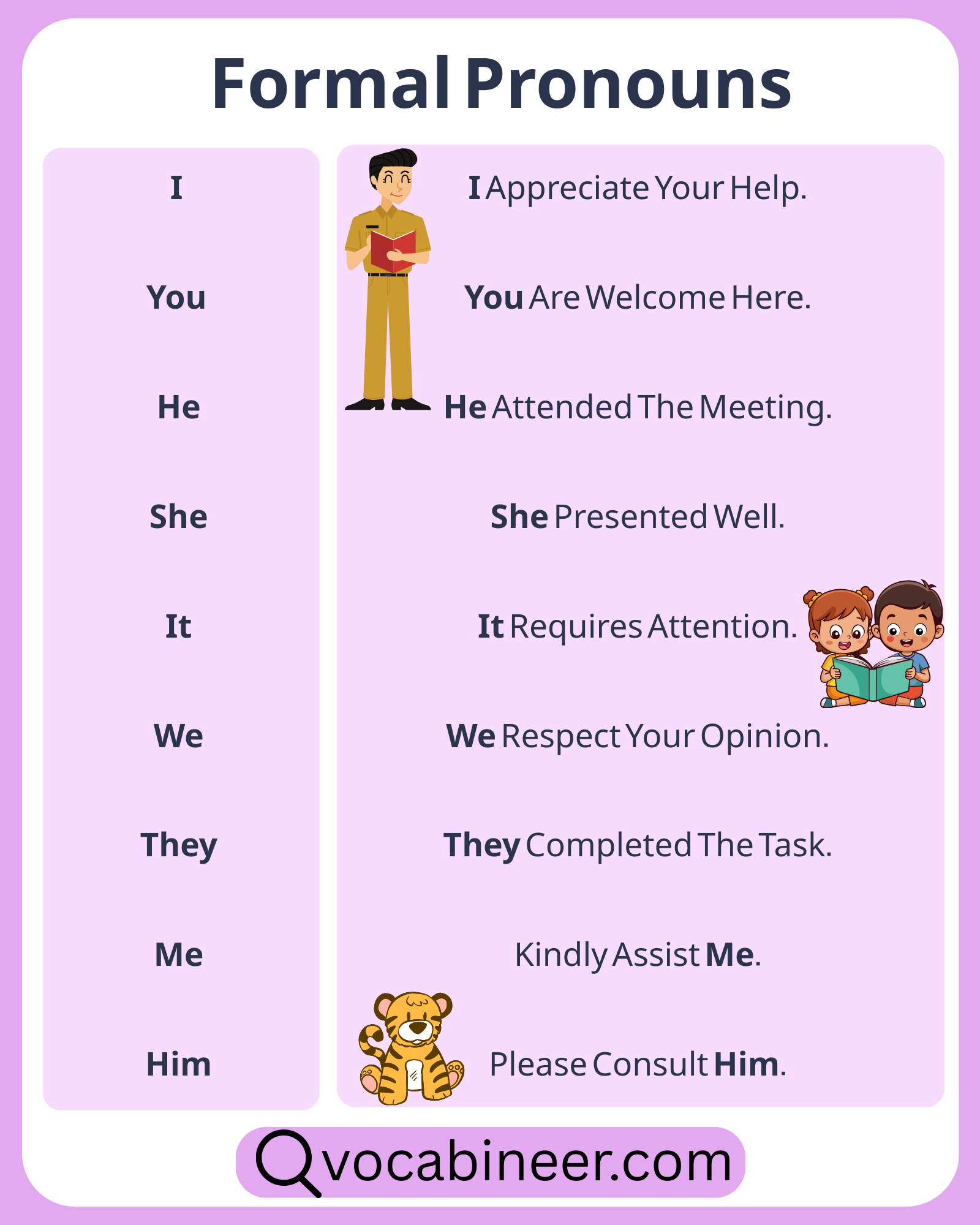
Formal Pronouns Chart
| Pronoun Type | Formal Pronouns | Example |
|---|---|---|
| Subject Pronouns | I, We, He, She, They | She wrote the report. |
| Object Pronouns | Me, Us, Him, Her, Them | The teacher helped them. |
| Relative Pronouns | Who, Whom, Whose, Which | The student whom I called answered. |
| General Pronouns | One, A person, They | One should speak politely. |
Subject Pronouns in Formal Writing
Subject pronouns are used as the subject of a sentence. They show who performs the action.
I
Use I when the speaker is the subject of the sentence. In formal writing, avoid using me as the subject.
Example: I submitted the application on time.
We
Use we when the speaker and one or more people are the subject. It is common in formal reports, group work, and presentations.
Example: We reviewed the results carefully.
He
Use he when referring to a male person as the subject of a sentence.
Example: He completed the assignment before the deadline.
She
Use she when referring to a female person as the subject of a sentence.
Example: She explained the answer clearly.
They
Use they for more than one person. It can also be used as a singular pronoun when the gender is unknown, unspecified, or when someone uses they as their pronoun.
Example: They prepared the documents for the meeting.
Object Pronouns in Formal Writing
Object pronouns receive the action in a sentence. They are used after verbs or prepositions.
Me
Use me when the speaker receives the action. Do not use I after a verb or preposition when an object is needed.
Example: The manager called me yesterday.
Us
Use us when the speaker and others receive the action.
Example: The instructor gave us clear instructions.
Him
Use him when referring to a male person as the object of a sentence.
Example: The principal thanked him for his help.
Her
Use her when referring to a female person as the object of a sentence.
Example: The committee selected her for the award.
Them
Use them when referring to more than one person as the object. It can also be used as a singular object pronoun for a person whose gender is unknown or unspecified.
Example: The teacher asked them to wait outside.
Relative Pronouns in Formal Sentences
Relative pronouns connect extra information to a noun. They are common in formal writing because they help make sentences more detailed and precise.
Who
Use who for people when the pronoun is the subject of the relative clause.
Example: The student who won the prize gave a speech.
Whom
Use whom for people when the pronoun is the object of a verb or preposition. It sounds more formal than who in many sentences.
Example: The officer whom we met was very helpful.
Whose
Use whose to show possession or connection.
Example: The writer whose article was published thanked the editor.
Which
Use which for animals, things, ideas, or extra information about a whole clause.
Example: The report, which was completed yesterday, is ready for review.
Formal Pronouns for General People
Some pronouns and pronoun phrases are useful when speaking about people in a general way. They often appear in formal, academic, or professional writing.
One
One is a formal pronoun used to talk about people in general. It can sound very formal, so it is best for essays, rules, advice, and general statements.
Example: One should respect the opinions of others.
A Person
A person is not a pronoun, but it is often used like a formal alternative when making general statements. It sounds clearer and less stiff than one in many sentences.
Example: A person should check the instructions before starting the test.
They
They can refer to people in general, a group of people, or one person whose gender is unknown or unspecified. It is common in modern formal English when used clearly.
Example: If a student has a question, they should ask the teacher.
Formal vs Informal Pronouns
Formal English usually uses correct pronoun case, clearer wording, and less casual sentence structure. Informal English may sound natural in conversation but less suitable for essays or professional writing.
| Informal Sentence | Formal Sentence |
|---|---|
| Me and Sara finished the project. | Sara and I finished the project. |
| Him and I talked after class. | He and I talked after class. |
| It was me who answered. | It was I who answered. |
| Who should I send this to? | To whom should I send this? |
| You should always be honest. | One should always be honest. |
| This is the person who I called. | This is the person whom I called. |
Common Mistakes with Formal Pronouns
Pronoun mistakes are common in formal writing, especially with I/me, who/whom, and general pronouns.
Using “me” as a subject
Incorrect: Me and John attended the meeting.
Correct: John and I attended the meeting.
Using “I” as an object
Incorrect: The teacher helped John and I.
Correct: The teacher helped John and me.
Using “who” where “whom” is more formal
Informal: Who did you call?
Formal: Whom did you call?
Using “you” in academic general statements
Informal: You should revise before the exam.
Formal: One should revise before the exam.
Natural formal option: Students should revise before the exam.
Using unclear “they”
Unclear: When the student met the teacher, they were upset.
Clear: When the student met the teacher, the student was upset.
Clear: When the student met the teacher, the teacher was upset.
FAQs
Formal pronouns are pronouns used correctly in careful, polite, academic, or professional English. They are not always separate pronouns, but standard forms such as I, me, who, whom, one, and they can sound formal when used properly.
Yes, whom is often used in formal English when referring to the object of a verb or preposition. For example, The person whom I met was kind sounds more formal than The person who I met was kind.
Yes, they can be formal when used clearly. It can refer to more than one person or to a single person whose gender is unknown, unspecified, or identified as they.
Use I as the subject of a sentence and me as the object. For example, Sara and I wrote the report is correct, while The teacher helped Sara and me is also correct.
Formal pronoun use follows standard grammar and sounds suitable for essays, reports, letters, and professional writing. Informal pronoun use may sound natural in speech but can include casual patterns such as me and John, it’s me, or who did you call?
Summary
Formal pronouns in English are pronouns used carefully in polite, academic, or professional writing. They include subject pronouns, object pronouns, relative pronouns, and general pronouns such as one and they. Learning formal pronoun use helps you write clearer sentences, avoid common grammar mistakes, and choose the right tone for formal communication.
Read More
- List of Pronouns in English
- Subject Pronouns in English
- First Person Pronouns in English
- Possessive Pronouns in English
- Reciprocal Pronouns in English