Informal pronouns are ordinary pronouns used in casual speech, texting, and everyday conversation. They are not a separate pronoun type like personal, possessive, or reflexive pronouns.
For example, “It’s me” is a natural informal sentence, while “It is I” sounds very formal or old-fashioned. Informal pronouns help English sound relaxed, friendly, and natural in daily communication.
In This Page
What Are Informal Pronouns?
Informal pronouns are regular pronouns used in a casual way. They often appear in conversations, text messages, friendly emails, and everyday speech.
Examples:
- You never know what will happen.
- Shall we start?
- They say it will rain.
- It’s me.
- That was fun.
- Someone left their phone.
In these examples, the pronouns are common English pronouns, but their use sounds natural and informal.
Informal pronouns are not a special grammar category. They are normal pronouns used in relaxed situations.
Informal Pronouns List
Here is a useful list of pronouns often used in informal English:
- I
- Me
- You
- We
- Us
- They
- Them
- It
- This
- That
- Everyone
- Someone
- Anybody
- Anything
These pronouns are not informal by themselves. They become informal because of how they are used in casual speech or writing.
Examples:
- You coming?
- We still meeting?
- They said yes.
- That was amazing.
- Someone forgot their bag.
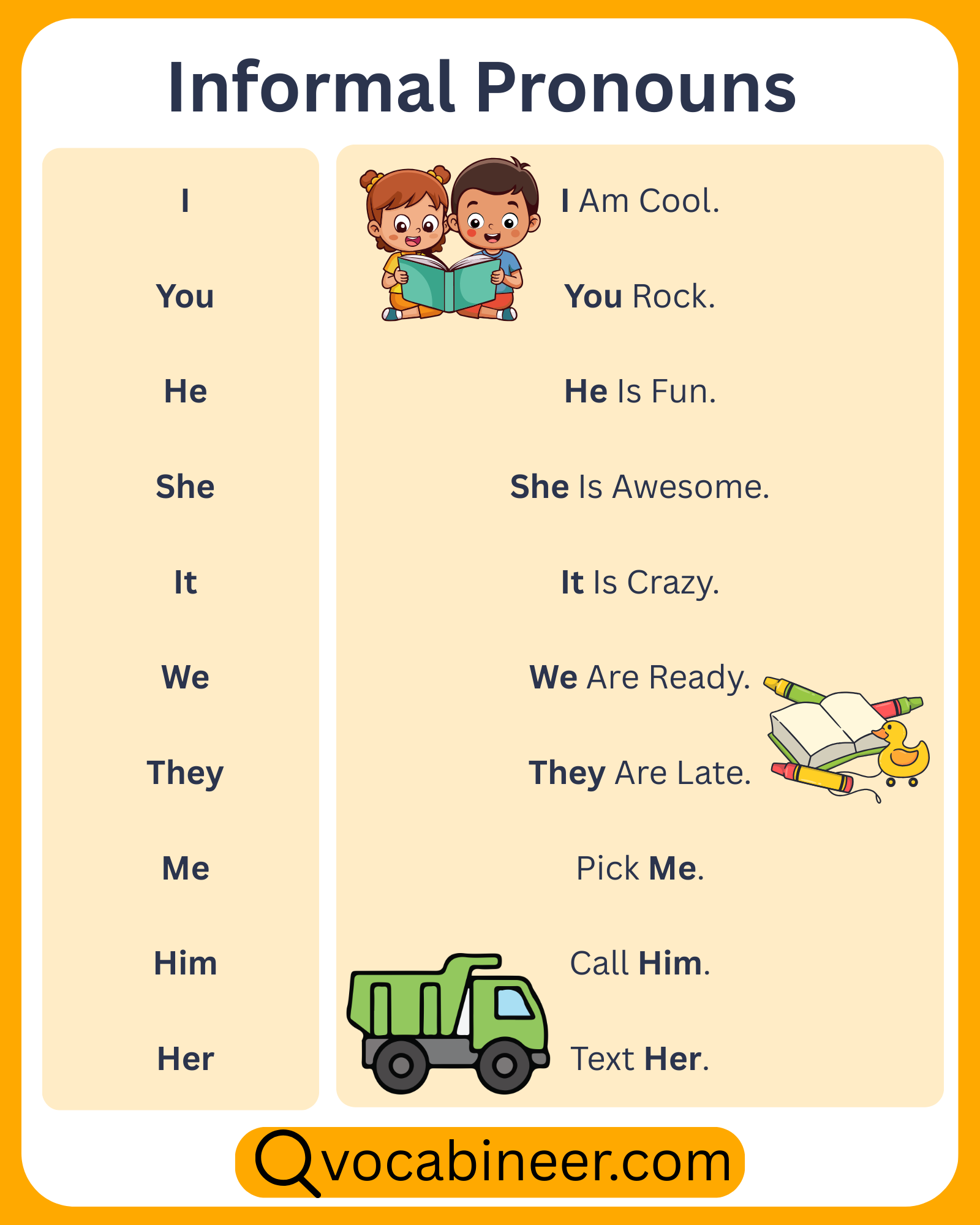
Informal Pronouns Chart
| Informal Pronoun Use | Meaning | Example |
|---|---|---|
| General you | People in general | You never know what will happen. |
| Friendly we | Speaker + listener or group | Shall we start? |
| Vague they | People, authorities, or sources in general | They say it will rain. |
| Natural object form | Casual identity phrase | It’s me. |
| Casual this/that | Refers to a situation or idea | That was fun. |
| General someone/anybody | Unknown person | Someone left their phone. |
This chart shows common ways pronouns appear in informal English. These uses are especially common in speaking, chatting, texting, and relaxed writing.
Formal vs Informal Pronouns
Some pronoun forms sound formal, while others sound natural in everyday English.
| Formal | Informal / Natural |
|---|---|
| It is I. | It’s me. |
| One should be careful. | You should be careful. |
| My friends and I are going. | Me and my friends are going. (casual speech) |
| The students submitted their work. | They turned in their work. |
| The person should bring his or her book. | Someone should bring their book. |
Informal pronouns are common in everyday conversation, but formal writing often needs clearer and more careful wording.
Examples:
- Informal: You should always check your work.
- Formal: Students should always check their work.
- Informal: They changed the rule.
- Formal: The school changed the rule.
You in Informal English
In informal English, you can mean the listener, but it can also mean people in general.
Examples:
- You never know what will happen.
- You can’t always get what you want.
- In this city, you see bikes everywhere.
- When you practice daily, you improve faster.
In these sentences, you does not mean only one specific person. It means people in general.
This use of you is common in conversation, advice, guides, and friendly explanations.
Examples:
- You should drink water after exercise.
- You need patience when learning a language.
- You can save money by cooking at home.
In formal writing, you can often replace general you with a noun.
| Informal | Formal |
|---|---|
| You should check your answer. | Students should check their answers. |
| You can see the problem clearly. | Readers can see the problem clearly. |
| You need strong evidence. | Writers need strong evidence. |
We in Informal English
In informal English, we can create a friendly, shared, or inclusive tone. It can refer to the speaker and listener, or to a whole group.
Examples:
- Shall we start?
- Are we ready?
- How are we feeling today?
- We don’t do that here.
- We can try again tomorrow.
Sometimes we makes a sentence sound warmer and more polite.
Compare:
- Direct: Start now.
- Friendly: Shall we start now?
- Direct: Are you ready?
- Friendly: Are we ready?
This use is common among teachers, parents, doctors, coaches, and speakers who want a friendly tone.
They in Informal English
In informal English, they can refer to a group, unknown people, authorities, or people in general.
Examples:
- They say it will rain tomorrow.
- They changed the rules.
- They are building a new road.
- They told me to wait.
- They don’t allow phones here.
Sometimes they is vague because we do not know exactly who the people are.
Example:
- They say prices will rise.
This sentence may mean experts, news sources, people online, or people in general.
In formal writing, it is better to name the source when possible.
| Informal | Formal |
|---|---|
| They say prices will rise. | Economists say prices will rise. |
| They changed the rule. | The school changed the rule. |
| They told us to wait. | The staff told us to wait. |
It’s Me and Other Informal Pronoun Forms
In everyday English, people usually say “It’s me” instead of “It is I.”
| Formal / Traditional | Informal / Natural |
|---|---|
| It is I. | It’s me. |
| It was he. | It was him. |
| It was she. | It was her. |
| This is she. | This is her. |
Examples:
- It’s me at the door.
- Yes, it was him.
- I think it was her.
- Is this Anna? Yes, this is her.
In everyday speech, object pronouns like me, him, and her sound natural after forms of be.
Formal forms like “It is I” are grammatically traditional, but they sound very formal, old-fashioned, or dramatic in normal conversation.
Informal Pronouns in Conversation and Texting
Informal pronouns are very common in everyday speech and messages. Sentences are often shorter in texting and casual conversation.
Examples:
- You coming?
- We still meeting?
- They said yes.
- That was amazing.
- It was so funny.
- Someone left their bag.
- Anybody home?
- This is great.
Some informal messages leave out words that are understood.
Full sentence:
- Are you coming?
Informal message:
- You coming?
Full sentence:
- Are we still meeting?
Informal message:
- We still meeting?
This style is common in texting and casual speech, but it is not suitable for formal essays or professional reports.
Old Informal Pronouns: Thou, Thee, Thy, and Thine
Older English had pronouns such as thou, thee, thy, and thine. These were once used for singular you, often in familiar or informal situations.
| Old Pronoun | Meaning |
|---|---|
| Thou | you as subject |
| Thee | you as object |
| Thy | your before a noun |
| Thine | yours |
Examples:
- Thou art kind.
- I thank thee.
- This is thy book.
- The choice is thine.
In modern English, these words are not normal informal speech. They now sound old-fashioned, poetic, religious, or historical.
For everyday English, use you, your, and yours instead.
Informal Pronouns vs Formal Writing
Informal pronouns are fine in conversation, texting, and casual writing. In formal writing, use clearer and more standard forms.
| Informal Sentence | Better Formal Version |
|---|---|
| You should check your work. | Students should check their work. |
| They say the rule changed. | The school announced that the rule changed. |
| Me and Sara finished it. | Sara and I finished it. |
| It’s me who called. | I am the person who called. |
| We don’t do that here. | This organization does not allow that. |
Informal writing is relaxed and personal. Formal writing is clearer, more specific, and more careful.
Use informal pronouns in:
- friendly chats
- text messages
- casual emails
- daily conversation
- social media captions
Use more formal pronoun choices in:
- essays
- reports
- business writing
- exams
- official documents
Common Mistakes with Informal Pronouns
Some informal pronoun forms are common in speech but should be avoided in formal writing.
| Casual / Incorrect in Formal Writing | Better Formal Writing |
|---|---|
| Me and Sara went home. | Sara and I went home. |
| Them are outside. | They are outside. |
| Her is my friend. | She is my friend. |
| They said it is true. (unclear source) | The teacher said it is true. |
| You can see many problems in this report. | Readers can see many problems in this report. |
| It’s me in a formal answer. | I am the person. |
Some informal forms are natural in speech but not ideal for formal grammar.
Examples:
- Casual: Me and my brother went shopping.
- Formal: My brother and I went shopping.
- Casual: Who did you give it to?
- Very formal: To whom did you give it?
- Casual: It’s me.
- Formal: It is I. / I am the person.
Quick Rules to Remember
| Rule | Example |
|---|---|
| Informal pronouns are ordinary pronouns used casually. | It’s me. |
| Use general you for people in general. | You never know. |
| Use friendly we for shared tone. | Shall we start? |
| Use vague they carefully. | They changed the rule. |
| Use clearer nouns in formal writing. | The school changed the rule. |
| Avoid casual subject mistakes in formal writing. | Sara and I went home. |
Simple reminders:
- It’s me is normal in everyday English.
- General you can mean people in general.
- Vague they is common in speech but unclear in formal writing.
- Me and Sara is casual; Sara and I is formal and correct.
- Old forms like thou and thee are not modern informal English.
FAQs
Informal pronouns are ordinary pronouns used in casual speech, texting, and everyday conversation. They are not a separate pronoun type in standard grammar.
No. Informal pronouns are not a separate grammar category. They are normal pronouns used in informal ways, such as general you, vague they, friendly we, and natural forms like it’s me.
Examples include you in “You never know,” we in “Shall we start?”, they in “They say it will rain,” and me in “It’s me.”
Yes. It’s me is correct and natural in everyday English. It is I is the traditional formal version, but it sounds old-fashioned in normal conversation.
Formal pronoun use is more careful and standard, while informal pronoun use is more relaxed and conversational. For example, “Sara and I went” is formal, while “Me and Sara went” is casual speech.
Summary
Informal pronouns are normal pronouns used in casual speech, texting, and everyday conversation. They are not a separate pronoun type, but they help English sound relaxed and natural.
Common informal patterns include general you, friendly we, vague they, casual this/that, and natural identity forms like it’s me. In formal writing, use clearer nouns, standard subject forms, and more specific wording when needed.
Read More
- List of Pronouns in English
- Subject Pronouns in English
- First Person Pronouns in English
- Pronouns for Kids in English
- Pronouns for People in English