Pronouns for people are words we use instead of repeating a person’s name or noun. Common pronouns for people include I, me, you, he, she, we, they, him, her, us, and them.
For example, instead of saying “Mia is here. Mia has Mia’s book,” we can say “Mia is here. She has her book.” Here, she replaces Mia, and her shows that the book belongs to Mia. These pronouns help us talk about ourselves, listeners, and other people clearly.
In This Page
What Are Pronouns for People?
Pronouns for people are pronouns that refer to a speaker, listener, person, or group of people. They help us speak and write without repeating names again and again.
Examples:
- I am ready.
- Please help me.
- You are kind.
- He is my brother.
- I called him yesterday.
- She is my teacher.
- I helped her.
- We are classmates.
- The teacher helped us.
- They are outside.
- We invited them.
In simple words, pronouns for people help us talk about ourselves, the person we are speaking to, and other people.
Pronouns for People List
Here is a useful list of common pronouns for people in English:
- I
- Me
- You
- He
- Him
- She
- Her
- We
- Us
- They
- Them
- My
- Mine
- Your
- Yours
- His
- Hers
- Our
- Ours
- Their
- Theirs
- Myself
- Yourself
- Yourselves
- Himself
- Herself
- Ourselves
- Themselves
- Themself
These pronouns can work as subject pronouns, object pronouns, possessive forms, or reflexive forms.
Examples:
- She is reading.
- I called her.
- This is her notebook.
- The notebook is hers.
- She made it herself.
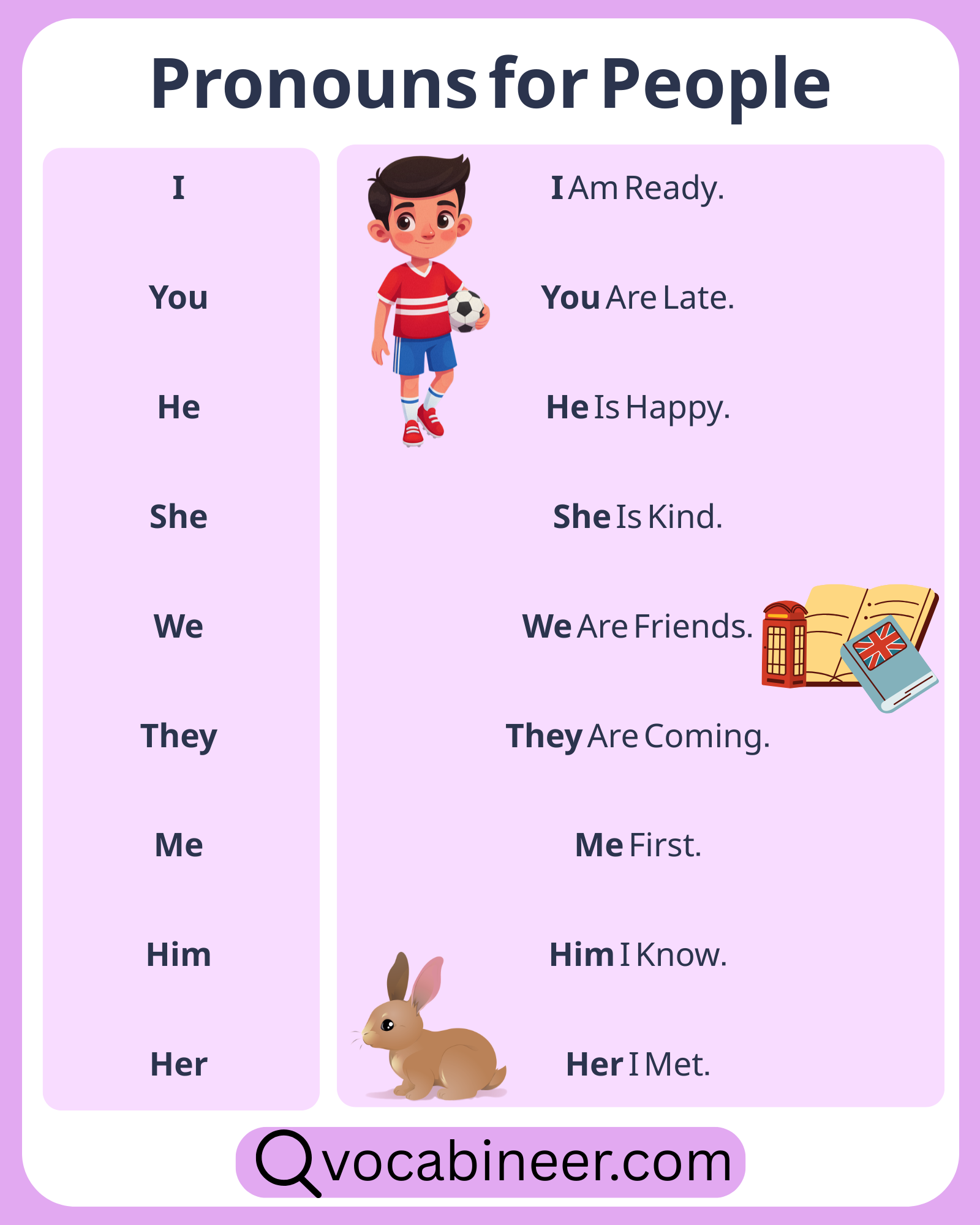
Pronouns for People Chart
| Person | Subject | Object | Possessive Adjective | Possessive Pronoun | Reflexive |
|---|---|---|---|---|---|
| Speaker | I | me | my | mine | myself |
| Listener | you | you | your | yours | yourself / yourselves |
| Male person | he | him | his | his | himself |
| Female person | she | her | her | hers | herself |
| Group including speaker | we | us | our | ours | ourselves |
| Group / unknown / neutral person | they | them | their | theirs | themselves / themself |
This chart shows how people pronouns change depending on their job in the sentence. For example, he is a subject pronoun, him is an object pronoun, his shows possession, and himself refers back to the same person.
He, She, and They for People
Use he, she, and they when talking about people who are not the speaker or listener.
Use he/him/his for a male person or someone who uses he/him pronouns.
Examples:
- He is my brother.
- I called him after school.
- This is his bag.
- The blue notebook is his.
- He introduced himself.
Use she/her/hers for a female person or someone who uses she/her pronouns.
Examples:
- She is my sister.
- I helped her with homework.
- This is her book.
- The red folder is hers.
- She made the card herself.
Use they/them/their for a group, an unknown person, a neutral person, or someone who uses they/them pronouns.
Examples:
- They are my friends.
- We invited them to the party.
- This is their classroom.
- The final choice is theirs.
- They prepared the room themselves.
- Jordan said they will arrive soon.
I, You, and We for People
Some people pronouns refer to the speaker, the listener, or a group that includes the speaker.
| Pronoun | Meaning | Example |
|---|---|---|
| I / me | The speaker | I am ready. / Help me. |
| You | The listener or reader | You are kind. / I called you. |
| We / us | The speaker and others | We are learning. / The teacher helped us. |
Use I when the speaker does the action.
Examples:
- I like English.
- I finished my homework.
- I need some help.
Use me when the speaker receives the action.
Examples:
- Please help me.
- The teacher called me.
- She gave me a book.
Use you for the person or people being spoken to.
Examples:
- You are welcome here.
- I saw you yesterday.
- This is your seat.
- This seat is yours.
Use we and us for a group that includes the speaker.
Examples:
- We are classmates.
- We joined the meeting.
- The coach trained us.
- This project is ours.
Gender Pronouns for People
Gender pronouns are the pronouns people use when others talk about them. Common gender pronoun sets include he/him, she/her, and they/them.
| Pronoun Set | Examples |
|---|---|
| he / him / his | He is here. I called him. This is his bag. |
| she / her / hers | She is here. I called her. This bag is hers. |
| they / them / theirs | They are here. I called them. This bag is theirs. |
Examples:
- Mark said he will come later.
- Sofia said she is ready.
- Jordan said they need more time.
- I gave him the message.
- I gave her the message.
- I gave them the message.
Using the correct pronouns helps us speak about people clearly and respectfully.
Singular They for People
They can refer to more than one person, but it can also refer to one person. This is called singular they.
Use singular they when:
- the person’s gender is unknown
- the person’s gender is not important
- a person uses they/them pronouns
Examples when gender is unknown:
- Someone left their phone here.
- A student should bring their notebook.
- If anyone calls, tell them I am busy.
- Each guest should take their seat.
Examples for one known person:
- Jordan said they will arrive soon.
- I gave them the message.
- This jacket is theirs.
- Jordan introduced themself.
Singular they is useful because it avoids guessing a person’s gender and keeps sentences natural.
Pronouns for People vs Things and Animals
Pronouns for people are different from pronouns for things and sometimes animals.
| Use | Common Pronouns | Example |
|---|---|---|
| People | he, she, they, you, we | She is my friend. |
| Things | it | The chair is old. It is broken. |
| Animals | it / he / she / they | My dog is playful. He loves walks. |
Use he, she, or they for people.
Examples:
- He is my cousin.
- She is my teacher.
- They are my neighbors.
Use it for things.
Examples:
- The phone is new. It works well.
- The bag is heavy. It is mine.
- The door is open. It needs to be closed.
Use it, he, or she for animals depending on context.
Examples:
- I saw a bird. It was fast.
- Luna is my cat. She is sleeping.
- Max is my dog. He loves walks.
- The horses ran fast. They looked strong.
Why We Usually Avoid “It” for People
In modern English, it is usually not used for people because it can sound impersonal or disrespectful.
Incorrect or unnatural:
- The teacher is nice. It helped me.
- My friend is here. It is waiting outside.
- The student is late. It forgot the book.
Correct:
- The teacher is nice. She helped me.
- The teacher is nice. He helped me.
- The teacher is nice. They helped me.
- My friend is here. They are waiting outside.
- The student is late. He/She/They forgot the book.
There are a few fixed expressions, such as “It’s a boy” or “It’s a girl” when announcing a baby. However, in normal sentences about people, use he, she, or they, not it.
People Pronouns in Sentences
Here are useful examples of pronouns for people in sentences.
Subject pronouns
- I am ready.
- You are helpful.
- He is my brother.
- She is reading.
- We are learning English.
- They are outside.
Object pronouns
- Please help me.
- I called you.
- We invited him.
- The teacher praised her.
- The coach trained us.
- I saw them yesterday.
Possessive adjectives
- This is my book.
- Is this your seat?
- This is his bag.
- That is her notebook.
- This is our classroom.
- That is their house.
Possessive pronouns
- This book is mine.
- That seat is yours.
- The blue bag is his.
- The red folder is hers.
- This room is ours.
- The final choice is theirs.
Reflexive pronouns
- I did it myself.
- You should trust yourself.
- He introduced himself.
- She made it herself.
- We prepared ourselves.
- They helped themselves.
Common Mistakes with Pronouns for People
Learners often confuse subject, object, possessive, and reflexive forms. Here are common mistakes and correct forms.
| Incorrect | Correct |
|---|---|
| Him is my friend. | He is my friend. |
| Her is reading. | She is reading. |
| I called he. | I called him. |
| I helped she. | I helped her. |
| This is she bag. | This is her bag. |
| This bag is her. | This bag is hers. |
| They invited we. | They invited us. |
| This is them classroom. | This is their classroom. |
| Someone left his bag. (gender unknown) | Someone left their bag. |
| The teacher is nice. It helped me. | The teacher is nice. She/He/They helped me. |
A simple way to avoid mistakes is to check the pronoun’s job in the sentence. Ask yourself: Is the pronoun doing the action, receiving the action, showing ownership, or referring back to the same person?
Quick Rules to Remember
| Rule | Example |
|---|---|
| Use I/me for the speaker. | I am ready. / Help me. |
| Use you for the listener. | You are kind. |
| Use he/she/they for people being discussed. | She is my friend. |
| Use we/us for a group including the speaker. | We are ready. / Help us. |
| Use they for a group. | They are outside. |
| Use singular they when gender is unknown or used by a person. | Someone left their bag. |
| Avoid it for people in normal use. | Not: The teacher is nice. It helped me. |
Simple reminders:
- Use he, not him, as a subject.
- Use she, not her, as a subject.
- Use him and her as objects.
- Use her before a noun, but hers alone.
- Use their before a noun, but theirs alone.
- Use they when referring to a group or one person whose pronoun is they/them.
FAQs
Common pronouns for people include I, me, you, he, him, she, her, we, us, they, them, my, mine, your, yours, his, hers, our, ours, their, and theirs.
Examples include I in “I am ready,” she in “She is reading,” him in “I called him,” they in “They are outside,” and their in “This is their house.”
Yes, they can refer to one person. Singular they is used when gender is unknown, not important, or when a person uses they/them pronouns.
We usually avoid it for people because it can sound impersonal or disrespectful. Use he, she, or they when talking about a person.
Gender pronouns are the pronouns people use when others talk about them. Common sets include he/him, she/her, and they/them.
Summary
Pronouns for people help us avoid repeating names and nouns. Common people pronouns include I, me, you, he, she, we, they, him, her, us, and them.
Use I/me for the speaker, you for the listener, he/she/they for people being discussed, and we/us for a group including the speaker. Use they for groups, unknown gender, or someone who uses they/them pronouns. Avoid using it for people in normal English.
Read More
- List of Pronouns in English
- Subject Pronouns in English
- First Person Pronouns in English
- Reciprocal Pronouns in English
- Negative Pronouns in English