

Interrogative pronouns are words we use to ask questions about people, things, ownership, choices, ideas, or information. The main interrogative pronouns in English are who, whom, whose, which, and what.
For example, in the question “Who is calling?”, the word who asks about a person. In “What happened?”, the word what asks about a thing, event, or information.
In This Page
What Are Interrogative Pronouns?
Interrogative pronouns are pronouns used to ask questions. They replace the unknown answer in a question.
Examples:
- Who is at the door?
- Whom did you invite?
- Whose is this?
- Which do you prefer?
- What happened?
In these questions, the interrogative pronoun stands in place of the answer.
For example:
- Who is at the door?
Answer: Sara is at the door. - What is missing?
Answer: The book is missing.
So, who replaces an unknown person, and what replaces unknown information or a thing.
Interrogative Pronouns List
Here is the main list of interrogative pronouns in English:
- Who
- Whom
- Whose
- Which
- What
These words are used to ask different kinds of questions.
Examples:
- Who called you?
- Whom did they choose?
- Whose are these?
- Which is correct?
- What did you find?
Each interrogative pronoun asks about a different type of answer.
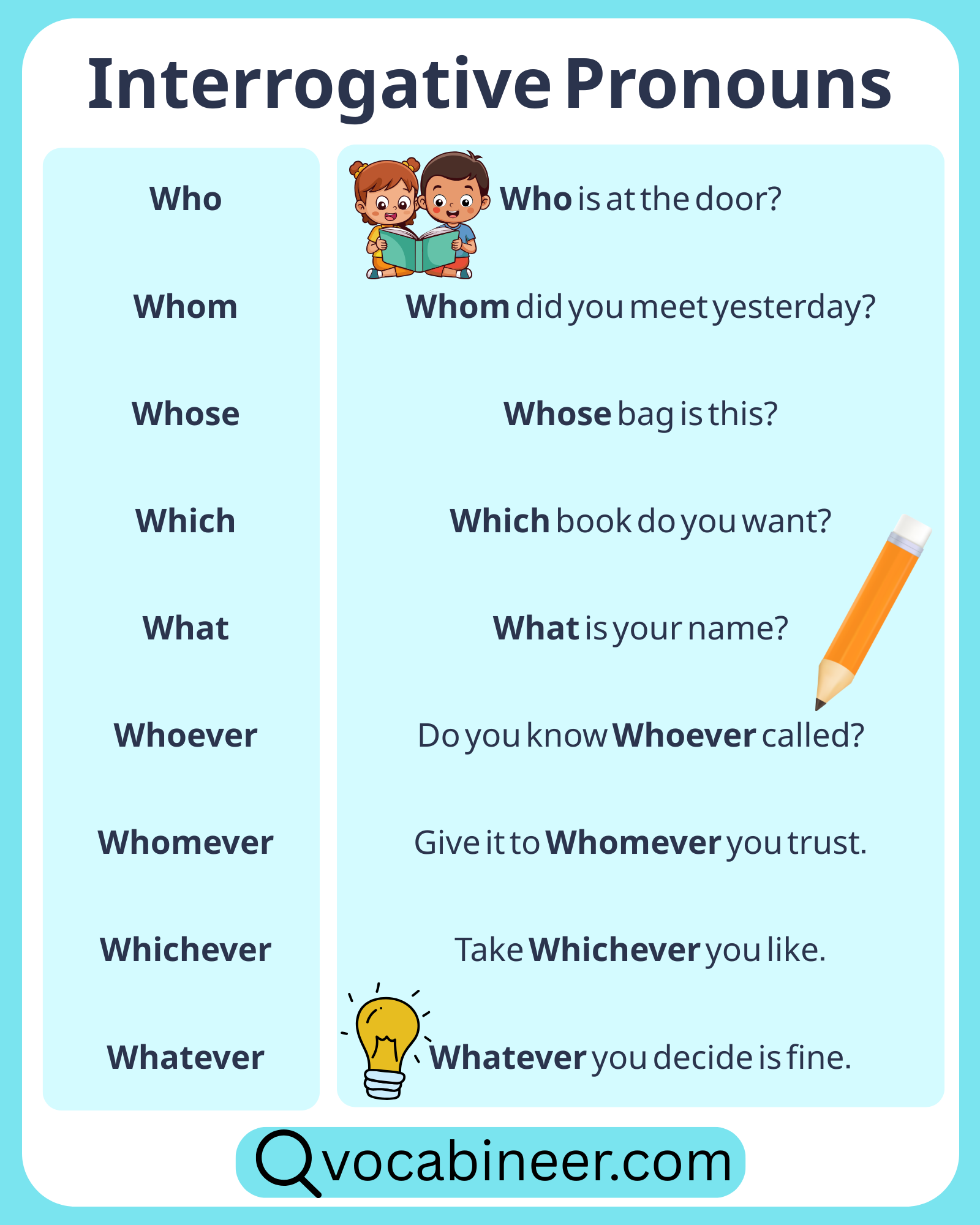
Interrogative Pronouns Chart
| Interrogative Pronoun | Use | Example |
|---|---|---|
| Who | Asks about a person | Who is calling? |
| Whom | Asks about a person as object | Whom did you invite? |
| Whose | Asks about ownership | Whose is this? |
| Which | Asks about a choice | Which do you prefer? |
| What | Asks about a thing, idea, or information | What happened? |
This chart shows the basic use of each interrogative pronoun. Use who and whom for people, whose for ownership, which for choices, and what for things, ideas, events, or information.
How Interrogative Pronouns Work
Interrogative pronouns work by replacing the unknown answer in a question.
Examples:
- Who is calling?
Unknown answer: a person - What happened?
Unknown answer: an event or situation - Which do you prefer?
Unknown answer: one choice - Whose is this?
Unknown answer: the owner
Interrogative pronouns can be used as subjects, objects, or possessive forms in questions.
Examples:
- Who called you?
Who is the subject. - Whom did you call?
Whom is the object. - Whose is this?
Whose asks about possession.
Who as an Interrogative Pronoun
Use who to ask about a person. Who is usually used when the unknown person is the subject of the question.
Examples:
- Who is at the door?
- Who called you?
- Who wants tea?
- Who wrote this answer?
- Who helped you?
- Who is your teacher?
- Who opened the window?
- Who lives next door?
In these questions, who asks about a person doing the action or being described.
Example:
- Who called you?
Answer: Emma called me.
Here, who asks about the person who did the action.
Whom as an Interrogative Pronoun
Use whom to ask about a person who receives the action. Whom is more formal than who and is often used in formal writing.
Examples:
- Whom did you invite?
- Whom should we ask?
- Whom did they choose?
- Whom did the teacher praise?
- Whom are you calling?
- Whom did she help?
In everyday spoken English, many people use who instead of whom.
Formal:
- Whom did you invite?
Common in speech:
- Who did you invite?
Both are widely understood, but whom is the more formal object form.
Whose as an Interrogative Pronoun
Use whose to ask about ownership. Whose asks who something belongs to.
Examples:
- Whose is this?
- Whose are these?
- Whose did you borrow?
- Whose was missing?
- Whose should we return first?
Whose can stand alone as an interrogative pronoun.
Examples:
- Whose is this bag? (whose comes before a noun, so it acts like a determiner)
- Whose is this? (whose stands alone, so it acts as a pronoun)
When whose stands alone, it replaces the noun idea.
Example:
- Whose is this?
Meaning: Whose thing is this?
Which as an Interrogative Pronoun
Use which to ask about a choice from a known or limited set.
Examples:
- Which do you prefer?
- Which is correct?
- Which should I choose?
- Which came first?
- Which belongs to you?
- Which is better?
- Which of these is yours?
Use which when the options are clear or limited.
Examples:
- Which do you want, tea or coffee?
- Which is your bag, the red one or the blue one?
- Which of the two answers is correct?
Here, which asks the listener to choose from known options.
What as an Interrogative Pronoun
Use what to ask about a thing, idea, action, event, or general information.
Examples:
- What happened?
- What is missing?
- What did you find?
- What caused the problem?
- What made that sound?
- What should we do?
- What is your answer?
- What comes next?
Use what when the answer is open or unknown.
Examples:
- What do you want to eat?
- What did you buy?
- What is in the box?
In these questions, there is no limited set of choices given.
Who vs Whom
Who and whom both ask about people, but they have different grammar jobs.
| Word | Use | Example |
|---|---|---|
| Who | Subject | Who called you? |
| Whom | Object | Whom did you call? |
Use who when the answer could be he, she, or they.
Example:
- Who called you?
- She called me.
Use whom when the answer could be him, her, or them.
Example:
- Whom did you call?
- I called her.
In everyday English, who often replaces whom, especially in speech.
Examples:
- Formal: Whom did you call?
- Common: Who did you call?
What vs Which
What and which both ask about things or choices, but they are used differently.
| Word | Use | Example |
|---|---|---|
| What | Open or general choice | What do you want to eat? |
| Which | Limited or known choice | Which do you want, tea or coffee? |
Use what when the answer can be many possible things.
Examples:
- What do you want to drink?
- What did you buy?
- What should we do?
Use which when the answer comes from a known set of choices.
Examples:
- Which do you want, tea or coffee?
- Which is your coat, the black one or the brown one?
- Which of these answers is correct?
Simple rule:
- What = open choice.
- Which = limited choice.
Whose vs Who’s
Whose and who’s sound the same, but they have different meanings.
| Word | Meaning | Example |
|---|---|---|
| Whose | Shows ownership | Whose is this? |
| Who’s | Means “who is” or “who has” | Who’s calling? |
Use whose when asking about ownership.
Examples:
- Whose is this?
- Whose bag is this?
- Whose are these shoes?
Use who’s when you mean who is or who has.
Examples:
- Who’s at the door?
Meaning: Who is at the door? - Who’s finished the work?
Meaning: Who has finished the work?
Common mistake:
- Incorrect: Who’s book is this?
- Correct: Whose book is this?
Interrogative Pronouns vs Interrogative Adjectives
Some question words can be interrogative pronouns or interrogative adjectives. The difference depends on whether the word stands alone or comes before a noun.
| Interrogative Pronoun | Interrogative Adjective / Determiner |
|---|---|
| Which is yours? | Which book is yours? |
| What happened? | What time is it? |
| Whose is this? | Whose bag is this? |
Simple rule:
- If the question word stands alone, it is an interrogative pronoun.
- If it comes before a noun, it works as an interrogative adjective or determiner.
Examples:
- Which is correct?
Which stands alone, so it is a pronoun. - Which answer is correct?
Which comes before answer, so it works as a determiner. - What happened?
What stands alone, so it is a pronoun. - What book did you read?
What comes before book, so it works as a determiner.
Interrogative Pronouns vs Relative Pronouns
Some words can be interrogative pronouns or relative pronouns. The difference depends on the sentence.
Interrogative pronouns ask questions. Relative pronouns connect extra information to a noun.
| Interrogative Use | Relative Use |
|---|---|
| Who is calling? | The girl who called is here. |
| Which is yours? | The book which I bought is new. |
| Whose is this? | The student whose bag was lost is here. |
Examples:
- Who helped you?
This asks a question. - The boy who helped me is kind.
This connects extra information to the boy. - Which do you prefer?
This asks a question. - The book which I bought is new.
This connects extra information to the book.
Interrogative Pronouns in Direct and Indirect Questions
Interrogative pronouns can be used in direct questions and indirect questions.
A direct question asks something directly.
Examples:
- Who is calling?
- What happened?
- Which is better?
- Whose is this?
An indirect question reports or introduces a question inside another sentence.
Examples:
- I wonder who is calling.
- She asked what happened.
- Tell me which is better.
- Do you know whose this is?
In indirect questions, the word order is usually more like a statement.
Compare:
- Direct: What did he say?
- Indirect: I wonder what he said.
Prepositions with Who and Whom
In formal English, whom is often used after a preposition.
Formal examples:
- To whom did you speak?
- With whom are you going?
- For whom is this gift?
- From whom did you hear the news?
In everyday English, the preposition often moves to the end, and who is commonly used.
Natural examples:
- Who did you speak to?
- Who are you going with?
- Who is this gift for?
- Who did you hear the news from?
Both patterns are useful. Use the formal pattern in formal writing, and the natural pattern in everyday speech.
Interrogative Pronouns in Sentences
Here are useful examples of interrogative pronouns in sentences.
Who
- Who is at the door?
- Who called you?
- Who wants tea?
- Who wrote this answer?
- Who helped the teacher?
Whom
- Whom did you invite?
- Whom should we ask?
- Whom did they choose?
- Whom did the teacher praise?
- Whom are you calling?
Whose
- Whose is this?
- Whose are these?
- Whose did you borrow?
- Whose was missing?
- Whose should we return?
Which
- Which do you prefer?
- Which is correct?
- Which should I choose?
- Which belongs to you?
- Which of these is better?
What
- What happened?
- What is missing?
- What did you find?
- What caused the problem?
- What should we do?
Common Mistakes with Interrogative Pronouns
Learners often confuse who, whom, whose, who’s, what, and which. Here are common mistakes and correct forms.
| Incorrect | Correct |
|---|---|
| Whom called you? | Who called you? |
| What of these two do you prefer? | Which of these two do you prefer? |
| Whose bag is this yours? | Whose bag is this? |
| Which happened? | What happened? |
| Who’s book is this? | Whose book is this? |
| Whose calling? | Who’s calling? |
| What do you prefer, tea or coffee? | Which do you prefer, tea or coffee? |
| Whom is at the door? | Who is at the door? |
| Whose did you call? | Whom/Who did you call? |
| Which is your name? | What is your name? |
A simple way to avoid mistakes is to ask what kind of answer you need. For a person as subject, use who. For ownership, use whose. For open information, use what. For a limited choice, use which.
Quick Rules to Remember
| Rule | Example |
|---|---|
| Use who for people as subjects. | Who called you? |
| Use whom for people as objects. | Whom did you call? |
| Use whose for ownership. | Whose is this? |
| Use which for limited choices. | Which do you prefer? |
| Use what for open information. | What happened? |
| Use whose, not who’s, for ownership. | Whose bag is this? |
Simple reminders:
- Who asks about a person.
- Whom asks about a person as an object.
- Whose asks about ownership.
- Which asks about a choice.
- What asks about a thing, idea, event, or information.
- Who’s means who is or who has.
FAQs
Interrogative pronouns are pronouns used to ask questions. The main interrogative pronouns are who, whom, whose, which, and what.
Examples of interrogative pronouns include who, whom, whose, which, and what. Example questions are “Who is calling?”, “Whose is this?”, “Which do you prefer?”, and “What happened?”
Use who when asking about the subject of the action, as in “Who called you?” Use whom when asking about the object, as in “Whom did you call?”
Use what for open or general information. Use which when choosing from a known or limited set, as in “Which do you want, tea or coffee?”
Yes, whose can be an interrogative pronoun when it stands alone, as in “Whose is this?” When it comes before a noun, as in “Whose bag is this?”, it works as an interrogative adjective or determiner.
Summary
Interrogative pronouns are used to ask questions. The main interrogative pronouns in English are who, whom, whose, which, and what. Use who for people as subjects, whom for people as objects, whose for ownership, which for limited choices, and what for open information, things, ideas, or events. Learning these pronouns will help you ask clearer and more accurate questions in English.
Read More
- List of Pronouns in English
- Subject Pronouns in English
- First Person Pronouns in English
- Reciprocal Pronouns in English
- Negative Pronouns in English