

Pronouns with -self and -selves are words that refer back to the subject or add emphasis. Common examples include myself, yourself, himself, herself, itself, ourselves, yourselves, and themselves.
For example, instead of saying “I hurt me,” we say “I hurt myself.” Here, myself refers back to I and shows that the same person did and received the action.
In This Page
What Are Pronouns with -self and -selves?
Pronouns with -self and -selves are special pronouns used when the subject and object are the same, or when we want to add emphasis.
Examples:
- I taught myself.
- You should trust yourself.
- He hurt himself.
- She introduced herself.
- The door closed by itself.
- We prepared ourselves.
- Please help yourselves.
- They enjoyed themselves.
These pronouns are often called reflexive pronouns. They can also work as intensive pronouns when they add emphasis.
Examples:
- Reflexive: She taught herself.
- Intensive: She herself taught the class.
Pronouns with -self and -selves List
Here is the main list of pronouns with -self and -selves:
- Myself
- Yourself
- Himself
- Herself
- Itself
- Ourselves
- Yourselves
- Themselves
- Themself
The forms ending in -self are usually singular. The forms ending in -selves are plural.
Examples:
- I made it myself.
- He blamed himself.
- We did it ourselves.
- They solved the problem themselves.
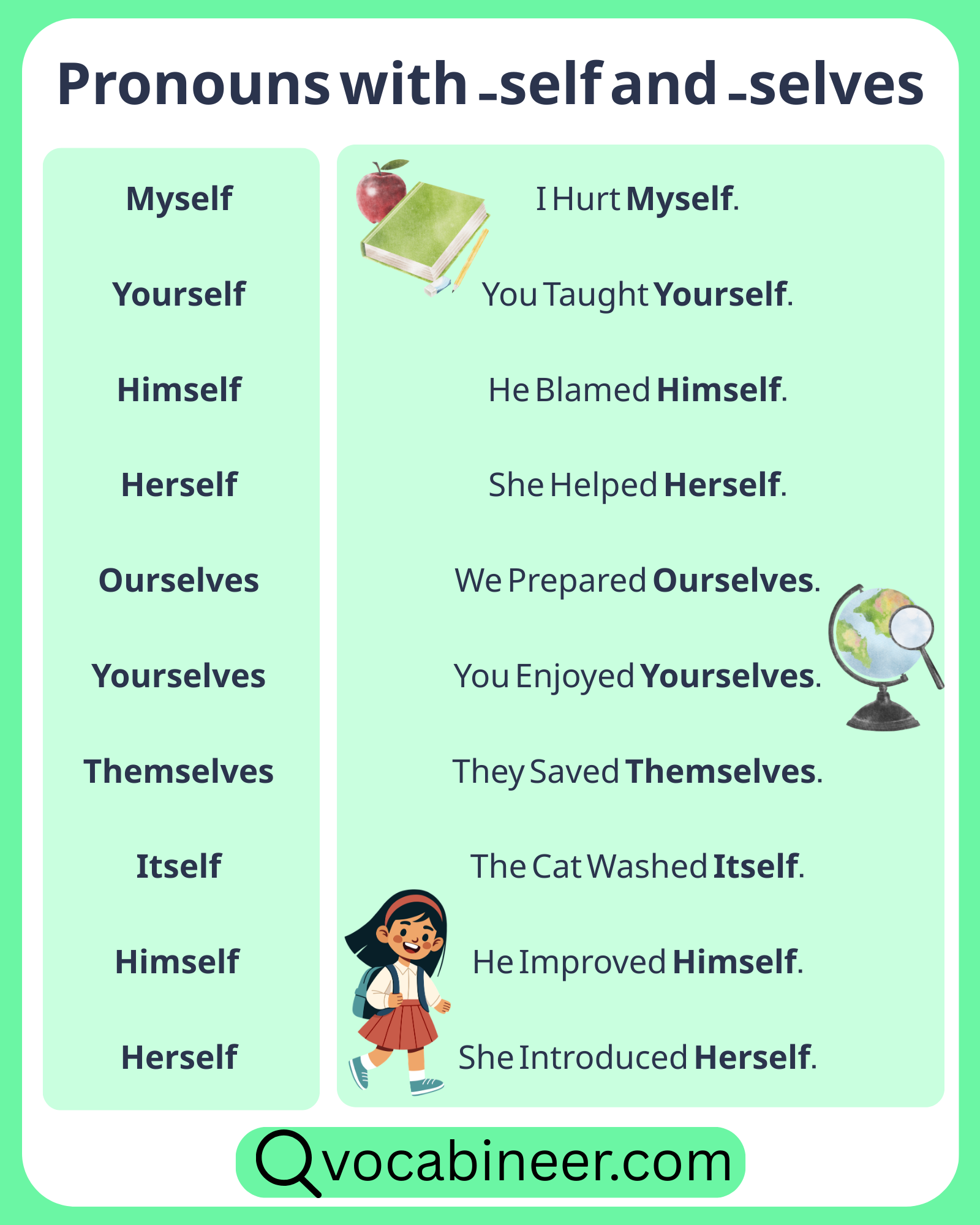
-self and -selves Pronouns Chart
| Base Pronoun | -self / -selves Pronoun | Example |
|---|---|---|
| I | myself | I taught myself. |
| you | yourself | You should help yourself. |
| he | himself | He hurt himself. |
| she | herself | She introduced herself. |
| it | itself | The door closed by itself. |
| we | ourselves | We prepared ourselves. |
| you | yourselves | Please help yourselves. |
| they | themselves | They enjoyed themselves. |
| singular they | themself | Jordan introduced themself. |
This chart shows how -self and -selves pronouns match different base pronouns.
-self vs -selves
The ending -self is used for singular forms. The ending -selves is used for plural forms.
| Ending | Use | Examples |
|---|---|---|
| -self | One person or thing | myself, yourself, himself, herself, itself |
| -selves | More than one person or thing | ourselves, yourselves, themselves |
Examples:
- I hurt myself. (one person)
- He introduced himself. (one person)
- We prepared ourselves. (more than one person)
- They helped themselves. (more than one person)
A simple rule is:
- Use -self for one.
- Use -selves for more than one.
How to Use -self and -selves Pronouns
Use -self and -selves pronouns when the action comes back to the same person, people, or thing.
Examples:
- I cut myself.
- She looked at herself.
- They blamed themselves.
- The machine turned itself off.
These pronouns can also add emphasis.
Examples:
- I myself saw the mistake.
- The teacher herself explained the rule.
- They themselves made the decision.
So, these pronouns have two main uses:
| Use | Example |
|---|---|
| Reflexive use | He hurt himself. |
| Emphatic / intensive use | He himself fixed the problem. |
Reflexive Pronouns
A reflexive pronoun shows that the subject and object are the same person, people, or thing.
Examples:
- I hurt myself.
- You should believe in yourself.
- He blamed himself.
- She taught herself.
- The cat cleaned itself.
- We introduced ourselves.
- The children enjoyed themselves.
In these sentences, the action returns to the subject.
Example:
- She taught herself.
This means she taught her own self.
More examples:
- I saw myself in the mirror.
- He prepared himself for the test.
- We protected ourselves from the rain.
- They reminded themselves about the meeting.
Intensive Pronouns
An intensive pronoun uses the same -self or -selves form to add emphasis. It is not needed to complete the sentence, but it makes the sentence stronger.
Examples:
- I myself heard the news.
- You yourself said that.
- He himself cleaned the room.
- She herself wrote the letter.
- We ourselves made the plan.
- They themselves admitted the mistake.
If you remove the intensive pronoun, the sentence still makes sense.
Examples:
- I myself heard the news.
- I heard the news.
- She herself wrote the letter.
- She wrote the letter.
The meaning remains clear, but the emphasis is weaker.
Reflexive vs Intensive Pronouns
Reflexive and intensive pronouns look the same, but they do different jobs.
| Use | Meaning | Example |
|---|---|---|
| Reflexive pronoun | Subject and object are the same | She taught herself. |
| Intensive pronoun | Adds emphasis | She herself taught the class. |
Simple test:
- If removing the pronoun breaks or changes the meaning, it is reflexive.
- If removing the pronoun only removes emphasis, it is intensive.
Examples:
Reflexive
- He hurt himself.
Without himself, the sentence feels incomplete.
Intensive
- He himself fixed the chair.
Without himself, the sentence still makes sense: He fixed the chair.
More examples:
| Reflexive | Intensive |
|---|---|
| I blamed myself. | I myself made the choice. |
| She taught herself. | She herself taught the lesson. |
| They helped themselves. | They themselves built the house. |
Yourself vs Yourselves
Yourself and yourselves are both used with you, but they are not the same.
Use yourself when speaking to one person. Use yourselves when speaking to more than one person.
| Word | Use | Example |
|---|---|---|
| Yourself | One person | Please introduce yourself. |
| Yourselves | More than one person | Please introduce yourselves. |
Examples with yourself:
- You should trust yourself.
- Please help yourself.
- Did you hurt yourself?
- You can do it yourself.
Examples with yourselves:
- You should all trust yourselves.
- Please help yourselves.
- Did you prepare yourselves?
- You can finish it yourselves.
Themself vs Themselves
Themselves is used for plural they. Themself is sometimes used with singular they.
Examples with plural they:
- The students helped themselves.
- They enjoyed themselves at the party.
- The children prepared themselves for school.
Examples with singular they:
- Jordan introduced themself.
- Alex prepared themself for the interview.
Many speakers also use themselves with singular they.
Example:
- Someone left without introducing themselves.
Both themself and themselves can appear with singular they, but themselves is more common in general English.
Pronouns with “By” for Alone or Without Help
Pronouns with -self and -selves are often used after by. The phrase can mean alone or without help.
Examples:
- I did it by myself.
- She lives by herself.
- He fixed the bike by himself.
- We finished the work by ourselves.
- The children played by themselves.
- The machine started by itself.
The meaning depends on context.
| Phrase | Meaning | Example |
|---|---|---|
| By myself | Alone | I sat by myself. |
| By myself | Without help | I made this by myself. |
More examples:
- She cooked dinner by herself.
- They cleaned the room by themselves.
- We solved the problem by ourselves.
- The door opened by itself.
Pronouns with -self and -selves in Sentences
Here are useful examples of -self and -selves pronouns in sentences.
Myself
- I hurt myself.
- I taught myself English.
- I made the card myself.
- I saw myself in the mirror.
Yourself
- You should believe in yourself.
- Please help yourself.
- Did you cut yourself?
- You can do it yourself.
Himself
- He blamed himself.
- He introduced himself.
- He fixed the chair himself.
- He looked at himself in the mirror.
Herself
- She taught herself.
- She made the cake herself.
- She introduced herself.
- She prepared herself for the test.
Itself
- The door closed by itself.
- The machine turned itself off.
- The cat cleaned itself.
- The problem solved itself.
Ourselves
- We prepared ourselves.
- We did it ourselves.
- We introduced ourselves.
- We reminded ourselves to be careful.
Yourselves
- Please help yourselves.
- You should all introduce yourselves.
- Did you prepare yourselves?
- You can solve it yourselves.
Themselves
- They enjoyed themselves.
- They solved it themselves.
- The students introduced themselves.
- The players prepared themselves for the match.
Common Mistakes with -self and -selves Pronouns
Learners often confuse reflexive pronouns with object pronouns or use myself where I or me is needed.
| Incorrect | Correct |
|---|---|
| I hurt me. | I hurt myself. |
| He introduced him. (same person) | He introduced himself. |
| Please help yourself. (many people) | Please help yourselves. |
| They enjoyed them. (same group) | They enjoyed themselves. |
| Myself went to school. | I went to school. |
| She made the cake by her. | She made the cake by herself. |
| The door closed by it. | The door closed by itself. |
| We prepared us for the test. | We prepared ourselves for the test. |
| The children washed them. (same group) | The children washed themselves. |
| You should trust you. | You should trust yourself. |
A simple way to avoid mistakes is to check whether the subject and object are the same. If they are the same, use a reflexive pronoun.
Examples:
- Correct: I hurt myself.
- Incorrect: I hurt me.
- Correct: She introduced herself.
- Incorrect: She introduced her. (if she introduced her own self)
Quick Rules to Remember
| Rule | Example |
|---|---|
| Use -self for singular forms. | myself, himself, herself |
| Use -selves for plural forms. | ourselves, yourselves, themselves |
| Use reflexive pronouns when subject and object are the same. | I hurt myself. |
| Use intensive pronouns for emphasis. | I myself saw it. |
| Use yourself for one person. | Help yourself. |
| Use yourselves for more than one person. | Help yourselves. |
| Use by myself to mean alone or without help. | I did it by myself. |
| Do not use myself as a normal subject. | Say: I went. |
Simple reminders:
- Myself goes with I.
- Himself goes with he.
- Herself goes with she.
- Itself goes with it.
- Ourselves goes with we.
- Themselves goes with they.
FAQs
Pronouns with -self and -selves are usually called reflexive pronouns. They can also be called intensive pronouns when they add emphasis.
Examples include myself, yourself, himself, herself, itself, ourselves, yourselves, themselves, and themself.
Use -self for singular forms, such as myself, himself, herself, and itself. Use -selves for plural forms, such as ourselves, yourselves, and themselves.
Use yourself when speaking to one person. Use yourselves when speaking to more than one person.
They use the same words, but they have different jobs. A reflexive pronoun is needed for meaning, as in She taught herself. An intensive pronoun adds emphasis, as in She herself taught the class.
Summary
Pronouns with -self and -selves include myself, yourself, himself, herself, itself, ourselves, yourselves, themselves, and themself. These pronouns are mostly used as reflexive pronouns when the subject and object are the same.
They can also work as intensive pronouns when they add emphasis. Use -self for singular forms and -selves for plural forms. Learning these pronouns will help you write clearer sentences and avoid mistakes like I hurt me, myself went, and they enjoyed them.
Read More
- List of Pronouns in English
- Subject Pronouns in English
- First Person Pronouns in English
- Reciprocal Pronouns in English
- Pronouns for People in English