

Pronouns are words we use instead of names or nouns. They make sentences shorter, clearer, and easier to read because we do not need to repeat the same name again and again.
For example, instead of saying “Emma is happy. Emma is smiling,” we can say “Emma is happy. She is smiling.” Here, she replaces Emma and helps the sentence sound smoother. Kids use pronouns every day when they say words like I, you, he, she, it, we, and they.
In This Page
What Are Pronouns for Kids?
A pronoun is a word we use instead of a name, person, animal, place, thing, or group.
Examples:
- I am happy.
- You are kind.
- He is running.
- She is reading.
- It is sleeping.
- We are playing.
- They are laughing.
In simple words, pronouns help us talk about people, animals, and things without using their names again and again.
Why Do We Use Pronouns?
We use pronouns to make sentences shorter, clearer, and easier to read.
Without pronouns:
- Emma has a pencil. Emma is writing with Emma’s pencil.
With pronouns:
- Emma has a pencil. She is writing with her pencil.
The second sentence sounds better because she replaces Emma, and her shows that the pencil belongs to Emma.
More examples:
- Tom is hungry. He wants lunch.
- The dog is tired. It is sleeping.
- My friends are here. They are playing.
- Mom and I are cooking. We are busy.
Pronouns for Kids List
Here is a simple list of common pronouns for kids:
- I
- You
- He
- She
- It
- We
- They
- Me
- Him
- Her
- Us
- Them
- My
- Your
- His
- Her
- Our
- Their
- Mine
- Yours
- Ours
- Theirs
- This
- That
- These
- Those
- Myself
- Yourself
- Himself
- Herself
- Themselves
These words are used in different ways. Some pronouns do the action, some receive the action, some show belonging, and some point to things.
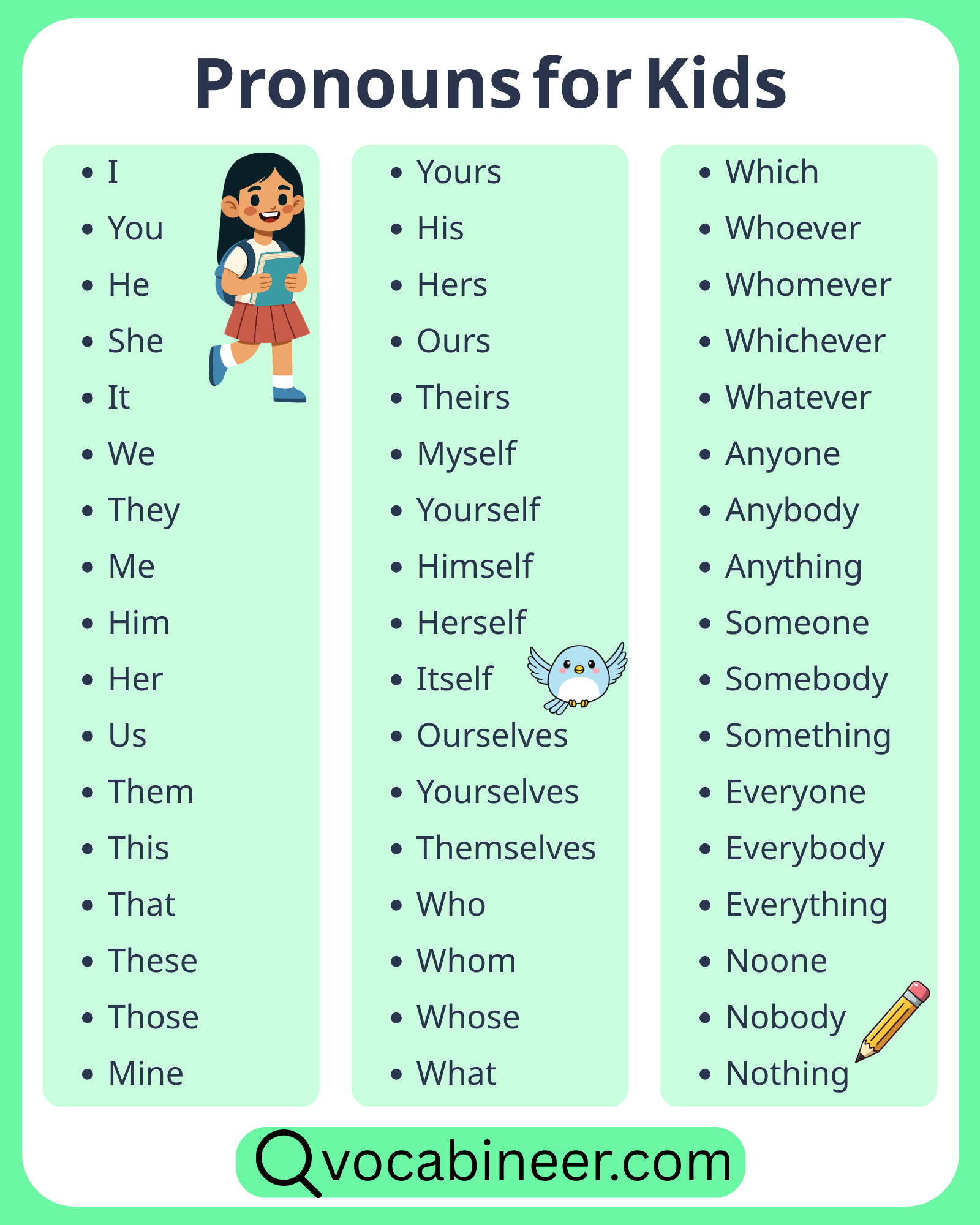
Pronouns for Kids Chart
| Pronoun Type | Easy Meaning | Examples | Sentence |
|---|---|---|---|
| Subject pronouns | Who does the action | I, you, he, she, it, we, they | She is reading. |
| Object pronouns | Who receives the action | me, him, her, us, them | The teacher helped us. |
| Possessive words | Show belonging | my, your, his, her, our, their | This is my bag. |
| Demonstrative pronouns | Point to things | this, that, these, those | This is mine. |
| Reflexive pronouns | Point back to the same person | myself, yourself, herself | I did it myself. |
This chart helps kids see the main types of pronouns in one place.
Noun to Pronoun Examples for Kids
A pronoun can replace a noun or name. This makes a sentence shorter and easier.
| Noun | Pronoun | Sentence |
|---|---|---|
| Emma | she | She is happy. |
| Jack | he | He is running. |
| The dog | it | It is sleeping. |
| Emma and Jack | they | They are friends. |
| My friend and I | we | We are playing. |
| The books | they | They are on the table. |
| The ball | it | It is red. |
More examples:
- Lily is singing. → She is singing.
- Ben is eating. → He is eating.
- The cat is sleeping. → It is sleeping.
- The children are laughing. → They are laughing.
- Dad and I are walking. → We are walking.
People, Animals, and Things Pronouns
Different pronouns are used for people, animals, and things.
| Noun Type | Pronoun | Example |
|---|---|---|
| Boy or man | he | He is playing. |
| Girl or woman | she | She is reading. |
| Animal or thing | it | It is sleeping. |
| Two or more people or things | they | They are happy. |
| Speaker | I | I am ready. |
| Speaker + others | we | We are friends. |
| Listener | you | You are kind. |
Examples:
- The boy is jumping. He is happy.
- The girl is drawing. She is creative.
- The bird is flying. It is fast.
- The toys are new. They are colorful.
- My brother and I are reading. We are quiet.
Subject Pronouns for Kids
Subject pronouns tell who is doing the action.
The main subject pronouns are:
- I
- You
- He
- She
- It
- We
- They
Examples:
- I run fast.
- You sing well.
- He kicks the ball.
- She reads a book.
- It barks loudly.
- We play together.
- They jump high.
Subject pronouns usually come before the action word.
Examples:
- He eats.
- She writes.
- They laugh.
- We learn.
Object Pronouns for Kids
Object pronouns receive the action. They often come after action words.
Common object pronouns include:
- Me
- You
- Him
- Her
- It
- Us
- Them
Examples:
- Mom helped me.
- I saw you.
- The teacher called him.
- Dad helped her.
- I found it.
- The coach trained us.
- We invited them.
Compare:
| Subject Pronoun | Object Pronoun |
|---|---|
| I | me |
| he | him |
| she | her |
| we | us |
| they | them |
Examples:
- I called him.
- She helped me.
- They invited us.
Possessive Pronouns for Kids
Possessive words show that something belongs to someone.
Some possessive words come before nouns:
- My
- Your
- His
- Her
- Our
- Their
Examples:
- This is my pencil.
- That is your bag.
- This is his book.
- That is her doll.
- This is our class.
- That is their house.
Some possessive pronouns stand alone:
- Mine
- Yours
- His
- Hers
- Ours
- Theirs
Examples:
- This pencil is mine.
- That bag is yours.
- The blue book is his.
- The red doll is hers.
- This classroom is ours.
- That house is theirs.
My vs Mine
Kids often confuse my and mine.
| Before a Noun | Stands Alone |
|---|---|
| my book | mine |
| your bag | yours |
| his pencil | his |
| her pen | hers |
| our class | ours |
| their house | theirs |
Examples:
- This is my book.
- This book is mine.
- That is your bag.
- That bag is yours.
- This is her pen.
- This pen is hers.
Simple rule:
Use my before a noun. Use mine when the noun is not repeated.
Demonstrative Pronouns for Kids
Demonstrative pronouns point to people or things.
The main demonstrative pronouns are:
- This
- That
- These
- Those
| Pronoun | Meaning | Example |
|---|---|---|
| this | one thing near | This is my pencil. |
| that | one thing far | That is your chair. |
| these | many things near | These are my books. |
| those | many things far | Those are your shoes. |
Examples:
- This is my toy.
- That is your bike.
- These are my crayons.
- Those are your shoes.
Simple rule:
Use this and that for one thing. Use these and those for more than one thing.
Reflexive Pronouns for Kids
Reflexive pronouns point back to the same person or thing.
Common reflexive pronouns include:
- Myself
- Yourself
- Himself
- Herself
- Itself
- Ourselves
- Yourselves
- Themselves
Examples:
- I did it myself.
- You should help yourself.
- He hurt himself.
- She made it herself.
- The door closed by itself.
- We prepared ourselves.
- They helped themselves.
Simple meaning:
- I did it myself = I did it without someone else doing it for me.
- She hurt herself = She got hurt by her own action.
Pronouns in Sentences for Kids
Here are simple pronoun sentences for kids.
Subject pronouns
- I am happy.
- You are nice.
- He is playing.
- She is singing.
- It is raining.
- We are friends.
- They are dancing.
Object pronouns
- Dad helped me.
- I saw you.
- We called him.
- The teacher praised her.
- I found it.
- Grandma visited us.
- We thanked them.
Possessive pronouns
- This is my bag.
- That pencil is mine.
- This is your seat.
- That seat is yours.
- The red ball is his.
- The blue bag is hers.
Demonstrative pronouns
- This is my cup.
- That is your hat.
- These are my shoes.
- Those are your toys.
Reflexive pronouns
- I tied my shoes myself.
- He washed himself.
- She dressed herself.
- They cleaned the room themselves.
Common Mistakes with Pronouns
Kids often mix up pronouns. Here are common mistakes and correct forms.
| Incorrect | Correct |
|---|---|
| Me am happy. | I am happy. |
| Him is playing. | He is playing. |
| Her is reading. | She is reading. |
| They is happy. | They are happy. |
| Us are going home. | We are going home. |
| This is mine bag. | This is my bag. |
| This book is my. | This book is mine. |
| These is my toys. | These are my toys. |
| This are my pencil. | This is my pencil. |
| I hurt me. | I hurt myself. |
A simple way to fix pronoun mistakes is to ask: Is the pronoun doing the action, receiving the action, showing belonging, or pointing to something?
Easy Pronoun Practice for Kids
Choose the correct pronoun.
- Emma is kind. ___ is my friend.
- The dog is tired. ___ is sleeping.
- I saw Jack. I called ___.
- The books are old. ___ are useful.
- This is ___ pencil. (my / mine)
- Lily and Ben are here. ___ are playing.
- Mom helped ___. (I / me)
- This bag is ___. (my / mine)
- ___ is my chair. (This / These)
- The children cleaned the room ___. (themselves / them)
Answers
- She
- It
- him
- They
- my
- They
- me
- mine
- This
- themselves
Quick Rules to Remember
| Rule | Example |
|---|---|
| Use he for a boy or man. | He is running. |
| Use she for a girl or woman. | She is reading. |
| Use it for one animal or thing. | It is sleeping. |
| Use they for more than one. | They are playing. |
| Use I, not me, before a verb. | I am happy. |
| Use me, not I, after an action. | Mom helped me. |
| Use my before a noun. | This is my bag. |
| Use mine alone. | This bag is mine. |
| Use this for one thing near you. | This is my pencil. |
| Use these for many things near you. | These are my books. |
Simple reminders:
- I does the action.
- Me receives the action.
- He is for a boy or man.
- She is for a girl or woman.
- It is for one animal or thing.
- They is for more than one.
- My comes before a noun.
- Mine stands alone.
FAQs
Pronouns are words we use instead of names or nouns. Examples include I, you, he, she, it, we, they, me, him, her, us, and them.
Examples of pronouns are I in “I am happy,” she in “She is reading,” it in “It is sleeping,” and they in “They are playing.”
We use pronouns to avoid repeating names or nouns again and again. They make sentences shorter, clearer, and easier to read.
Use my before a noun, as in “my book.” Use mine when the noun is not repeated, as in “This book is mine.”
Kids can learn pronouns easily by replacing names with pronouns in simple sentences. For example, “Emma is happy” becomes “She is happy.”
Summary
Pronouns are words we use instead of names or nouns. They help make sentences shorter and clearer. Common pronouns for kids include I, you, he, she, it, we, they, me, him, her, us, and them.
Kids can learn pronouns by practicing simple noun-to-pronoun changes, such as Emma → she, Jack → he, the dog → it, and Emma and Jack → they. Learning pronouns helps children speak and write better English sentences.
Read More
- List of Pronouns in English
- Subject Pronouns in English
- First Person Pronouns in English
- Reciprocal Pronouns in English
- Pronouns for People in English