Pronouns for things are words we use instead of repeating the names of objects, places, ideas, or situations. Common pronouns for things include it, they, them, its, their, this, that, these, and those.
For example, instead of saying “The phone is new. The phone works well,” we can say “The phone is new. It works well.” Here, it replaces the phone and makes the sentence shorter and smoother.
These pronouns help us talk about one thing, many things, nearby things, faraway things, and things that own or have something. Learning them will help you write clearer and more natural English sentences.
In This Page
What Pronouns Do We Use for Things?
We usually use it for one thing and they for more than one thing. We use them when plural things receive the action, and we use its or their to show possession.
Examples:
- The bag is heavy. It is new.
- The books are old. They are useful.
- I found the keys and put them on the table.
- The box lost its lid.
- The boxes lost their labels.
In simple words, use it for one thing, they/them for more than one thing, and its/their to show ownership.
Pronouns for Things List
Here is a useful list of pronouns we commonly use for things:
- It
- They
- Them
- Its
- Their
- Theirs
- Itself
- Themselves
- This
- That
- These
- Those
These pronouns can refer to objects, places, ideas, events, or situations.
Examples:
- The chair is old. It is broken.
- The chairs are old. They are broken.
- I fixed the chair. I fixed it.
- I fixed the chairs. I fixed them.
- The machine stopped by itself.
- The doors closed by themselves.
- This is my phone.
- Those are old shoes.
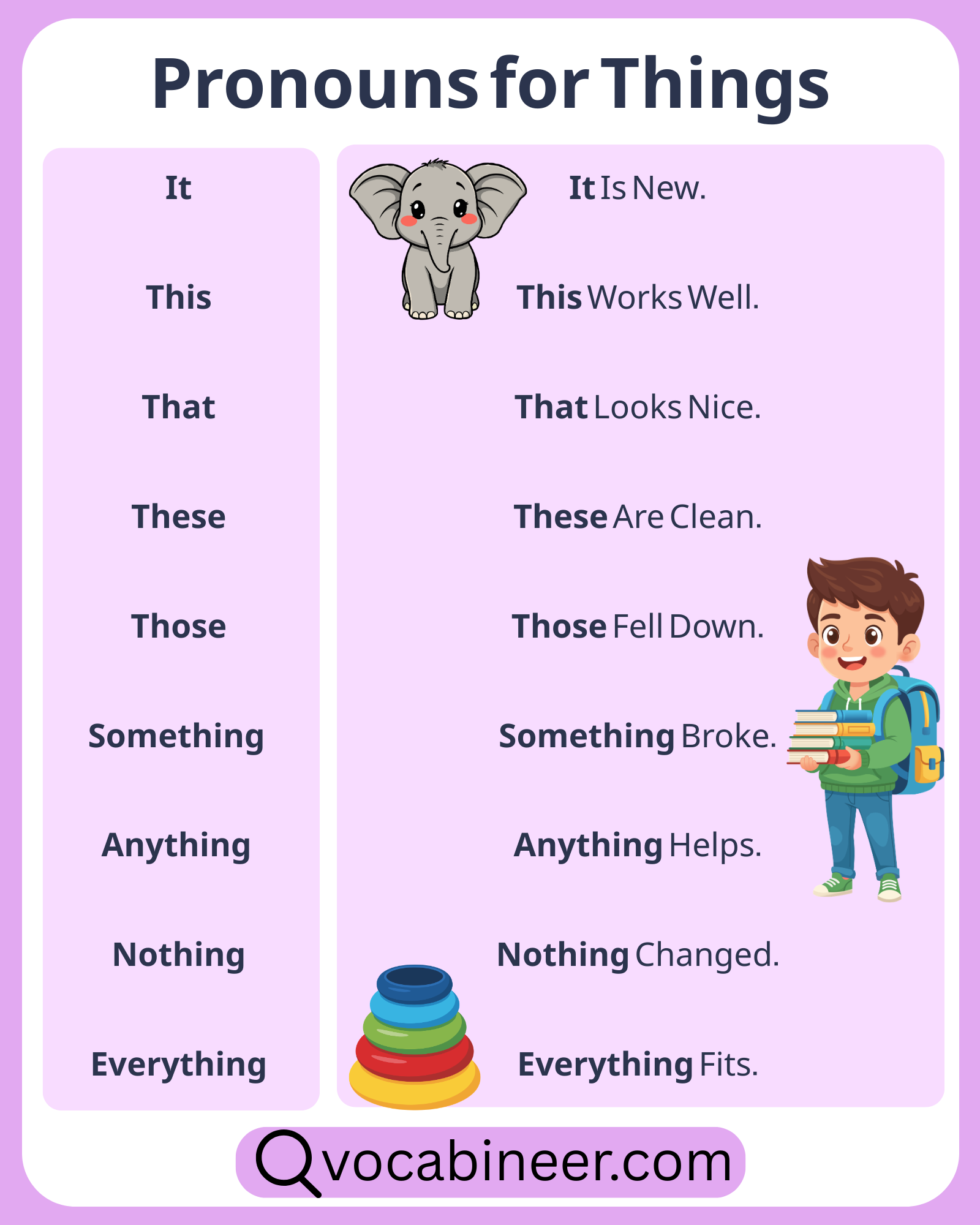
Pronouns for Things Chart
| Situation | Best Pronoun | Example |
|---|---|---|
| One thing | it | The phone is new. It works well. |
| More than one thing | they | The books are old. They are useful. |
| One thing as object | it | I found it under the table. |
| Many things as object | them | I found them under the table. |
| One thing’s possession | its | The box lost its lid. |
| Many things’ possession | their | The boxes lost their lids. |
| Near singular thing | this | This is my bag. |
| Far singular thing | that | That is your chair. |
| Near plural things | these | These are my keys. |
| Far plural things | those | Those are old shoes. |
This chart shows the most common pronouns for things. The right pronoun depends on whether the thing is singular or plural, near or far, and whether it is the subject, object, or owner in the sentence.
When to Use “It” for Things
Use it for one thing, object, place, idea, event, or situation.
Examples:
- The phone is new. It works well.
- The chair is old. It is broken.
- The bag is heavy. It is on the table.
- The room is clean. It looks nice.
- The plan is simple. It should work.
- The meeting was long. It ended late.
Use it as a subject when the thing does the action or is being described.
Examples:
- It looks beautiful.
- It costs too much.
- It feels soft.
- It works now.
Use it as an object when the thing receives the action.
Examples:
- I found it.
- She opened it.
- We fixed it.
- Please move it.
When to Use “They” and “Them” for Things
Use they for more than one thing when the things are the subject of the sentence.
Examples:
- The books are old. They are useful.
- The windows are open. They need to be closed.
- The keys are missing. They were on the table.
- The chairs are broken. They need repair.
Use them when plural things receive the action or come after a verb or preposition.
Examples:
- I found the keys and put them in my bag.
- The books were heavy, so I carried them carefully.
- The windows were open, so I closed them.
- The papers are on the desk. Please take them.
Simple rule:
- They = plural things as the subject.
- Them = plural things as the object.
It vs They for Things
The difference between it and they is number.
Use it for one thing. Use they for more than one thing.
| Singular Thing | Plural Things |
|---|---|
| The phone is new. It works well. | The phones are new. They work well. |
| The chair is old. It is broken. | The chairs are old. They are broken. |
| The book is useful. It is on the desk. | The books are useful. They are on the desk. |
Use it and them when the thing receives the action.
| One Thing as Object | Many Things as Object |
|---|---|
| I fixed it. | I fixed them. |
| She found it. | She found them. |
| Please move it. | Please move them. |
Examples:
- The box is heavy. It is hard to lift.
- The boxes are heavy. They are hard to lift.
- I opened the box. I opened it carefully.
- I opened the boxes. I opened them carefully.
Possessive Pronouns for Things
Use possessive forms when something belongs to or is connected with a thing.
| Meaning | Possessive Form | Example |
|---|---|---|
| One thing owns or has something | its | The clock lost its hand. |
| Many things own or have something | their | The clocks lost their hands. |
| Plural possession alone | theirs | These books are theirs. |
Use its for one thing.
Examples:
- The box lost its lid.
- The phone lost its signal.
- The table has its own drawer.
- The machine made its usual sound.
Use their for more than one thing.
Examples:
- The boxes lost their labels.
- The chairs lost their legs.
- The books have their covers.
- The windows have their locks.
Use theirs when the noun is not repeated, though it is more common when talking about people or groups.
Example:
- These books are theirs.
Its vs It’s
Its and it’s look similar, but they have different meanings.
| Word | Meaning | Example |
|---|---|---|
| Its | Shows possession | The box lost its lid. |
| It’s | Means “it is” or “it has” | It’s on the table. |
Use its when something belongs to a thing or is part of it.
Examples:
- The phone lost its signal.
- The chair lost its leg.
- The machine stopped because its battery died.
- The book lost its cover.
Use it’s when you mean it is or it has.
Examples:
- It’s working now.
- It’s on the desk.
- It’s been repaired.
- It’s too heavy.
Simple test: If you can replace the word with it is or it has, use it’s. If you mean possession, use its.
This, That, These, and Those for Things
We use this, that, these, and those to point to things.
| Pronoun | Number | Distance | Example |
|---|---|---|---|
| This | Singular | Near | This is my phone. |
| That | Singular | Far | That is your bag. |
| These | Plural | Near | These are my books. |
| Those | Plural | Far | Those are old chairs. |
Use this for one thing near you.
Examples:
- This is my bag.
- This feels soft.
- This is useful.
Use that for one thing farther away.
Examples:
- That is your chair.
- That looks expensive.
- That was a good idea.
Use these for more than one thing near you.
Examples:
- These are my keys.
- These are clean plates.
- These look new.
Use those for more than one thing farther away.
Examples:
- Those are old shoes.
- Those are your books.
- Those look heavy.
Pronouns for Things vs People and Animals
Pronouns for things are different from pronouns for people and sometimes animals.
| Use | Common Pronouns | Example |
|---|---|---|
| People | he, she, they | She is my teacher. |
| Things | it, they | The bag is heavy. It is new. |
| Animals | it / he / she / they | My dog is playful. He loves walks. |
Use it for one thing.
Examples:
- The phone is new. It works well.
- The door is open. It needs to be closed.
- The bag is heavy. It is mine.
Use they for plural things.
Examples:
- The phones are new. They work well.
- The doors are open. They need to be closed.
- The bags are heavy. They are mine.
Use he, she, or they for people. Use it for things.
Examples:
- The teacher is kind. She helped me.
- The table is old. It needs repair.
“It” for Ideas, Places, and Situations
The pronoun it does not only refer to physical objects. It can also refer to ideas, places, events, weather, and situations.
Examples with ideas:
- The plan is simple. It should work.
- The answer is correct. It makes sense.
- The idea is new. It sounds interesting.
Examples with places:
- The room is clean. It looks nice.
- The city is busy. It feels crowded.
- The school is old. It has many classrooms.
Examples with events or situations:
- The meeting was long. It ended late.
- The trip was fun. It was exciting.
- The problem is serious. It needs attention.
Examples with weather:
- It is raining.
- It is cold today.
- It feels warm outside.
Thing Pronouns in Sentences
Here are useful examples of pronouns for things in sentences.
It
- The phone is new. It works well.
- The chair is old. It is broken.
- The plan is simple. It should work.
- The bag is heavy. It is on the floor.
- The window is open. It lets in air.
They and Them
- The books are old. They are useful.
- The keys are missing. They were on the table.
- I found the keys and put them in my bag.
- The windows are open. Please close them.
- The boxes are heavy. Move them carefully.
Its and Their
- The box lost its lid.
- The phone lost its signal.
- The table has its own drawer.
- The boxes lost their labels.
- The chairs lost their legs.
This, That, These, and Those
- This is my bag.
- That is your chair.
- These are my notes.
- Those are old shoes.
- This looks better than that.
Common Mistakes with Pronouns for Things
Learners often confuse it, they, them, its, it’s, this, that, these, and those.
| Incorrect | Correct |
|---|---|
| The phone is new. They works well. | The phone is new. It works well. |
| The books are old. It are useful. | The books are old. They are useful. |
| I found the keys. I put it on the table. | I found the keys. I put them on the table. |
| The box lost it’s lid. | The box lost its lid. |
| These is my keys. | These are my keys. |
| This are my bag. | This is my bag. |
| The chairs lost its legs. | The chairs lost their legs. |
| The book is on the table. Them is new. | The book is on the table. It is new. |
| The windows are open. Close it. | The windows are open. Close them. |
| That are my shoes. | Those are my shoes. |
A simple way to avoid mistakes is to check the number. If you mean one thing, use it, its, this, or that. If you mean more than one thing, use they, them, their, these, or those.
Quick Rules to Remember
| Rule | Example |
|---|---|
| Use it for one thing. | The phone is new. It works. |
| Use they for more than one thing. | The books are old. They are useful. |
| Use them after verbs or prepositions for plural things. | I found them. |
| Use its for one thing’s possession. | The box lost its lid. |
| Use their for plural things’ possession. | The boxes lost their labels. |
| Use this/that for one thing. | This is my bag. |
| Use these/those for plural things. | These are my books. |
| Use it’s only for “it is” or “it has.” | It’s on the table. |
Simple reminders:
- It = one thing.
- They = more than one thing.
- Them = plural things as objects.
- Its = belongs to it.
- It’s = it is or it has.
- This/that = one thing.
- These/those = more than one thing.
FAQs
We use it for one thing and they for more than one thing. We also use them, its, their, this, that, these, and those for things.
Use it for one thing and they for more than one thing. For example, “The phone is new. It works well” and “The phones are new. They work well.”
Use its for one thing’s possession, as in “The box lost its lid.” Use their for more than one thing, as in “The boxes lost their labels.”
Its shows possession, as in “The phone lost its signal.” It’s means it is or it has, as in “It’s working now.”
Yes. This, that, these, and those often refer to things. Use this and that for one thing, and use these and those for more than one thing.
Summary
Pronouns for things help us avoid repeating the names of objects, places, ideas, and situations. Use it for one thing, they for more than one thing, them as the plural object form, and its or their to show possession.
Use this and that for one thing, and these and those for more than one thing. Learning these pronouns will help you write clearer, shorter, and more natural English sentences.
Read More
- List of Pronouns in English
- Subject Pronouns in English
- First Person Pronouns in English
- Reciprocal Pronouns in English
- Negative Pronouns in English