

Pronouns for animals depend on the animal, the context, and whether we know its sex. Common animal pronouns include it, he, she, they, him, her, its, and their.
For example, we can say “A bird flew by. It was fast” when the bird is unknown. But if we are talking about a pet or a known animal, we may say “Luna is my cat. She is sleeping.”
In simple English, use it for one unknown animal, he or she for a known animal or pet, and they for more than one animal. These pronouns help us talk about animals clearly and naturally.
In This Page
What Pronouns Do We Use for Animals?
We usually use it for one animal when its sex is unknown, unimportant, or when we are speaking generally. We use he or she when the animal’s sex is known, especially for pets, named animals, or animals we feel close to.
Examples:
- I saw a dog. It looked hungry.
- My dog Bruno is friendly. He loves walks.
- Luna is my cat. She sleeps near the window.
- The lioness carried her cub.
- The birds flew away. They were fast.
In simple words, use it for an unknown animal, he or she for a known animal, and they for more than one animal.
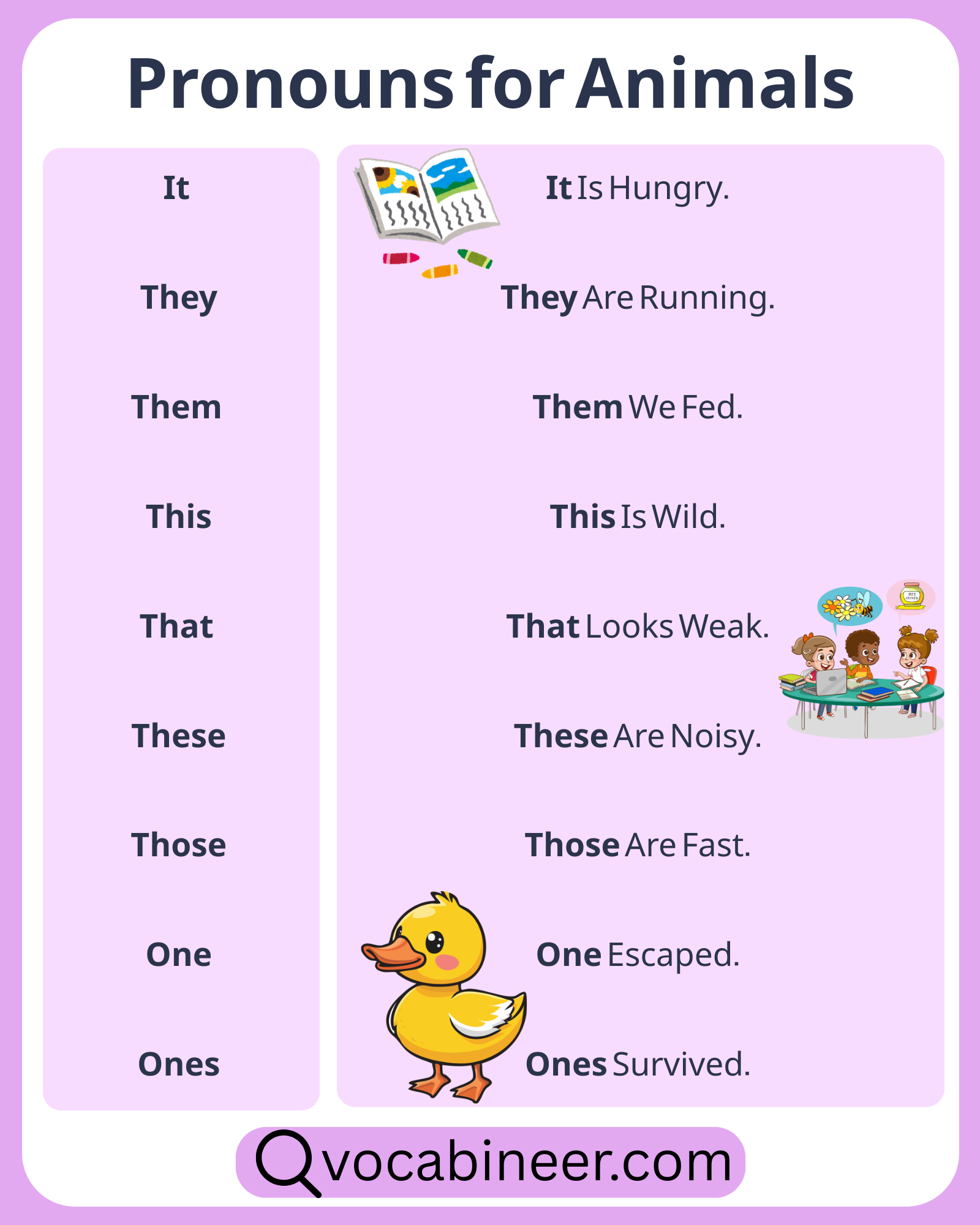
Pronouns for Animals Chart
| Situation | Best Pronoun | Example |
|---|---|---|
| Unknown animal | it | A bird flew by. It was fast. |
| Named pet / known sex | he/she | Luna is sleeping. She looks tired. |
| Plural animals | they | The dogs are barking. They are hungry. |
| Known female animal | she/her | The lioness carried her cub. |
| Known male animal | he/him | The rooster spread his wings. |
| General species | it/they | A rabbit uses its ears to hear. |
This chart gives the easiest rule: it is common for one unknown animal, he or she is common for known animals, and they is used for plural animals.
When to Use “It” for Animals
Use it when the animal’s sex is unknown, not important, or when you are talking about an animal in a general way.
Examples:
- I saw a bird. It had blue feathers.
- A rabbit ran across the garden. It was quick.
- The snake moved slowly. It looked dangerous.
- A frog jumped into the pond. It disappeared quickly.
- A horse stood near the fence. It looked calm.
Use it when you are speaking generally about an animal species.
Examples:
- A rabbit uses its ears to hear.
- A bird uses its wings to fly.
- A fish moves its tail in water.
- A cat cleans its paws.
- A dog wags its tail when happy.
In grammar, it is correct for animals when the animal is not personally known or when its sex does not matter.
When to Use “He” or “She” for Animals
Use he or she when the animal’s sex is known. These pronouns are also common for pets, named animals, farm animals, and animals people feel emotionally connected to.
Use he for a male animal.
Examples:
- Bruno is my dog. He loves walks.
- The rooster spread his wings.
- The bull lowered his head.
- My parrot is loud. He repeats words.
- The male lion shook his mane.
Use she for a female animal.
Examples:
- Luna is my cat. She is sleeping.
- The lioness protected her cub.
- The hen sat on her eggs.
- My rabbit is quiet. She likes carrots.
- The mare stayed near her foal.
When an animal has a name or a clear identity, he or she often sounds more natural than it.
When to Use “They” for Animals
Use they when talking about more than one animal.
Examples:
- The dogs are barking. They are hungry.
- The horses ran fast. They looked strong.
- The birds flew south. They followed the wind.
- The puppies were tired. They slept together.
- The cats are outside. They are playing.
Use them as the object form.
Examples:
- I saw the dogs and fed them.
- The children watched the birds and followed them.
- The farmer called the cows and moved them.
- We found the kittens and helped them.
Use their to show possession.
Examples:
- The horses shook their heads.
- The birds built their nests.
- The puppies opened their eyes.
- The cats cleaned their paws.
Pronouns for Pets
For pets, people often use he or she, especially when the pet has a name and the owner knows its sex.
Examples:
- Max is my dog. He is playful.
- Luna is my cat. She sleeps a lot.
- Coco is my parrot. He talks loudly.
- Bella is my rabbit. She likes carrots.
- Milo is my kitten. He follows me everywhere.
Using it for a pet is grammatically possible, but it can sound less personal.
Compare:
- Luna is my cat. It is cute.
- Luna is my cat. She is cute.
The second sentence sounds warmer and more natural because Luna is a named pet.
Pronouns for Wild Animals
For wild animals, we often use it when the animal’s sex is unknown or not important.
Examples:
- A fox crossed the road. It moved quickly.
- A deer stood in the field. It looked alert.
- A snake slid under a rock. It disappeared.
- A bird landed on the branch. It sang loudly.
- A whale rose from the water. It looked huge.
Use he or she when the animal’s sex is known.
Examples:
- The lioness protected her cub.
- The stag lowered his head.
- The mare fed her foal.
- The male peacock spread his feathers.
- The queen bee left her hive.
So, it is common for wild animals in general, but he and she are correct when the sex is clear.
Possessive Pronouns for Animals
Animals can also use possessive forms such as his, her, its, and their.
| Pronoun | Possessive Form | Example |
|---|---|---|
| he | his | The dog wagged his tail. |
| she | her | The cat licked her paw. |
| it | its | The bird spread its wings. |
| they | their | The horses shook their heads. |
Use its for one animal when the sex is unknown or not important.
Examples:
- The bird opened its wings.
- The dog wagged its tail.
- The cat cleaned its paws.
- The rabbit moved its ears.
Use his or her when the animal’s sex is known.
Examples:
- The rooster spread his wings.
- The lioness carried her cub.
- The bull shook his head.
- The mare watched her foal.
Important note: its and it’s are different.
| Word | Meaning | Example |
|---|---|---|
| Its | Shows possession | The bird spread its wings. |
| It’s | Means “it is” or “it has” | It’s flying away. |
Singular They for Animals
They is normally used for more than one animal, but it can sometimes refer to one animal when the sex is unknown and the speaker wants to avoid it.
Examples:
- I found a puppy. It looked scared.
- I found a puppy. They looked scared.
The first sentence is the most common simple grammar choice. The second sentence can sound more personal or informal.
More examples:
- Someone left a kitten outside. They need help.
- I saw a dog near the road. They looked lost.
- The puppy was shaking. They seemed cold.
For basic grammar, use it for one unknown animal. Use singular they when you want a softer or more personal tone.
Who, That, or Which for Animals
When using relative pronouns with animals, that and which are common. Who can be used for named pets or personified animals.
| Relative Pronoun | Use | Example |
|---|---|---|
| That | Common for animals | The dog that barked is mine. |
| Which | Animals in formal or descriptive writing | The bird which nested here returned. |
| Who | Named pets or personified animals | This is Max, who loves sleeping. |
Examples:
- The cat that scratched the sofa is outside.
- The bird which built a nest here flew away.
- This is Bella, who follows me everywhere.
- The horse that won the race is strong.
- My dog Bruno, who loves children, is very gentle.
For general animal grammar, that is usually the safest choice.
Animal Pronouns in Sentences
Here are useful examples of animal pronouns in sentences.
It
- A rabbit ran across the garden. It was quick.
- I saw a bird. It had blue feathers.
- The snake moved slowly. It looked dangerous.
- A turtle crossed the path. It moved slowly.
- The frog jumped away. It was tiny.
He
- Bruno is my dog. He loves walks.
- The rooster spread his wings.
- The bull shook his head.
- My parrot is loud. He talks every morning.
- The male lion lifted his head.
She
- Luna is my cat. She is sleeping.
- The lioness guarded her cub.
- The hen sat on her eggs.
- My rabbit is soft. She likes carrots.
- The mare stayed near her foal.
They
- The horses ran fast. They looked strong.
- The puppies were hungry. They needed food.
- The birds flew south. They followed the wind.
- The dogs barked loudly. They wanted attention.
- The cats climbed the wall. They moved quickly.
Common Mistakes with Animal Pronouns
Learners often confuse it, he, she, they, its, and it’s when talking about animals.
| Incorrect | Correct |
|---|---|
| The dog wagged it’s tail. | The dog wagged its tail. |
| The birds flew away. It was fast. | The birds flew away. They were fast. |
| The lioness protected his cub. | The lioness protected her cub. |
| A rabbit is small. He has long ears. (sex unknown) | A rabbit is small. It has long ears. |
| Luna is my cat. It is cute. (less personal) | Luna is my cat. She is cute. |
| The horses shook its heads. | The horses shook their heads. |
| The rooster opened her wings. | The rooster opened his wings. |
| The puppy lost their toy. (basic grammar) | The puppy lost its toy. |
A simple way to avoid mistakes is to ask: Is the animal unknown, known, or plural? Use it for one unknown animal, he/she for a known animal, and they for more than one animal.
Quick Rules to Remember
| Rule | Example |
|---|---|
| Use it for one unknown animal. | A bird flew by. It was fast. |
| Use he/she when sex is known. | The lioness carried her cub. |
| Use he/she for named pets. | Max is my dog. He is playful. |
| Use they for plural animals. | The dogs barked. They were loud. |
| Use its, not it’s, for possession. | The cat cleaned its paws. |
| Use their for plural animal possession. | The horses shook their heads. |
Simple reminders:
- It = one unknown animal.
- He = known male animal.
- She = known female animal.
- They = more than one animal.
- Its = possession.
- It’s = it is or it has.
FAQs
Use it for one animal when the sex is unknown or unimportant. Use he or she when the animal’s sex is known, especially for pets or named animals. Use they for more than one animal.
Yes, all three can be correct. Use it for animals in general, and use he or she when the animal is known, named, or personally familiar.
Yes, singular they can be used for one animal when the sex is unknown and the speaker wants to avoid it. However, it is still the most common choice in basic grammar for one unknown animal.
Use its when the animal’s sex is unknown, as in “The bird spread its wings.” Use his for a known male animal, her for a known female animal, and their for plural animals.
Pets are often called he or she because they are named and personally known. For example, “Luna is my cat. She is sleeping” sounds more natural and personal than “It is sleeping.”
Summary
Pronouns for animals depend on context. Use it for one unknown or general animal, he or she for known animals and pets, and they for plural animals.
Use its for one unknown animal’s possession, his for a known male animal, her for a known female animal, and their for plural animals. Learning these forms helps you write clear and natural sentences about pets, wild animals, and animal groups.
Read More
- List of Pronouns in English
- Subject Pronouns in English
- First Person Pronouns in English
- Reciprocal Pronouns in English
- Negative Pronouns in English