

Negative pronouns are words that show the absence of a person, thing, place, amount, or choice. Common negative pronouns include nobody, no one, nothing, none, neither, and nowhere.
For example, instead of saying “No person answered,” we can say “Nobody answered.” Here, nobody replaces no person and gives the sentence a clear negative meaning.
Negative pronouns make sentences shorter, clearer, and more natural. They are useful when we want to say that no person came, no thing happened, no place was available, or no choice was correct.
In This Page
What Are Negative Pronouns?
Negative pronouns are pronouns that replace nouns and give a negative meaning. They show that there is no person, no thing, no place, no amount, or not one of two choices.
Examples:
- Nobody answered the phone.
- No one was outside.
- Nothing happened.
- None were ready.
- Neither is correct.
- Nowhere was open.
In these sentences, the negative pronouns stand in place of nouns and make the sentence negative.
For example:
- Nobody means no person.
- Nothing means no thing.
- None means not any.
- Neither means not one of two.
Negative Pronouns List
Here is the main list of negative pronouns in English:
- Nobody
- No one
- Nothing
- None
- Neither
- Nowhere
These words are used when we want to talk about absence, lack, or zero choice.
Examples:
- Nobody came to the door.
- No one replied to the message.
- Nothing was missing.
- None of them answered.
- Neither was correct.
- Nowhere looked safe.
The word no is also negative, but it usually comes before a noun, so it often works as a negative determiner, not a pronoun.
Example:
- I have no money.
- I have none.
In the first sentence, no comes before the noun money. In the second sentence, none replaces the noun idea.
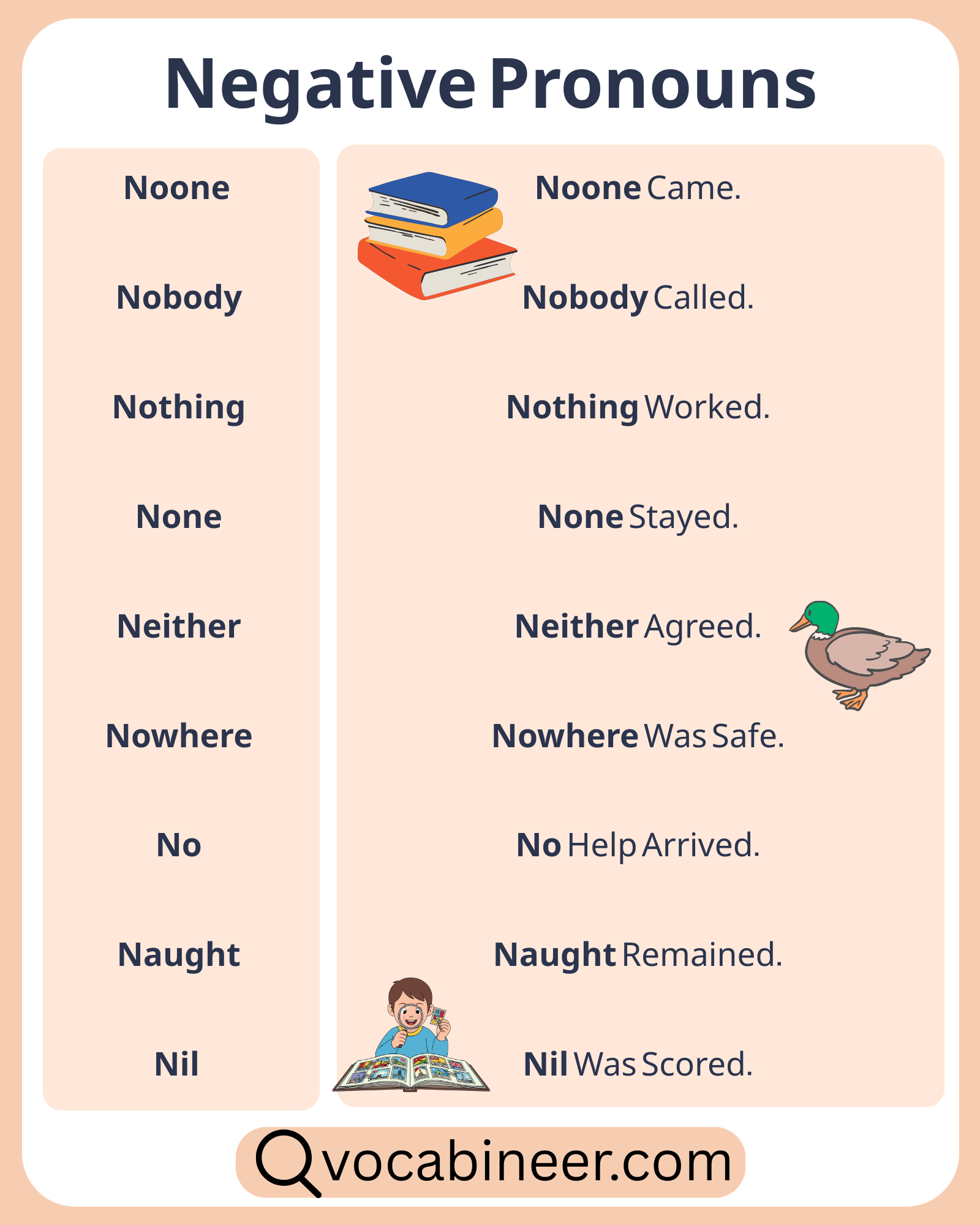
Negative Pronouns Chart
| Negative Pronoun | Use | Example |
|---|---|---|
| Nobody | No person | Nobody answered. |
| No one | No person | No one was outside. |
| Nothing | No thing | Nothing happened. |
| None | Not any amount or member | None were ready. |
| Neither | Not one of two | Neither is correct. |
| Nowhere | No place | Nowhere was open. |
This chart shows the main negative pronouns and how they are used in simple sentences.
How Negative Pronouns Work
Negative pronouns already carry a negative meaning. Because of this, we usually do not need another negative word in the same clause in standard English.
Examples:
- Nobody came.
- Nothing changed.
- None replied.
- Neither worked.
Each sentence is already negative because of the negative pronoun.
Compare:
- Correct: I saw nobody.
- Correct: I did not see anybody.
- Incorrect: I did not see nobody.
The incorrect sentence has two negative words: did not and nobody. In standard English, this is called a double negative.
Nobody and No One
Nobody and no one both mean no person. They are very similar and often interchangeable.
Examples:
- Nobody knows the answer.
- No one knows the answer.
- Nobody was at home.
- No one was at home.
- Nobody wanted to leave.
- No one wanted to leave.
Both nobody and no one usually take singular verbs.
Examples:
- Nobody is here.
- No one has replied.
- Nobody knows the truth.
- No one wants to wait.
The main spelling difference is that no one is written as two words.
Nothing
Nothing means no thing. It is used when we talk about the absence of a thing, event, action, or idea.
Examples:
- Nothing happened.
- Nothing was missing.
- Nothing changed after the meeting.
- Nothing looked unusual.
- I heard nothing.
- She said nothing.
Nothing usually takes a singular verb when it is the subject.
Examples:
- Nothing is wrong.
- Nothing was ready.
- Nothing seems easy.
- Nothing has changed.
Do not use another negative word with nothing in standard English.
Incorrect:
- I did not hear nothing.
Correct:
- I heard nothing.
- I did not hear anything.
None
None means not any or not one from a group or amount. It can refer to people, things, or amounts.
Examples:
- I called five people, but none answered.
- There was milk, but none was left.
- We checked the answers, but none were correct.
- She offered help, but none came.
- I wanted some cake, but none was available.
None is often used with of.
Examples:
- None of them answered.
- None of the students came.
- None of it was useful.
- None of the answers were correct.
None can take a singular or plural verb depending on meaning and style.
Examples:
- None was left. (no amount)
- None were ready. (no people or things)
In simple beginner English, use the verb that sounds natural with the noun idea in the sentence.
Neither
Neither means not one of two. Use neither when there are exactly two people, things, choices, or options.
Examples:
- I tried two keys. Neither worked.
- There are two answers. Neither is correct.
- I asked both students, but neither knew.
- We had two plans, but neither was useful.
- Both shirts looked nice, but neither fit me.
Neither usually takes a singular verb.
Examples:
- Neither is correct.
- Neither was ready.
- Neither has arrived.
- Neither works well.
Use neither of before a specific pair.
Examples:
- Neither of them was ready.
- Neither of the two answers is correct.
- Neither of us knew the answer.
Nowhere
Nowhere means no place. It is used when no place exists or no place is suitable, available, or possible.
Examples:
- Nowhere was open.
- I found nowhere to sit.
- There was nowhere to hide.
- We had nowhere to go.
- Nowhere seemed safe.
- The keys were nowhere to be found.
Nowhere is sometimes described as a negative adverb because it refers to place. However, in many beginner grammar lessons, it is included with negative pronoun-like words because it replaces a place idea.
Compare:
- I found no place to sit.
- I found nowhere to sit.
Negative Pronouns vs Negative Determiners
Negative pronouns stand alone and replace a noun. Negative determiners come before nouns.
The word no is usually a negative determiner because it comes before a noun.
| Use | Example | Function |
|---|---|---|
| Negative determiner | I have no money. | No comes before a noun. |
| Negative pronoun | I have none. | None replaces a noun. |
More examples:
| Negative Determiner | Negative Pronoun |
|---|---|
| There were no students. | There were none. |
| I have no books. | I have none. |
| She gave no answer. | She gave none. |
| We found no chairs. | We found none. |
Simple rule:
Use no before a noun. Use none when the noun is already understood.
Nothing vs None
Nothing and none are both negative pronouns, but they are not used the same way.
| Word | Meaning | Example |
|---|---|---|
| Nothing | No thing | Nothing happened. |
| None | Not any of a group or amount | I asked for help, but none came. |
Use nothing when you mean no thing, no event, or no action.
Examples:
- Nothing was missing.
- Nothing happened.
- I saw nothing.
Use none when you mean not any from a group or amount.
Examples:
- I called five people, but none answered.
- There was water, but none was left.
- We had many choices, but none worked.
Compare:
- Nothing happened.
- I asked three people, but none answered.
Neither vs None
Neither and none are both negative, but they refer to different numbers.
| Word | Use | Example |
|---|---|---|
| Neither | Not one of two | I tried two keys. Neither worked. |
| None | Not any of three or more, or no amount | I called five people. None answered. |
Use neither for two choices.
Examples:
- There are two answers. Neither is correct.
- I tried both doors. Neither opened.
- We asked two people. Neither knew.
Use none for three or more, or for an amount.
Examples:
- I called four friends. None answered.
- We checked ten papers. None were perfect.
- There was soup, but none was left.
Negative Pronouns and Double Negatives
A negative pronoun already makes a sentence negative. In standard English, we usually avoid using another negative word in the same clause.
| Incorrect | Correct |
|---|---|
| I didn’t see nobody. | I saw nobody. |
| I didn’t see anything. | Correct alternative. |
| She doesn’t know nothing. | She knows nothing. |
| She doesn’t know anything. | Correct alternative. |
| We didn’t find nowhere. | We found nowhere. |
| We didn’t find anywhere. | Correct alternative. |
Use nobody, no one, nothing, none, neither, and nowhere in sentences without another negative word.
Examples:
- I saw nobody.
- She knows nothing.
- We found nowhere.
Use anybody, anyone, anything, any, either, and anywhere after not, don’t, didn’t, doesn’t, or can’t.
Examples:
- I did not see anybody.
- She does not know anything.
- We could not find anywhere to sit.
Verb Agreement with Negative Pronouns
Some negative pronouns usually take singular verbs, while none can depend on meaning.
| Negative Pronoun | Common Verb Use | Example |
|---|---|---|
| Nobody | Singular | Nobody is here. |
| No one | Singular | No one knows the answer. |
| Nothing | Singular | Nothing was missing. |
| Neither | Usually singular | Neither is correct. |
| None | Singular or plural by meaning | None was left. / None were ready. |
More examples:
- Nobody has called.
- No one wants to leave.
- Nothing seems wrong.
- Neither works well.
- None of the food was fresh.
- None of the students were late.
Negative Pronouns with “Of”
Negative pronouns are often used with of before object pronouns or specific noun groups.
Examples:
- None of them answered.
- Neither of us was ready.
- None of the students came.
- Neither of the two answers is correct.
- None of it was useful.
- None of the chairs were empty.
Use none of for no part or no member of a group.
Examples:
- None of the books were new.
- None of the water was clean.
- None of them agreed.
Use neither of for not one of two.
Examples:
- Neither of the keys worked.
- Neither of my brothers came.
- Neither of them was ready.
Negative Pronouns in Questions
Negative pronouns can appear in questions, but questions with anyone, anything, any, or anywhere often sound more natural.
Examples with negative pronouns:
- Did nobody answer?
- Has no one replied?
- Is nothing missing?
- Did none of them come?
- Was neither correct?
- Was nowhere open?
More natural alternatives:
- Did anyone answer?
- Has anyone replied?
- Is anything missing?
- Did any of them come?
- Was either correct?
- Was anywhere open?
Both forms can be correct, but any- forms are often more common in ordinary questions.
Common Mistakes with Negative Pronouns
Learners often make mistakes with double negatives, verb agreement, and word choice.
| Incorrect | Correct |
|---|---|
| No one are here. | No one is here. |
| Nobody know the answer. | Nobody knows the answer. |
| I didn’t see nobody. | I saw nobody. / I didn’t see anybody. |
| Nothing were missing. | Nothing was missing. |
| I have no. | I have none. |
| Neither of the three answers is correct. | None of the three answers is correct. |
| None of the two keys worked. | Neither of the two keys worked. |
| She doesn’t know nothing. | She knows nothing. / She doesn’t know anything. |
| There was nowhere not open. | Nowhere was open. |
| None of it were useful. | None of it was useful. |
A simple way to avoid mistakes is to check three things: the meaning, the number, and whether the sentence already has a negative word.
Quick Rules to Remember
| Rule | Example |
|---|---|
| Use nobody/no one for no person. | Nobody answered. |
| Use nothing for no thing. | Nothing happened. |
| Use none for not any amount or member. | None were ready. |
| Use neither for not one of two. | Neither worked. |
| Use nowhere for no place. | Nowhere was open. |
| Avoid double negatives in standard English. | Not: I didn’t see nobody. |
| Use singular verbs with nobody, no one, and nothing. | No one is here. |
| Use none of for groups or amounts. | None of them came. |
Simple reminders:
- Nobody and no one mean no person.
- Nothing means no thing.
- None means not any.
- Neither means not one of two.
- No one is written as two words.
- Use anybody or anything after not.
FAQs
Negative pronouns are pronouns that show the absence of a person, thing, place, amount, or choice. Examples include nobody, no one, nothing, none, neither, and nowhere.
Examples of negative pronouns are nobody, no one, nothing, none, neither, and nowhere. Example sentences include “Nobody answered,” “Nothing happened,” and “Neither is correct.”
Nobody and no one both mean no person. They are usually interchangeable, but no one is written as two words.
Nothing means no thing, as in “Nothing happened.” None means not any of a group or amount, as in “I called five people, but none answered.”
In standard English, avoid double negatives. Say “I saw nobody” or “I didn’t see anybody,” not “I didn’t see nobody.”
Summary
Negative pronouns show absence or zero meaning. Common negative pronouns include nobody, no one, nothing, none, neither, and nowhere.
Use nobody or no one for no person, nothing for no thing, none for not any amount or member, neither for not one of two, and nowhere for no place. Learning negative pronouns helps you write clearer negative sentences and avoid common mistakes such as double negatives.
Read More
- List of Pronouns in English
- Subject Pronouns in English
- First Person Pronouns in English
- Reciprocal Pronouns in English
- Formal Pronouns in English