

Inclusive pronouns are ordinary pronouns used to include the listener, reader, group, or people of different genders. Common inclusive pronouns include we, us, our, ours, you, they, them, their, everyone, and someone.
For example, “We can learn this together” sounds friendly because we includes the speaker and the listener. In “Someone left their phone,” the word their avoids guessing whether the person is male or female.
In This Page
What Are Inclusive Pronouns?
Inclusive pronouns are pronouns that help include people in a sentence. They can make writing and speaking sound more welcoming, respectful, and shared.
Examples:
- We can solve this together.
- This helps us improve.
- Our goal is clear communication.
- You can use this rule.
- Someone left their bag.
- Everyone is welcome.
Inclusive pronouns are not a separate pronoun type like personal pronouns or reflexive pronouns. They are normal pronouns used in an inclusive way.
In simple words, inclusive pronouns help avoid leaving people out.
Inclusive Pronouns List
Here is a useful list of inclusive pronouns and inclusive pronoun-like words in English:
- We
- Us
- Our
- Ours
- You
- They
- Them
- Their
- Theirs
- Everyone
- Everybody
- Someone
- Anyone
- Each
- All
These words are not always inclusive by themselves. They become inclusive when they help include a listener, reader, group, or person whose gender is unknown or not important.
Examples:
- We can try again.
- This belongs to us.
- Our class is improving.
- You can follow this step.
- Each learner can choose their answer.
- Everyone can join.
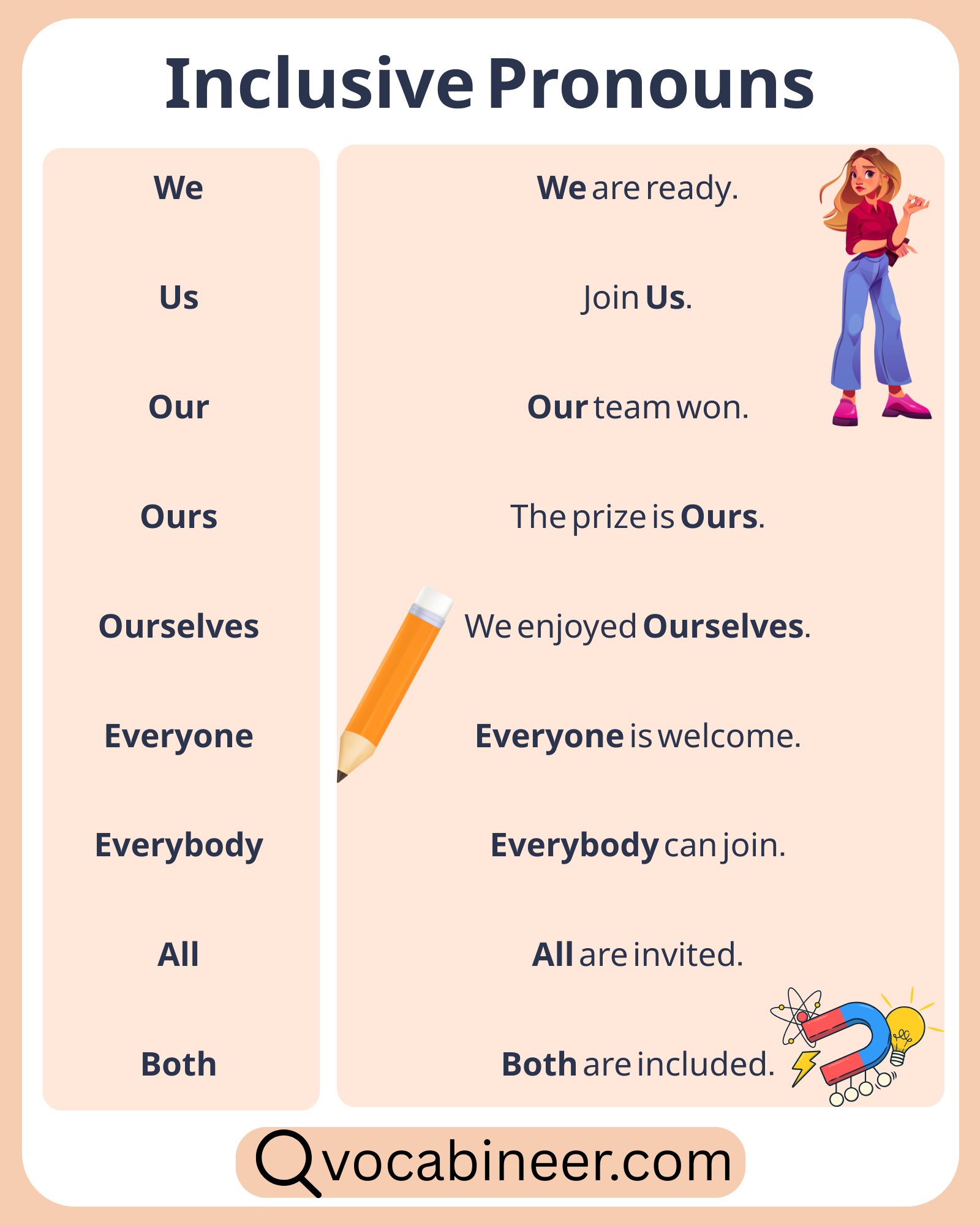
Inclusive Pronouns Chart
| Inclusive Pronoun | Use | Example |
|---|---|---|
| We | Includes speaker and listener or group | We can learn this together. |
| Us | Includes speaker and listener or group as object | This helps us improve. |
| Our | Shows shared belonging | Our goal is clear communication. |
| You | Speaks directly to the reader or listener | You can use this rule. |
| They | Avoids gender assumptions | Someone left their phone. |
| Everyone | Includes all people in a group | Everyone can join. |
This chart shows that inclusive pronouns can include people in different ways. Some create a shared feeling, while others avoid gender assumptions or speak directly to the reader.
Inclusive We, Us, Our, and Ours
The pronouns we, us, our, and ours are often inclusive because they can include the speaker and the listener or reader.
| Pronoun | Inclusive Use | Example |
|---|---|---|
| We | Speaker + listener or group | We can solve this together. |
| Us | Speaker + listener or group as object | This lesson helps us learn. |
| Our | Shared belonging | Our class is improving. |
| Ours | Shared ownership alone | This success is ours. |
Examples:
- We can learn this step by step.
- This rule helps us write better.
- Our goal is clear English.
- The final success is ours.
These pronouns make the sentence feel shared. They are useful in lessons, teamwork, speeches, guides, and friendly writing.
Inclusive vs Exclusive We
The pronoun we can be inclusive or exclusive. The meaning depends on whether the listener or reader is included.
| Type | Meaning | Example |
|---|---|---|
| Inclusive we | Includes the listener or reader | We should practice daily. |
| Exclusive we | Excludes the listener or reader | We will call you tomorrow. |
Examples of inclusive we:
- We can improve with practice.
- We should read the example first.
- We all need clear communication.
In these sentences, we includes the speaker and the listener or reader.
Examples of exclusive we:
- We will send you an email.
- We reviewed your form.
- We will call you tomorrow.
In these sentences, we probably means the speaker’s team or organization, not the listener.
To avoid confusion, formal writing can use clearer nouns.
Example:
- Unclear: We will contact you.
- Clear: Our support team will contact you.
Singular They as an Inclusive Pronoun
They is often used as a plural pronoun, but it can also refer to one person. This is called singular they.
Singular they is inclusive because it can avoid gender assumptions.
Use singular they when:
- the person’s gender is unknown
- the person’s gender is not important
- a person uses they/them pronouns
Examples:
- Someone left their phone here.
- A student should bring their notebook.
- Each learner can choose their answer.
- Jordan said they will arrive soon.
- I gave them the message.
- This jacket is theirs.
Singular they helps us speak clearly without guessing whether a person uses he, she, or another pronoun.
Gender-Inclusive Pronouns
Gender-inclusive pronouns help us refer to people respectfully without making unfair assumptions about gender.
Common pronoun sets include:
| Pronoun Set | Example |
|---|---|
| he / him / his | He is here. I called him. This is his bag. |
| she / her / hers | She is here. I called her. This bag is hers. |
| they / them / theirs | They are here. I called them. This bag is theirs. |
Examples:
- Mark said he is ready.
- Sofia said she will join.
- Jordan said they need more time.
- I gave him the note.
- I gave her the note.
- I gave them the note.
Using the correct pronouns is an important part of clear and respectful communication.
Inclusive Pronouns in Writing
Inclusive pronouns can make writing sound friendly, direct, and respectful.
Examples:
- We will learn this step by step.
- You can use this rule in daily writing.
- Each learner can choose their answer.
- Our goal is clear communication.
- Everyone deserves a clear explanation.
- This guide helps us understand the topic.
Different inclusive pronouns create different effects.
| Pronoun | Effect in Writing | Example |
|---|---|---|
| We | Creates a shared tone | We can practice together. |
| You | Speaks directly to the reader | You can try this example. |
| They / their | Avoids gender assumptions | A learner should check their answer. |
| Everyone | Includes the whole group | Everyone can take part. |
| Our | Creates shared ownership | Our aim is better writing. |
Use inclusive pronouns carefully. They should make the sentence clearer, not vague.
Inclusive Pronouns in Conversation
Inclusive pronouns are common in everyday conversation. They can make speech sound friendly, supportive, and welcoming.
Examples:
- We can try again.
- This helps us all.
- You can do it.
- Everyone is welcome.
- Someone forgot their bag.
- Jordan said they are ready.
- Our team is here to help.
- Let’s do our best.
Inclusive pronouns are especially useful when speaking to a group.
Examples:
- We are going to learn something new today.
- Everyone can ask questions.
- You can share your ideas.
- Our class can work together.
These pronouns create a warm and shared tone.
Inclusive Pronouns vs Gendered Pronouns
Some sentences use gendered pronouns even when the gender is unknown or not important. Inclusive pronouns can make those sentences more neutral and welcoming.
| Gendered / Specific | Inclusive / Neutral |
|---|---|
| He should bring his form. | They should bring their form. |
| Each student must ask his teacher. | Each student must ask their teacher. |
| The chairman gave his speech. | The chairperson gave their speech. |
| A reader should check his notes. | Readers should check their notes. |
Examples:
- Less inclusive: Every student should bring his book.
- More inclusive: Every student should bring their book.
- Less inclusive: A teacher should help his or her students.
- More inclusive: A teacher should help their students.
- Less inclusive: Each worker must submit his report.
- More inclusive: Each worker must submit their report.
Using they/their can make writing simpler and more inclusive.
Less Inclusive vs More Inclusive Pronoun Examples
Here are more examples of how pronoun choices can make a sentence more inclusive.
| Less Inclusive | More Inclusive |
|---|---|
| Every student should bring his book. | Every student should bring their book. |
| A teacher should help his or her students. | A teacher should help their students. |
| Each worker must submit his report. | Each worker must submit their report. |
| The reader should follow his notes. | Readers should follow their notes. |
| A user must enter his/her password. | Users must enter their passwords. |
| A person should do his best. | A person should do their best. |
A good inclusive sentence avoids guessing gender and includes more people naturally.
Common Mistakes with Inclusive Pronouns
Inclusive pronouns are useful, but they should still be clear and grammatically correct.
| Weak / Less Clear | Better |
|---|---|
| Everyone should bring his book. | Everyone should bring their book. |
| The user must enter his/her password. | Users must enter their passwords. |
| We will contact you. (unclear who “we” means) | Our support team will contact you. |
| Jordan said he is coming. (if Jordan uses they/them) | Jordan said they are coming. |
| The reader should follow his notes. | Readers should follow their notes. |
| Each student should submit his answer. | Each student should submit their answer. |
A simple way to avoid mistakes is to ask:
- Does this pronoun include the right people?
- Am I guessing someone’s gender?
- Is the pronoun clear?
- Would a noun make the sentence clearer?
Quick Rules to Remember
| Rule | Example |
|---|---|
| Inclusive pronouns include the listener, reader, or group. | We can learn together. |
| Use we, us, our for shared meaning. | Our goal is clear. |
| Use you to speak directly to readers. | You can try this. |
| Use singular they to avoid gender assumptions. | Someone left their phone. |
| Use everyone to include a whole group. | Everyone can join. |
| Make vague we clear in formal writing. | Our team will reply. |
Simple reminders:
- We can include the reader or listener.
- Us includes the speaker and others as the object.
- Our shows shared belonging.
- They/their can avoid gender assumptions.
- Everyone includes the whole group.
- Clear pronouns are better than vague pronouns.
FAQs
Inclusive pronouns are ordinary pronouns used to include the listener, reader, group, or people of different genders. Examples include we, us, our, you, they, their, everyone, and someone.
No. Inclusive pronouns are not a separate traditional pronoun type. They are normal pronouns used in an inclusive way.
Examples include we in “We can learn together,” us in “This helps us,” our in “Our goal is clear,” and they in “Someone left their bag.”
Inclusive we means we includes the listener or reader. For example, “We should practice daily” can mean the speaker and the reader should practice together.
Singular they helps avoid guessing a person’s gender. For example, “Someone left their phone” is more inclusive than assuming his or her.
Summary
Inclusive pronouns are normal pronouns used to include people, avoid assumptions, and create a shared tone. Common examples include we, us, our, you, they, their, everyone, and someone.
Use we, us, and our for shared meaning, you for direct reader connection, and singular they to avoid gender assumptions. Inclusive pronouns help make English clearer, friendlier, and more respectful.
Read More
- List of Pronouns in English
- Subject Pronouns in English
- First Person Pronouns in English
- Pronouns for Kids in English
- Interrogative Pronouns in English