

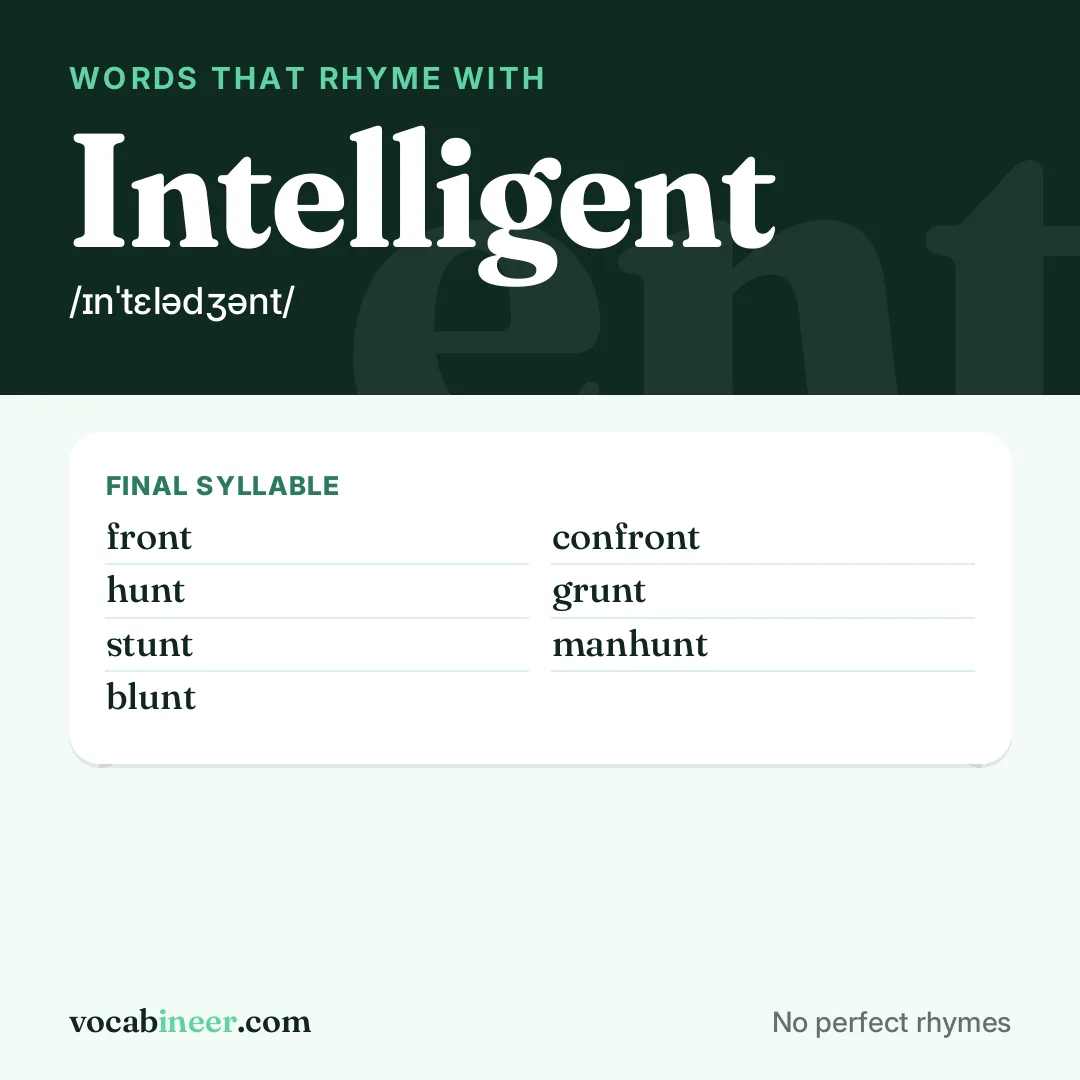
“Intelligent” has no perfect rhyme in common English. That ending, /ɛlədʒənt/ from the stressed vowel onward, occurs in no other common word, and a perfect rhyme has to match it exactly. Writers rhyme it one way: on the final syllable alone (front, hunt and stunt).
Spoken aloud, “intelligent” is /ɪnˈtɛlədʒənt/, respelled ihn-TEH-luh-juhnt, four syllables with the stress on the second. A rhyme has to match from that stressed syllable to the end, and the syllables before it are free to differ.
“Intelligent” has no perfect rhyme in common use; the nearest matches are five near rhymes and eight rhymes on its final syllable.
In This Page
What Rhymes With Intelligent
No common English word rhymes with “intelligent” on every sound. Front, hunt and stunt come closest, matching the final syllable alone.
- Front
- Hunt
- Stunt
Near Rhymes With Intelligent
In common English, “intelligent” has five near rhymes, and relevant and irrelevant are the most common of them, both ending in /ɛləvənt/. Measured against the full /ɛlədʒənt/ ending of “intelligent”, most of its near rhymes change, add or leave out one sound.
Near Rhymes For Intelligent Ending In -elevant: Relevant And Irrelevant
Words such as relevant and irrelevant end in /ɛləvənt/, which is /v/ in place of the /dʒ/ of “intelligent”.
- Relevant
- Irrelevant
Elephant /ɛləfənt/, element /ɛləmənt/ and elegant /ɛləɡənt/ also rhyme loosely with “intelligent”, though no other common word shares their endings.
Rhymes On The Final Syllable Of Intelligent
“Intelligent” ends on an unstressed /-ənt/, a syllable it shares with eight common words. Only that last syllable matches and the stressed syllables differ, so the rhyme is weak on the page. Songwriters and poets still use rhymes of this kind, because listeners do not hear the difference in stress when the beat is on the final syllable.
- Front
- Hunt
- Stunt
- Blunt
- Confront
- Grunt
- Manhunt
- Waterfront
Does Elephant Rhyme With Intelligent
People often ask whether these words rhyme with “intelligent”. Only the sounds from the stressed vowel on count, so two words can share four letters and still not rhyme.
| Word | Rhymes With Intelligent | Reason |
|---|---|---|
| Elephant | Near rhyme | /f/ in place of the /dʒ/ of "intelligent", near enough for the end of a line |
| Element | Near rhyme | /m/ in place of the /dʒ/ of "intelligent", near enough for the end of a line |
| Registered | Consonance only | Same stressed vowel, and the final consonant is of the same kind rather than the same sound |
| Front | No | Only the unstressed last syllable matches, and the stressed syllable is different |
| Agent | No | Same letters at the end, but said /eɪdʒənt/ |
| Urgent | No | Same letters at the end, but said /ɝdʒənt/ |
Near Rhymes For Intelligent By Word Class
The near rhymes for “intelligent” include eight nouns and three adjectives, and each word is counted once, under the part of speech it takes most often. Front is both an adjective and a noun, so it is listed once, under the part of speech it takes more often. Among the adjectives, relevant, irrelevant and elegant are in the same word class as “intelligent”, which is a adjective.
| Word Class | Near Rhymes |
|---|---|
| Nouns | Elephant, element, front, hunt, stunt, grunt, manhunt, waterfront |
| Adjectives | Relevant, irrelevant, elegant |
The Ending Sound In Intelligent
“Intelligent” ends in the rhyme sound /ɛlədʒənt/, made up of the stressed vowel /ɛ/ followed by /l/, /ə/, /dʒ/, /ə/, /n/ and /t/. Common English has no other word with the full /ɛlədʒənt/ ending of “intelligent”, which leaves near rhymes that match part of it. The ending has three syllables, so a perfect rhyme has to match the stressed vowel and every sound after it.
Words That Look Like Intelligent But Do Not Rhyme
“Intelligent” shares its -gent spelling with agent, urgent, regent and gent, and none of them rhymes with it. Agent ends in /eɪdʒənt/ and urgent and detergent end in /ɝdʒənt/, whereas “intelligent” ends in /ɛlədʒənt/. These words and “intelligent” have the same closing /nt/, so a pairing with any of them is a near rhyme rather than a perfect rhyme.
| Word | Ending Sound | Closing Sound Shared With Intelligent |
|---|---|---|
| Agent | /eɪdʒənt/ | /nt/ |
| Urgent | /ɝdʒənt/ | /nt/ |
| Regent | /idʒənt/ | /nt/ |
| Gent | /ɛnt/ | /nt/ |
| Detergent | /ɝdʒənt/ | /nt/ |
| Diligent | /ɪlɪdʒənt/ | /nt/ |
| Negligent | /ɛɡlɪdʒənt/ | /nt/ |
| Contingent | /ɪndʒənt/ | /nt/ |
Rhyme Schemes With Intelligent
“Intelligent” fits the common stanza forms through near rhymes and consonance, since it has no perfect rhyme. In the scheme, lines with the same letter rhyme with each other.
| Scheme | Line endings | How The Lines Pair |
|---|---|---|
| ABAB | Intelligent / relevant / front / irrelevant | With no perfect rhyme available, the consonance pair ends the B lines and the final-syllable rhyme ends the A lines. |
FAQs
No common English word rhymes perfectly with “intelligent”, so the closest matches are near rhymes such as elephant, element, elegant and relevant. Words such as front and hunt match its final syllable alone, so the rhyme at the end of a line is lighter.
“Intelligent” has five near rhymes in common English and no perfect rhyme. They have four different ending sounds, and the most frequent is /ɛləvənt/.
“Intelligent” ends in the same letters as agent, urgent and regent, yet none of them rhymes with it. Spoken aloud, they have a different stressed vowel from “intelligent”, so none of them rhymes with it.
“Intelligent” has four syllables, said ihn-TEH-luh-juhnt, with the stress on the second. Everything from that syllable onward has to match for a word to rhyme with “intelligent”.