

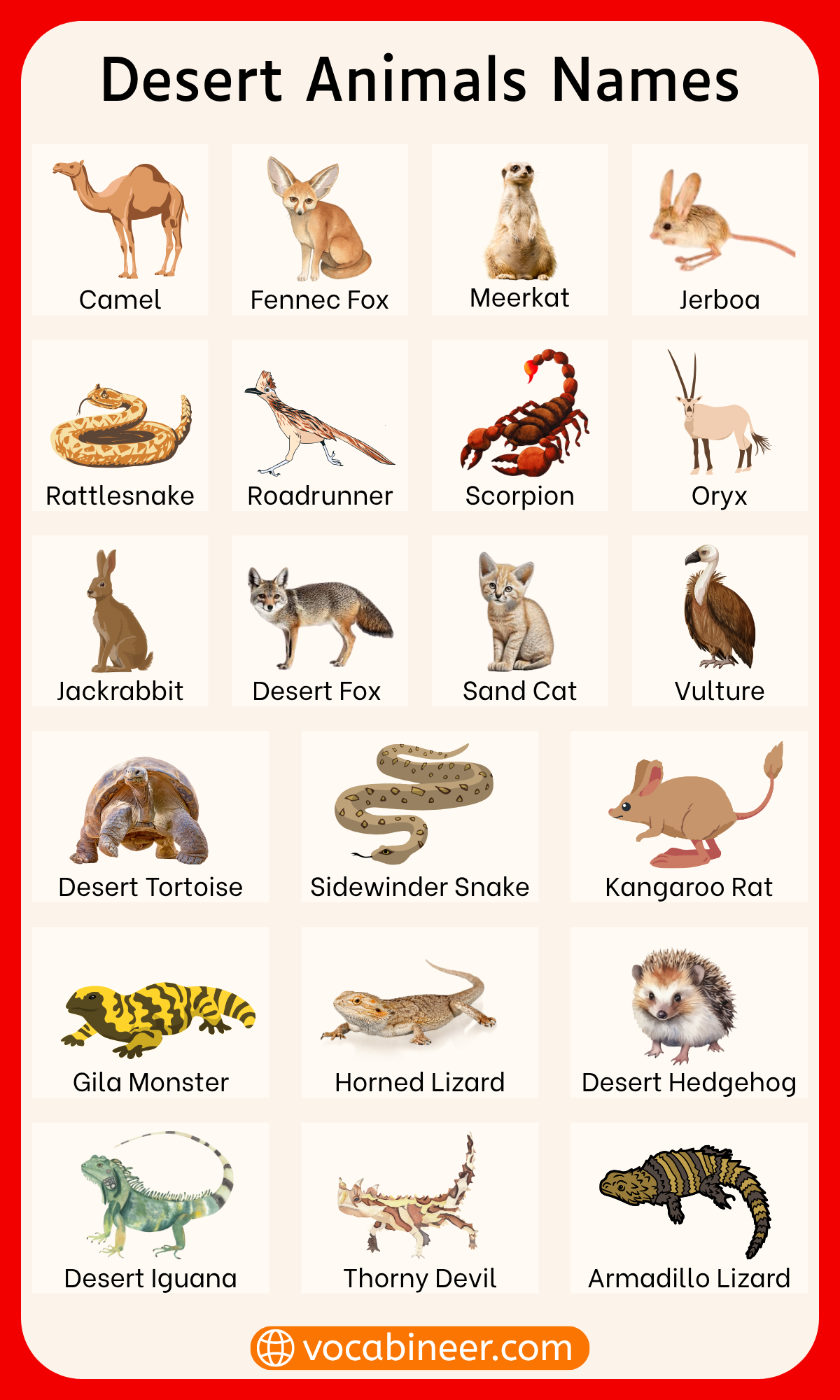
Desert animals names include the animals that live in hot, dry, and sandy regions where water is limited and weather conditions are harsh. These animals are adapted to survive in extreme heat, strong sunlight, and long periods without much food or water. Camels, lizards, snakes, foxes, scorpions, and desert birds are some common examples of desert animals. Many of them have special body features and behaviors that help them live safely in the desert environment.
In this article, you will learn desert animals names with pictures and simple examples. It also covers common animals found in desert habitats, so kids, students, and English learners can improve their animal vocabulary in a clear and easy way. This topic is useful for classroom learning, basic science vocabulary, and everyday English practice.
In This Page
Common Desert Animals Names
Deserts are home to many fascinating animals that can survive hot temperatures, dry conditions, and limited water. Camels, foxes, reptiles, birds, and small mammals have unique adaptations that help them find food, stay safe, and survive in harsh desert environments.
Camel
Camels are well adapted to hot, dry environments and can travel long distances across sandy deserts. Their bodies conserve water and help them tolerate high temperatures.
Fennec Fox
The fennec fox is a small desert fox with very large ears. Its ears help release heat, while its thick fur protects it from the hot ground and cool nights.
Dromedary
The dromedary is a one-humped camel commonly associated with the deserts of North Africa and the Middle East. It can survive long periods with limited access to water.
Desert Tortoise
The desert tortoise lives in dry regions and spends much of its time in underground burrows. These shelters protect it from extreme heat.
Kangaroo Rat
Kangaroo rats are small rodents with powerful hind legs that help them move across sandy ground. They obtain much of the water they need from the seeds they eat.
Meerkat
Meerkats live in dry areas of southern Africa and often stay in underground burrow systems. They work together to watch for predators while other members search for food.
Fennec Fox
The fennec fox is especially suited to desert life because of its large ears, light-colored coat, and ability to remain active in cooler nighttime conditions.
Jerboa
Jerboas are small jumping rodents with long hind legs and tails. Their unusual body shape helps them move quickly across deserts.
Scorpion
Scorpions are common desert predators with pincers and a venomous tail. Many species are nocturnal and hunt during cooler nighttime hours.
Horned Lizard
Horned lizards have flattened bodies and pointed scales that help protect them from predators. Several species live in hot, dry habitats.
Sidewinder Snake
The sidewinder moves across loose sand using a distinctive sideways motion. This movement helps reduce contact with the hot surface.
Desert Cobra
Desert cobras are venomous snakes adapted to arid environments. They hunt small animals and can remain active in warm desert conditions.
Desert Hedgehog
The desert hedgehog has a body covered with protective spines. It is mainly active at night when temperatures are lower.
Addax
The addax is a desert antelope with long, twisted horns and a pale coat. It can survive in extremely dry environments by obtaining moisture from its food.
Arabian Oryx
The Arabian oryx has a bright white coat and long, straight horns. Its light coloring helps reflect sunlight in hot desert habitats.
Gila Monster
The Gila monster is a venomous lizard found in desert regions of the southwestern United States and northwestern Mexico. Its patterned skin provides a distinctive appearance.
Roadrunner
The roadrunner is a fast-running desert bird that spends much of its time on the ground. It eats insects, lizards, snakes, and other small animals.
Desert Bighorn Sheep
Desert bighorn sheep live among rocky desert mountains and slopes. Their strong legs and hooves help them climb steep terrain.
Desert Toad
Desert toads spend much of the year sheltered underground or in other protected places. They become more active when seasonal rains provide suitable conditions.
Desert Hare
Desert hares have long ears and powerful hind legs that help them move quickly across dry landscapes. Many species are most active during cooler periods.
Desert Animals Names and Their Habitats
Deserts support a surprisingly wide variety of wildlife despite their dry conditions, limited water, and extreme temperatures. Mammals, birds, reptiles, amphibians, insects, and arachnids have developed different ways to survive in these challenging environments.
The following desert animals names in English include familiar and unusual species found across sandy deserts, rocky plains, dry grasslands, and other arid regions.
Mammals Adapted to Desert Life
Camel
A large desert mammal with humps that store fat, helping it survive when food and water are limited.
Fennec Fox
A small desert fox with exceptionally large ears that help release body heat.
Jerboa
A small jumping rodent with long hind legs that allow it to move quickly across sandy ground.
Kangaroo Rat
A desert rodent that obtains much of the moisture it needs from the seeds it eats.
Dromedary
A one-humped camel commonly associated with hot desert regions.
Dingo
A wild canine found across Australia, including several dry and desert environments.
Bat-eared Fox
A small fox with large ears and sandy-colored fur that suits open, dry landscapes.
Addax
A pale desert antelope recognized by its long, twisted horns.
Oryx
A large antelope with long, straight horns that lives in several arid regions.
Desert Hedgehog
A small spiny mammal that curls into a ball when it feels threatened.
Rock Hyrax
A compact mammal that often shelters among rocky cliffs and crevices in dry regions.
Meerkat
A social mammal known for standing upright while watching for danger.
Birds Seen Across Dry Landscapes
Desert birds cope with intense heat and limited water in different ways. Some spend much of their time on the ground, while others travel long distances between feeding and watering areas.
Roadrunner
A fast-moving ground bird associated with the deserts and drylands of North America.
Sandgrouse
A desert bird known for carrying water in specialized belly feathers to its chicks.
Burrowing Owl
A small owl that shelters in underground burrows and feeds on insects and small animals.
Lark
A small ground-dwelling bird commonly found in open and dry habitats.
Greater Roadrunner
A larger roadrunner species recognized for its long tail and strong running ability.
Desert Sparrow
A small pale-colored bird associated with desert regions of North Africa and nearby areas.
Hoopoe Lark
A ground-dwelling desert bird with distinctive wing markings and a long curved bill.
Egyptian Vulture
A scavenging bird that occurs in dry and desert regions and feeds on animal remains.
Brown-necked Raven
A large dark bird commonly seen across deserts of North Africa and the Middle East.
Reptiles Built for Sand, Heat, and Rocks
Reptiles are especially well represented in desert habitats. Their scales, burrowing behavior, body shape, and activity patterns help them cope with hot ground and limited moisture.
Horned Lizard
A spiny-bodied lizard whose colors often blend with dry soil and sand.
Sidewinder Snake
A desert snake known for its distinctive sideways movement across loose sand.
Gila Monster
A heavy-bodied lizard recognized by its patterned skin and venomous bite.
Desert Tortoise
A sturdy tortoise with thick legs and a domed shell that spends much of its time in shelters or burrows.
Fringe-toed Lizard
A sand-dwelling lizard with specialized toes that help it move across loose surfaces.
Gecko
A small reptile often seen on rocks, cliffs, and other sheltered surfaces in dry regions.
Collared Lizard
A fast-moving lizard recognized by the dark bands around its neck.
Amphibians That Wait for Desert Rain
Although amphibians usually need moisture, several species survive in dry environments by spending long periods underground. Rainfall can trigger sudden periods of activity and breeding.
Spadefoot Toad
A burrowing amphibian that remains underground during dry periods and becomes active after rain.
Desert Rain Frog
A small burrowing frog associated with dry coastal areas.
Couch’s Spadefoot
A desert-adapted amphibian known for becoming active after seasonal rainfall.
Mexican Burrowing Toad
A burrowing toad that spends much of its life beneath the ground.
Great Basin Spadefoot
A North American spadefoot associated with dry and semi-arid environments.
Western Toad
A toad that can occur around cooler and wetter areas bordering dry landscapes.
Insects of Hot and Arid Regions
Desert insects survive through burrowing, nighttime activity, water conservation, and specialized feeding habits. Some have developed particularly unusual ways to live in extremely dry places.
Dung Beetle
A beetle that feeds on animal waste and may roll pieces into rounded balls.
Antlion
An insect whose larvae create sandy pits that trap ants and other small prey.
Desert Locust
A grasshopper species known for forming large migratory swarms under suitable conditions.
Velvet Ant
Despite its name, this insect is actually a type of wasp with a dense, fuzzy-looking body.
Blister Beetle
A beetle that produces a defensive chemical capable of irritating skin.
Namib Beetle
A desert beetle associated with the Namib region, where some species collect moisture from fog.
Red Harvester Ant
An ant commonly associated with dry parts of North America that gathers seeds for food.
Scorpions, Spiders, and Other Desert Arachnids
Arachnids are well suited to dry habitats because many spend the hottest hours under rocks, in cracks, or inside burrows. They often become more active when temperatures fall.
Scorpion
An arachnid recognized by its pincers and curved tail ending in a stinger.
Camel Spider
A fast-moving desert arachnid with large jaws. Despite its name, it is not a true spider.
Wolf Spider
An active hunting spider that searches for prey instead of relying mainly on a capture web.
Tarantula
A large, hairy spider that often shelters in burrows.
Sun Spider
Another common name used for members of the same arachnid group commonly called camel spiders.
Trapdoor Spider
A burrowing spider that waits inside a concealed shelter before rushing out at passing prey.
Animals That Disappear into Sand and Stone
Camouflage helps many desert animals avoid predators or approach prey. Their pale, sandy, brown, and mottled colors often resemble the ground around them.
Horned Viper
A desert snake whose sandy coloration helps it remain difficult to see against the ground.
Desert Hare
A hare with pale fur that blends into dry landscapes.
Sandfish Lizard
A smooth-bodied lizard known for moving beneath loose sand.
Desert Iguana
A light-colored lizard whose appearance matches many sandy desert surroundings.
Stone Curlew
A ground-dwelling bird with mottled feathers that blend with stones and dry soil.
Thorny Devil
A small Australian lizard covered in sharp-looking spines and patterned in earthy colors.
Desert Chameleon
A chameleon whose coloration can help it blend with the vegetation and ground in dry habitats.
Desert Wildlife That Comes Out After Dark
Many desert animals avoid the hottest part of the day and become active after sunset. Cooler nighttime temperatures allow them to search for food while reducing exposure to intense heat.
Aardwolf
A nocturnal mammal that feeds mainly on termites.
Kangaroo Rat
This small rodent usually becomes active after sunset and spends much of the daytime inside a burrow.
Fennec Fox
The fennec fox often hunts at night, using its sensitive hearing to locate prey.
Scorpion
Many desert scorpions hide during the day and become active once temperatures fall.
Owl
Several owl species living in dry regions hunt rodents, insects, and other prey after dark.
Cape Fox
A small fox with silver-gray fur that is mainly active at night.
Desert Hedgehog
This spiny mammal often leaves its daytime shelter after sunset to search for food.
Rare and Threatened Animals of Desert Regions
Some desert animals face pressure from hunting, habitat change, and declining populations. Their ability to survive harsh climates does not always protect them from human-related threats.
Addax
A desert antelope with spiral horns whose wild populations have declined severely.
Arabian Oryx
A desert antelope that disappeared from the wild in the past before conservation programs helped restore wild populations.
Saharan Cheetah
A rare cheetah population associated with the Sahara and surrounding arid regions.
Sand Cat
A small desert cat with thick fur on the soles of its feet that helps protect them from hot sand.
Desert Monitor
A large desert-dwelling lizard found across parts of North Africa, the Middle East, and Asia.
Persian Leopard
A large leopard population found across parts of western and central Asia, including some dry and mountainous environments.
Hot vs Cold Desert Animals
Deserts can be hot or cold, and each type has animals specially adapted to survive in extreme conditions. The table below shows the main differences and examples of animals from both environments.
| Feature | Hot Desert Animals | Cold Desert Animals |
|---|---|---|
| Climate | Very hot days and cool nights with little rain | Freezing temperatures with snow and ice |
| Body Adaptation | Light-colored bodies to reflect heat | Thick fur or fat layers to keep warm |
| Behavior | Active at night to avoid daytime heat | Active during the day when sunlight gives warmth |
| Water Source | Store water or get it from food | Eat snow or use body fat for water |
| Shelter | Live in burrows or under rocks | Live in dens or caves for warmth |
| Examples | Camel, Fennec Fox, Meerkat, Desert Tortoise, Sidewinder Snake | Arctic Fox, Snow Leopard, Yak, Penguin, Caribou |
Small and Large Animals That Live in Deserts
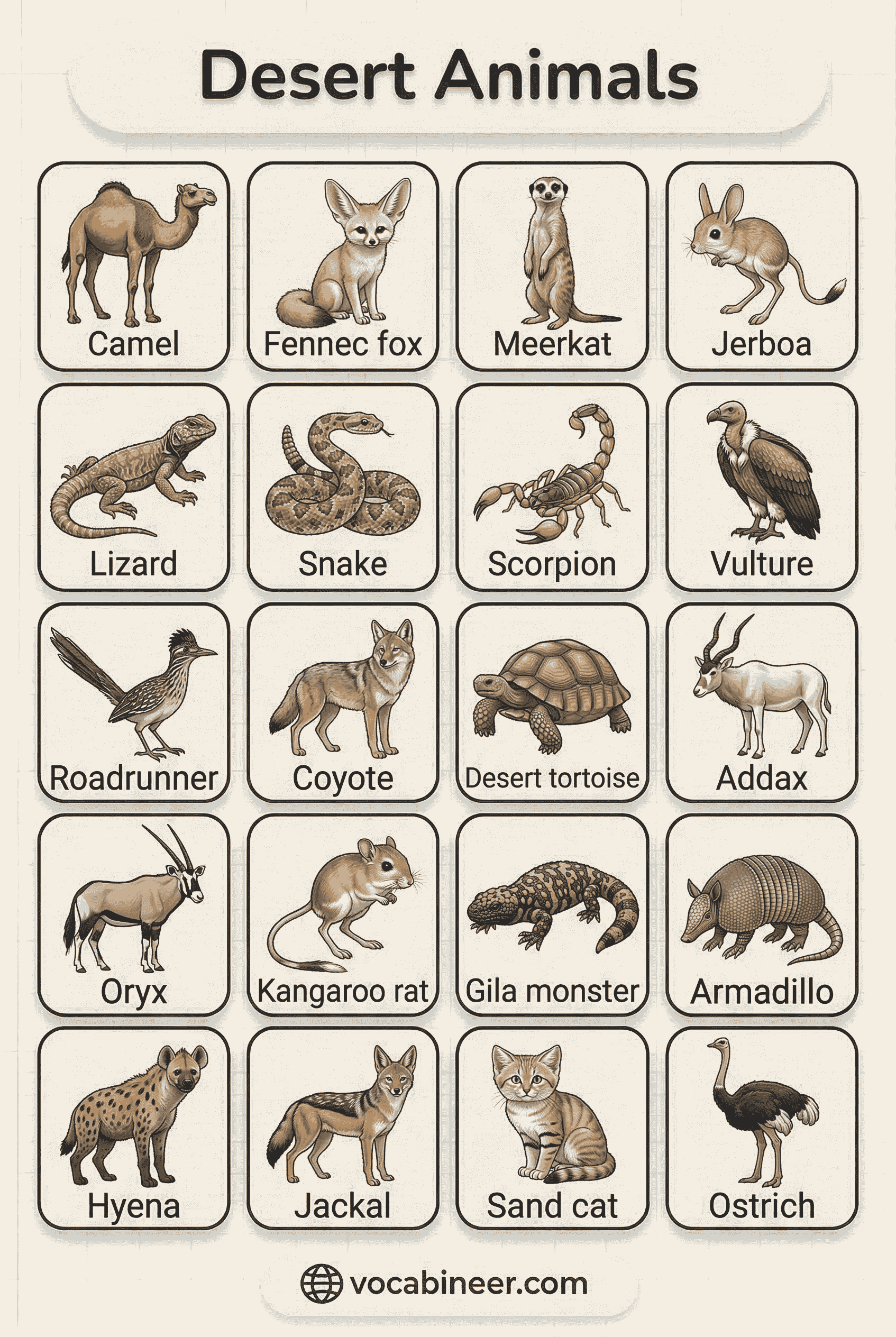
Deserts are home to both small and large animals, each adapted to survive with little water and extreme temperatures. Small desert animals often hide during the day to stay cool, while large animals use their size to travel long distances and store water or fat for survival.
Small Desert Animals
These animals are lightweight, fast, and often nocturnal. They live in burrows or under rocks to escape the heat.
Examples:
- Fennec Fox: Tiny fox with large ears that release body heat.
- Kangaroo Rat: Gets water from seeds and rarely drinks.
- Lizard: Cold-blooded reptile that basks in morning sunlight.
- Scorpion: Hides in sand during the day and hunts insects at night.
- Jerboa: Small hopping rodent that digs burrows in desert soil.
Large Desert Animals
These animals travel across wide deserts to find food and water. Their strong bodies help them live through long, dry seasons.
Examples:
- Camel: Can go days without water by storing fat in its hump.
- Oryx: Antelope with long horns that help defend against predators.
- Desert Elephant: Moves in herds to find scarce food and water.
- Dromedary: One-humped camel adapted for hot deserts.
- Addax: White-coated antelope that reflects sunlight and stays cool.
How Desert Animals Survive
Desert animals use several adaptations to cope with heat and limited water. Some obtain moisture from their food, while others reduce water loss through specialized bodies and behaviors.
Nocturnal activity is another important adaptation. Animals such as foxes, rodents, and scorpions often search for food at night, avoiding the hottest part of the day.
Conclusion
Deserts may seem empty, but they are full of life. From small lizards and foxes to large camels and elephants, each animal has special features that help it survive extreme heat or cold. Learning desert animals names helps us understand how living things adapt to harsh environments and stay in balance with nature. These creatures prove that even the driest places on Earth can be full of amazing life.
FAQs
Animals like the camel, fennec fox, horned lizard, and sidewinder snake are well adapted to survive heat and dryness.
Yes, species such as the spadefoot toad and desert rain frog live in deserts by staying underground during dry periods and emerging when it rains.
Some nocturnal desert animals include the scorpion, kangaroo rat, owl, cape fox, and aardwolf. They avoid daytime heat.
Yes. Examples are the thorny devil, horned viper, desert chameleon, and sandfish lizard, all of which blend in with sand or rocks.
Hot desert animals like the camel and scorpion deal with heat, while cold desert animals such as the yak and snow leopard survive in freezing, dry areas.
Read More
