

A child’s first spelling words may look simple: cat, sun, map, dog, and bed. However, these small words do important work. They help children hear sounds, match letters to those sounds, write with more confidence, and understand how English words are built.
Good spelling words for kids should not feel like random homework. The best lists match a child’s age, reading level, phonics stage, and writing needs. A strong spelling plan includes easy beginner words, grade-level spelling lists, phonics patterns, high-frequency writing words, tricky words, sentence practice, activities, worksheets, and common spelling mistake fixes.
In This Page
What Are Spelling Words for Kids?
Spelling words for kids are words children practice so they can write them correctly, read them more easily, and use them in sentences.
These words may come from:
- phonics lessons
- reading books
- classroom spelling lists
- weekly homework
- sight word practice
- writing activities
- vocabulary lessons
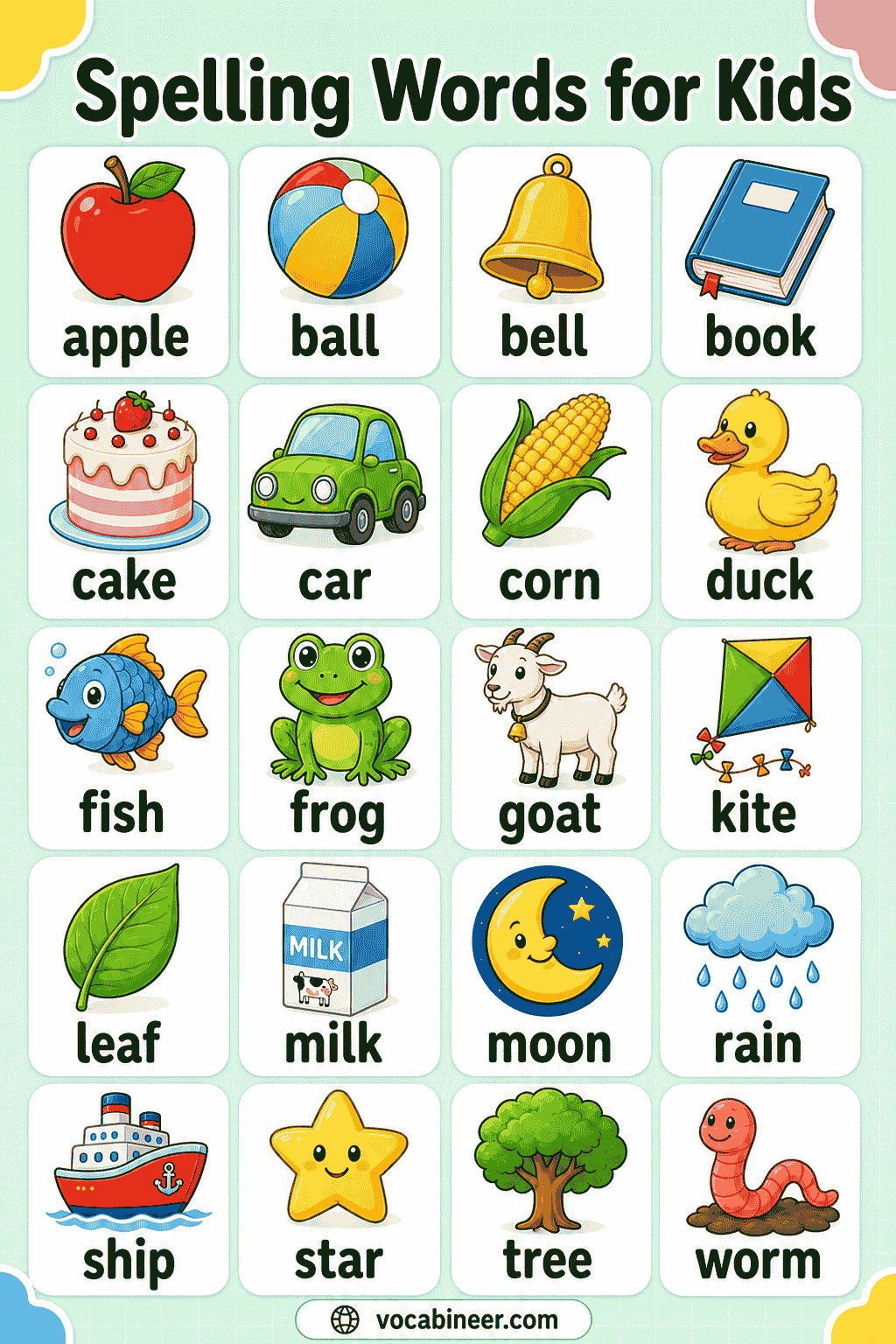
For young learners, spelling words should be simple, useful, and connected to sounds. Words like cat, map, sun, and bed work well for beginners because children can hear each sound and match it to a letter.
As children grow, spelling lists can include longer and less regular words. These may include silent e words, vowel team words, consonant blends, digraphs, compound words, high-frequency words, and tricky spellings such as said, friend, people, and because.
Why Spelling Words Help Reading and Writing
Spelling supports reading because it teaches children how letters and sounds work together. When children spell a word, they listen for sounds, choose letters, remember patterns, and write the letters in the correct order.
Strong spelling practice can help children:
- hear sounds inside words
- connect sounds to letters
- notice spelling patterns
- read familiar patterns faster
- write sentences more clearly
- remember common writing words
- build confidence with schoolwork
For example, a child who can spell cat may find it easier to spell bat, hat, mat, and sat. One familiar spelling pattern can help children write many related words.
How to Choose Spelling Words for Kids
A good spelling list should match the child’s current stage. Beginners need short, clear words. Growing readers can practice blends, digraphs, long vowels, endings, and tricky high-frequency words.
Use these guidelines when choosing spelling words:
- Start with words children can hear clearly.
- Group words by sound or spelling pattern.
- Use words children can read or are learning to read.
- Add high-frequency writing words slowly.
- Mix easy review words with a few new words.
- Keep tricky words separate from regular phonics words.
- Include words children can use in simple sentences.
- Review older words before adding many new ones.
A useful spelling list has a clear pattern. For example, cat, bat, hat, mat, and sat work well together because they all share the -at spelling pattern.
Easy Spelling Words for Beginners
Beginner spelling words should be short, decodable, and easy to hear. These words help children practice basic sound-letter matching.
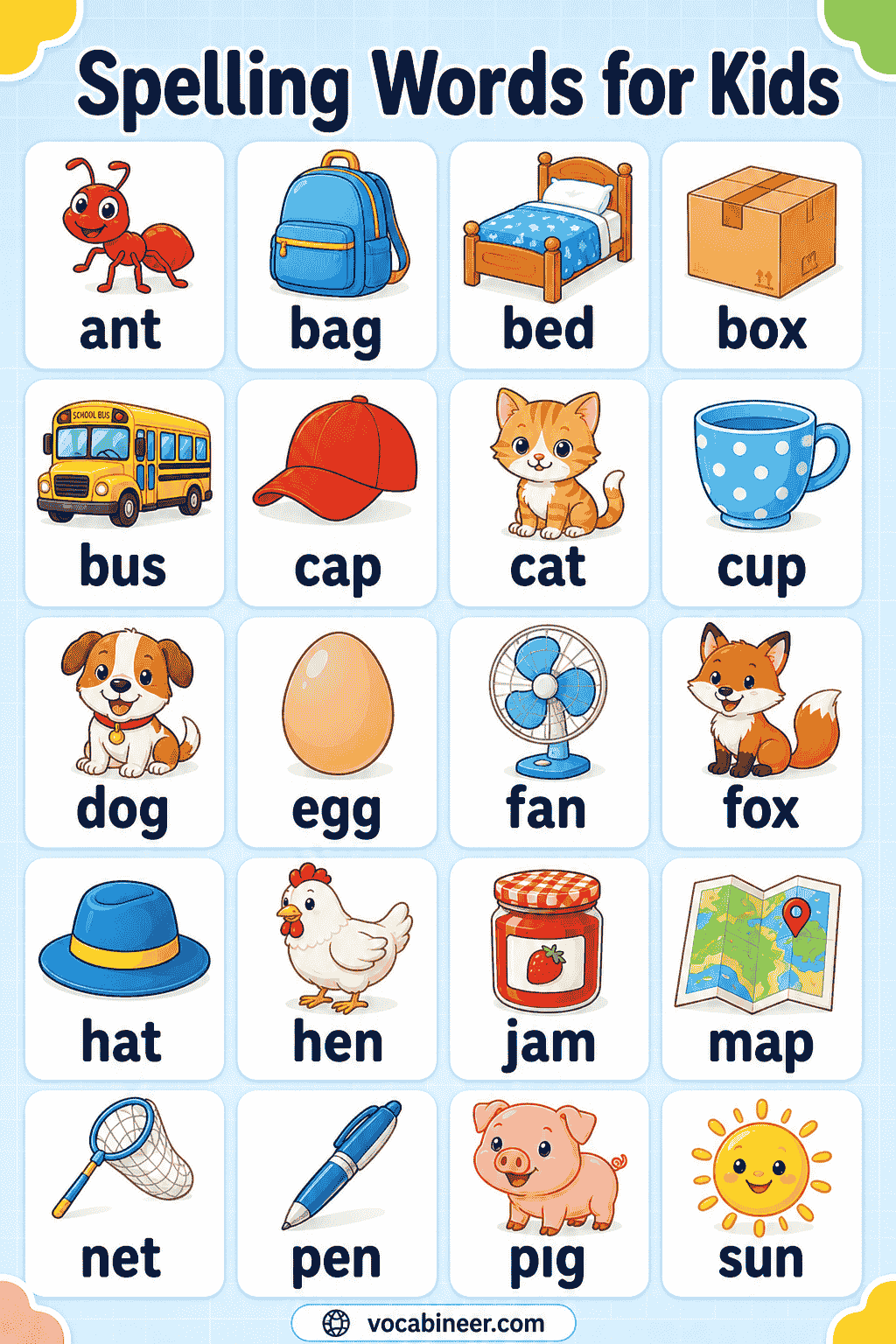
- Short A: cat, bat, hat, map, fan, bag, jam, tap, cap, ran
- Short E: bed, red, hen, pen, jet, wet, leg, net, ten, pet
- Short I: pin, pig, sit, lip, big, dig, win, fin, kit, lid
- Short O: dog, log, hop, pot, box, fox, mop, top, cot, dot
- Short U: sun, run, bug, cup, rug, tub, mud, hut, bun, nut
A simple beginner routine:
- Say the word.
- Stretch the sounds.
- Write each sound.
- Read the word again.
- Use it in a short sentence.
Example:
Word: cat
Sounds: /c/ /a/ /t/
Sentence: The cat is big.
Spelling Words by Grade Level
Grade-level spelling lists help parents and teachers choose words that fit a child’s learning stage. These levels are flexible because children develop at different speeds.
Preschool Spelling Readiness
Preschool spelling should focus on readiness, not formal spelling tests. At this age, children benefit from hearing sounds, recognizing letters, tracing names, matching pictures, and noticing simple words in daily life.
Preschool practice can use simple name, label, color, and picture words, but the goal is recognition and sound play.
Useful practice words include:
- Name and family words: mom, dad, me
- Picture words: cat, dog, sun, hat, cup
- Color words: red, blue
- Number words: one, two
- Daily words: bed, bag, ball, toy
Good readiness activities include:
- tracing letters
- finding letters in names
- matching pictures to words
- clapping syllables
- saying beginning sounds
- copying simple labels
- pointing to familiar words in books
Kindergarten Spelling Words
Kindergarten spelling words should focus on simple sounds, short vowels, common classroom words, and early writing words.
Good kindergarten spelling words include:
- CVC words: cat, cap, tap, bed, hen, pot, cub, net
- Family words: mom, dad, man, kid
- School words: book, bag, pen, desk
- Color words: red, blue, green
- Number words: one, two, three
- Action words: run, hop, sit, jump
- Common words: I, a, the, my, can, see
Kindergarten spelling practice works best when children can say the word, hear the sounds, write the letters, and use the word in a short sentence.
First Grade Spelling Words
First grade spelling expands from simple CVC words to blends, digraphs, long vowels, and common writing words.
Good first grade spelling words include:
- Short vowel words: clap, drop, swim, fast, hand, grass
- Blends: flag, stop, crab, spin, drum, trip
- Digraphs: ship, chip, thin, shop, lunch, much
- Silent e words: cake, bike, home, cube, name, smile, stone
- Vowel team words: rain, train, boat, seed
- Common words: said, was, they, have, come
- Writing words: friend, school, because, little
First graders should practice spelling words in sentences, not only from isolated lists.
Second Grade Spelling Words
Second grade spelling can include longer patterns, endings, contractions, compound words, and more high-frequency words.
Good second grade spelling words include:
- Long vowels: rain, boat, seed, light, road, clean
- R-controlled words: car, bird, horn, turn, farm
- Compound words: bedtime, sunshine, notebook, backpack, playground
- Endings: jumped, helping, taller, fastest, teacher, helper
- Contractions: can’t, don’t, I’m, we’ll, didn’t
- Tricky words: people, enough, again, would, could
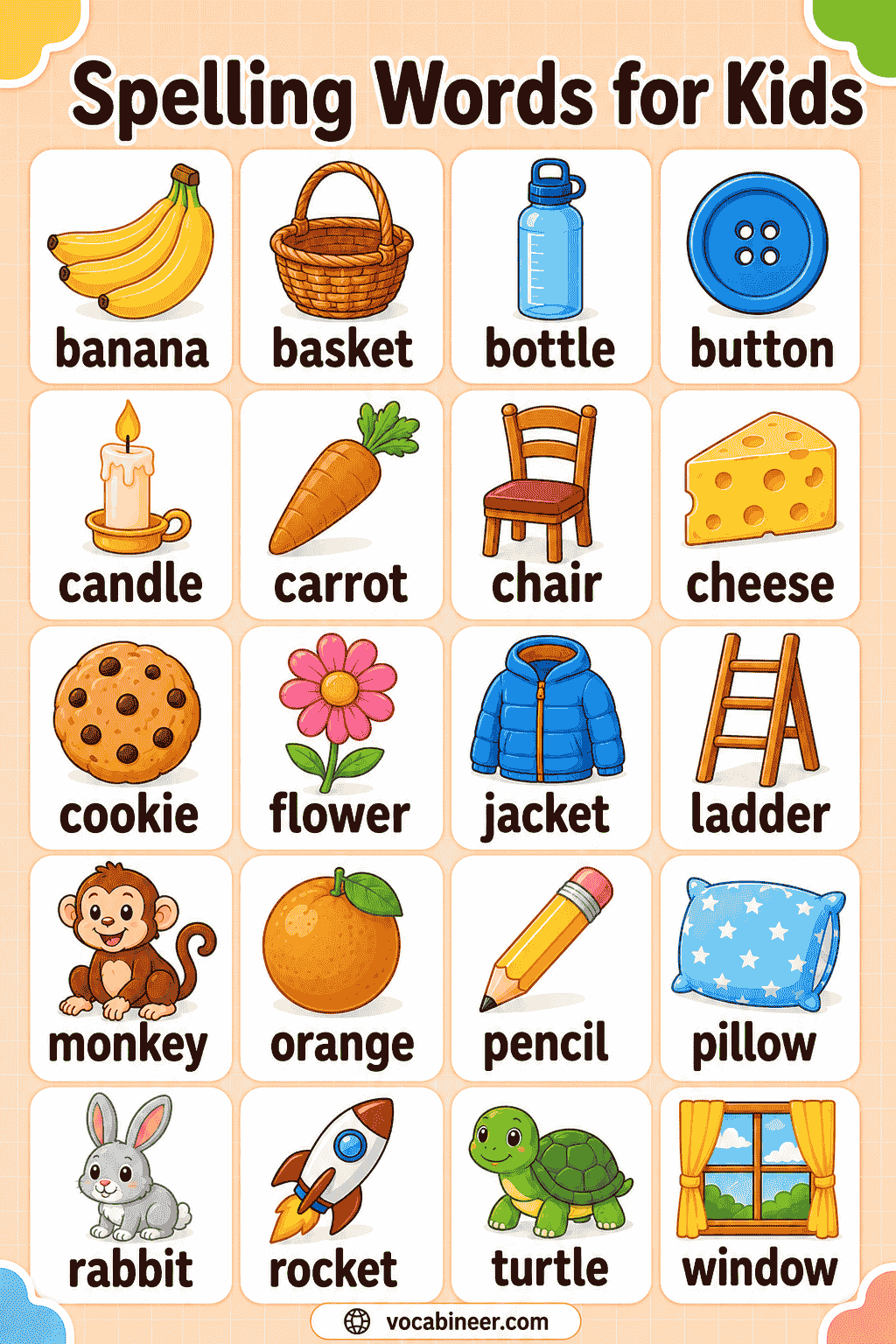
- Two-syllable words: picnic, rabbit, magnet, basket
Second-grade spelling should help children notice word parts, patterns, and endings.
Third Grade Spelling Words
Third grade spelling words can include multisyllable words, prefixes, suffixes, homophones, irregular words, and academic words.
Good third grade spelling words include:
- Multisyllable words: animal, family, holiday, library, several
- Prefixes: unhappy, replay, dislike, preview, rewrite
- Suffixes: careful, kindness, teacher, slowly, fearless
- Homophones: to, too, two; there, their, they’re
- Academic words: science, history, question, answer, important
- Tricky words: beautiful, different, enough, thought, favorite
Third-grade spelling should support stronger writing, reading fluency, and vocabulary growth.
Spelling Words by Phonics Pattern
Phonics patterns help children understand why many words are spelled the way they are. Instead of memorizing every spelling word separately, children learn common sound-spelling patterns.
CVC Spelling Words
CVC words have a consonant-vowel-consonant pattern.
Examples:
- Short A: cat, map, fan, bag, jam, tap
- Short E: bed, pen, ten, red, hen, net
- Short I: pin, sit, pig, lip, win, lid
- Short O: dog, log, hop, pot, box, cot
- Short U: sun, run, bug, cup, rug, hut
These words are excellent for beginners because each sound is usually easy to hear.
Short Vowel Spelling Words
This group helps children hear and spell the five short vowel sounds more clearly.
- Short A: apple, cat, bag, hand, clap
- Short E: egg, bed, nest, step, dress
- Short I: insect, pig, swim, list, milk
- Short O: octopus, dog, frog, clock, shop
- Short U: umbrella, sun, drum, brush, jump
Short vowel spelling is important because children often mix up vowels such as a, e, and i.
Word Family Spelling Words
Word families help children spell groups of words with the same ending pattern.
- -at family: cat, bat, hat, mat, sat
- -an family: can, fan, man, pan, ran
- -it family: bit, fit, hit, sit, kit
- -op family: hop, mop, pop, top, stop
- -ug family: bug, hug, mug, rug, dug
Once children know one pattern, they can spell several related words.
Consonant Blend Spelling Words
Consonant blends have two or more consonants together, and each sound can still be heard.
- Beginning blends: flag, clap, stop, frog, drum, spin
- Ending blends: hand, jump, best, milk, gift, pond
- Three-letter blends: strap, split, spring, scrub
Children may need extra practice hearing each sound in a blend, especially at the end of a word.
Digraph Spelling Words
A digraph is two letters that make one sound.
- sh words: ship, shop, shell, fish, wish
- ch words: chip, chat, lunch, much, rich
- th words: thin, bath, path, moth, this
- wh words: when, whip, whiz
Digraphs should be taught as one sound unit, not two separate letter sounds.
Silent E Spelling Words
Silent e often makes the vowel say its long sound.
Examples:
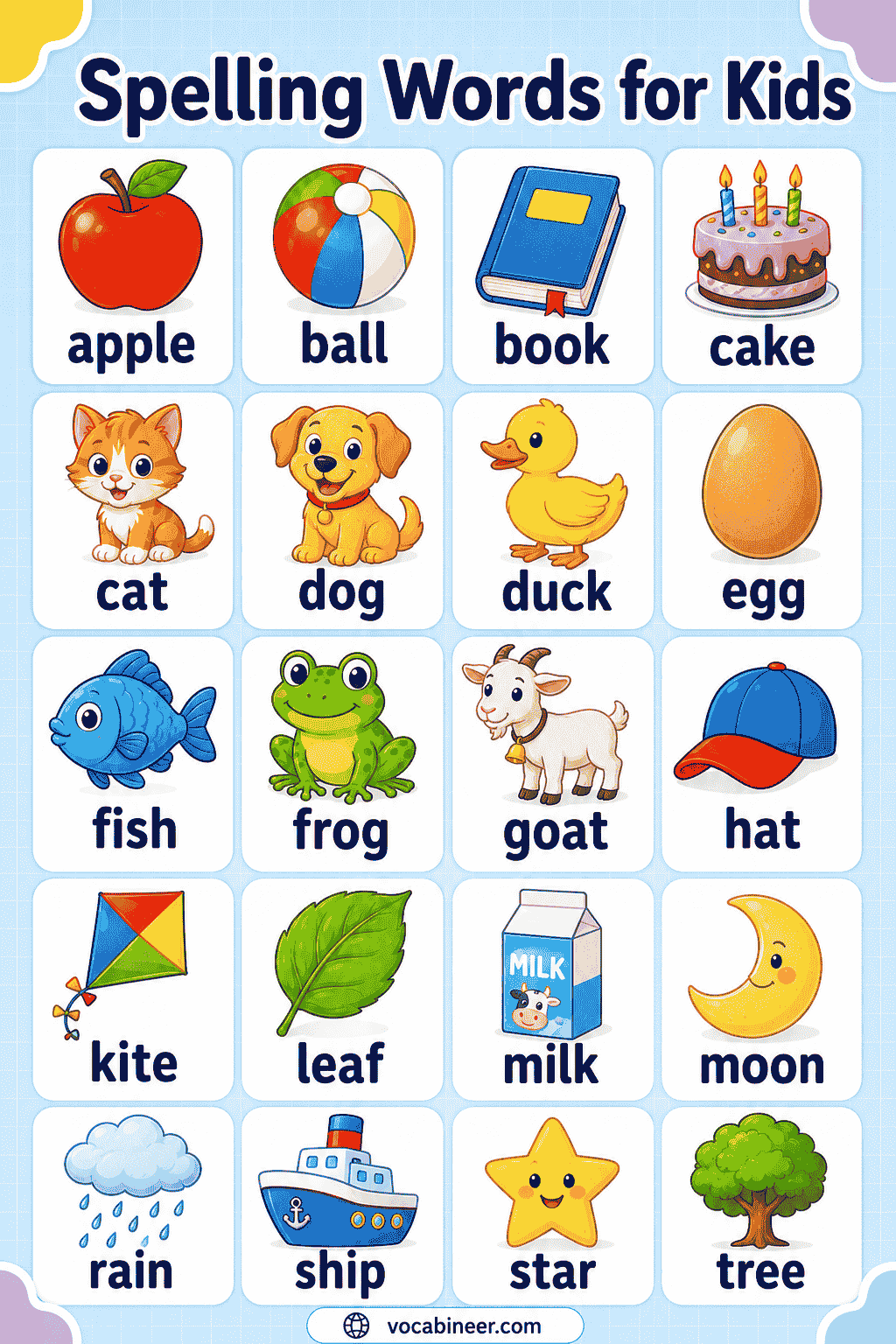
- a_e: cake, name, game, plane
- i_e: bike, five, line, smile
- o_e: home, rope, stone, note
- u_e: cube, tube, mule, June
Compare these pairs:
| Short Vowel | Silent E |
|---|---|
| cap | cape |
| mad | made |
| pin | pine |
| hop | hope |
| cub | cube |
Vowel Team Spelling Words
Vowel teams use two or more letters to make one vowel sound.
Examples:
- ai: rain, train, paint, snail
- ay: day, play, stay, tray
- ee: see, tree, green, sleep
- ea: leaf, team, beach, read
- oa: boat, coat, road, soap
- ow: snow, grow, show, yellow
Vowel teams can be tricky because different spellings may make similar sounds.
R-Controlled Spelling Words
R-controlled words have a vowel followed by r, which changes the vowel sound.
Examples:
- ar: car, star, farm, park
- er: her, fern, term
- ir: bird, girl, shirt, first
- or: corn, horn, fork, storm
- ur: burn, turn, curl, hurt
Children often need repeated practice with r-controlled vowels because the vowel sound is not short or long.
Words with Common Endings
Common endings help children spell longer words.
Examples:
- -ed: jumped, looked, played, helped
- -ing: running, helping, jumping, reading
- -er: teacher, helper, faster, smaller
- -est: fastest, tallest, smallest, kindest
- -ful: helpful, careful, playful
- -less: careless, helpless, fearless
When children learn endings, they begin to understand how base words change.
High-Frequency Writing Words
High-frequency writing words are words children use often in sentences. Some are easy to sound out, while others need extra memory practice.
Common high-frequency writing words include:
- the
- and
- is
- was
- you
- they
- have
- said
- are
- come
- little
- there
- where
- because
- friend
- people
- school
- again
- could
- would
These words matter because children need them in everyday writing.
Simple sentence practice:
- I have a red bag.
- My friend is kind.
- We went to school.
- They can play outside.
- I said thank you.
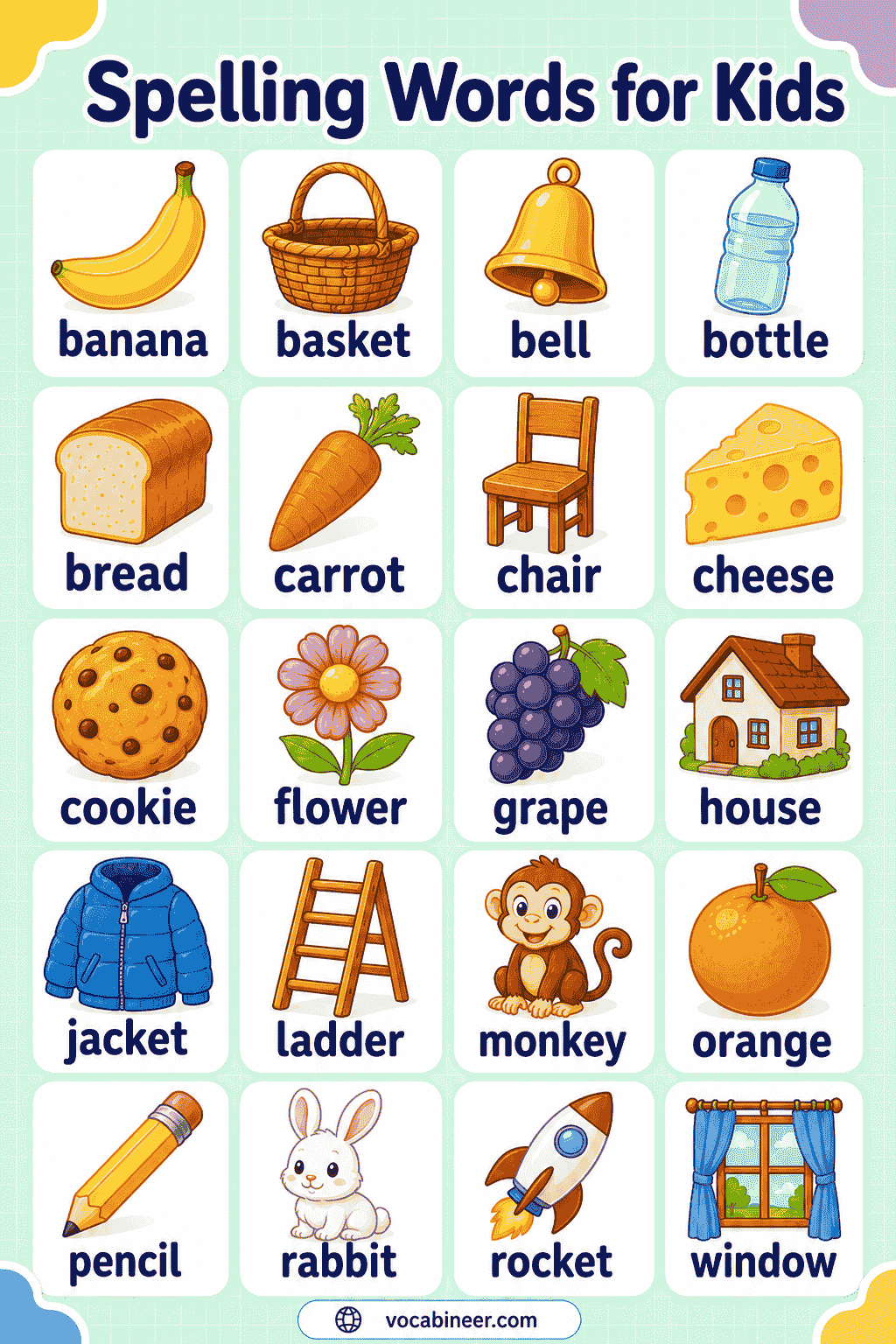
Tricky Spelling Words for Kids
Some words are tricky because they do not follow the easiest sound-letter patterns.
Examples:
- said
- does
- one
- two
- once
- where
- could
- would
- people
- friend
- enough
- because
- school
- laugh
- thought
Teach tricky words slowly. Children should see the word, say it, notice the hard part, write it, and use it in a sentence.
| Word | Tricky Part | Sentence |
|---|---|---|
| said | ai says /e/ | She said hello. |
| one | unusual vowel sound | I have one book. |
| friend | ie spelling | My friend can help. |
| because | long word | I smiled because I won. |
| people | unusual spelling | Many people came. |
Spelling Words in Simple Sentences
Sentence practice helps children use spelling words in real writing.
Examples:
- The cat is big.
- I can run fast.
- She has a red bag.
- The dog sat on the rug.
- My friend is kind.
- We went to school.
- I like to read books.
- The ship is in the water.
- He made a cake.
- They played in the park.
For beginners, sentence practice can stay short and clear:
- I see a cat.
- The dog can run.
- My bag is red.
- We can play.
- She has a book.
Weekly Spelling Practice Plan
A weekly spelling routine helps children practice without feeling overwhelmed.
| Day | Practice Focus |
|---|---|
| Monday | Read and say the words |
| Tuesday | Sort words by sound or pattern |
| Wednesday | Write words in sentences |
| Thursday | Practice tricky words |
| Friday | Review or quiz |
Example weekly routine:
- Monday: read the list aloud
- Tuesday: circle the spelling pattern
- Wednesday: write five sentences
- Thursday: practice missed words
- Friday: take a short spelling check
Helpful practice note:
- Use fewer words for younger children.
- Keep review words on the list.
- Separate regular phonics words from tricky words.
- Let children correct mistakes and rewrite only the missed words.
- Ten focused words are often better than twenty random words.
Spelling Activities That Build Word Skills
Good spelling activities help children hear sounds, see patterns, remember letters, and use words in writing.
- Sound boxes: Say a word and write one sound in each box.
- Word sorting: Sort words by vowel, ending, or spelling pattern.
- Trace-copy-write: Trace the word, copy it, then write it from memory.
- Build a word: Use letter tiles or cards to build spelling words.
- Missing letters: Fill in missing letters from a spelling word.
- Rainbow writing: Write the same word in different colors.
- Word ladders: Change one letter to make a new word, such as cat → bat → bag.
- Sentence writing: Use each spelling word in a short sentence.
- Partner quiz: One person says the word, and the other writes it.
- Read and cover: Read the word, cover it, then write it from memory.
Spelling Worksheets and Flashcards
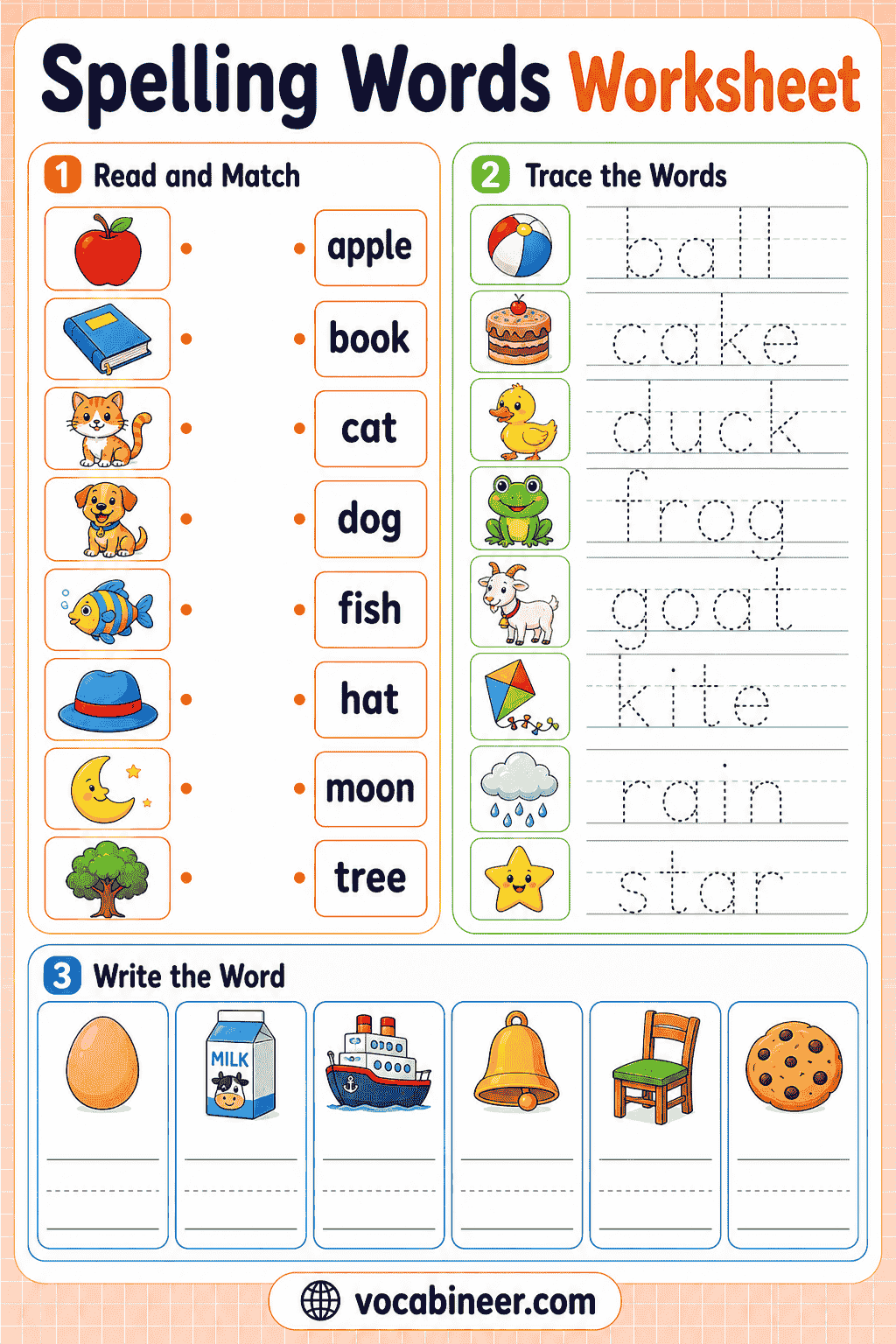
Worksheets and flashcards are helpful when they support real spelling practice, not just copying.
Useful spelling worksheet ideas include:
- spelling word list page
- missing-letter worksheet
- word sort worksheet
- picture spelling worksheet
- sentence writing worksheet
- weekly spelling test sheet
- trace-copy-write page
- word family spelling sheet
- phonics pattern worksheet
- tricky word practice page
Good flashcard sets include:
- beginner CVC words
- short vowel words
- sight words
- spelling pattern cards
- tricky spelling words
- sentence cards
- weekly review cards
- small pattern-based decks
For younger children, small focused sets work better than large mixed decks.
Common Spelling Mistakes and Fixes
Children make spelling mistakes for many reasons. Some mistakes come from hearing sounds incorrectly, while others come from confusing patterns or trying to memorize too many words.
| Mistake | Example | Helpful Fix |
|---|---|---|
| Mixing short vowels | pen → pin | Practice vowel listening |
| Forgetting final sounds | dog → do | Tap each sound |
| Adding extra letters | cat → catt | Say and write slowly |
| Reversing letters | bad → dab | Practice letter formation |
| Confusing b and d | big → dig | Use visual letter cues |
| Forgetting silent e | cake → cak | Compare cap/cape |
| Mixing blends and digraphs | ship → s-hip | Teach sh as one sound |
| Spelling by letter names | are → r | Practice sounds and word memory |
| Memorizing without patterns | random errors | Sort words by pattern |
| Practicing too many words | low recall | Use shorter lists |
FAQs
Good spelling words for kids are words that match the child’s reading level and spelling stage. Beginners can start with simple words like cat, map, sun, dog, pin, bed, run, and cup.
Many young children do well with 8 to 12 spelling words per week. Older children may handle more, but the list should still include clear patterns and enough review.
Kindergarten kids can practice simple CVC words, name words, color words, number words, and common words like I, a, the, my, can, see, cat, dog, sun, and run.
Use short daily practice. Say the word, stretch the sounds, write the letters, read the word again, and use it in a sentence. Word sorting, sound boxes, and flashcards can also help.
Reading and spelling use related but different skills. A child may recognize a word while reading but still need practice hearing each sound, remembering the spelling pattern, and writing the word correctly.
Read More
- CVC Rhyming Words for Kids
- Short Vowel Words for Kids
- Long Vowel Words for Kids
- 300+ Kindergarten Words
- Blending Words for Kids
- Reading Words for Kids