

A child’s first reading words are often small words like cat, sun, dog, map, and I. These simple words help children take an important step in early reading: seeing a word, saying it, and understanding what it means.
Reading words for kids should include more than one type of word. Children need decodable words they can sound out, high-frequency words they see often, and simple words they can read in short sentences. A strong reading word list helps children build decoding skills, word recognition, fluency, comprehension, and confidence.
In This Page
What Are Reading Words for Kids?
Reading words for kids are words children practice reading aloud, recognizing in books, and understanding in simple sentences.
These words may include:
- easy decodable words
- CVC words
- short vowel words
- word family words
- sight words
- high-frequency words
- simple sentence words
- grade-level reading words
Examples of beginner reading words include:
- cat
- dog
- sun
- map
- bed
- run
- hen
- cup
- I
- can
- see
- the
Some reading words are easy to sound out, such as cat, hen, and sun. Other words, such as the, said, and was, appear often in books and need extra practice.
Why Reading Words Help Children Read Better
Reading words help children move from letter sounds to real reading. When children can read simple words, they begin to read short phrases, sentences, and stories with more confidence.
Good reading word practice helps children:
- blend sounds into words
- recognize common words quickly
- read short sentences
- understand simple text
- build reading fluency
- connect words with meaning
- feel more confident with books
For example, a child who can read cat, sat, and mat can begin reading a sentence like:
The cat sat on the mat.
That small sentence gives the child practice with decoding, sight-word recognition, and meaning all at once.
Reading Words vs Sight Words
Reading words and sight words are related, but they are not the same.
| Reading Words | Sight Words |
|---|---|
| Any words children practice reading | Common words children recognize quickly |
| Can be decodable or tricky | Often appear again and again in books |
| Examples: cat, sun, play, school | Examples: the, said, was, they |
Reading words is the broader term. It includes words children sound out, words they recognize quickly, and words they read in sentences.
Sight words are reading words too, but they are a smaller group of common words children practice until they can recognize them quickly.
Reading Words vs Spelling Words
Reading words focus on reading. Spelling words focus on writing correctly.
| Reading Words | Spelling Words |
|---|---|
| Practiced by reading aloud | Practiced by writing |
| Help with decoding and fluency | Help with spelling accuracy |
| Used in books and sentences | Used in writing and tests |
| Examples: cat, the, play, book | Examples: cat, school, because |
A child may be able to read a word before they can spell it correctly. That is normal because reading and spelling are connected but not identical skills.
Decodable Words vs High-Frequency Words
Children need both decodable words and high-frequency words.
| Decodable Words | High-Frequency Words |
|---|---|
| Follow sound-spelling patterns children can read | Appear often in books and sentences |
| Help with phonics and decoding | Help with fluency and common text reading |
| Examples: cat, map, sun, ship, cake | Examples: the, and, was, said, they |
Decodable words help children practice phonics skills.
High-frequency words help children read common words that appear again and again in books.
Some high-frequency words are easy to decode, while others have tricky parts.
| Easier High-Frequency Words | Trickier High-Frequency Words |
|---|---|
| in, it, and, up, can, see | said, was, one, come, people, because |
How to Choose the Right Reading Words
The best reading words match the child’s reading stage. A beginner needs short, simple words. A growing reader can practice blends, digraphs, silent e words, vowel teams, and longer words.
Use these tips when choosing reading words:
- Start with words children can sound out.
- Add a few common words children see often.
- Group words by sound or spelling pattern.
- Use words in short sentences.
- Avoid too many tricky words at once.
- Review older words before adding many new ones.
- Choose words from books children are reading.
A good list should feel useful, not random. For example, cat, bat, hat, mat, and sat work well together because they share the -at pattern.
First Reading Words for Beginners
First reading words should be short, clear, and easy to use in sentences.
Good beginner reading words include:
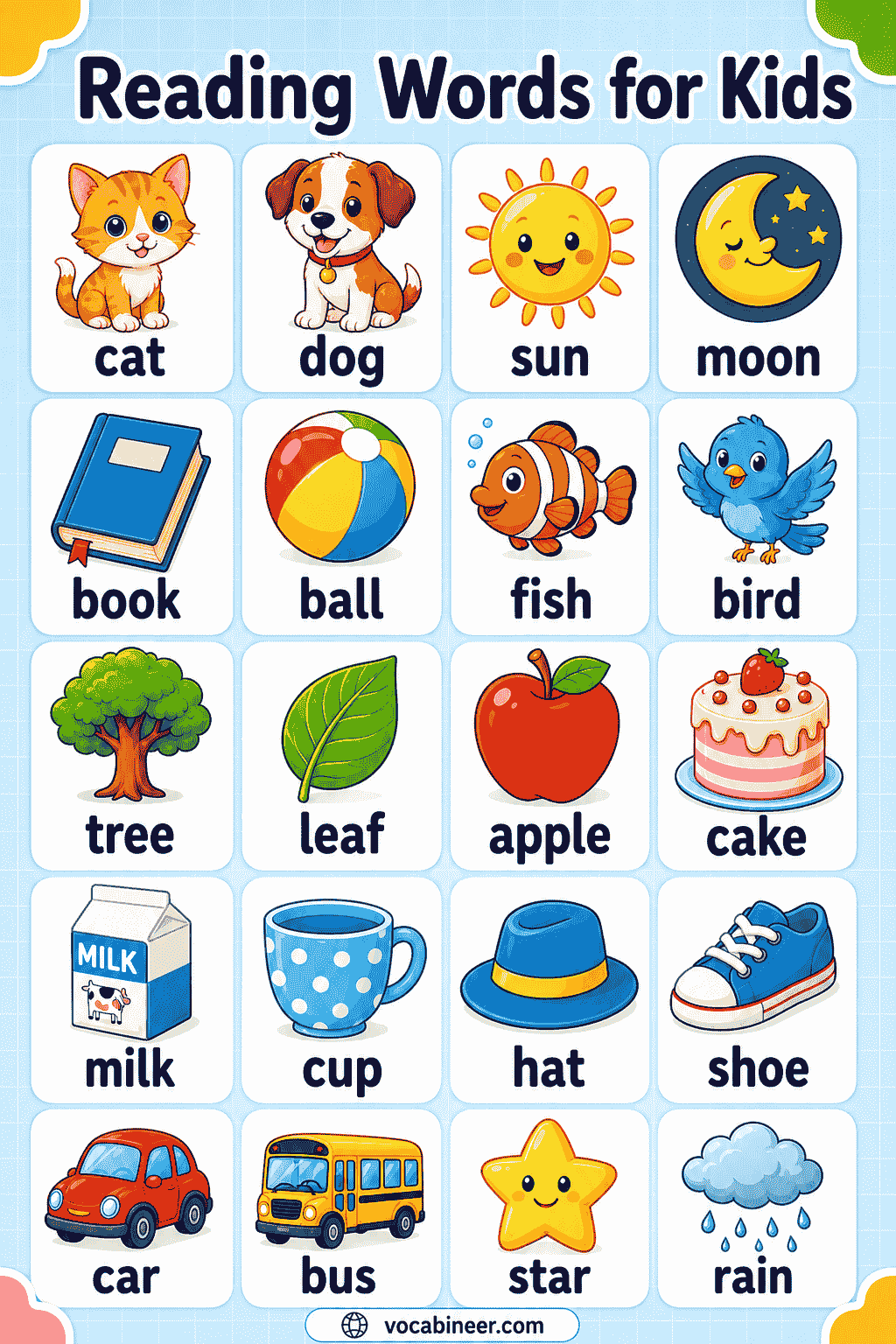
- Short A: cat, bat, hat, map, fan, bag, jam, ran, cap, tap
- Short E: bed, red, hen, pen, jet, wet, leg, ten, net, pet
- Short I: pin, pig, sit, lip, big, dig, win, fin, kit, lid
- Short O: dog, log, hop, pot, box, fox, mop, top, cot, nod
- Short U: sun, run, bug, cup, rug, tub, mud, hut, cub, rub
Common beginner words also include:
- I
- a
- the
- my
- can
- see
- go
- is
- in
- on
Simple beginner sentences:
- I see a cat.
- The dog can run.
- My hat is red.
- A bug is on the rug.
- We can go.
Reading Words by Age and Grade
Reading word lists should grow slowly. Children need enough practice with easy words before they move to harder patterns.
Preschool Word Recognition
Preschool children usually do not need formal reading word lists. They benefit from recognizing familiar words, hearing sounds, looking at picture labels, and noticing print around them.
Useful preschool word recognition examples include:
- Name and family words: mom, dad, me
- Picture words: cat, dog, sun, hat, cup
- Color words: red, blue
- Daily words: bed, ball, toy, book
- Environmental words: stop, exit, open
Good preschool practice includes:
- pointing to words in books
- matching pictures to words
- finding letters in names
- saying beginning sounds
- listening to rhyming words
- reading labels on familiar objects
Kindergarten Reading Words
Kindergarten reading words should focus on short vowels, CVC words, word families, and common sight words.
Good kindergarten reading words include:
- CVC words: cat, cap, tap, bed, hen, pin, pot, cub
- Word family words: bat, hat, mat, fan, man, pan
- Action words: run, hop, sit, jump, look
- Common words: I, a, the, my, can, see, like, go
- School words: book, bag, pen, desk
- Color words: red, blue, green, yellow
Kindergarten practice should include word cards, picture matching, short sentences, and simple decodable books.
First Grade Reading Words
First grade reading words can include blends, digraphs, silent e words, long vowels, and more high-frequency words.
Good first grade reading words include:
- Blends: flag, stop, crab, spin, drum, trip
- Digraphs: ship, chip, thin, shop, lunch, much
- Silent e words: cake, bike, home, cube, name, smile
- Long vowel words: rain, train, boat, seed, light
- Common words: said, was, they, have, come, little
- Sentence words: friend, school, play, read, happy, home
First graders should practice reading words in sentences, not only from flashcards.
Second Grade Reading Words
Second grade reading words can include longer words, vowel teams, r-controlled words, compound words, endings, and more complex high-frequency words.
Good second grade reading words include:
- Vowel team words: rain, boat, leaf, seed, road, snow
- R-controlled words: car, bird, horn, turn, farm, storm
- Compound words: bedtime, sunshine, notebook, backpack
- Words with endings: jumped, helping, taller, fastest
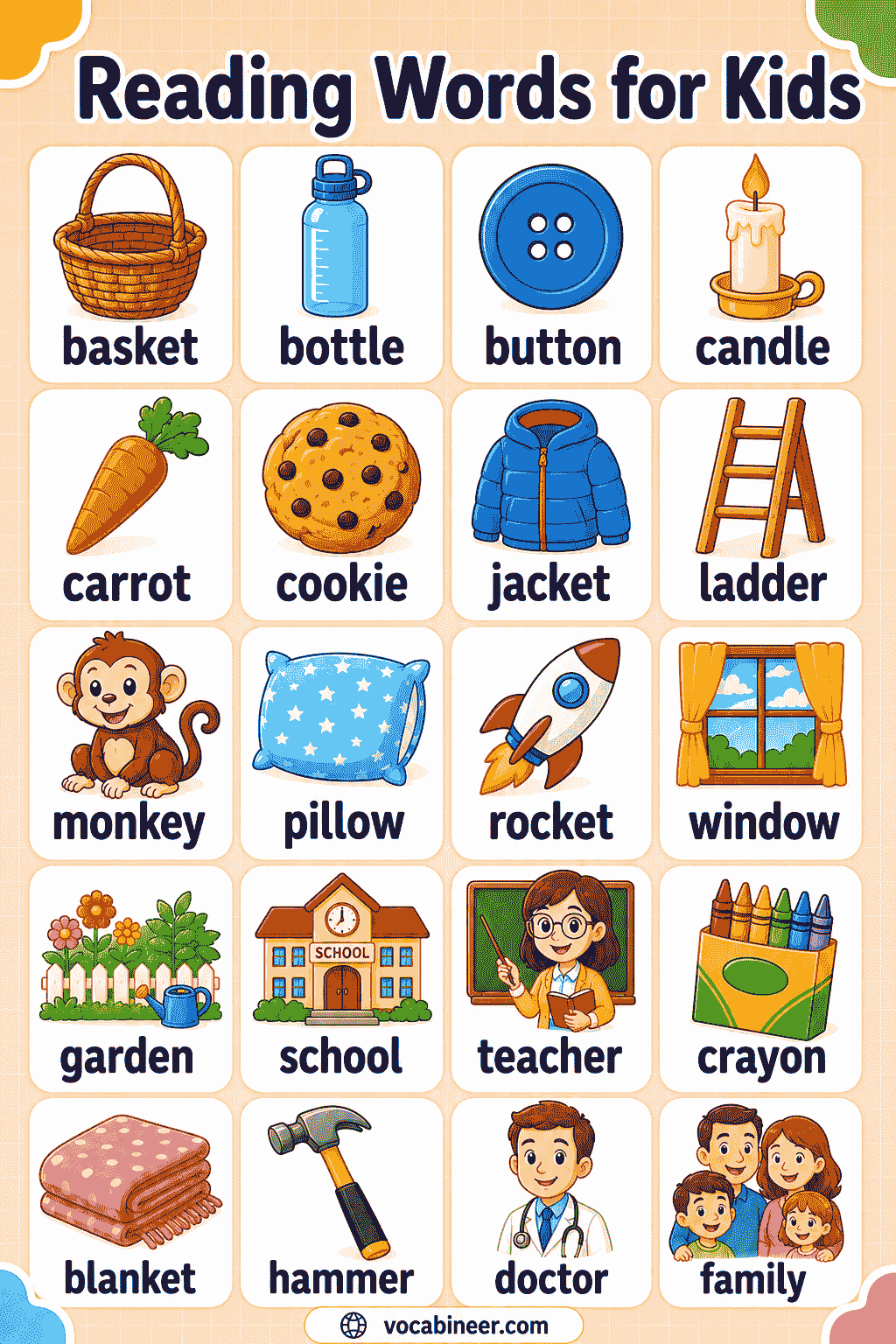
- Longer words: picnic, rabbit, magnet, basket
- Common words: because, people, again, could, would
Second-grade readers should begin reading longer sentences, short passages, and simple stories with familiar word patterns.
Reading Words by Phonics Skill
Phonics patterns help children read new words instead of guessing. This section groups reading words by the skill children practice.
CVC Words for Early Reading
CVC words have a consonant-vowel-consonant pattern.
Examples:
- Short A: cat, map, fan, bag, jam
- Short E: bed, pen, ten, red, hen
- Short I: pin, sit, pig, lip, win
- Short O: dog, log, hop, pot, box
- Short U: sun, run, bug, cup, rug
These words are useful because beginners can sound out each letter.
Short Vowel Words for Reading Practice
This group helps children hear and read the five short vowel sounds more clearly.
Examples:
- Short A: cat, hand, clap, fast, snack
- Short E: bed, nest, step, dress, shell
- Short I: pig, swim, list, milk, brick
- Short O: dog, frog, clock, shop, pond
- Short U: sun, drum, brush, jump, truck
Word Family Words for Pattern Reading
Word family words share the same ending pattern. They help children read groups of words more easily.
Examples:
- -at family: cat, bat, hat, mat, sat
- -an family: can, fan, man, pan, ran
- -it family: bit, fit, hit, sit, kit
- -op family: hop, mop, pop, top
- -ug family: bug, hug, mug, rug
After children learn one pattern, they can read several related words.
Consonant Blend Words for Growing Readers
Consonant blend words have two or more consonants together, and each sound can still be heard.
Examples:
- Beginning blends: flag, clap, stop, frog, drum, spin
- Ending blends: hand, jump, best, milk, gift, pond
- Three-letter blends: strap, split, spring, scrub
These words are better after children can read simple CVC words confidently.
Digraph Words for Reading Practice
A digraph is two letters that make one sound.
Examples:
- sh words: ship, shop, shell, fish, wish
- ch words: chip, chat, lunch, much, rich
- th words: thin, bath, path, this
- wh words: when, whip, whiz
Children should read digraphs as one sound unit. For example, sh in ship makes one sound.
Silent E Words for Later Reading
Silent e words often have a long vowel sound.
Examples:
- a_e: cake, name, game, plane
- i_e: bike, five, line, smile
- o_e: home, rope, stone, note
- u_e: cube, tube, mule, June
Helpful pairs:
| Short Vowel | Silent E |
|---|---|
| cap | cape |
| mad | made |
| pin | pine |
| hop | hope |
| cub | cube |
Vowel Team Words for Reading Fluency
Vowel teams use two or more letters to make one vowel sound.
Examples:
- ai: rain, train, paint, snail
- ay: day, play, stay, tray
- ee: see, tree, green, sleep
- ea: leaf, team, beach, read
- oa: boat, coat, road, soap
- ow: snow, grow, show, yellow
Vowel teams can be tricky because the same sound can have more than one spelling.
R-Controlled Words for Advanced Practice
R-controlled words have a vowel followed by r, which changes the vowel sound.
Examples:
- ar: car, star, farm, park
- er: her, fern, term
- ir: bird, girl, shirt, first
- or: corn, horn, fork, storm
- ur: burn, turn, curl, hurt
These words are useful for growing readers who already understand short vowels and simple long vowels.
High-Frequency Words Kids Read Often
High-frequency words are common words children see again and again in books and sentences.
Examples:
- the
- and
- is
- in
- it
- to
- you
- was
- said
- they
- have
- come
- little
- where
- because
- friend
- people
- school
Some high-frequency words are easy to decode, such as in, it, and, and up. Others need extra practice because they have tricky parts, such as said, was, and one.
| Easier High-Frequency Words | Trickier High-Frequency Words |
|---|---|
| in, it, up, can, see, go | said, was, one, come, people, because |
| and, on, at, am, if, but | they, have, where, could, would, friend |
Tricky Reading Words Kids Need to Know
Tricky reading words are words children may not be able to sound out easily at first.
Examples:
- said
- was
- one
- two
- does
- come
- where
- could
- would
- people
- friend
- because
- school
- enough
Teach tricky words slowly. Children can look at the word, say it, notice the tricky part, and read it in a sentence.
| Word | Tricky Part | Sentence |
|---|---|---|
| said | ai sounds like /e/ | She said hello. |
| one | unusual vowel sound | I have one book. |
| friend | ie spelling | My friend can help. |
| people | unusual spelling | Many people came. |
| because | long word | I smiled because I won. |
Reading Words in Simple Sentences
Children need to read words in context. A word list is helpful, but sentence reading shows how words work together.
Examples:
- I see a cat.
- The dog can run.
- My hat is red.
- A bug is on the rug.
- The ship is in the water.
- He made a cake.
- We can play outside.
- My friend is at school.
- The frog can jump.
- I like to read books.
Beginner sentence practice can stay short and clear:
- I see a dog.
- The cat can run.
- My bag is red.
- We can play.
- She has a book.
Short Reading Practice for Kids
Short reading practice helps children move from single words to connected text.
Practice 1
I see a cat.
The cat can run.
The dog can run too.
I see the dog.
Practice 2
Sam has a hat.
The hat is red.
Sam sat on the mat.
The cat sat too.
Practice 3
The bug is on the rug.
The pup can jump.
The sun is hot.
The cup is red.
Practice 4
The ship is big.
The fish can swim.
The shell is on the sand.
I see a crab.
Word Reading Activities for Kids
Good reading word activities should help children decode, recognize, understand, and read words in context.
- Read and point: Point to each word while reading.
- Picture match: Match a word to the correct picture.
- Word sort: Sort words by vowel sound, pattern, or word family.
- Word hunt: Find target words in a book or worksheet.
- Flashcard reading: Read a small set of words quickly.
- Sentence strips: Read simple sentences with target words.
- Build and read: Build a word with letter cards, then read it.
- Read and draw: Read a word or sentence and draw the meaning.
- Mini book practice: Read a small book with repeated word patterns.
- Cover and read: Read a word, cover it, then read it again from memory.
Reading Word Worksheets and Flashcards
Worksheets and flashcards work best when they support real reading, not just copying words.
Useful worksheet ideas include:
- match words to pictures
- circle the word you hear
- sort words by phonics pattern
- read and draw
- complete simple sentences
- find the word in a short passage
- read a word family list
- match high-frequency words
- read and color the word
- build CVC words with letters
Good flashcard sets include:
- CVC word cards
- short vowel cards
- word family cards
- sight word cards
- high-frequency word cards
- digraph word cards
- silent e word cards
- sentence cards
- small focused decks with one pattern at a time
Problems Kids Have with Reading Words
Children may struggle with reading words for different reasons. A problem-fix table can help parents and teachers choose the right support.
| Problem | What It Looks Like | Helpful Fix |
|---|---|---|
| Guessing from the first letter | Says “dog” for “dad” | Point to every sound |
| Memorizing lists only | Reads cards but not sentences | Practice words in short sentences |
| Confusing short vowels | Mixes pin, pen, pan | Sort words by vowel sound |
| Skipping small words | Misses the, a, in, on | Use finger tracking |
| Reading too slowly | Sounds out every word each time | Review familiar words often |
| Struggling with tricky words | Cannot read said or was | Teach the tricky part |
| Ignoring meaning | Reads word but does not understand it | Use pictures and sentences |
| Mixing blends and digraphs | Splits sh into s + h | Teach digraphs as one sound |
| Guessing from pictures only | Says a word that fits the picture | Cover picture first, then read |
| Avoiding hard words | Stops reading often | Use easier decodable text first |
FAQs
Reading words for kids are words children practice reading aloud, recognizing in books, and understanding in sentences. Examples include cat, dog, sun, the, and, play, school, and friend.
Children should usually start with simple decodable words like cat, map, sun, dog, pin, bed, run, and cup, along with a few common words like I, a, the, can, and see.
No. Sight words are words children learn to recognize quickly. Reading words are broader and include decodable words, sight words, high-frequency words, and words used in sentences.
Use short daily practice. Start with a small list, read each word aloud, match words to pictures, use the words in simple sentences, and review familiar words often.
A child may memorize flashcards without understanding how words work in sentences. Practice reading the same words in short sentences, mini passages, and simple books.
Read More
- CVC Rhyming Words for Kids
- Easy Spelling Lists for Kids
- Short Vowel Words for Kids
- Long Vowel Words for Kids
- 300+ Kindergarten Words
- Blending Words for Kids