

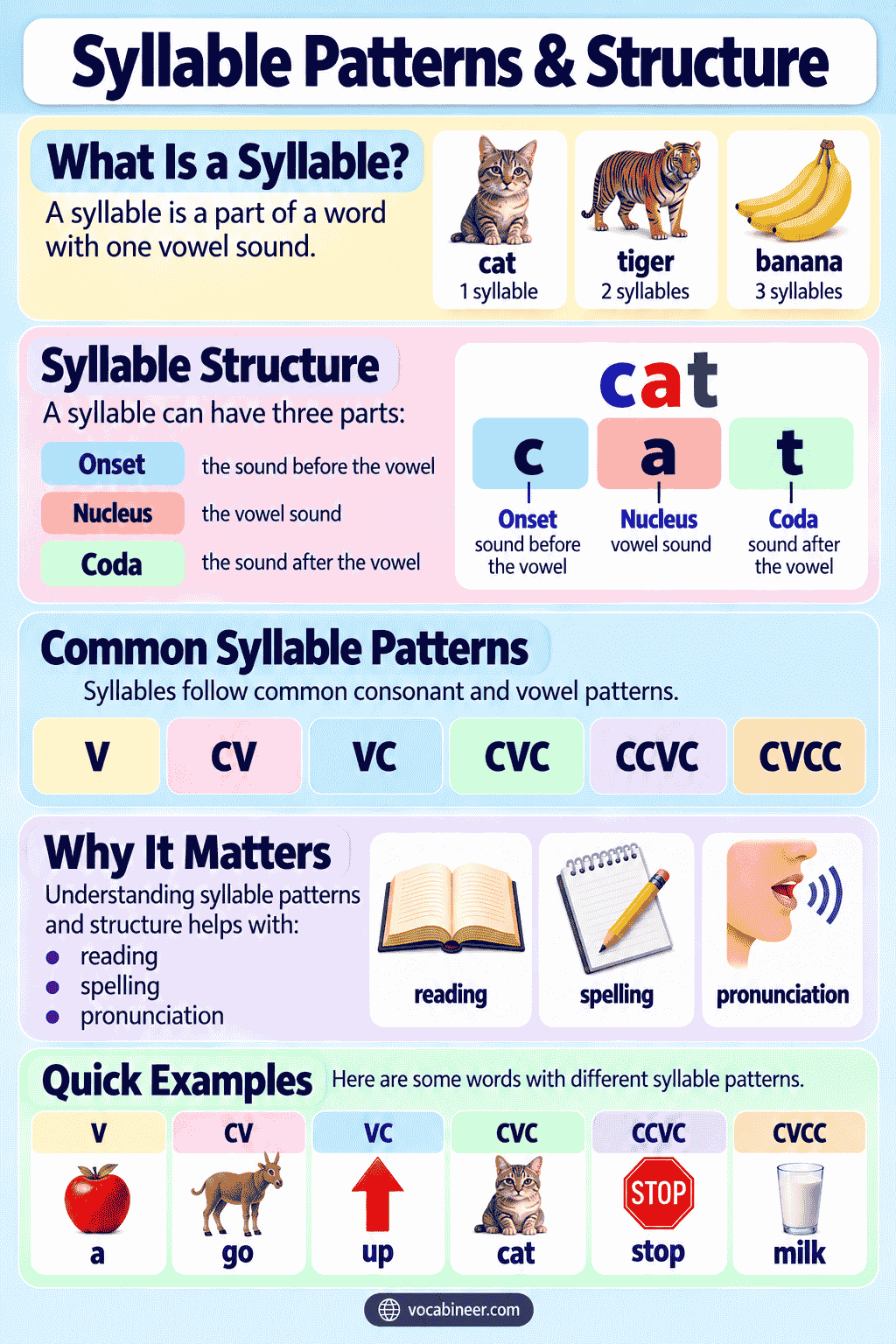
Syllable structure explains how sounds are arranged inside a syllable. A syllable may begin with one or more consonant sounds, contain a central vowel sound, and end with one or more consonant sounds.
Patterns such as V, CV, VC, CVC, CCVC, CVCC, and CCVCC give a simple way to describe these sound arrangements. Understanding the structure first makes each pattern easier to recognize.
In This Page
What Is Syllable Structure?
Syllable structure describes how sounds are organized within a syllable.
A syllable can contain three main structural components:
- onset;
- nucleus;
- coda.
The nucleus and coda together form the rime.
The basic relationship is:
Syllable = Onset + Rime
and:
Rime = Nucleus + Coda
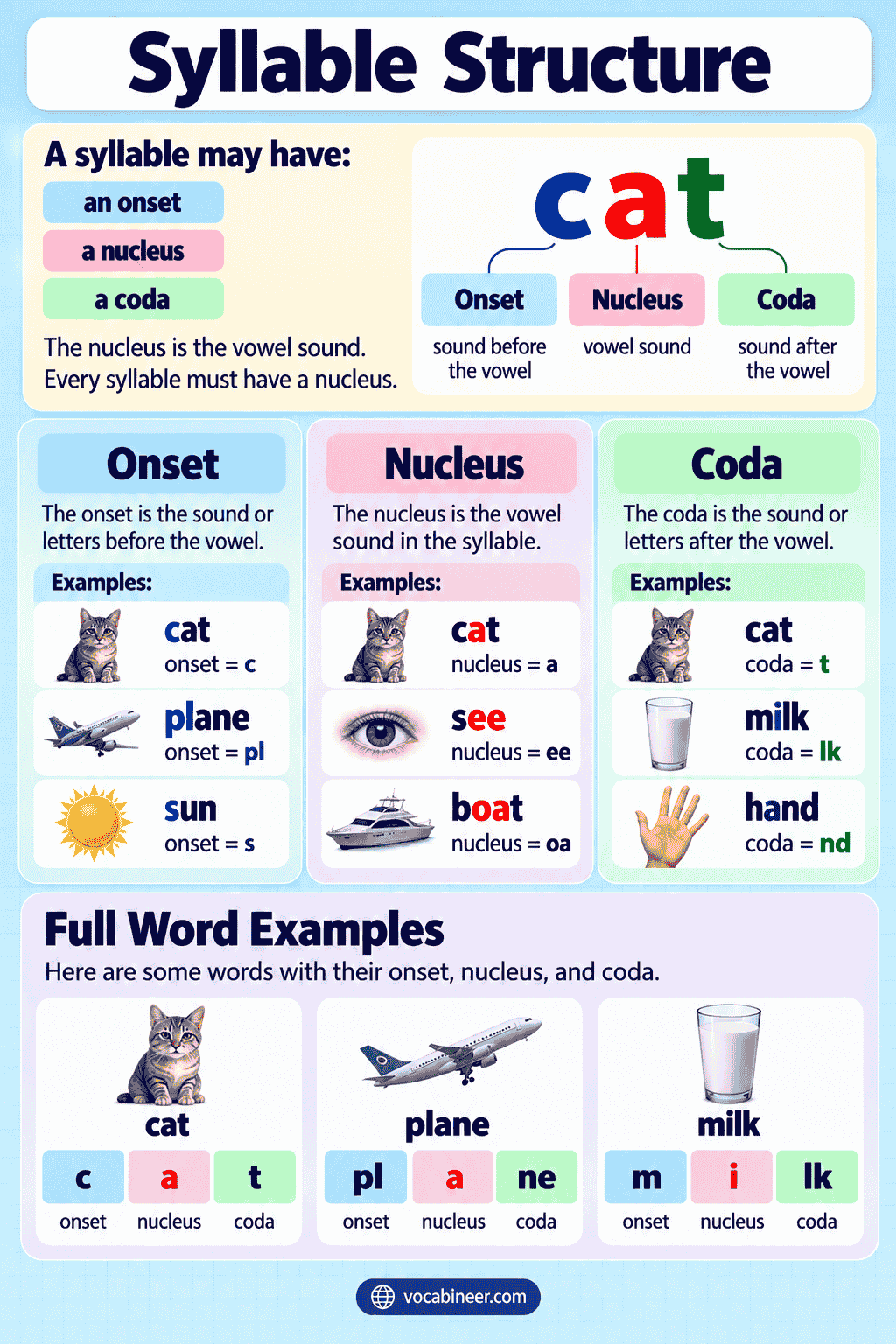
The onset and coda are optional, but every syllable needs a nucleus.
For readability, many examples below use familiar letters to represent sounds. In precise phonological analysis, however, syllable structure describes speech sounds rather than written letters.
Onset, Nucleus, Coda, and Rime
The four key terms describe different parts of syllable structure.
| Term | Meaning | Example in cat |
|---|---|---|
| Onset | Consonant sound(s) before the nucleus | /k/ |
| Nucleus | Core vowel sound | /æ/ |
| Coda | Consonant sound(s) after the nucleus | /t/ |
| Rime | Nucleus + coda | /æt/ |
Onset
The onset contains the consonant sound or consonant cluster before the nucleus.
cat
Onset: /k/
play
Onset: /pl/
street
Onset: /str/
A syllable does not need an onset.
For example, at begins directly with a vowel sound, so the syllable has no onset.
Nucleus
The nucleus forms the center of the syllable.
It usually contains:
- a vowel sound;
- a diphthong.
Examples:
cat
Nucleus: /æ/
go
Nucleus: /oʊ/
coin
Nucleus: /ɔɪ/
Every syllable needs a nucleus. In basic English phonics, the nucleus is usually a vowel sound.
Coda
The coda contains the consonant sound or sounds after the nucleus.
cat
Coda: /t/
milk
Coda: /lk/
plant
Coda: /nt/
A syllable does not need a coda.
For example, me ends with its vowel sound and therefore has no coda.
Rime
The rime consists of the nucleus and coda together.
In cat:
- nucleus = /æ/;
- coda = /t/;
- rime = /æt/.
In milk:
- nucleus = /ɪ/;
- coda = /lk/;
- rime = /ɪlk/.
Some sources use the spelling rhyme, but rime is a common linguistic term for this structural unit.
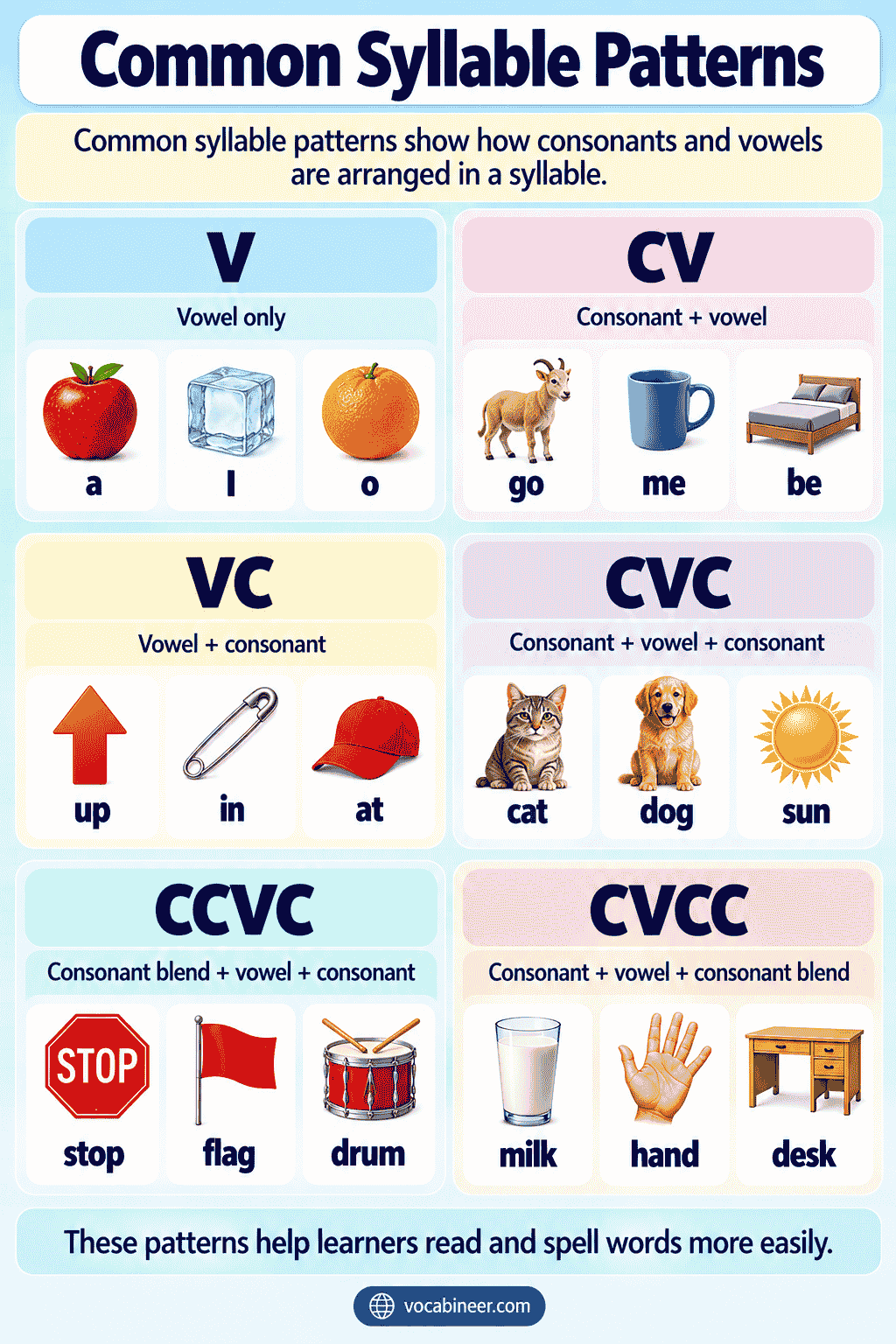
Common Syllable Patterns: V, CV, VC, CVC, and More
Syllable patterns often use two simple symbols:
C = consonant sound
V = vowel sound
These symbols describe the arrangement of sounds inside a syllable.
V Pattern
A V syllable contains only a vowel sound.
Example:
I
Structure:
- no onset;
- nucleus only;
- no coda.
This is one of the simplest syllable structures.
CV Pattern
A CV syllable contains:
consonant + vowel
Example:
me
Structure:
- onset = /m/;
- nucleus = /iː/;
- no coda.
Because the syllable ends with the nucleus, it has an open structure.
VC Pattern
A VC syllable contains:
vowel + consonant
Example:
at
Structure:
- no onset;
- nucleus = /æ/;
- coda = /t/.
The final consonant forms a coda.
CVC Pattern
A CVC syllable contains:
consonant + vowel + consonant
Example:
cat
Structure:
- onset = /k/;
- nucleus = /æ/;
- coda = /t/.
CVC is one of the most familiar English syllable shapes.
CCVC Pattern
A CCVC syllable begins with two consonant sounds.
Example:
stop
Structure:
- onset = /st/;
- nucleus = /ɒ/ or /ɑː/, depending on accent;
- coda = /p/.
The two opening consonants form a complex onset.
CVCC Pattern
A CVCC syllable ends with two consonant sounds.
Example:
milk
Structure:
- onset = /m/;
- nucleus = /ɪ/;
- coda = /lk/.
The final consonant cluster forms a complex coda.
CCVCC Pattern
A CCVCC syllable contains consonant clusters on both sides of the nucleus.
Example:
plant
Structure:
- onset = /pl/;
- nucleus = /æ/;
- coda = /nt/.
This pattern combines a complex onset with a complex coda.
Common Syllable Patterns at a Glance
| Pattern | Structure | Example |
|---|---|---|
| V | Vowel | I |
| CV | Consonant + vowel | me |
| VC | Vowel + consonant | at |
| CVC | Consonant + vowel + consonant | cat |
| CCVC | Two consonants + vowel + consonant | stop |
| CVCC | Consonant + vowel + two consonants | milk |
| CCVCC | Two consonants + vowel + two consonants | plant |
These patterns describe syllable shape, not the number of syllables in a word.
Simple and Complex Onsets
The onset may contain one consonant sound or several.
Simple Onset
A simple onset contains one consonant.
Examples:
cat → /k/
dog → /d/
Complex Onset
A complex onset contains two or more consonant sounds.
Examples:
play → /pl/
street → /str/
A complex onset still belongs to a single syllable. The additional consonants do not automatically create more syllables.
Simple and Complex Codas
A coda can also contain one consonant or a cluster.
Simple Coda
A simple coda contains one consonant.
Examples:
cat → /t/
sun → /n/
Complex Coda
A complex coda contains two or more consonant sounds.
Examples:
milk → /lk/
plant → /nt/
Again, a consonant cluster can remain within one syllable.
How Open and Closed Syllables Fit the Structure
Open and closed syllables can also be explained through syllable structure.
An open syllable has no coda.
Example:
me
Pattern:
CV
The vowel sound ends the syllable.
A closed syllable has a coda.
Example:
met
Pattern:
CVC
The consonant sound after the nucleus closes the syllable.
This structural view explains why the terms open and closed are used.
Syllable Shape vs. Syllable Type
Syllable shape and syllable type describe different features.
Consider:
cat
Its syllable shape is:
CVC
Its phonics type is:
closed syllable
These labels are related, but they are not the same classification.
| Concept | What It Describes | Example |
|---|---|---|
| Syllable structure | Internal parts | onset + nucleus + coda |
| Syllable shape | Arrangement of consonant and vowel sounds | CVC |
| Syllable type | Phonics spelling pattern | closed syllable |
Other syllable types, such as open, VCe, vowel team, r-controlled, and consonant-le, belong to a different phonics classification system.
CVC vs. VC/CV: Structure and Division Patterns
CVC and VC/CV may look similar, but they describe different things.
CVC describes the sound structure of one syllable.
Example:
cat
Pattern:
CVC
By contrast, VC/CV is commonly used in phonics instruction as a syllable-division pattern.
Example:
rabbit
may be shown as:
rab | bit
The slash marks the division between syllables.
So:
CVC describes syllable shape, while VC/CV describes a possible syllable-division pattern in a longer word.
The two notation systems should not be treated as interchangeable.
Are Syllable Patterns Based on Letters or Sounds?
Syllable structure describes sounds, although beginner examples often use letters because the relationship is easy to see.
In a simple word such as:
cat
the letters closely match the sounds, so the CVC pattern is straightforward.
English spelling becomes more complicated when words contain:
- digraphs;
- vowel teams;
- silent letters;
- diphthongs;
- consonant combinations.
For that reason, counting written letters alone does not always reveal the true syllable structure.
Pronunciation matters more than spelling.
Can a Nucleus Contain a Diphthong?
Yes.
A syllable nucleus can contain a simple vowel or a diphthong.
For example:
coin
contains the diphthong /ɔɪ/ in its nucleus.
A diphthong changes vowel quality during pronunciation, but it still functions as one syllable nucleus.
This is why a word can contain two vowel sounds within one nucleus without automatically creating two syllables.
Syllabic Consonants
Most English syllables use a vowel sound as the nucleus, but some pronunciations allow a consonant to become syllabic.
This commonly happens with sounds such as:
- /l/;
- /n/.
For beginner phonics, however, it is usually enough to remember:
The nucleus normally contains the main vowel sound of the syllable.
Syllabic consonants are an advanced exception rather than the main pattern.
Why Syllable Structure Matters
Syllable structure shows how sounds fit together inside a word.
For example:
plant
can be analyzed as:
- onset = /pl/;
- nucleus = /æ/;
- coda = /nt/;
- syllable pattern = CCVCC.
This makes it easier to see that several consonants can belong to one syllable rather than creating separate syllables.
Frequently Asked Questions
The main structural components are the onset, nucleus, and coda. The nucleus and coda together form the rime.
CVC means consonant-vowel-consonant. The word cat is a simple example because it contains one consonant sound before the vowel and one after it.
No. A syllable can have no onset, no coda, or neither. Every syllable does, however, need a nucleus.
A syllable pattern such as CVC describes the arrangement of consonant and vowel sounds. A syllable type such as closed or open describes a phonics spelling pattern.
No. CVC describes the internal shape of one syllable, while VC/CV is commonly used in phonics to show a possible division between syllables in a longer word.
Read More
- What is a Syllable?
- Closed syllable words
- Open syllable words
- Open and closed syllable words
- Multisyllabic Words List
- 1 syllable words
- 2 syllable words
- 3 syllable words
- 4 syllable words
- 5 syllable words
- Six syllable words