

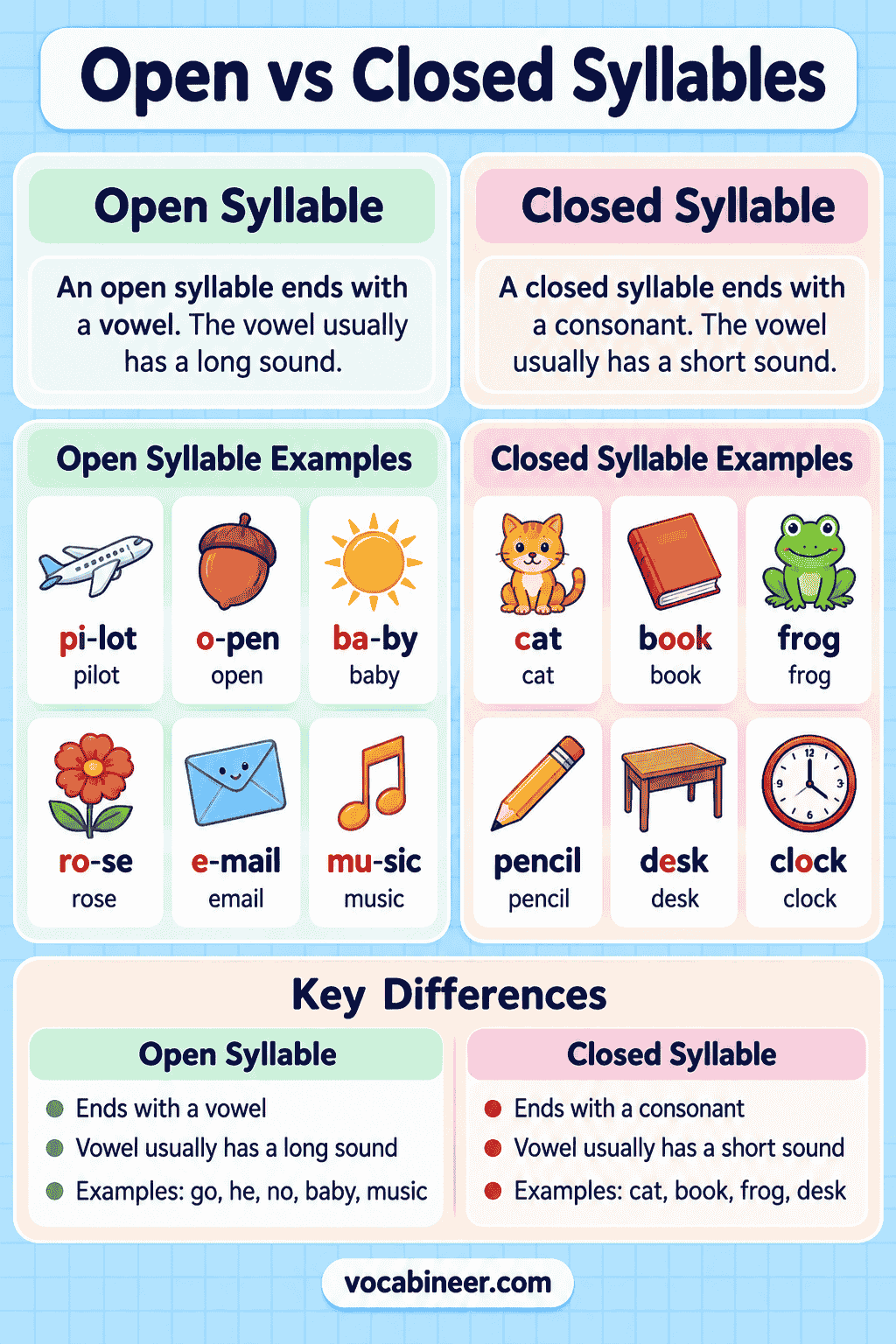
Open and closed syllables are two common syllable patterns in English phonics. The main difference is simple: an open syllable ends in a vowel, while a closed syllable ends in a consonant.
That ending often affects the vowel sound. Open syllables commonly have a long vowel sound, while closed syllables commonly have a short vowel sound. Learning the difference can help readers decode unfamiliar words and recognize common spelling patterns more easily.
In This Page
Open vs. Closed Syllables at a Glance
The easiest way to compare open and closed syllables is to look at how each syllable ends.
| Feature | Open Syllable | Closed Syllable |
|---|---|---|
| Ending | Ends in a vowel | Ends in a consonant |
| Common vowel sound | Usually long | Usually short |
| Simple examples | me, go, hi | cat, bed, hot |
| Common pattern | V or CV | VC or CVC |
| Can appear in longer words? | Yes | Yes |
The words usually and commonly matter. English pronunciation contains exceptions, especially in unstressed syllables and longer words.
What Is an Open Syllable?
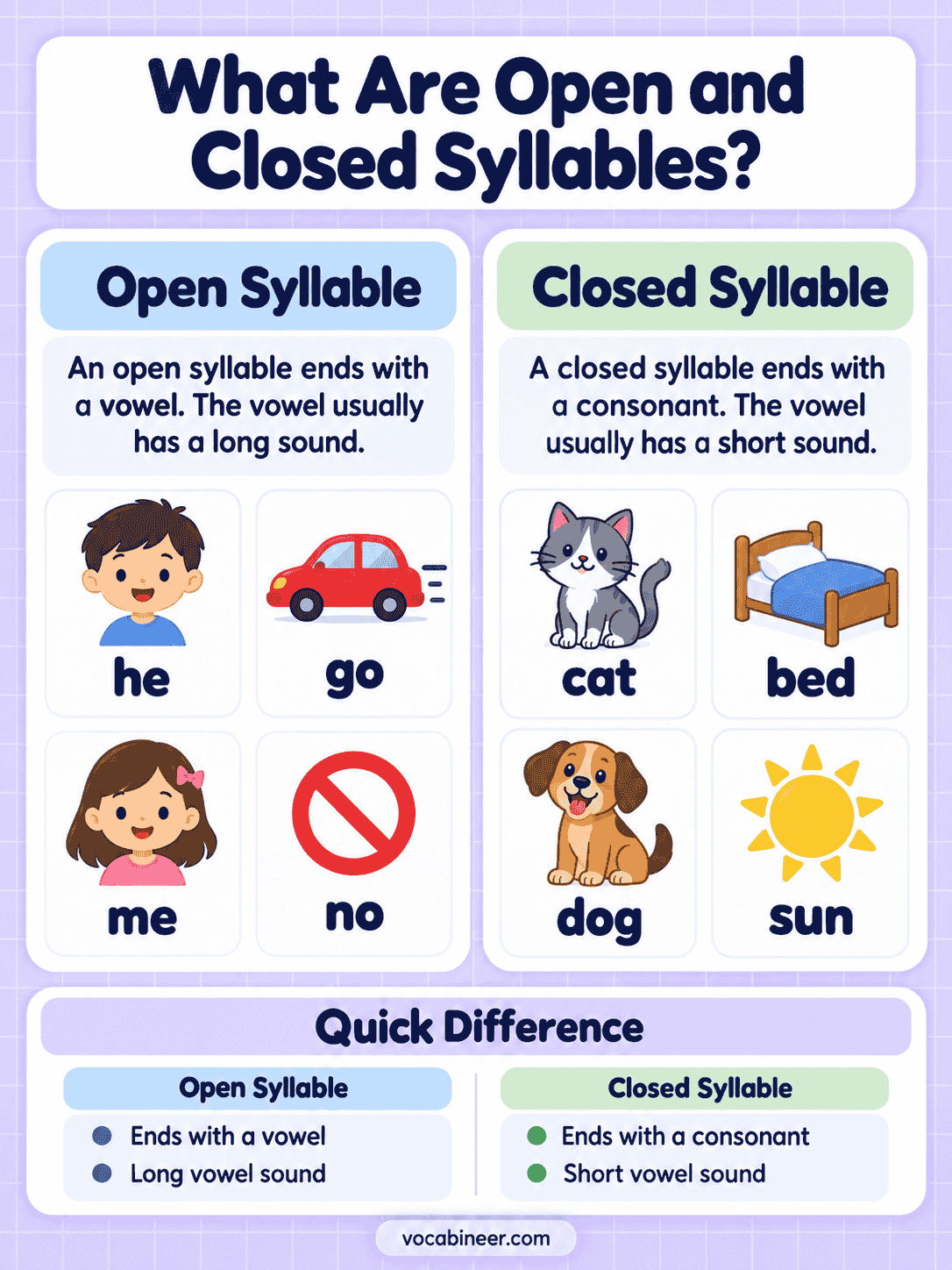
An open syllable ends in a vowel sound. Because no consonant closes the syllable after the vowel, the vowel commonly has its long sound.
Examples include:
Me
The syllable ends in e, and the vowel has its long sound.
He
The final e forms the end of the syllable.
She
The syllable ends with the vowel sound represented by e.
Go
The syllable ends in o, which has its long sound.
No
The vowel remains at the end of the syllable.
So
This is another one-syllable open pattern.
Hi
The syllable ends in i, which has its long sound.
Open Syllables Ending in Y
The letter y can act as a vowel at the end of an open syllable.
Examples include:
My
By
In these words, y represents a vowel sound and appears at the end of the syllable.
This is useful to remember because an open syllable does not always have to end in one of the letters a, e, i, o, or u.
What Is a Closed Syllable?
A closed syllable ends in a consonant. The consonant comes after the vowel and “closes” the syllable.
The vowel commonly has a short sound.
Examples include:
Cat
The vowel a is followed by the consonant t.
Bed
The vowel e is closed by d.
Sit
The vowel i is followed by t.
Hot
The vowel o is closed by t.
Sun
The vowel u is followed by n.
Web
The vowel e is closed by b.
Flat
The vowel is followed by consonants at the end of the syllable.
Up
The vowel u is followed by p, so the syllable is closed.
Why Are They Called Open and Closed Syllables?
The names describe what happens after the vowel.
In an open syllable, the vowel appears at the end of the syllable.
In a closed syllable, one or more consonants follow the vowel within that syllable.
Compare:
me → open
met → closed
The added consonant t closes the syllable.
Likewise:
hi → open
hit → closed
This simple contrast explains both the names and the typical vowel-sound change.
How Open and Closed Syllables Affect Vowel Sounds
Open and closed syllables are especially useful because the pattern often helps predict the vowel sound.
An open syllable commonly gives the vowel its long sound, while a closed syllable commonly gives it a short sound.
Compare these pairs:
| Open Syllable | Closed Syllable | What Changes? |
|---|---|---|
| me | met | e changes from long to short |
| hi | hit | i changes from long to short |
| she | shed | e changes from long to short |
| no | not | o changes from long to short |
| he | hen | e changes from long to short |
These pairs make the structural difference easy to see.
Me vs. Met
Me ends in a vowel, so it is open.
Met ends in a consonant, so it is closed.
The added t changes the structure and the vowel sound.
Hi vs. Hit
Hi is open because the vowel ends the syllable.
Hit is closed because t comes after the vowel.
No vs. Not
No ends in a vowel and commonly uses a long vowel sound.
Not ends in a consonant and uses the short vowel sound.
The pattern is useful for decoding because the ending gives the reader a clue about how the vowel may sound.
Open and Closed Syllables in Longer Words
Open and closed labels apply to individual syllables, not only to complete one-syllable words.
A longer word may contain:
- two closed syllables;
- an open syllable followed by a closed syllable;
- a closed syllable followed by an open syllable;
- open or closed syllables combined with other syllable types.
Two Closed Syllables
Consider:
nap | kin
Both syllables are closed:
nap ends in p.
kin ends in n.
So napkin contains two closed syllables.
Another example is:
rab | bit
Both syllables end in consonants, so both are closed.
Open Followed by Closed
Some longer words contain an open syllable followed by a closed syllable.
For example:
ro | bot
The first syllable ro ends in a vowel sound and is open.
The second syllable bot ends in a consonant and is closed.
This shows why it is more accurate to classify individual syllables rather than label an entire multisyllabic word as simply open or closed.
Closed Followed by Open
The opposite pattern can also occur.
A word may begin with a closed syllable and continue with an open syllable.
The important question is always:
How does each individual syllable end?
That is the most reliable starting point.
The Syllable Gets the Label, Not the Whole Word
Beginners sometimes say:
“This word is an open word.”
A more accurate statement is:
“This word contains an open syllable.”
For a one-syllable word such as me, the whole word and the syllable are the same unit, so calling it an open syllable is simple.
However, in a longer word, each syllable may follow a different pattern.
For example:
ro | bot
- ro = open
- bot = closed
The word contains both types.
Basic Open and Closed Syllable Patterns
Simple letter patterns can make the difference easier to recognize.
Open Pattern: CV
C = consonant
V = vowel
Example:
me
m = consonant
e = vowel
The syllable ends in the vowel, so it is open.
Closed Pattern: CVC
Example:
met
m = consonant
e = vowel
t = consonant
The final consonant closes the syllable.
The patterns CV and CVC are useful beginner models, but English words can contain more complex consonant combinations.
For example:
flat
has a more complex spelling pattern but is still closed because the syllable ends in consonants.
Open Syllables vs. Silent-e Syllables
An open syllable should not be confused with a vowel-consonant-e or silent-e syllable.
Compare:
me → open syllable
met → closed syllable
mete → vowel-consonant-e pattern
In me, the vowel is at the end of the syllable.
In mete, the vowel is followed by a consonant, and the final e forms part of a different spelling pattern.
Both may contain a long vowel sound, but they do not belong to the same syllable type.
Open Syllables vs. Vowel-Team Syllables
An open syllable may also produce a long vowel sound, but that does not make it the same as a vowel-team syllable.
Compare:
go → open syllable
boat → vowel-team syllable
In go, the vowel ends the syllable.
In boat, the vowel sound is represented by the letter combination oa.
The vowel sound may be similar, but the spelling pattern is different.
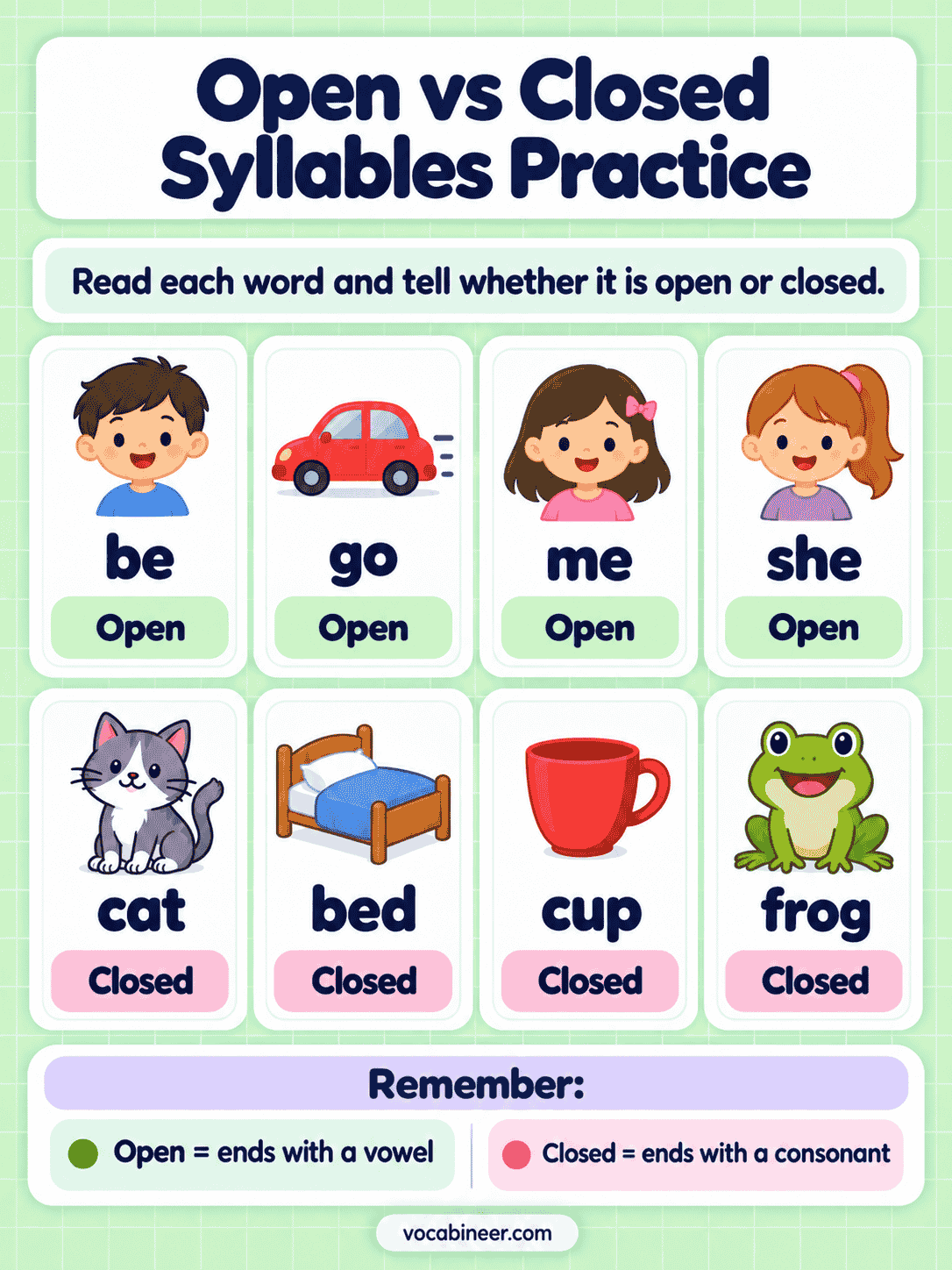
How to Identify an Open or Closed Syllable
A simple process works well for most beginner examples.
1. Identify the Syllable
If the word contains more than one syllable, consider each syllable separately.
2. Look at the Ending
Ask:
Does the syllable end in a vowel or a consonant?
3. Vowel Ending = Open
Examples:
- me
- go
- hi
4. Consonant Ending = Closed
Examples:
- cat
- bed
- hot
5. Check the Vowel Sound
In many beginner words:
- open syllable → long vowel;
- closed syllable → short vowel.
Use the sound as supporting evidence rather than the only test.
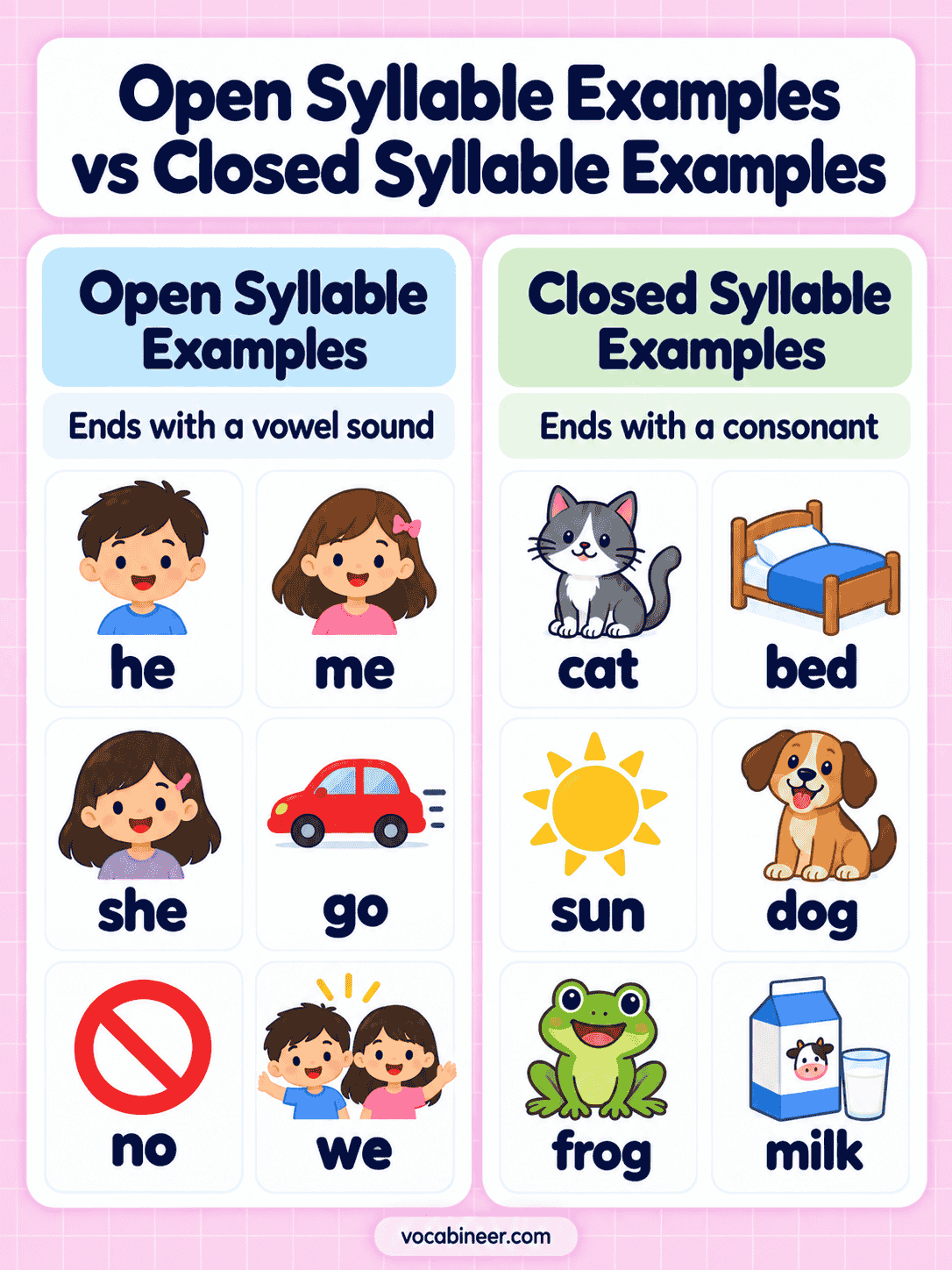
Open and Closed Syllable Examples Side by Side
A wider example set makes the pattern easier to recognize.
| Open Syllables | Closed Syllables |
|---|---|
| me | met |
| he | hen |
| she | shed |
| hi | hit |
| go | got |
| no | not |
| so | sock |
| my | myth |
The exact vowel sounds and spelling patterns vary, but the central distinction remains the syllable ending.
When the Simple Vowel Rule Does Not Work Perfectly
The beginner rule:
open = long vowel
closed = short vowel
is useful, but English pronunciation is more complex than a single rule.
Unstressed Syllables
In longer words, unstressed vowels may become reduced instead of keeping a clear long or short vowel sound.
A common reduced vowel is called schwa.
This means an open syllable in a multisyllabic word may not always sound like a simple example such as me or go.
Other Syllable Types
A long vowel sound does not automatically mean the syllable is open.
For example:
cake
contains a long vowel sound but follows a vowel-consonant-e pattern.
Likewise:
boat
contains a long vowel sound but follows a vowel-team pattern.
Therefore, identify the spelling pattern rather than relying only on vowel length.
English Has Exceptions
Phonics patterns describe common relationships in English spelling and pronunciation, but they are not exceptionless mathematical rules.
Using usually or commonly keeps the explanation accurate.
Why Open and Closed Syllables Help With Reading
Recognizing open and closed syllables can give readers a useful clue about how a vowel is likely to sound.
Suppose a learner sees:
me
Because the syllable ends in a vowel, the reader can recognize an open pattern and expect the common long vowel sound.
Now compare:
met
The consonant after the vowel closes the syllable, so the reader can expect the common short vowel sound.
This becomes especially useful in longer words because a reader can examine one syllable at a time instead of trying to decode the entire word at once.
For example:
nap | kin
Recognizing both parts as closed syllables helps explain the vowel sounds in each part.
The pattern also supports spelling because learners begin connecting vowel sounds with the structures that commonly represent them.
Frequently Asked Questions
An open syllable ends in a vowel, while a closed syllable ends in a consonant. Open syllables commonly have long vowel sounds, and closed syllables commonly have short vowel sounds.
Common examples include me, he, she, go, no, so, hi, my, and by. The syllable ends in a vowel sound in each case.
Examples include cat, bed, sit, hot, sun, web, flat, and up. Each syllable ends in a consonant.
Yes. A multisyllabic word can contain different syllable types. For example, in ro-bot, the first syllable is open and the second is closed.
No. Open syllables commonly have long vowel sounds in basic phonics examples, but unstressed vowels in longer words may be reduced. Other pronunciation patterns and exceptions also occur.
Read More
- What is a Syllable?
- Closed syllable words
- Open syllable words
- Open and closed syllable words
- Multisyllabic Words List
- 1 syllable words
- 2 syllable words
- 3 syllable words
- 4 syllable words
- 5 syllable words
- Six syllable words