

Counting syllables becomes much easier when you focus on how a word sounds instead of simply looking at its spelling. English words often contain silent letters, vowel teams, and endings that can make written vowel counts misleading.
The most reliable method is to say the word naturally, listen for its spoken parts, and then use spelling clues only when the count is unclear. You can also check your answer with clapping, tapping, the chin method, or a pronunciation source.
Quick Answer: To count syllables, say the word naturally and count the separate spoken units you hear. Most syllables contain one vowel sound, but written vowel letters do not always equal syllables. For example, rain has two vowel letters but only one syllable, while ta-ble has two syllables.
In This Page
How to Count Syllables Step by Step
A simple counting process works for most English words.
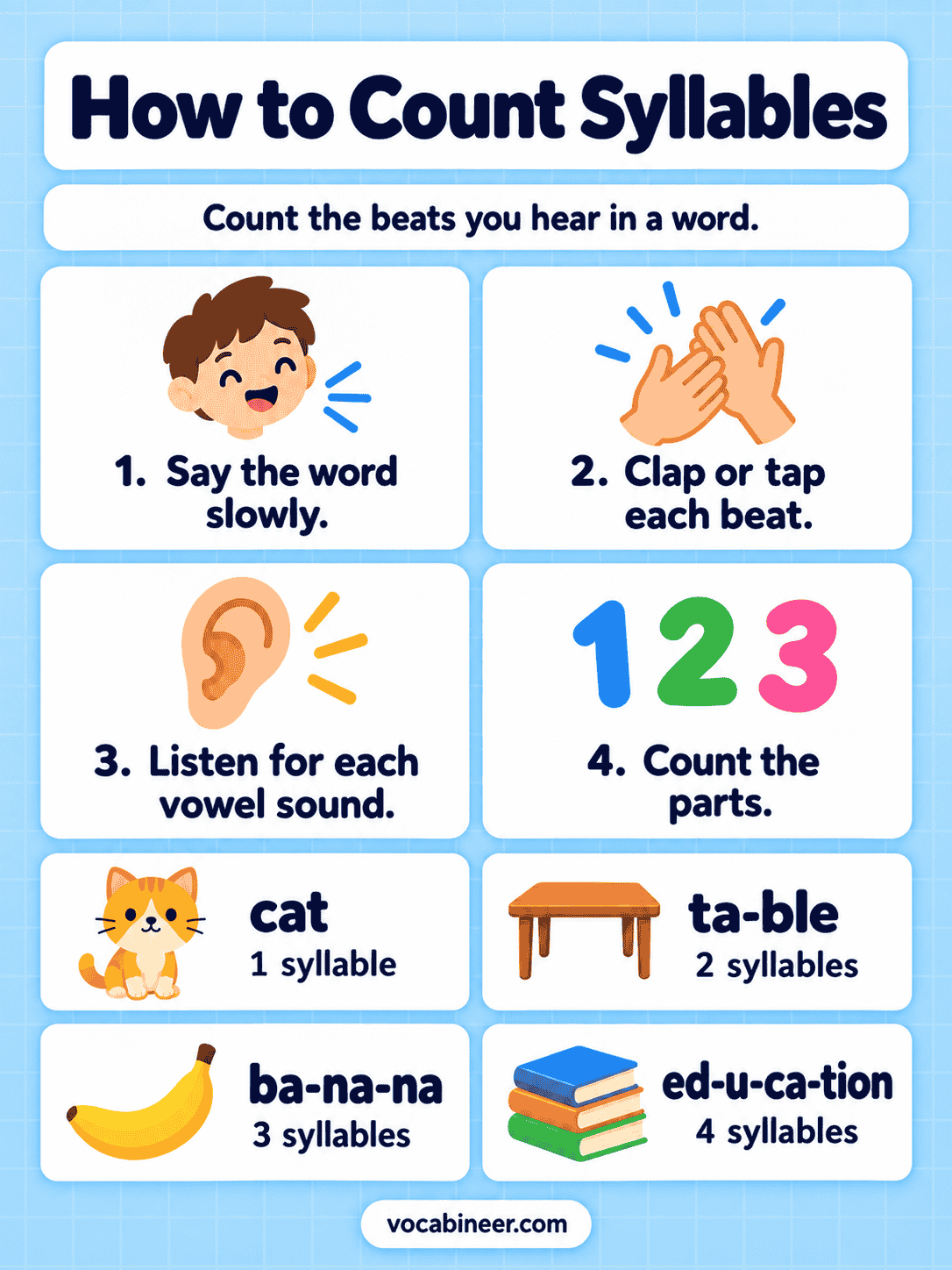
1. Say the Word Naturally
Start by pronouncing the word at your normal speaking speed.
For example:
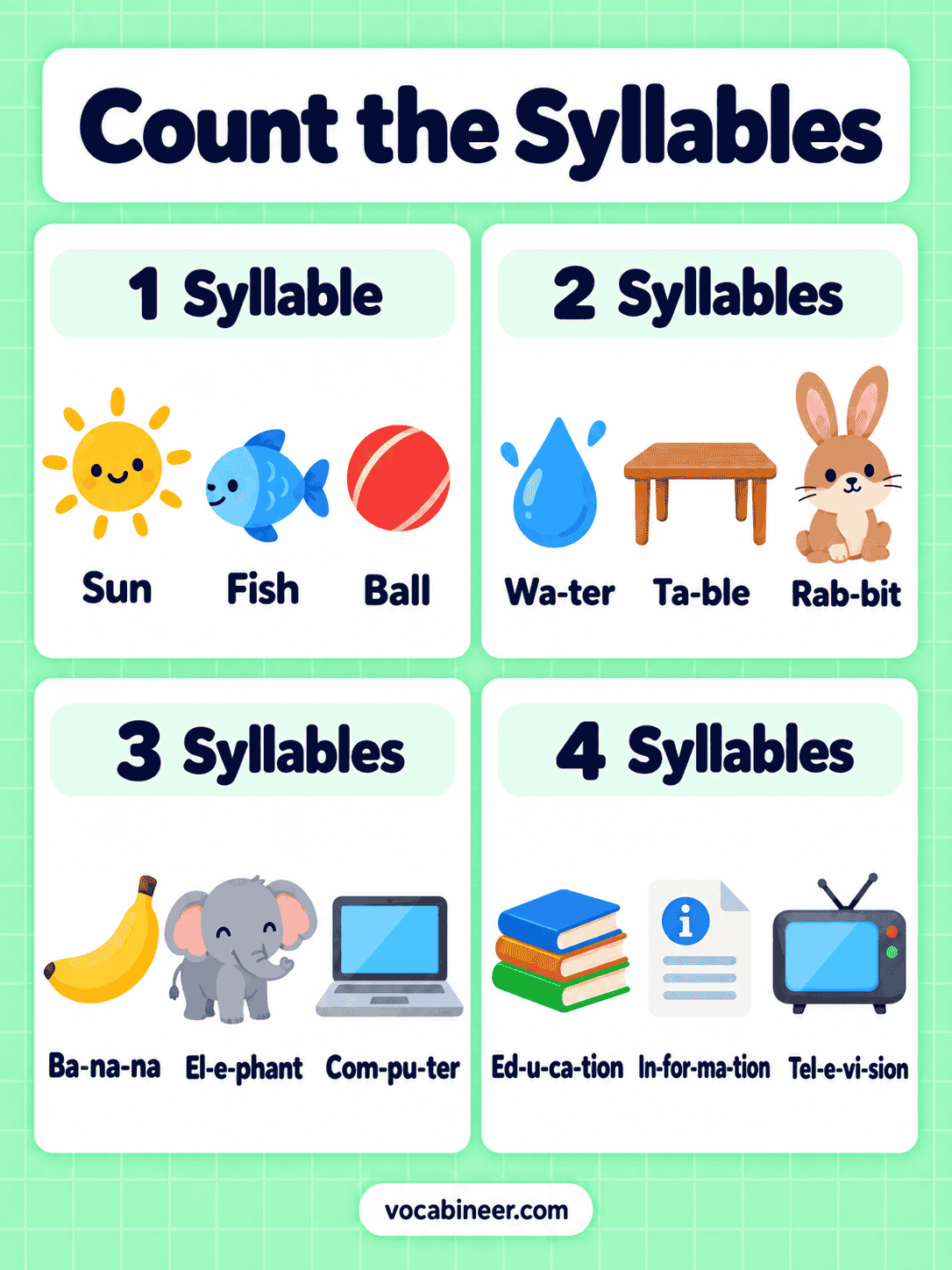
banana
Say it naturally:
ba | na | na
You can hear three spoken units, so banana has three syllables.
Avoid sounding out every written letter individually. Doing that may create extra sounds that are not part of normal pronunciation.
2. Listen for the Spoken Units
Each syllable forms one pronounceable part of the word.
Consider:
computer
You can hear:
com | pu | ter
That gives the word three syllables.
Likewise:
window
can be heard as:
win | dow
so it has two syllables.
3. Listen for Vowel Sounds
Most syllables contain a vowel sound at their center.
For example:
paper
can be heard as:
pa | per
The two vowel centers correspond to two spoken units.
However, this does not mean you should simply count the written vowels. English spelling often uses more than one vowel letter for a single sound, and some vowel letters are silent.
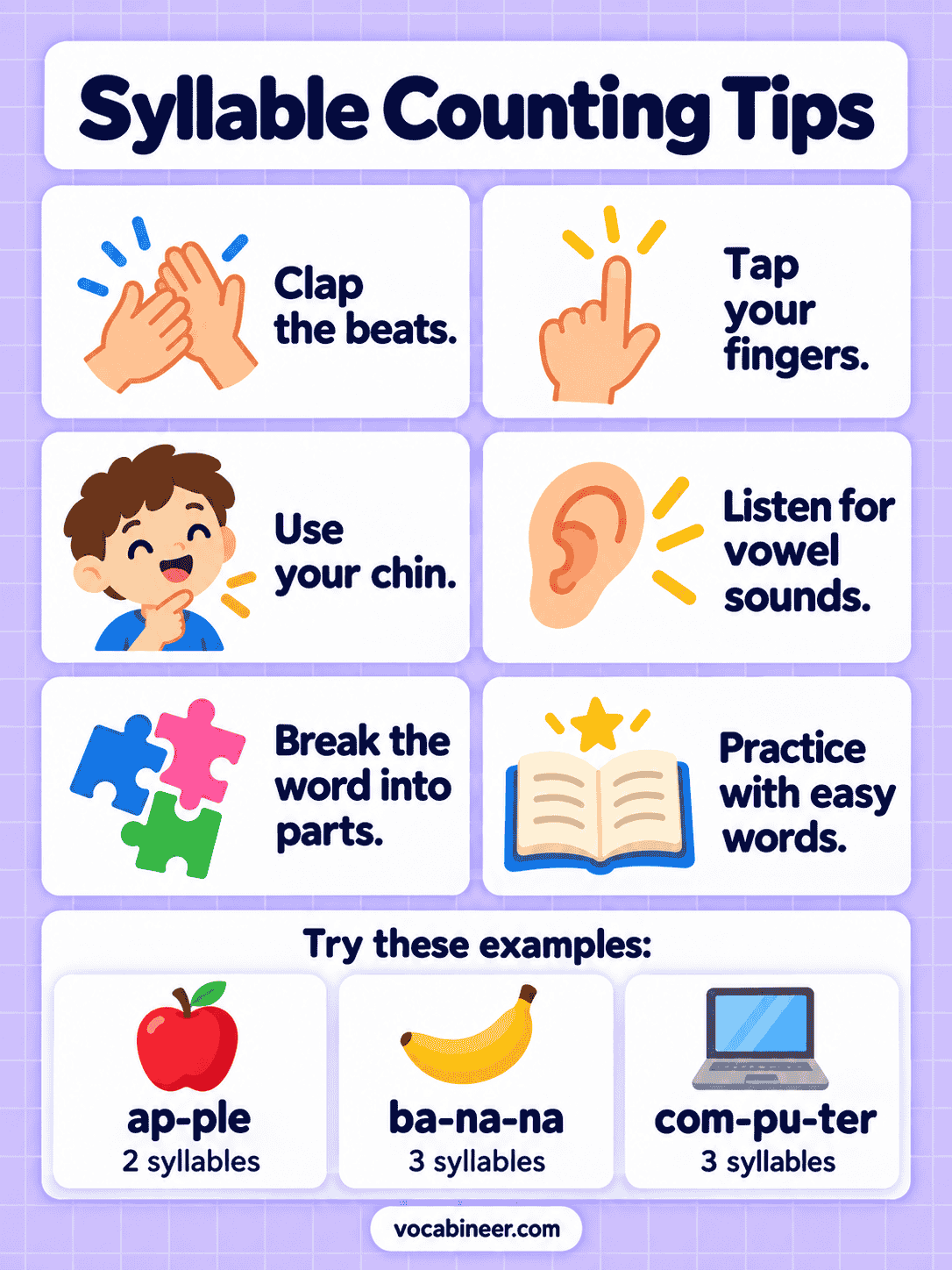
4. Use a Physical Check if Needed
If you are unsure, try one of these methods:
- clap once for each spoken unit;
- tap your finger for each beat;
- place your hand under your chin and notice the main jaw movements;
- hum the word and listen for its rhythm.
These methods help you confirm what you hear.
5. Check the Spelling for Tricky Patterns
If the word is still confusing, look for common patterns such as:
- silent final e;
- vowel teams;
- consonant + le;
- -ed endings;
- -es endings.
These patterns can help explain why a word has the syllable count you hear.
6. Check the Pronunciation if the Word Is Unclear
Names, borrowed words, unusual spellings, and accent-sensitive words can be difficult to count from spelling alone.
If pronunciation matters, listen to a reliable dictionary pronunciation or other trusted audio source and count the spoken units in that pronunciation.
Easy Ways to Hear Syllables
Several methods can make syllables easier to notice. Listening should remain the main method, while the others work as helpful checks.
| Method | How It Works | Best Use |
|---|---|---|
| Listening | Say the word naturally and hear its spoken parts | Best overall method |
| Clapping | Clap once for each syllable | Clear beginner words |
| Tapping | Tap once for each spoken beat | Quiet alternative to clapping |
| Chin method | Feel the main jaw movements while speaking | Physical checking cue |
| Humming | Hum the word and notice its rhythm | Hearing speech patterns |
The Clapping Method
Say:
elephant
and clap with each spoken part:
el – e – phant
You should hear and clap three syllables.
Clapping works well with clear words, but a syllable is not literally a clap. The clap simply helps mark the sound units you already hear.
The Chin Method
Place your hand lightly under your chin and say:
animal
an | i | mal
Your jaw will usually move downward around the vowel center of each syllable.
You can often notice three main movements, which supports a count of three syllables.
However, jaw movement is only a physical clue. Natural pronunciation should decide the count.
The Tapping Method
Instead of clapping, tap a finger on a desk or your hand once for each spoken part.
For:
teacher
you may tap:
teach | er
That gives two syllables.
The Humming Method
Try humming the word without focusing on individual consonants.
A word such as:
banana
produces three noticeable rhythmic parts when hummed:
ba | na | na
This can help when consonant-heavy spelling distracts you from the word’s rhythm.
Count Sounds, Not Vowel Letters
One of the most common syllable-counting mistakes is counting written vowel letters.
English spelling does not match pronunciation one-to-one.
| Word | Vowel Letters | Syllables |
|---|---|---|
| cat | 1 | 1 |
| rain | 2 | 1 |
| boat | 2 | 1 |
| cake | 2 | 1 |
| table | 2 | 2 |
| idea | 3 | 3 |
The table shows why vowel letters are only clues.
In rain, the letters a and i work together to represent one vowel sound.
In cake, the final e is silent.
By contrast, idea contains three clearly pronounced syllables.
A useful rule is:
Listen first. Use the spelling to explain the count, not to determine it automatically.
Syllable Counting Rules for Tricky Words
Some spelling patterns regularly confuse learners. These rules can help, provided you treat them as pronunciation clues rather than absolute formulas.
Silent Final E
A final e is often silent and does not create another syllable.
Examples:
cake → 1 syllable
bike → 1 syllable
name → 1 syllable
home → 1 syllable
For example:
cake
is pronounced as one spoken unit, not:
ca-ke
So counting both written vowels would give the wrong answer.
Avoid using a rule such as “always subtract one when a word ends in e.” English contains exceptions, so pronunciation still comes first.
Vowel Teams
Two or more vowel letters can work together to represent a single vowel sound.
Examples:
rain → 1
boat → 1
team → 1
moon → 1
The important point is not that two vowels always make one syllable. Instead, these particular letter combinations represent one vowel sound in these words.
Compare:
boat → 1 syllable
with:
poet → 2 syllables
Both words contain adjacent vowel letters, but the pronunciations differ.
Consonant + le
A final consonant + le often forms another syllable.
Examples:
ta | ble → 2
lit | tle → 2
pur | ple → 2
sim | ple → 2
This pattern is useful because the final e behaves differently from the silent e in words such as cake.
Compare:
| Word | Pattern | Syllables |
|---|---|---|
| cake | Silent final e | 1 |
| table | Consonant + le | 2 |
| bike | Silent final e | 1 |
| little | Consonant + le | 2 |
So a final e does not always affect syllable counting in the same way.
When -ed Adds a Syllable
The ending -ed sometimes creates an extra syllable and sometimes does not.
Compare:
want | ed → 2 syllables
need | ed → 2 syllables
but:
walked → 1 syllable
played → 1 syllable
cleaned → 1 syllable
The practical rule is simple:
Count -ed as another syllable only when you actually hear it as a separate spoken unit.
In wanted, the ending creates another syllable.
In walked, it does not.
When -es Adds a Syllable
The ending -es can also create an extra spoken unit in some words.
Examples:
box | es → 2
watch | es → 2
dish | es → 2
However:
cats → 1
dogs → 1
Again, pronunciation decides the count.
Do not automatically add a syllable simply because a word has a plural or verb ending.
Tricky Syllable Examples
The following words combine several common counting problems.
| Word | Common Count | Why |
|---|---|---|
| rain | 1 | Vowel team represents one vowel sound |
| cake | 1 | Final e is silent |
| table | 2 | Consonant + le forms another syllable |
| wanted | 2 | -ed creates another spoken unit |
| walked | 1 | -ed does not form another syllable |
| boxes | 2 | -es creates another spoken unit |
| school | 1 | Several letters form one spoken unit |
| beautiful | 3 | Spelling contains more vowel letters than spoken syllables |
| quiet | 2 | Two clear vowel centers are pronounced |
| family | Often 3 | Pronunciation may vary in faster speech |
These examples show why counting written letters alone is unreliable.
When Pronunciation Can Change the Syllable Count
Most common words have a stable syllable count, but some pronunciations vary by accent, region, or speaking style.
For example:
family
is often pronounced as:
fam | i | ly
with three syllables.
However, some speakers reduce the middle vowel in fast speech, making the word sound more compressed.
Words such as camera, every, and chocolate can also sound different across accents or speech styles.
When this happens, do not force one written-spelling rule onto every pronunciation. Instead:
- identify how the word is actually being pronounced;
- count the spoken units in that pronunciation;
- check a trusted pronunciation source if accuracy matters.
This is especially important in poetry, song lyrics, language learning, names, and public speaking.
Names and Unfamiliar Words
Names and borrowed words can be difficult because their spelling may not reveal their pronunciation clearly.
For example, a personal or place name may contain several vowel letters but fewer or more syllables than expected.
The safest approach is:
- hear the intended pronunciation;
- repeat it naturally;
- count the spoken units.
Guessing from spelling alone is less reliable.
Counting Syllables vs. Dividing Syllables
These two tasks are related but not identical.
Counting syllables asks:
How many spoken units are in the word?
Dividing syllables asks:
Where should the word be separated for pronunciation, spelling, or teaching?
For example:
banana
has three syllables:
ba | na | na
Here, counting and dividing are simple.
However, formal dictionary or spelling divisions do not always match the most intuitive visual break a beginner might use. If your goal is only to count syllables, focus first on the number of spoken units.
How to Count Syllables in a Sentence
To count syllables in a sentence, count the syllables in each word and then add them together.
For example:
The sun is shining.
Count each word:
The → 1
sun → 1
is → 1
shin-ing → 2
Total:
5 syllables
This same method works for phrases, captions, speech lines, and short pieces of verse.
How to Count Syllables in Poetry or Haiku
Poetry uses the same basic counting method.
Say each word naturally, count its syllables, and then total the syllables across the line.
For example, if a line contains:
- a one-syllable word;
- a two-syllable word;
- another two-syllable word;
the line contains five syllables in total.
Haiku is often taught in English using a 5-7-5 syllable pattern:
- first line: 5 syllables;
- second line: 7 syllables;
- third line: 5 syllables.
When counting poetry, pronunciation matters more than spelling because contractions, reduced vowels, or variant pronunciations can change the spoken count.
Do Online Syllable Counters Always Agree?
Not always.
Online syllable counters may use:
- pronunciation dictionaries;
- stored word lists;
- spelling patterns;
- automatic estimation rules.
They often work well for common words, but disagreements can appear with:
- names;
- borrowed words;
- uncommon vocabulary;
- words with multiple pronunciations;
- accent-sensitive words.
For example, if two accepted pronunciations of a word use different numbers of spoken vowel centers, automated tools may return different counts depending on the pronunciation source they follow.
Use an online syllable counter as a checking tool, not as a replacement for the pronunciation you actually intend to use.
A Simple Syllable-Counting Checklist
When you are unsure about a word, use this order:
1. Say the word naturally
↓
2. Listen for the spoken units
↓
3. Notice the vowel sounds
↓
4. Clap, tap, hum, or use the chin method if needed
↓
5. Check silent e, vowel teams, -le, -ed, and -es
↓
6. Verify the pronunciation if the word is still unclear
For example:
beautiful
Say it naturally:
beau | ti | ful
You hear three spoken units.
So:
beautiful = 3 syllables
This approach is more reliable than trying to calculate the answer from written vowel letters alone.
FAQs About Counting Syllables
Say the word naturally and listen for its separate spoken units. If the count is difficult to hear, clap or tap once for each unit you notice.
Count vowel sounds, not written vowel letters. Words such as rain and boat contain two vowel letters but only one syllable.
Usually not when the final e is silent, as in cake, bike, and home. However, do not rely on spelling alone because English contains other final-e patterns.
The ending -ed adds a syllable when you hear it as a separate spoken unit, as in wanted and needed. It does not add one in words such as walked or played.
Sometimes. Accent, regional pronunciation, and reduced speech can affect certain words. When accuracy matters, count the syllables in the pronunciation actually being used.
Read More
- What is a Syllable?
- Closed syllable words
- Open syllable words
- Open and closed syllable words
- Multisyllabic Words List
- 1 syllable words
- 2 syllable words
- 3 syllable words
- 4 syllable words
- 5 syllable words
- Six syllable words