

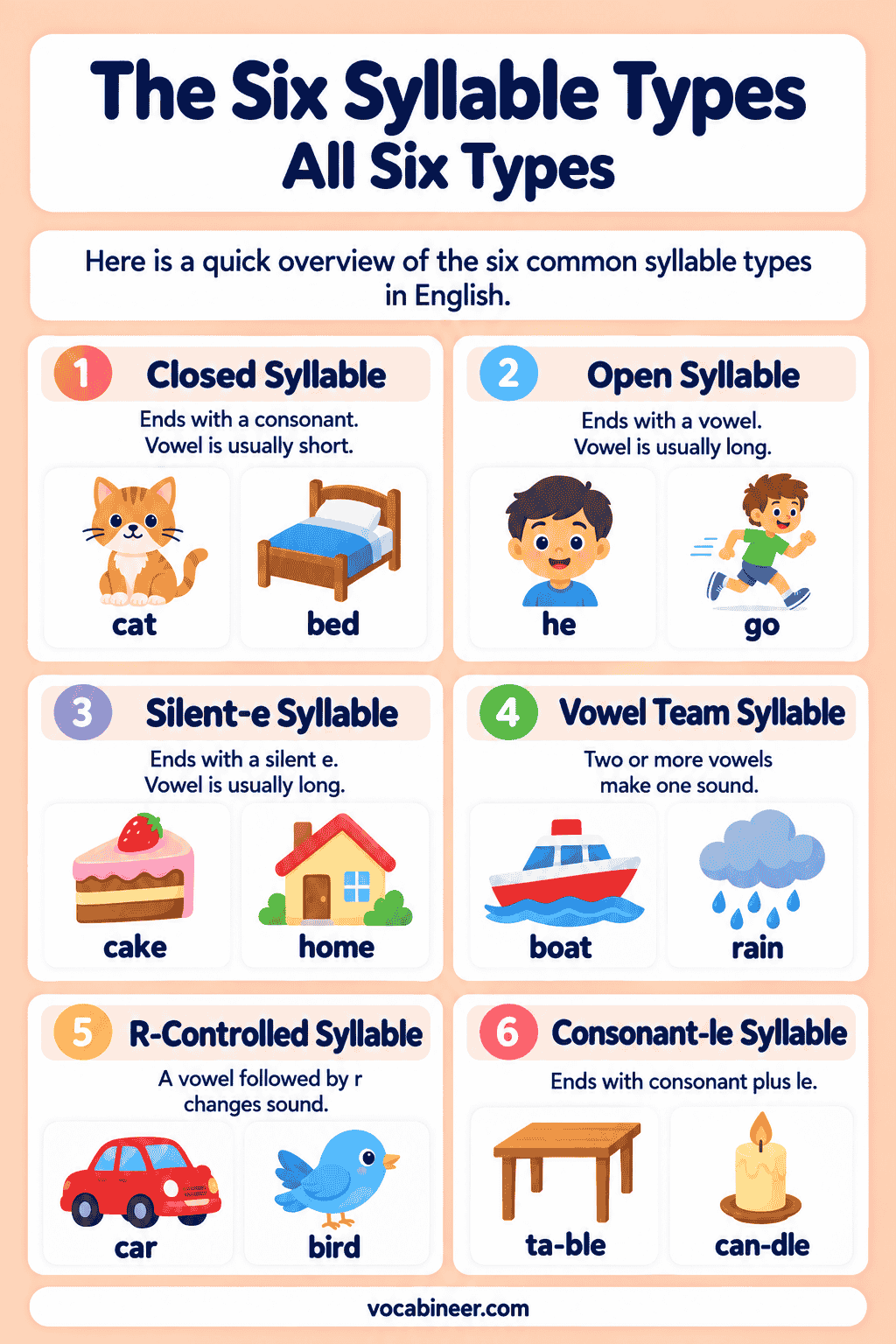
English phonics commonly groups written syllables into six useful types. Each type has a recognizable spelling pattern that can help readers predict how a vowel is likely to sound and make longer words easier to decode.
The six types are closed, open, vowel-consonant-e, vowel team, r-controlled, and consonant-le. These are written phonics patterns rather than a complete linguistic classification of every spoken syllable, so English still includes irregular spellings and unstressed syllables that do not fit the patterns perfectly.
In This Page
The Six Syllable Types at a Glance
The table below shows the main recognition clue, usual vowel behavior, and simple examples for each type.
| Syllable Type | Recognition Clue | Common Vowel Behavior | Examples |
|---|---|---|---|
| Closed | Ends in one or more consonants | Usually short | cat, bed, sit |
| Open | Ends in a vowel | Usually long | me, go, hi |
| Vowel-Consonant-e | Vowel + consonant + final silent e | Usually long | cake, bike, home |
| Vowel Team | Multi-letter spelling represents a vowel sound | Varies | rain, boat, coin |
| R-Controlled | Vowel followed by r | Vowel sound changes | car, bird, turn |
| Consonant-le | Final consonant + le | Final unstressed syllable | table, little, candle |
The words usually and commonly matter because English spelling contains exceptions.
What Does “Syllable Type” Mean?
A syllable type is a written spelling pattern used in phonics instruction.
The six types help readers connect:
- the way a syllable is spelled;
- the way its vowel is likely to sound;
- the way longer words can be decoded in smaller parts.
A spoken syllable and a written syllable pattern are related, but they are not exactly the same concept.
For example, a spoken word may contain clear syllable beats, while the written spelling of those syllables follows one or more phonics patterns.
So the six types should be understood mainly as a reading and spelling framework.
1. Closed Syllables
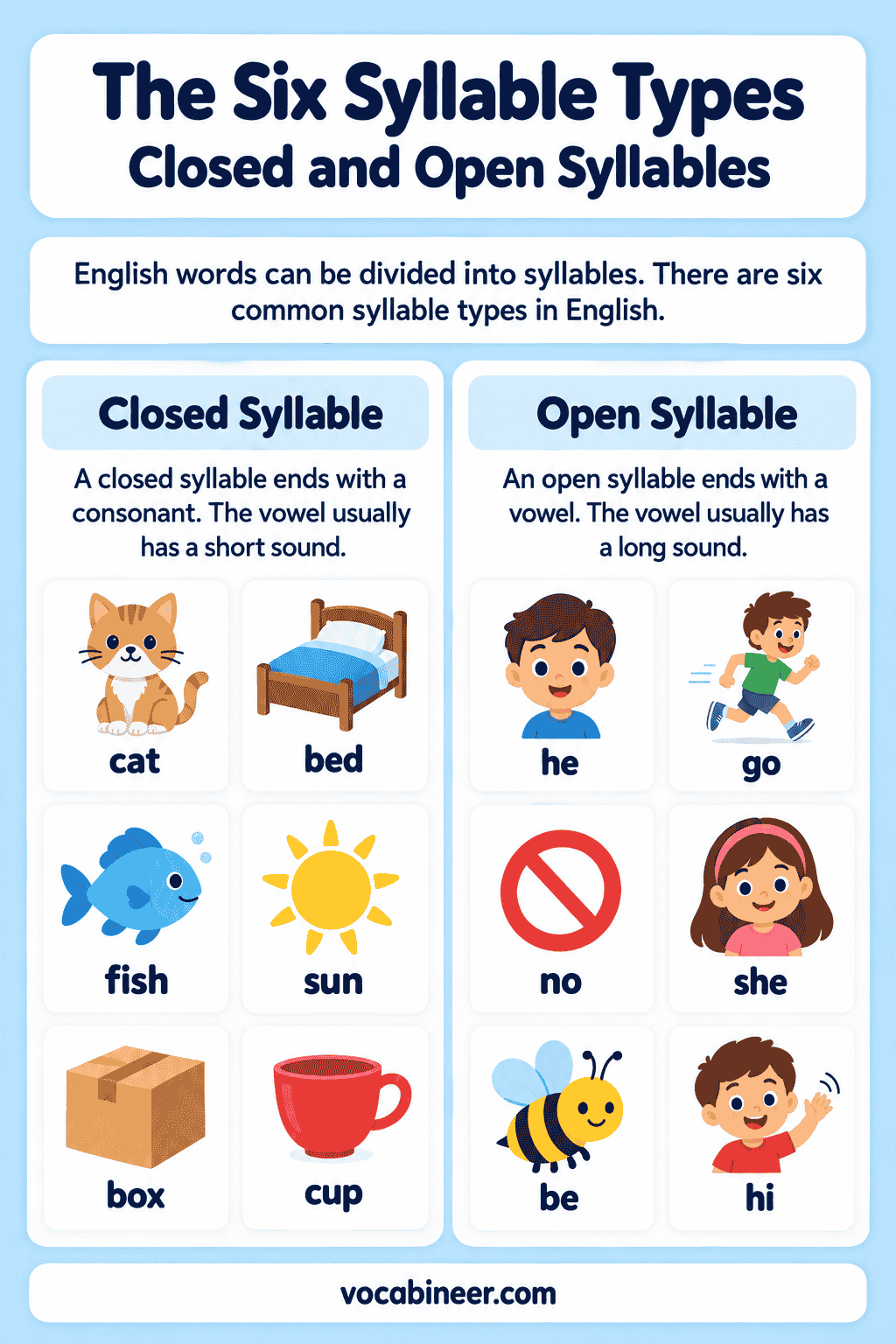
A closed syllable has a vowel followed by one or more consonants within the syllable. The consonant or consonants “close” the syllable.
The vowel commonly has a short sound.
Examples:
Cat
The vowel a is followed by t.
Bed
The vowel e is closed by d.
Sit
The vowel i is followed by t.
Hot
The vowel o is followed by t.
Sun
The vowel u is closed by n.
A closed syllable does not have to follow only a simple consonant-vowel-consonant pattern.
For example:
flat
is still closed because the vowel is followed by consonants at the end of the syllable.
Closed-Syllable Recognition Clue
Ask:
Is the vowel followed by one or more consonants before the syllable ends?
If yes, the syllable is likely closed.
Closed syllables commonly contain short vowel sounds, although English has exceptions.
2. Open Syllables
An open syllable ends in a vowel.
Because no consonant comes after the vowel within that syllable, the vowel commonly has its long sound.
Examples:
Me
He
Go
No
Hi
The pattern also occurs inside longer words.
For example:
ro | bot
The first syllable ro is open because it ends in a vowel.
Y Can Act as a Vowel
The letter y may function as a vowel at the end of an open syllable.
Examples:
my
by
In these words, y represents a vowel sound and ends the syllable.
Open-Syllable Recognition Clue
Ask:
Does the syllable end in a vowel sound?
If yes, it may be an open syllable.
Open syllables commonly have long vowel sounds in clear beginner examples, but unstressed vowels in longer words may behave differently.
3. Vowel-Consonant-e Syllables
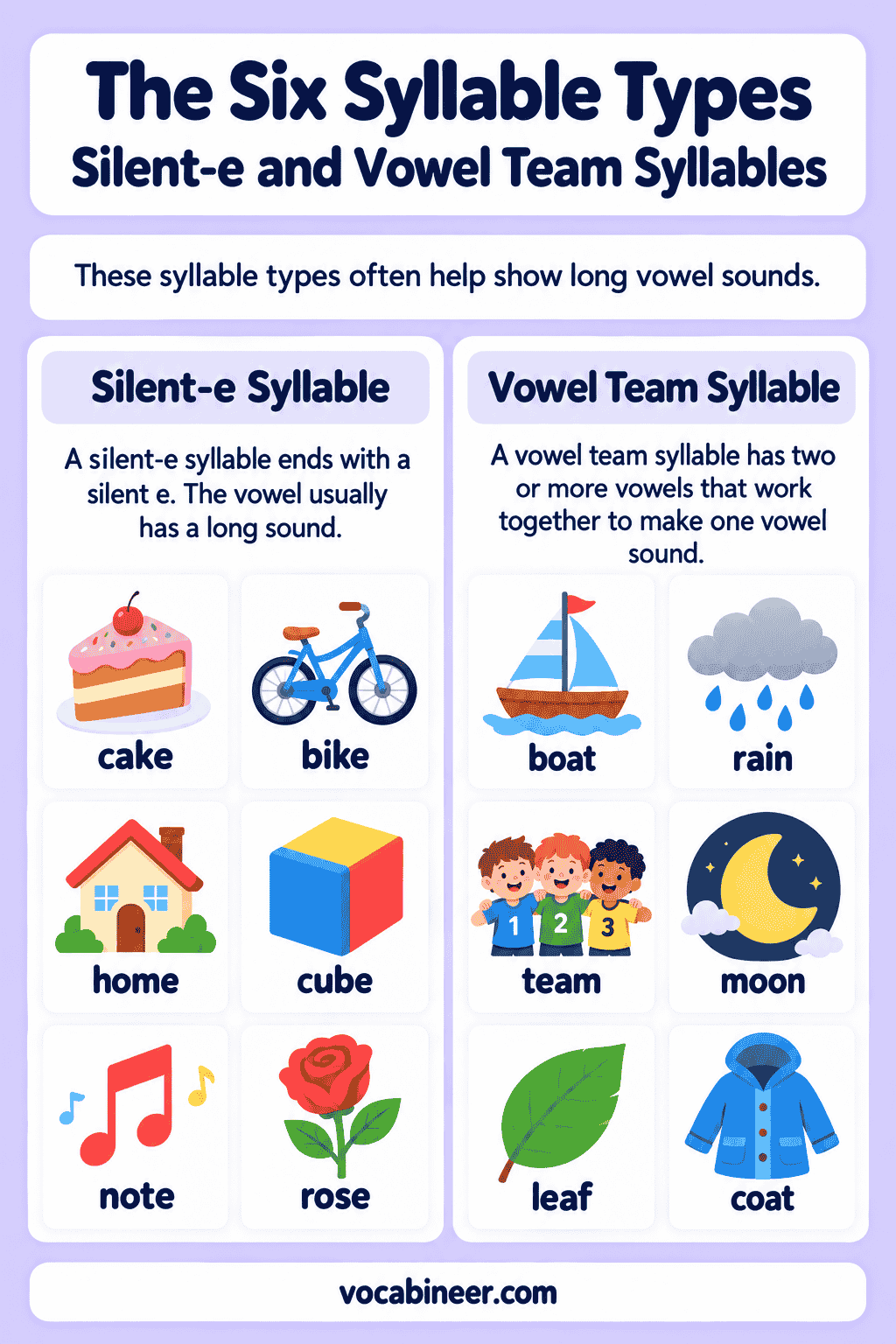
A vowel-consonant-e syllable follows a common spelling pattern:
vowel + consonant + final silent e
This type is often shortened to VCe.
It may also be called:
- silent-e;
- magic-e.
Examples:
Cake
Bike
Home
Theme
Cube
In these examples, the final e is silent, and the earlier vowel commonly has a long sound.
Compare:
cap → closed syllable
cape → VCe syllable
The final e changes the spelling pattern and commonly changes the vowel sound.
Not Every Final-e Word Is VCe
A word should not be classified as VCe simply because it ends in e.
The syllable needs to follow the actual vowel-consonant-e structure.
For example, English contains final-e words with different spelling patterns, so checking the complete syllable pattern is more reliable than looking only at the last letter.
VCe Recognition Clue
Look for:
vowel + consonant + silent e
Then check whether the first vowel has the expected long sound.
4. Vowel-Team Syllables
A vowel-team syllable contains a multi-letter spelling that represents a vowel sound.
The term is sometimes simplified to “two vowels together,” but vowel-team patterns can be more varied than that.
Examples include:
Rain
Boat
Team
Coin
Day
Snow
In rain, the letters ai work together to represent the vowel sound.
In boat, oa represents the main vowel sound.
In coin, oi represents a diphthong rather than a simple long vowel.
Vowel Teams Do Not Always Make Long Vowels
Some vowel teams represent long vowel sounds:
- rain
- boat
- team
Others represent diphthongs or different vowel sounds:
- coin
- boil
So a more accurate rule is:
A vowel team uses a multi-letter spelling to represent a vowel sound, but that sound can vary.
Vowel-Team Recognition Clue
Look for two or more letters working together as the main vowel spelling in the syllable.
Do not assume every pair of adjacent vowels automatically forms a vowel team. Pronunciation and spelling pattern both matter.
5. R-Controlled Syllables
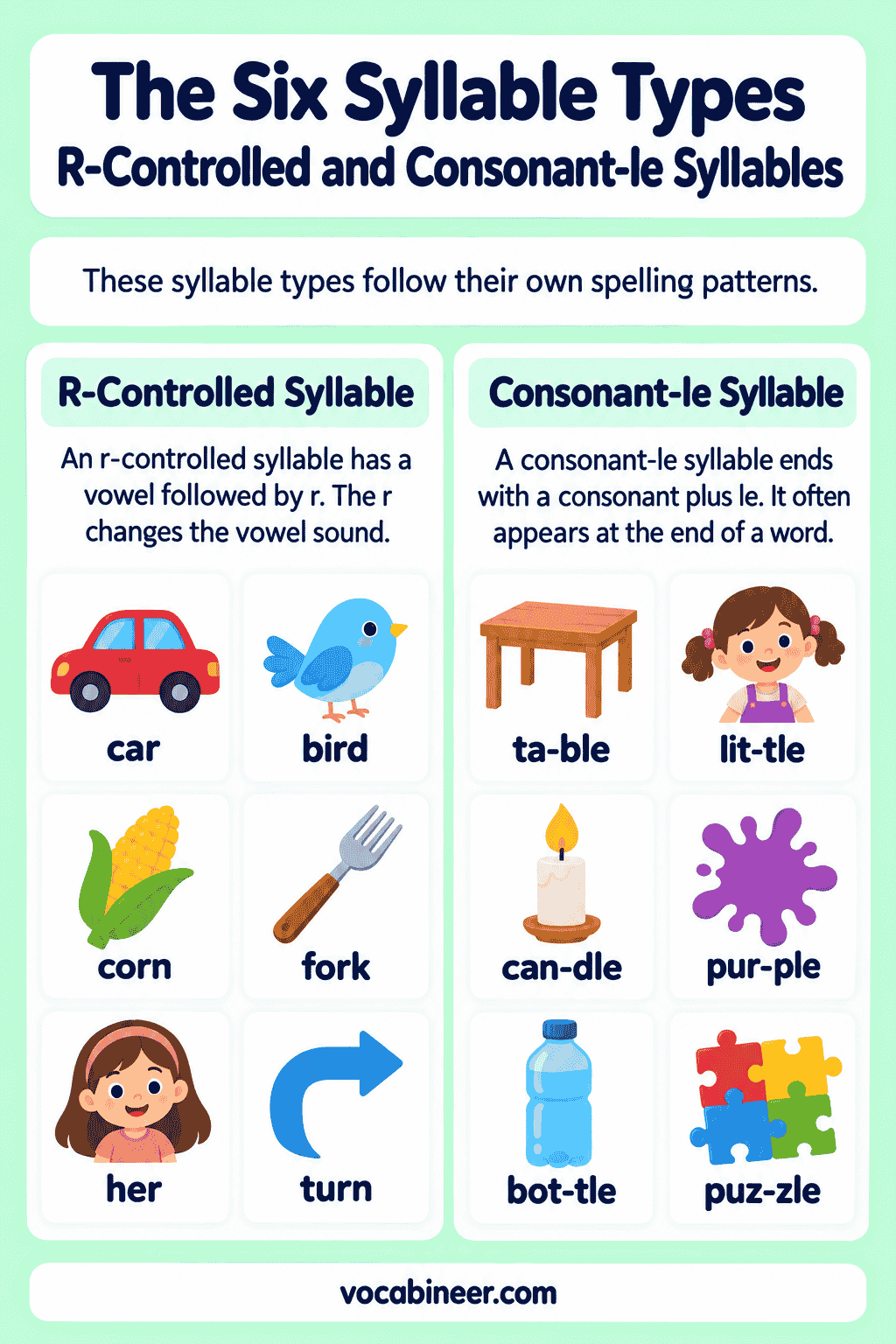
An r-controlled syllable contains a vowel followed by the letter r.
The r affects the way the vowel is pronounced.
This type is also commonly called a vowel-r syllable.
Some beginner resources use the informal term bossy r.
Common patterns include:
- ar
- er
- ir
- or
- ur
Examples:
Car
Her
Bird
Fork
Turn
In each case, the vowel does not behave like a simple short or long vowel because the following r changes its pronunciation.
R-Controlled Recognition Clue
Look for:
vowel + r
Then listen for the characteristic r-influenced vowel sound.
The article does not need separate rules for every possible ar, er, ir, or, and ur spelling to recognize the category.
6. Consonant-le Syllables
A consonant-le syllable normally appears at the end of a multisyllabic word.
Its common pattern is:
consonant + le
Examples:
Ta | ble
Lit | tle
Can | dle
Ma | ple
Pur | ple
The consonant-le unit forms the final syllable.
For example:
table
contains:
ta | ble
The ending -ble forms the consonant-le syllable.
Consonant-le Is a Final Pattern
Unlike several other syllable types, consonant-le occurs at the end of a word.
It is also typically unstressed.
This is one reason it often appears later in phonics instruction than simpler syllable patterns.
Consonant-le Recognition Clue
At the end of a multisyllabic word, look for:
consonant + le
If that ending forms its own spoken syllable, it is likely a consonant-le pattern.
Closed vs. Open Syllables
Closed and open syllables are often taught together because their structures contrast clearly.
| Closed Syllable | Open Syllable |
|---|---|
| Ends in consonant | Ends in vowel |
| Usually short vowel | Usually long vowel |
| cat | me |
| bed | go |
| sit | hi |
For example:
me → open
met → closed
The added consonant closes the syllable and commonly changes the vowel from long to short.
A separate open-versus-closed lesson can explore this contrast more deeply, but this comparison is enough to distinguish the two types within the six-type system.
Open vs. Vowel-Consonant-e Syllables
Both patterns can contain long vowel sounds, so beginners may confuse them.
Compare:
me → open
mete → VCe
The structural difference is clear:
- an open syllable ends in the vowel;
- a VCe syllable has a consonant after the vowel plus final silent e.
Likewise:
go → open
home → VCe
The vowel sound may be similar, but the spelling pattern is different.
Vowel-Consonant-e vs. Consonant-le
Both categories can end in the letter e, but they work differently.
Compare:
cake → VCe
table → consonant-le
In cake, the final e is silent and forms part of the vowel-consonant-e pattern.
In table, the ending -ble forms a separate final syllable.
This distinction is important because final e does not perform the same job in every word.
How to Identify the Six Syllable Types
A practical recognition process can make the categories easier to use.
1. Look at How the Syllable Ends
If it ends in one or more consonants after a vowel, check for a closed syllable.
If it ends directly in a vowel, check for an open syllable.
2. Look for Final Silent E
If you see:
vowel + consonant + e
check whether the syllable follows the VCe pattern.
3. Look for a Multi-Letter Vowel Spelling
If several letters work together to represent the vowel sound, the syllable may contain a vowel team.
4. Look for Vowel + R
If the vowel is directly followed by r, check for an r-controlled pattern.
5. Check the End of a Multisyllabic Word
If the word ends in:
consonant + le
the final syllable may be consonant-le.
6. Confirm With Pronunciation
Spelling patterns provide strong clues, but pronunciation can reveal exceptions or irregular words.
Syllable Types in Longer Words
Multisyllabic words can contain more than one syllable type.
Two Closed Syllables
nap | kin
nap → closed
kin → closed
The word contains two closed syllables.
Open + Closed
ro | bot
ro → open
bot → closed
This word combines two different types.
Closed + Consonant-le
lit | tle
The first syllable is closed.
The final -tle follows the consonant-le pattern.
These examples show why syllable types apply to individual syllables rather than to an entire multisyllabic word as one category.
Simple and More Complex Patterns
The basic examples often use short words, but syllable types can also contain consonant clusters.
Compare:
cat and flat
Both are closed syllables.
Likewise:
late and plate
Both follow the VCe pattern.
The extra consonants make the spelling more complex, but they do not automatically change the syllable type.
Do All English Syllables Fit the Six Types?
Not perfectly.
The six syllable types describe many important spelling patterns, but English also contains:
- irregular spellings;
- unusual pronunciation patterns;
- unstressed syllables;
- schwa;
- words that do not fit a beginner rule neatly.
So the framework is best understood as a high-value phonics system, not a complete explanation of every English word.
Schwa in Unstressed Syllables
In longer words, an unstressed vowel may be reduced to a neutral vowel sound called schwa.
When that happens, the vowel may not sound clearly long or short even if the spelling resembles a familiar syllable pattern.
This is why simple phonics descriptions should use words such as usually, commonly, and typically rather than always.
Written Syllable Types and Spoken Syllables Are Not Identical
The six syllable types classify written spelling patterns.
A spoken syllable, by contrast, is a unit of pronunciation.
The two concepts work together during reading, but formal spoken syllable boundaries and written phonics divisions do not always match perfectly.
For beginners, the most useful approach is to treat the six types as a way to connect spelling with likely pronunciation rather than as six rigid linguistic categories.
Why the Six Syllable Types Help With Reading and Spelling
Recognizing syllable types gives readers clues about unfamiliar words.
For example:
cat
has a closed pattern, so the vowel is likely short.
me
has an open pattern, so the vowel is likely long.
cake
has a VCe pattern, which suggests a long vowel.
car
contains vowel + r, so the vowel follows an r-controlled pattern.
These clues become particularly useful in longer words because the reader can examine one syllable at a time.
Syllable types can also support spelling. A learner who understands the difference between closed, open, and VCe patterns can connect vowel sounds with the spelling structures that commonly represent them.
However, syllable-type knowledge is only one part of English reading and spelling. Readers also need broader phonics, vocabulary, morphology, and experience with irregular words.
Frequently Asked Questions
The six commonly taught types are closed, open, vowel-consonant-e, vowel team, r-controlled, and consonant-le syllables.
The terms often refer to the same phonics pattern. Vowel-consonant-e or VCe is the more precise structural name, while silent-e and magic-e are common teaching labels.
No. Vowel-team spellings can involve more than two letters, and some patterns may include consonant letters. The key idea is that multiple letters work together to represent the vowel sound.
Yes. A multisyllabic word may combine several patterns. For example, robot contains an open first syllable and a closed second syllable.
No. The six-type framework covers many important phonics patterns, but English also contains irregular spellings, schwa, and other cases that do not fit a simple beginner category perfectly.
Read More
- What is a Syllable?
- Closed syllable words
- Open syllable words
- Open and closed syllable words
- Multisyllabic Words List
- 1 syllable words
- 2 syllable words
- 3 syllable words
- 4 syllable words
- 5 syllable words
- Six syllable words