

Syllables are the spoken parts that make up words. Learning to hear them can make longer words easier to pronounce, read, and spell because you can break a word into smaller sound units instead of relying only on its written letters.
A word may contain one syllable or several. Understanding syllables also helps clarify vowel sounds, pronunciation, word stress, and common English spelling patterns.
Quick Answer: A syllable is a unit of spoken pronunciation in a word. Most syllables have a vowel sound at their center. For example, cat has one syllable, ta-ble has two, and ba-na-na has three.
In This Page
What Is a Syllable?
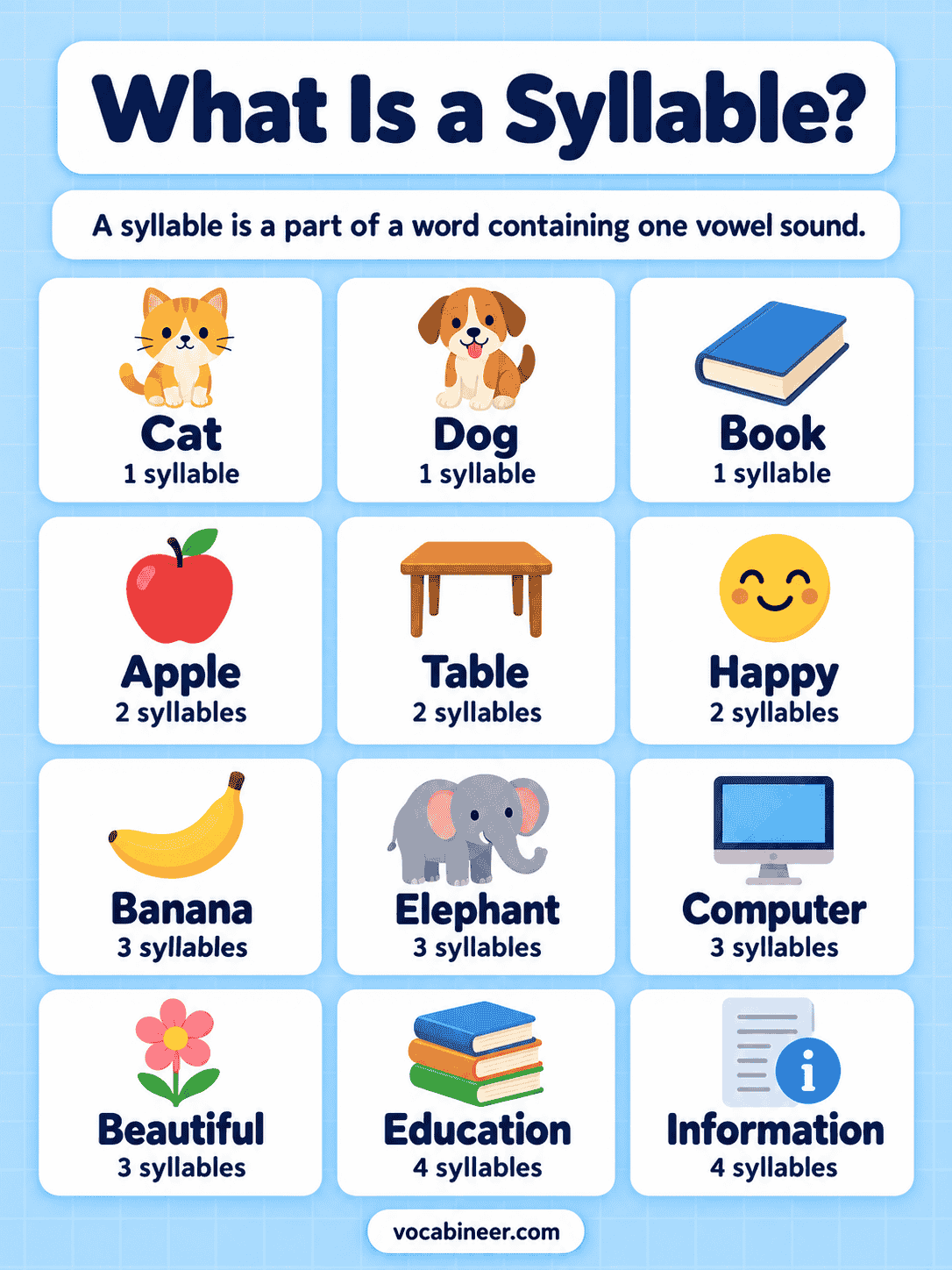
A syllable is one spoken unit within a word. Most syllables contain a vowel sound and may also include consonant sounds before or after it.
For example:
- cat = 1 syllable
- ta-ble = 2 syllables
- ba-na-na = 3 syllables
- in-for-ma-tion = 4 syllables
Teachers sometimes describe syllables as the beats in a word because each syllable forms a noticeable spoken part.
Take the word banana:
ba | na | na
You can hear three separate units, so the word has three syllables.
The key idea is that syllables depend mainly on pronunciation, not simply on how many letters appear in a word.
Syllable Examples
Comparing words with different syllable counts makes the concept easier to recognize.
| Syllable Count | Examples |
|---|---|
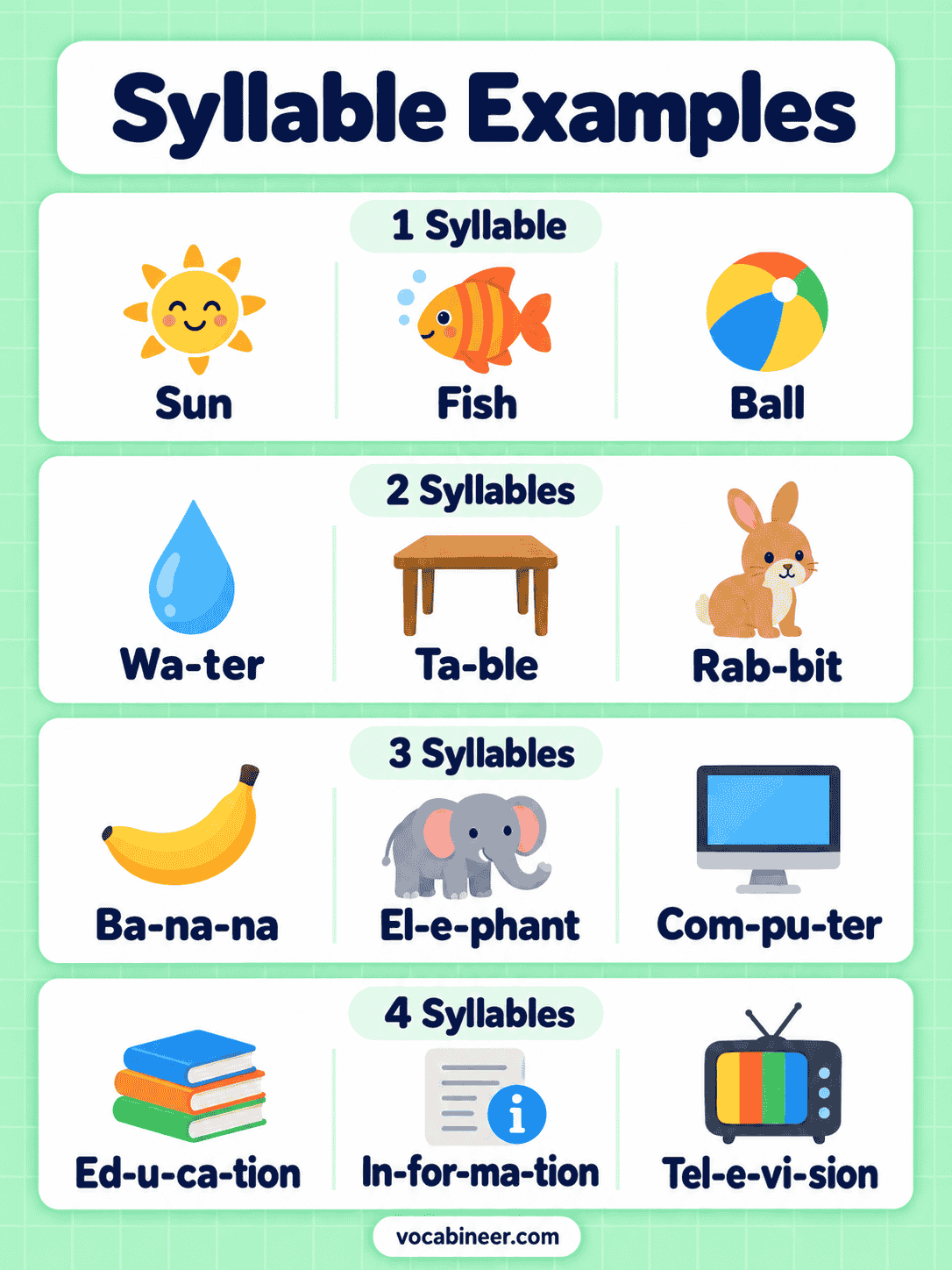
| 1 syllable | cat, book, train, milk, school |
| 2 syllables | ta-ble, win-dow, ti-ger, pen-cil, hap-py |
| 3 syllables | ba-na-na, an-i-mal, el-e-phant, com-pu-ter |
| 4 syllables | in-for-ma-tion, ed-u-ca-tion, tel-e-vi-sion |
A one-syllable word may be called a monosyllable or described as monosyllabic.
Words containing more than one syllable are multisyllabic.
Written length does not determine syllable count. For example, school has six letters but only one syllable, while banana also has six letters but contains three.
Visual Syllable Pattern
A simple way to picture increasing syllable counts is:
CAT
1 syllable
TA | BLE
2 syllables
BA | NA | NA
3 syllables
IN | FOR | MA | TION
4 syllables
Each divider marks a separate spoken unit rather than simply a group of letters.
How to Count Syllables in a Word
The best beginner method is to say the word naturally and listen to its spoken parts.
1. Say the Word Normally
Start with the word at a natural speaking speed.
For example:
computer
can be heard as:
com | pu | ter
That gives the word three syllables.
Avoid pronouncing every written letter separately because spelling does not always match spoken syllables.
2. Listen for the Sound Units
Pay attention to the parts your voice naturally moves through.
For example:
elephant
can be heard as:
el | e | phant
The word has three syllables.
3. Listen for Vowel Sounds
Most syllables contain a vowel sound at their center.
Consider:
paper
You can hear:
pa | per
That gives the word two syllables.
However, count the sounds you hear, not simply the written vowel letters you see.
4. Try the Clapping Method
Clapping can help beginners hear each spoken part.
Say:
banana
and clap once with each syllable:
ba – na – na
You should hear three syllables and make three claps.
A syllable is not literally “a clap.” Clapping is simply a practical way to notice the units already present in pronunciation.
5. Use the Chin Method
Place your hand lightly under your chin and say a word naturally.
Your jaw often drops as you produce the vowel sound at the center of a syllable.
For example:
animal
an | i | mal
You can usually notice three main jaw movements.
The chin method works as a useful check, but listening to natural pronunciation should remain your primary method.
Tricky Syllable Examples
Some words show why counting vowel letters alone can produce the wrong answer.
| Word | Syllables | Why |
|---|---|---|
| rain | 1 | ai represents one vowel sound |
| cake | 1 | The final e is silent |
| table | 2 | The ending -ble forms the second syllable |
| beautiful | 3 | Several vowel letters combine into fewer spoken units |
| wanted | 2 | The -ed ending forms a separate spoken syllable |
| school | 1 | Several letters form one spoken unit |
| quiet | 2 | The word contains two clearly heard vowel centers |
| family | Often 3 | Some pronunciations may reduce the middle sound |
These examples show why pronunciation matters more than letter counting.
Syllables and Vowels Are Not the Same
A syllable and a vowel are closely related, but they describe different things.
| Term | Meaning | Example |
|---|---|---|
| Syllable | A spoken unit in a word | ta-ble has 2 |
| Vowel sound | A speech sound that usually forms the center of a syllable | The vowel sound in cat |
| Vowel letter | A written symbol used in spelling | a, e, i, o, u |
| Letter | Any written alphabet symbol | train has 5 letters |
| Phoneme | An individual contrastive speech sound | cat contains several phonemes |
Consider:
cake
The word contains the vowel letters a and e, but it has only one syllable because the final e does not form a separate spoken unit.
Now compare:
rain
The letters a and i work together to represent one vowel sound, so the word still has only one syllable.
A useful rule is:
Count the spoken units you hear, not simply the vowel letters you see.
Syllable vs. Letter
A letter belongs to written language, while a syllable describes pronunciation.
For example:
train
has five letters but one syllable.
By contrast:
banana
has six letters but three syllables.
Therefore, a word with more letters does not necessarily contain more syllables.
Syllable vs. Phoneme
A phoneme is an individual speech sound that can distinguish meaning, while a syllable is a larger unit that may contain several speech sounds.
For example:
cat
has one syllable but contains several individual sounds.
In simple terms:
phoneme = smaller sound unit
syllable = larger spoken unit
This distinction becomes especially useful when learning more about English pronunciation and phonics.
Six Common Syllable Types
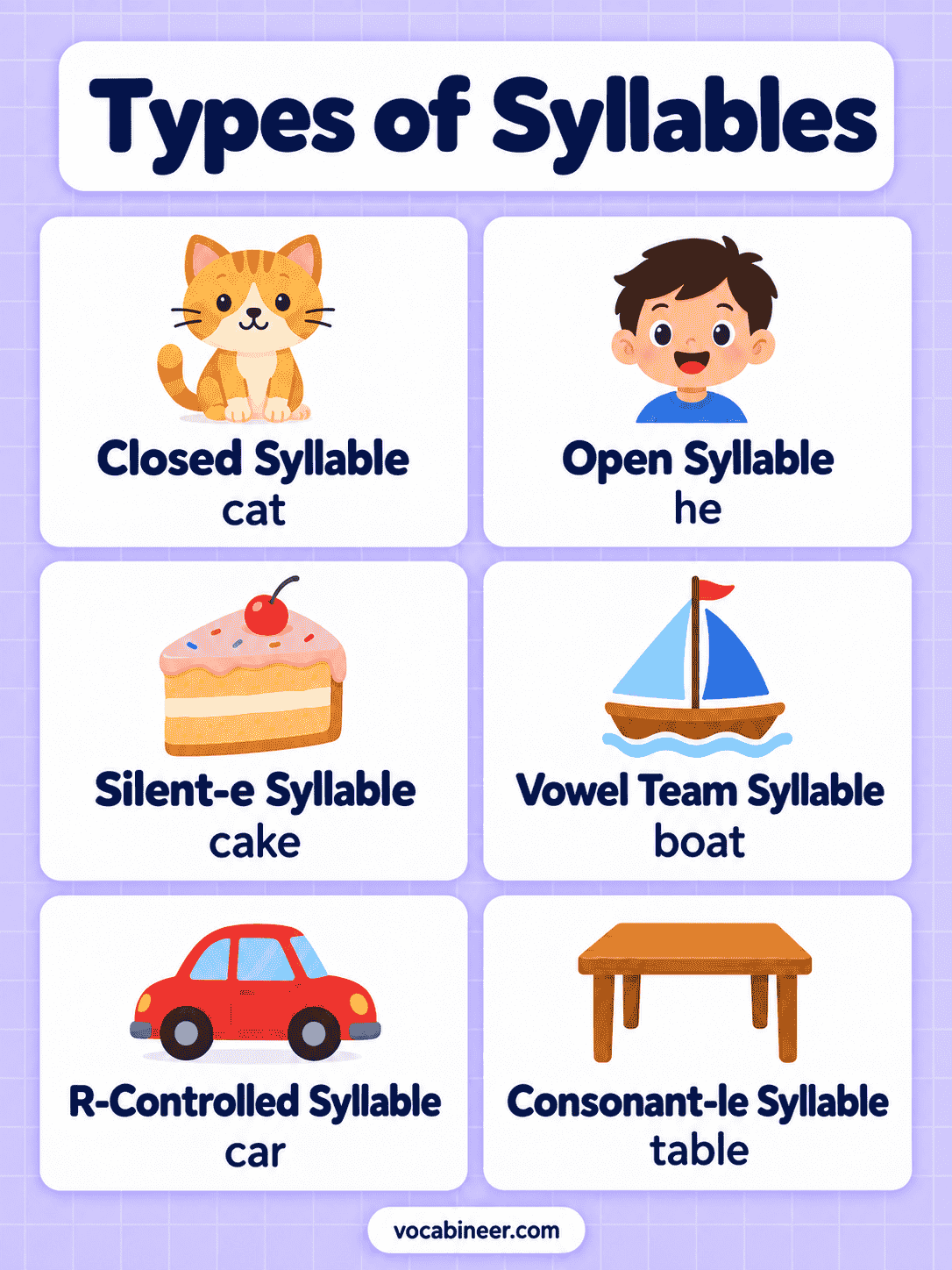
In English phonics instruction, syllables are often grouped into six common spelling patterns. These categories help learners connect written forms with pronunciation.
| Syllable Type | Basic Pattern | Examples |
|---|---|---|
| Closed | Usually ends in a consonant | cat, bed, sit |
| Open | Ends in a vowel sound | he, go, me |
| Vowel-consonant-e | Vowel + consonant + final silent e | cake, bike, home |
| Vowel team | Two or more letters represent a vowel sound | rain, boat, team |
| R-controlled | A vowel is followed by r | car, bird, fork |
| Consonant-le | Commonly ends in consonant + le | table, little, purple |
A closed syllable usually ends in a consonant and often contains a short vowel sound, as in cat and bed.
An open syllable, by contrast, ends in a vowel sound. He, go, and me are simple examples.
The vowel-consonant-e pattern appears in words such as cake, bike, and home. The final e is normally silent, so it does not create another syllable in these examples.
A vowel team uses two or more letters to represent a vowel sound. Thus, rain and boat each remain one-syllable words.
In an r-controlled syllable, r affects the preceding vowel sound, as in car, bird, and fork.
Finally, a consonant-le syllable commonly appears at the end of a longer word, as in ta-ble, lit-tle, and pur-ple.
These six categories are commonly used for reading and spelling instruction. They describe spelling patterns rather than replacing the basic sound-based definition of a syllable.
Can Related Words Have Different Syllable Counts?
Yes. Adding an ending can sometimes create another syllable.
Compare:
rain → 1 syllable
rain-y → 2 syllables
train → 1 syllable
train-ing → 2 syllables
help → 1 syllable
help-ful → 2 syllables
teach → 1 syllable
teach-er → 2 syllables
These pairs show that syllable count belongs to the pronunciation of the complete word rather than to its root alone.
Syllables and Word Stress
Syllable count and word stress describe different features of pronunciation.
Syllable count tells you how many spoken units a word contains.
Word stress identifies the syllable that receives stronger emphasis.
For example:
TA-ble
has two syllables, and the first syllable receives the main stress.
By contrast:
a-BOUT
also has two syllables, but the second syllable is stressed.
So two words can contain the same number of syllables while placing stress in different positions.
Can Syllable Count Change With Accent?
Sometimes.
English pronunciation varies across regions, accents, and speaking styles. A vowel sound may be reduced or omitted in one pronunciation but clearly spoken in another.
For instance, a word such as family may sound closer to three syllables in a careful pronunciation:
fam | i | ly
In faster speech, some speakers may reduce the middle vowel considerably.
Likewise, a small number of other English words can vary depending on accent.
This does not mean syllable counting is unreliable. Instead, it shows that syllables belong to spoken pronunciation, so genuine pronunciation differences can occasionally affect the count.
For beginner practice, words such as cat, table, banana, and computer are useful because their syllable structure is comparatively clear.
Common Mistakes When Counting Syllables
Most errors happen when learners focus on spelling instead of sound.
| Common Mistake | Better Approach |
|---|---|
| Counting every vowel letter | Listen for spoken vowel sounds |
| Counting silent e as another syllable | Check whether it produces a separate sound |
| Dividing the word only by spelling | Pronounce the word naturally first |
| Adding extra sounds while speaking slowly | Keep the normal pronunciation |
| Assuming every accent is identical | Allow for genuine pronunciation variation |
For instance, rain contains two vowel letters but only one syllable.
Similarly, cake has a final e, yet it remains a one-syllable word.
The safest general approach is simple: say the word naturally first, then count the spoken units you actually hear.
How Syllables Help With Reading and Pronunciation
Syllable awareness makes longer words easier to handle because readers can approach them in smaller spoken parts.
Take:
information
Instead of treating it as one long sequence, a learner can hear:
in | for | ma | tion
This can make the word easier to recognize and pronounce.
Syllables also support reading because many longer words become more manageable when broken into pronounceable units. Meanwhile, common patterns such as closed syllables, vowel teams, and silent-e syllables can help explain why written vowels behave differently from word to word.
They also provide the units on which word stress falls. Once learners can identify the syllables in a word, they can more easily notice which part receives stronger emphasis.
A Simple Syllable Recognition Chart
Use this pattern when checking a new word:
1. Say it naturally
↓
2. Listen for the spoken parts
↓
3. Notice the vowel sounds
↓
4. Clap or use the chin method if needed
↓
5. Check tricky spelling only after listening
For example:
beautiful
Say it naturally:
beau | ti | ful
You hear three main spoken units.
So:
beautiful = 3 syllables
The spelling looks more complicated than the pronunciation, which is why listening comes first.
Frequently Asked Questions About Syllables
Most English syllables contain a vowel sound at their center. However, some pronunciations contain a syllabic consonant, where a consonant such as l or n functions as the center of a syllable. Listening for vowel sounds is still a useful beginner method.
Say the word naturally and listen for its separate spoken units. If the count is difficult to hear, try clapping, tapping, or placing a hand under your chin while you pronounce the word.
No. Written vowel letters do not correspond directly to syllable count. For example, rain contains two vowel letters but only one syllable, while a silent vowel letter may add no extra syllable at all.
A one-syllable word is called a monosyllable or a monosyllabic word. Examples include cat, book, school, and train.
Yes, occasionally. Accent and speaking style can affect whether a particular vowel sound is clearly pronounced or reduced. However, many common English words have stable syllable counts.
Read More
- Closed syllable words
- Open syllable words
- Open and closed syllable words
- Multisyllabic Words List
- 1 syllable words
- 2 syllable words
- 3 syllable words
- 4 syllable words
- 5 syllable words
- Six syllable words