

Mirrors come in many forms, from simple wall mirrors to full-length, vanity, decorative, and bathroom mirrors. Each one has a different purpose, shape, placement, or design, so knowing the main categories makes them easier to recognize.
Some mirrors are used for dressing and grooming, while others are chosen to brighten a room or improve its style. This guide explains the most common mirror types in a simple way, so you can understand how each one is used and how it differs from the others.
In This Page
Common Types of Mirrors
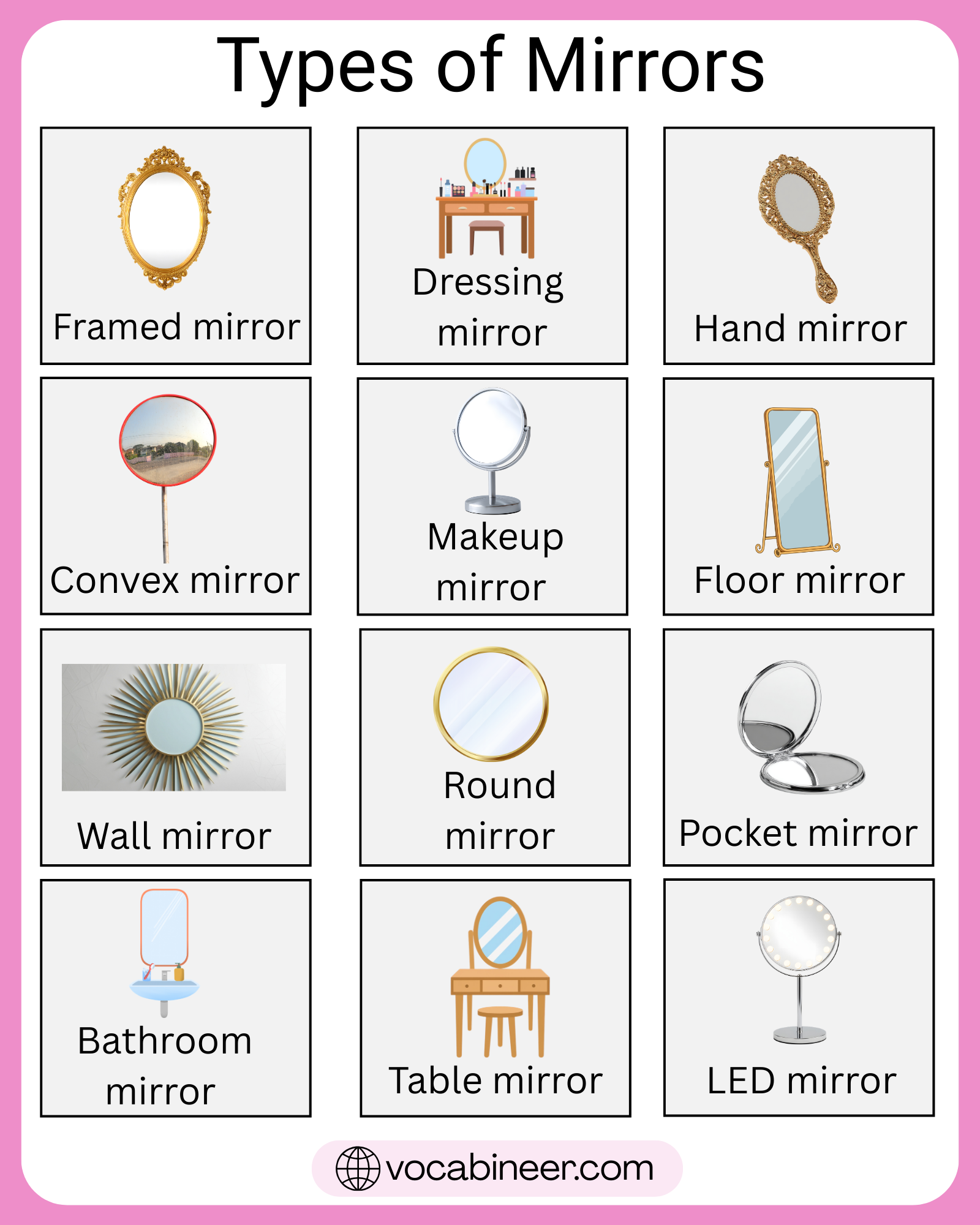
Mirrors come in several types, and each one is known by how it is used or how it looks. Some are named by where they go, while others are named by their shape or design.
- Wall mirror: A mirror designed to hang or mount on a wall.
- Floor mirror: A mirror that stands on the floor, often with a support frame.
- Leaning mirror: A large mirror that rests against a wall instead of hanging.
- Over-the-door mirror: A mirror that hangs over the top of a door.
- Full-length mirror: A tall mirror made to show most or all of the body.
- Vanity mirror: A mirror used for makeup, shaving, and other close-up tasks.
- Accent mirror: A mirror used mainly to add style and visual interest.
- Round mirror: A circular mirror often used for a softer look.
- Oval mirror: An elongated round mirror with a smooth curved shape.
- Square mirror: A mirror with four equal sides for a balanced look.
- Rectangular mirror: A long or wide mirror with straight sides and corners.
- Arched mirror: A mirror with a curved top that adds a softer design detail.
- Framed mirror: A mirror surrounded by a visible frame.
- Frameless mirror: A mirror with no outer frame for a cleaner look.
- Beveled mirror: A mirror with angled edges that create a decorative finish.
Mirror Types and Their Simple Meanings
Simple meanings help readers understand mirror names before comparing shapes, rooms, and styles.
- Wall Mirror — a mirror attached to a wall.
- Floor Mirror — a large mirror placed on or near the floor.
- Full-Length Mirror — a mirror that shows the whole body.
- Dressing Mirror — a mirror used for checking clothes and outfits.
- Standing Mirror — a mirror that stands on its own support.
- Vanity Mirror — a mirror used for grooming or makeup.
- Bathroom Mirror — a mirror used in a bathroom.
- Makeup Mirror — a mirror used for close face reflection.
- Decorative Mirror — a mirror used to improve room style.
- Framed Mirror — a mirror with a frame around it.
- Frameless Mirror — a mirror without a visible frame.
- Over-the-Door Mirror — a mirror that hangs on a door.
Mirror Types and Best Uses
Different mirrors work better for different rooms, activities, wall spaces, and decoration needs.
- Wall Mirror — best for living rooms, bathrooms, hallways, and bedrooms.
- Floor Mirror — best for bedrooms, dressing areas, and large rooms.
- Full-Length Mirror — best for outfit checks and dressing rooms.
- Dressing Mirror — best for wardrobes, closets, and bedrooms.
- Vanity Mirror — best for makeup tables and grooming spaces.
- Bathroom Mirror — best for sink areas and bathroom vanities.
- Makeup Mirror — best for makeup, shaving, skincare, and close grooming.
- Decorative Mirror — best for wall decor and room styling.
- Framed Mirror — best for traditional, rustic, modern, or decorative spaces.
- Frameless Mirror — best for clean bathrooms and minimalist rooms.
- Over-the-Door Mirror — best for small bedrooms, dorm rooms, and rental homes.
- LED Mirror — best for bathrooms, makeup areas, and modern interiors.
Wall, Floor, and Standing Mirror Types
Placement-based mirrors are named by how they are placed, mounted, or supported in a room.
- Wall-Mounted Mirror — fixed directly to a wall.
- Hanging Mirror — hangs from a hook, chain, rope, or wall support.
- Floor Mirror — stands or leans on the floor.
- Leaning Mirror — rests against a wall instead of being fixed tightly.
- Standing Mirror — has legs, a frame, or a base for support.
- Freestanding Mirror — can stand without being attached to a wall.
- Full-Length Mirror — shows the body from head to toe.
- Dressing Mirror — used for checking clothes and appearance.
- Door Mirror — attached to a door surface.
- Over-the-Door Mirror — hangs over the top edge of a door.
- Mirror Wall — a large wall area covered with mirrors.
- Mirror Tiles — small mirror pieces used together on a wall.
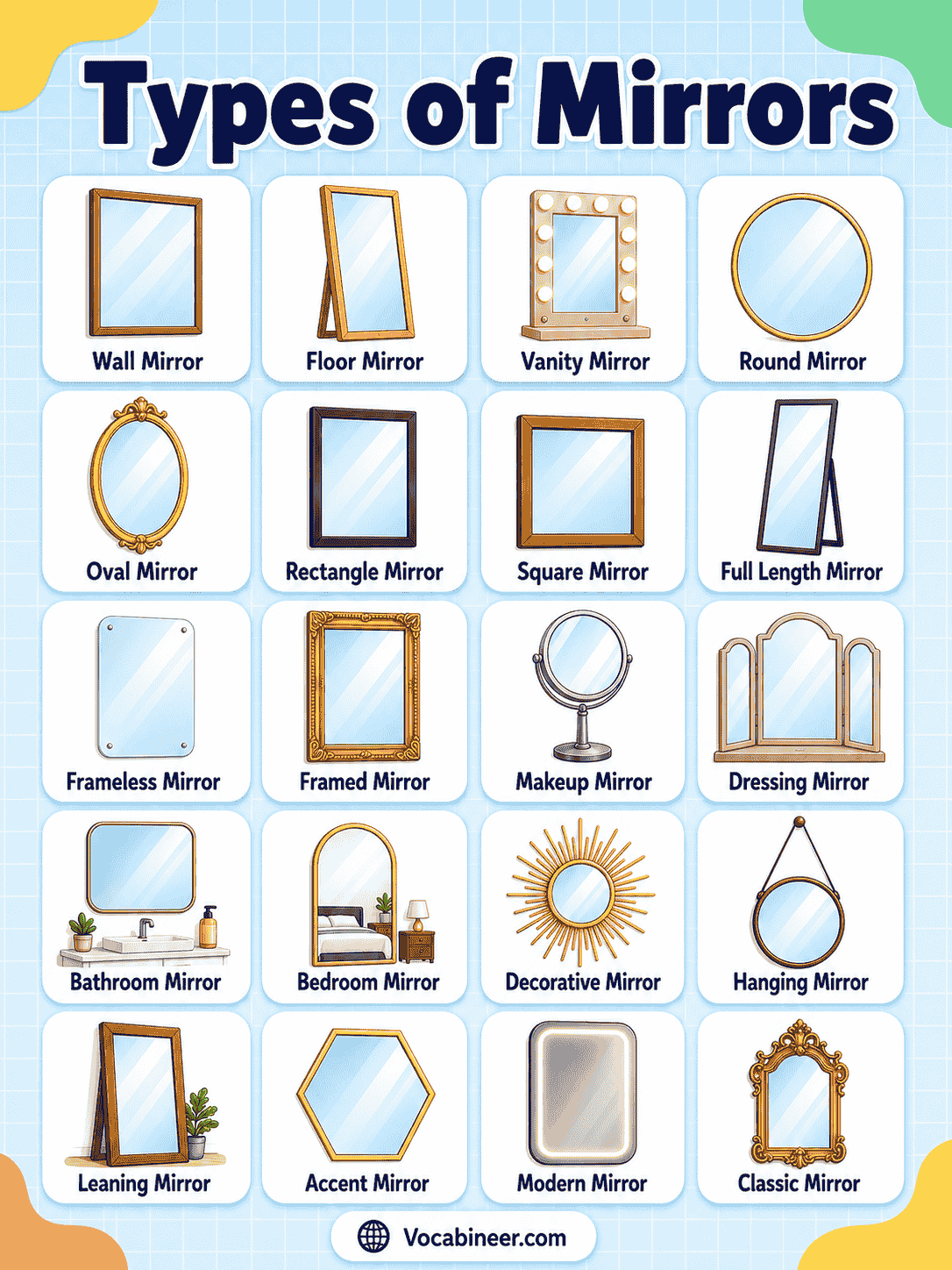
Bathroom and Vanity Mirror Types
Bathroom and vanity mirrors are used for grooming, washing, shaving, makeup, and daily routines.
- Bathroom Mirror — placed above a sink, vanity, or bathroom counter.
- Vanity Mirror — used with a vanity table or bathroom vanity.
- LED Mirror — has built-in LED lighting around or behind the mirror.
- Lighted Mirror — includes visible lights for better face reflection.
- Backlit Mirror — glows from behind for soft lighting.
- Medicine Cabinet Mirror — combines a mirror with hidden storage.
- Pivot Mirror — tilts forward or backward on side supports.
- Magnifying Mirror — enlarges the reflection for close grooming.
- Makeup Mirror — helps with makeup, skincare, and face details.
- Shaving Mirror — used for shaving and close face care.
- Anti-Fog Mirror — resists steam in bathrooms.
- Smart Mirror — may show time, weather, light settings, or digital features.
Mirror Shapes and Design Styles
Mirror shape affects how a room looks and how the mirror fits with furniture, walls, and decor.
- Round Mirror — has a circular shape and soft appearance.
- Oval Mirror — has a long rounded shape.
- Rectangular Mirror — has a classic long or wide shape.
- Square Mirror — has four equal sides and a balanced look.
- Arched Mirror — has a curved top and straight sides.
- Capsule Mirror — has a long rounded capsule shape.
- Wavy Mirror — has soft uneven edges.
- Irregular Mirror — has a freeform or unusual shape.
- Asymmetrical Mirror — has an uneven design that is not perfectly balanced.
- Geometric Mirror — uses shapes such as hexagons, diamonds, or polygons.
- Sunburst Mirror — has rays around the mirror like the sun.
- Heart-Shaped Mirror — has a heart shape, often used for decoration.
Decorative Mirror Types for Home
Decorative mirrors add beauty, light, depth, and personality to home interiors.
- Decorative Mirror — used for both reflection and room style.
- Antique Mirror — has an old, classic, or aged appearance.
- Vintage Mirror — inspired by older design styles.
- Modern Mirror — has a clean and updated look.
- Rustic Mirror — uses wood, natural textures, or farmhouse style.
- Industrial Mirror — often uses metal frames and bold shapes.
- Minimalist Mirror — has a simple design with fewer details.
- Ornate Mirror — has a detailed or carved frame.
- Venetian Mirror — has decorative glass details around the mirror.
- Starburst Mirror — has a star-like frame around the center mirror.
- Gold Mirror — has a gold-colored frame for a rich look.
- Wooden Frame Mirror — has a frame made of wood or wood-like material.
Technical Mirror Types Explained Simply
Technical mirrors are named by how their surface reflects light or how they are used in special places.
- Plane Mirror — a flat mirror that gives a normal reflection.
- Flat Mirror — another name for a mirror with a flat surface.
- Convex Mirror — curves outward and gives a wider view.
- Concave Mirror — curves inward and can magnify reflection.
- Two-Way Mirror — works like a mirror on one side and glass on the other side in certain lighting.
- One-Way Mirror — another common name for a two-way mirror.
- Safety Mirror — designed to reduce danger if broken or used in public areas.
- Security Mirror — helps people see around corners or monitor spaces.
- Non-Reversing Mirror — shows a reflection without the usual left-right reversal.
- Acrylic Mirror — a lightweight plastic mirror often used for safety.
- Glass Mirror — a common mirror made with glass.
- Dental Mirror — a small mirror used by dentists to see inside the mouth.
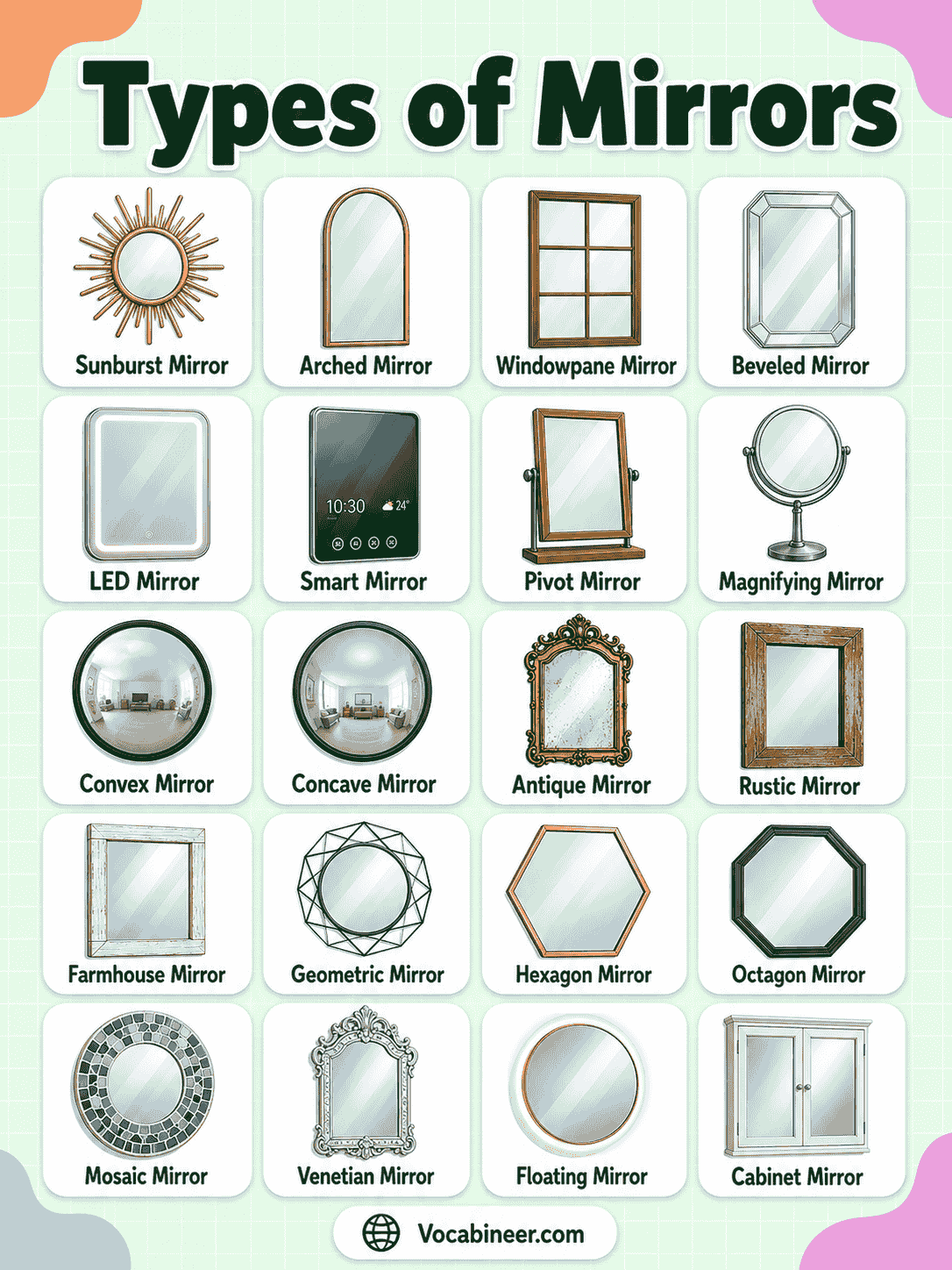
Mirrors for Different Rooms and Places
Room-based mirrors help readers choose the right mirror size, shape, and function for each space.
- Bedroom Mirror — used for dressing, grooming, and room decoration.
- Bathroom Mirror — used near sinks, vanities, and bathroom counters.
- Living Room Mirror — adds style, brightness, and wall decoration.
- Hallway Mirror — helps with quick checks before leaving home.
- Entryway Mirror — placed near the entrance for style and convenience.
- Closet Mirror — used inside or near a closet for outfit checks.
- Dressing Room Mirror — used in dressing areas and clothing spaces.
- Dining Room Mirror — adds light and elegance to dining areas.
- Gym Mirror — helps users check posture and movement.
- Salon Mirror — used for hair, makeup, and beauty services.
- Hotel Mirror — used in rooms, bathrooms, lobbies, and dressing areas.
- Office Mirror — used for decoration, brightness, or small space design.
Mirror Mounting and Installation Types
Mirror mounting affects safety, placement, wall use, and how easily the mirror can be moved.
- Wall-Mounted Mirror — attached securely to a wall.
- Freestanding Mirror — stands without wall support.
- Leaning Mirror — rests against a wall.
- Hanging Mirror — hangs from hooks, ropes, chains, or brackets.
- Door Mirror — fixed to a door.
- Over-the-Door Mirror — hangs over a door without major installation.
- Cabinet Mirror — attached to a storage cabinet or medicine cabinet.
- Adhesive Mirror — sticks to a wall or surface with adhesive backing.
- Mirror Tiles — small mirror squares or shapes attached together.
- Mirror Panel — a larger mirror section used on walls or furniture.
- Pivot Mirror — tilts on side supports.
- Recessed Mirror — fitted into a wall or cabinet space.
Confusing Mirror Terms Explained
Some mirror terms sound similar, but they describe different uses, shapes, placements, or reflection types.
| Mirror Terms | Difference |
|---|---|
| Wall Mirror vs Floor Mirror | A wall mirror hangs on a wall, while a floor mirror stands or leans on the floor. |
| Vanity Mirror vs Bathroom Mirror | A vanity mirror is used for grooming or makeup, while a bathroom mirror is placed in a bathroom. |
| Framed Mirror vs Frameless Mirror | A framed mirror has a border, while a frameless mirror has clean edges without a frame. |
| Convex Mirror vs Concave Mirror | A convex mirror curves outward for a wider view, while a concave mirror curves inward and can magnify. |
| Full-Length Mirror vs Dressing Mirror | Both help show the body or outfit, but a dressing mirror is more directly used for clothing checks. |
| Lighted Mirror vs Backlit Mirror | A lighted mirror has visible lighting, while a backlit mirror glows from behind. |
| One-Way Mirror vs Two-Way Mirror | Both terms are often used for glass that acts like a mirror from one side under certain lighting. |
Types of Mirrors Chart with Pictures
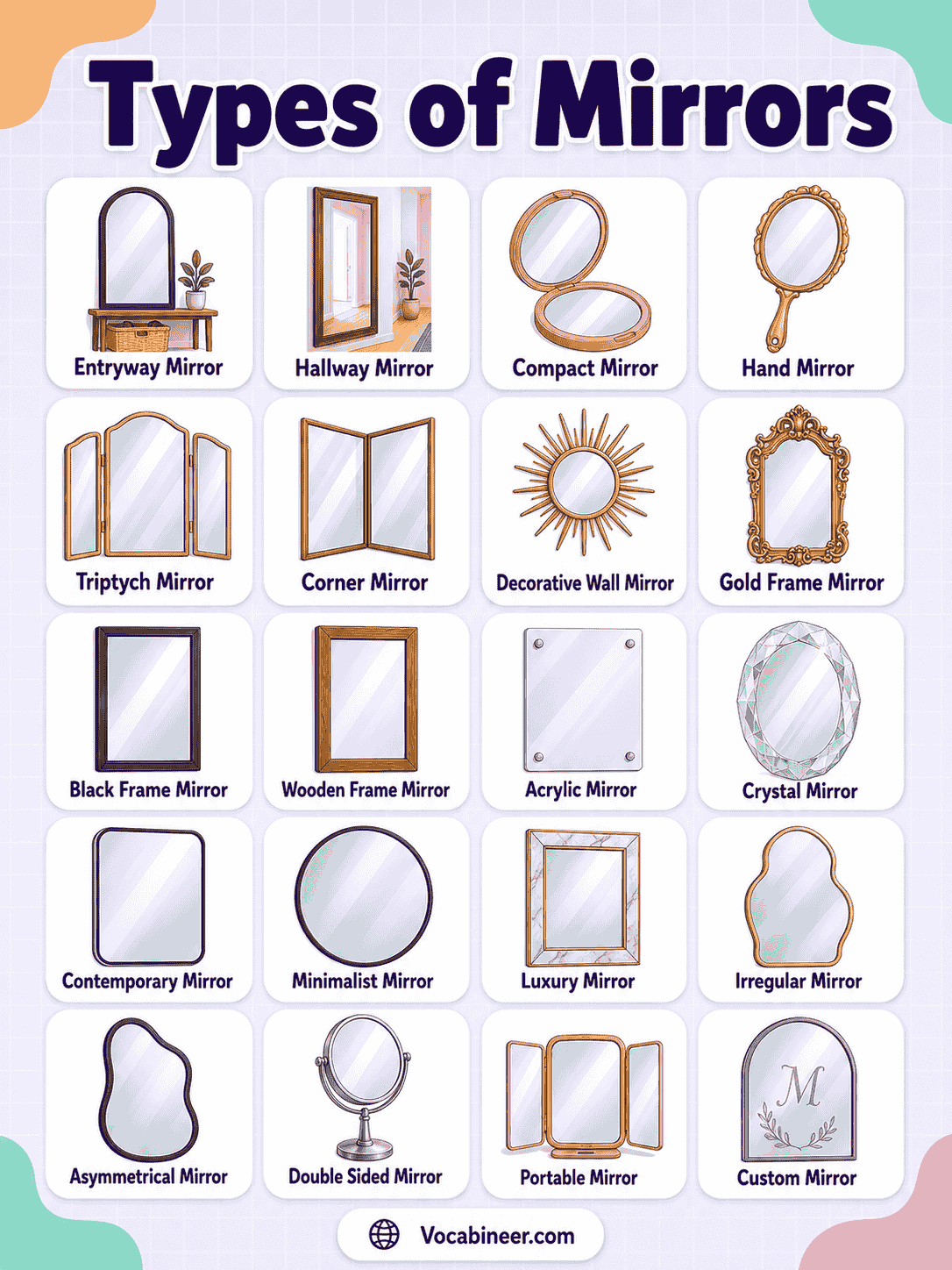
A mirror chart helps readers compare mirror groups quickly by use, place, shape, and examples.
| Mirror Group | Details |
|---|---|
| Wall and Floor Mirrors | Best for: bedrooms, hallways, living rooms, and dressing areas Examples: wall mirror, floor mirror, leaning mirror |
| Bathroom and Vanity Mirrors | Best for: grooming, shaving, makeup, and bathroom use Examples: vanity mirror, LED mirror, medicine cabinet mirror |
| Shape-Based Mirrors | Best for: matching room design and wall shape Examples: round mirror, arched mirror, rectangular mirror |
| Decorative Mirrors | Best for: home decor, wall styling, and room brightness Examples: antique mirror, rustic mirror, sunburst mirror |
| Technical Mirrors | Best for: science, safety, security, and special reflection needs Examples: plane mirror, convex mirror, concave mirror |
| Room-Based Mirrors | Best for: choosing mirrors by location Examples: bedroom mirror, bathroom mirror, hallway mirror |
| Mounting Types | Best for: different installation needs Examples: wall-mounted mirror, hanging mirror, over-the-door mirror |
How to Choose the Right Type of Mirror
Choosing the right mirror depends on the room, wall space, purpose, shape, size, lighting, and style. A full-length mirror works well in bedrooms, closets, and dressing rooms, while a bathroom mirror or vanity mirror is better for grooming. For small spaces, an over-the-door mirror, wall mirror, or frameless mirror can save space and keep the room looking open.
Design also matters. A round mirror can soften a room, while a rectangular mirror gives a classic look. LED, lighted, and backlit mirrors are useful for bathrooms and makeup areas. For decoration, antique, vintage, rustic, modern, ornate, or sunburst mirrors can add style and make a room feel brighter.
FAQs
The main types of mirrors include wall mirrors, floor mirrors, leaning mirrors, over-the-door mirrors, full-length mirrors, vanity mirrors, and shape-based styles.
A full-length mirror is best for full-body viewing because it is tall enough to show most or all of the body.
A framed mirror has a visible border around it, while a frameless mirror has no outer frame and looks simpler.
Identify them by placement, purpose, shape, and design. Most mirror names describe one of these features clearly.
The most common mirror shapes are round, oval, square, rectangular, and arched.
Summary
Types of mirrors are usually grouped by placement, purpose, shape, and design. Common examples include wall mirrors, floor mirrors, full-length mirrors, vanity mirrors, round mirrors, and framed mirrors.
Once you understand these groups, mirror names become much easier to recognize. That also helps you tell one type from another without confusion.
Read More