


If you have ever tried to rhyme music in a chorus and given up, you were not doing it wrong. Music is one of the hardest common words to rhyme in English, because almost nothing matches its exact ending sound. Real songwriters and poets get around this with near rhymes like acoustic and classic, and with phrase rhymes like use it and lose it. Once you know which type to reach for, the word stops fighting you.
In This Page
Does Music Have a Perfect Rhyme?
Music has no everyday perfect rhyme. A perfect rhyme has to match a word from its stressed vowel to the end, and music ends in the sound /juː-zɪk/ with the stress on the first syllable. Rhyming dictionaries confirm it: RhymeZone and Merriam-Webster return only rare or technical words such as muzhik, musick, and word-music, none of which you would use in a normal line.
So the honest answer poets need is this: stop hunting for a perfect rhyme with music and choose a strong near rhyme or a phrase rhyme instead. That is how the word is handled in actual songs.
Why Music Is Hard to Rhyme
The trouble is in the shape of the word. The stress falls on mu-, and the ending -sic is unstressed and quiet. Because the strong beat comes first and the rhyming part comes last as a soft syllable, only two options are open to you: match the faint /ɪk/ ending with another -ic word, or match the fuller /juːz/ sound with a short phrase. Both work. Neither gives you a clean single-word twin, which is exactly why music feels impossible until you switch tactics.
Near Rhymes and Slant Rhymes for Music
Near rhymes, also called slant rhymes, share the -ic ending without matching music exactly. Most modern poets and lyricists rely on them, and readers accept them as rhyme when the line is sung or read aloud. The strongest ones are short, two-syllable words that echo the compact shape of music.
Strongest near rhymes ✅
- Acoustic: the closest in feel, because the oo vowel echoes music before the shared -stic ending.
- Classic: clean and singable, a favorite in pop lyrics.
- Magic: warm and positive, easy to land at a line end.
- Basic: modern and casual, good for conversational lyrics.
- Mystic: moody, works in atmospheric or dreamy lines.
- Tragic: heavier tone for sad or dramatic songs.
- Rustic, comic, tonic, tunic, cubic, public, rubric: solid -ic matches when you need variety.
Wider near rhymes for longer lines
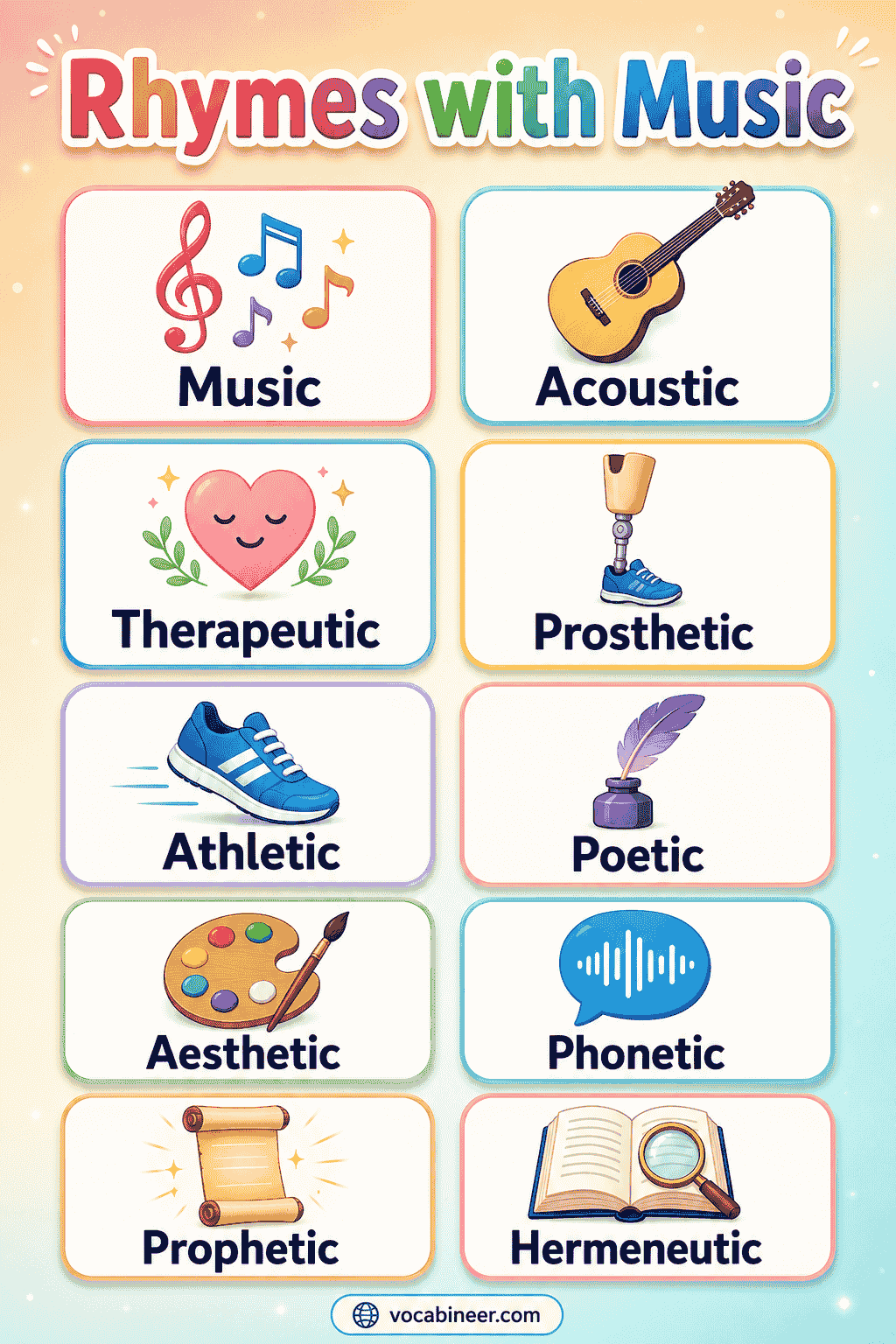
- Poetic, romantic, electric, harmonic, artistic, nostalgic, symphonic, electronic, dramatic, athletic.
Weaker matches to use with care ❌
- Energetic, futuristic, optimistic, automatic, symbolic: these share only the final syllable, so they slip out of rhyme unless the rhythm carries them.
Phrase Rhymes and Mosaic Rhymes for Music
This is the trick most rhyming tools never explain. A mosaic rhyme matches one word against two short words, and it gives music its closest possible partner. Say music and use it back to back and you hear it: /mjuː-zɪk/ against /juːz-ɪt/. The use matches the vowel, and the it answers the soft ending. That echo is stronger than any single -ic word.
Because these phrases sound natural and sing well, they show up constantly in real lyrics.
- Use it
- Lose it
- Choose it
- Move it
- Groove it
- Prove it
- Do it
- Through it
- Fuse it
- View it
Build a line so the phrase falls where the beat wants a rhyme, and the couplet fits together cleanly.
Music Phrases That Sound Right in a Line
These do not rhyme with music. They repeat it. Ending nearby lines on a music phrase makes a refrain feel steady and chant-like, which is why choruses often use the word itself rather than a forced rhyme.
- Live music, soft music, sweet music, loud music
- New music, true music, calm music, dance music
Use them for hooks and repeated lines where the point is the word music, not a rhyme for it.
Rhymes with Music for Songs and Lyrics
Songwriters almost always pick phrase rhymes for music, because a sung line forgives a loose match that a page would not. The use it family fits fast, rhythmic hooks, while a near rhyme like acoustic or electric suits a slower, image-driven line.
- Fast hook: Feel the music, don’t lose it.
- Slower line: A quiet room turns electric with music.
Match the rhyme to the mood: sharp verbs for movement, softer near rhymes for feeling.
Rhymes with Music for Poems
Poems give you more room to slow down, so near rhymes read better here than in a tight chorus. Acoustic, poetic, and nostalgic add meaning as well as sound, which lets the rhyme strengthen the image instead of just closing the line.
- Her voice turned soft and poetic, / carried on a thread of music.
- The old hall still felt nostalgic, / holding the ghost of its music.
Rhymes with Music for Captions and Quotes
Short rhyme lines work well for captions, reels, and song posts, where a small echo makes the words stick.
- Choose music, not noise.
- Feel the music, then use it.
- New music, new mood.
- When words fail, choose music.
- True music never fades.
Rhymes with Music and Their Meanings
Knowing what each rhyme means helps you pick one that fits the tone, not just the sound.
- Acoustic: natural sound, or music played without electronic amplification.
- Classic: traditional and well loved over time.
- Magic: wonder or a sense of the extraordinary.
- Mystic: mysterious, spiritual, or dreamlike.
- Rhythmic: marked by a steady, repeated beat.
- Poetic: having the beauty or feeling of poetry.
- Nostalgic: tied to warm memories of the past.
- Electric: charged with energy and excitement.
- Use it: to put something to work.
- Lose it: to let something slip away, or to lose control.
- Groove it: to move with the rhythm of a beat.
How to Use Rhymes with Music in a Line
Pick your rhyme type by the job the line has to do. Reach for a phrase rhyme when you want a close, natural echo in a sung hook. Reach for a near rhyme when you want the rhyme word to add meaning, as in a poem or a slower verse. And when the point of the line is the word music itself, repeat it rather than force a weak match.
A quick way to test any choice: read the two lines aloud at speed. If the rhyme makes you wince or slows the line, swap in a phrase rhyme or reshape the line so music falls where it does not need a partner.
Example Sentences with Music Rhymes
- If you love the sound, then use it.
- When the beat feels right, choose it.
- Do not lose it when the music takes over.
- Let the rhythm move it.
- A strong beat can make you groove it.
- Good music helps you move through it.
- Soft guitar can sound warm and acoustic.
- The concert felt loud and electric.
- Her song had a poetic, romantic feeling.
- The dance track sounded bright and energetic.
Short Poems Using Rhymes with Music
Phrase rhymes like use it, choose it, and move it read more naturally than a forced single-word rhyme, so they carry a short poem well.
When life feels quiet
When life feels quiet, I choose music. When words feel heavy, I use it.
Feel the beat
Feel the beat, Don’t lose it. Take the moment, Move through it.
Common Mistakes with Music Rhymes
A few habits cause more trouble with music than with most words. Watch for these:
- Calling a loose -ic match a perfect rhyme when music has none.
- Mixing phrase rhymes and single-word rhymes in the same line without a clear rhythm.
- Leaning on weak matches like topic or comic where the sound almost misses.
- Repeating use it, choose it, and lose it so often the song sounds thin.
- Choosing a rhyme that fits the sound but works against the meaning of the line.
Words That Rhyme with Music Chart
| Rhyme type | Best for | Examples |
|---|---|---|
| Phrase rhymes | Sung hooks and fast lines | Use it, lose it, choose it, move it |
| Strong near rhymes | Clean rhyme in songs and poems | Acoustic, classic, magic, basic, mystic |
| Wider near rhymes | Longer, image-rich lines | Poetic, electric, nostalgic, symphonic |
| Music phrases | Refrains built on the word itself | Live music, soft music, new music, true music |
| Weak matches | Playful or flexible lines only | Topic, comic, futuristic, symbolic |
FAQs
Nothing rhymes with music perfectly in everyday English. The words that work are near rhymes like acoustic, classic, magic, basic, and mystic, and phrase rhymes like use it, lose it, and choose it.
No common one. Rhyming dictionaries list only rare words such as muzhik, which you would not use in a normal line. For real writing, a strong near rhyme or a phrase rhyme is the answer.
Acoustic is the closest in feel, followed by classic, magic, basic, mystic, tragic, and rustic. These short -ic words echo the shape of music and stay singable.
The stress falls on the first syllable and the ending -sic is soft and unstressed, so no common word matches it exactly. That leaves near rhymes and phrase rhymes as the practical options.
Use a mosaic rhyme, which matches music against two short words like use it or lose it. The use carries the vowel and the it answers the ending, giving you the closest echo available.
In lyrics, most writers use phrase rhymes such as use it, move it, and groove it, because a sung line carries a loose match easily. Near rhymes like electric and acoustic work well in slower verses.
Read More