

Birds are beautiful animals found in many parts of the world. Some birds live near homes, some live in forests, some swim in water, and some cannot fly at all. Learning birds names helps students, children, and English learners understand animal vocabulary in simple English.
In this article, you will learn birds names in English through clear and practical categories. You will also learn common bird names, different types of birds, and many useful bird words often seen in books, schools, nature lessons, and daily life.
In This Page
What Are Birds?
Birds are animals with feathers, wings, and beaks. Most birds can fly, although some cannot. They also lay eggs, and many of them build nests in trees, on the ground, or in other safe places.
Some birds live near people, while others live in forests, oceans, rivers, or open fields. In this topic, the focus stays on common bird names and useful groupings, so readers can learn the vocabulary in a clear and organized way.
Common Birds Names
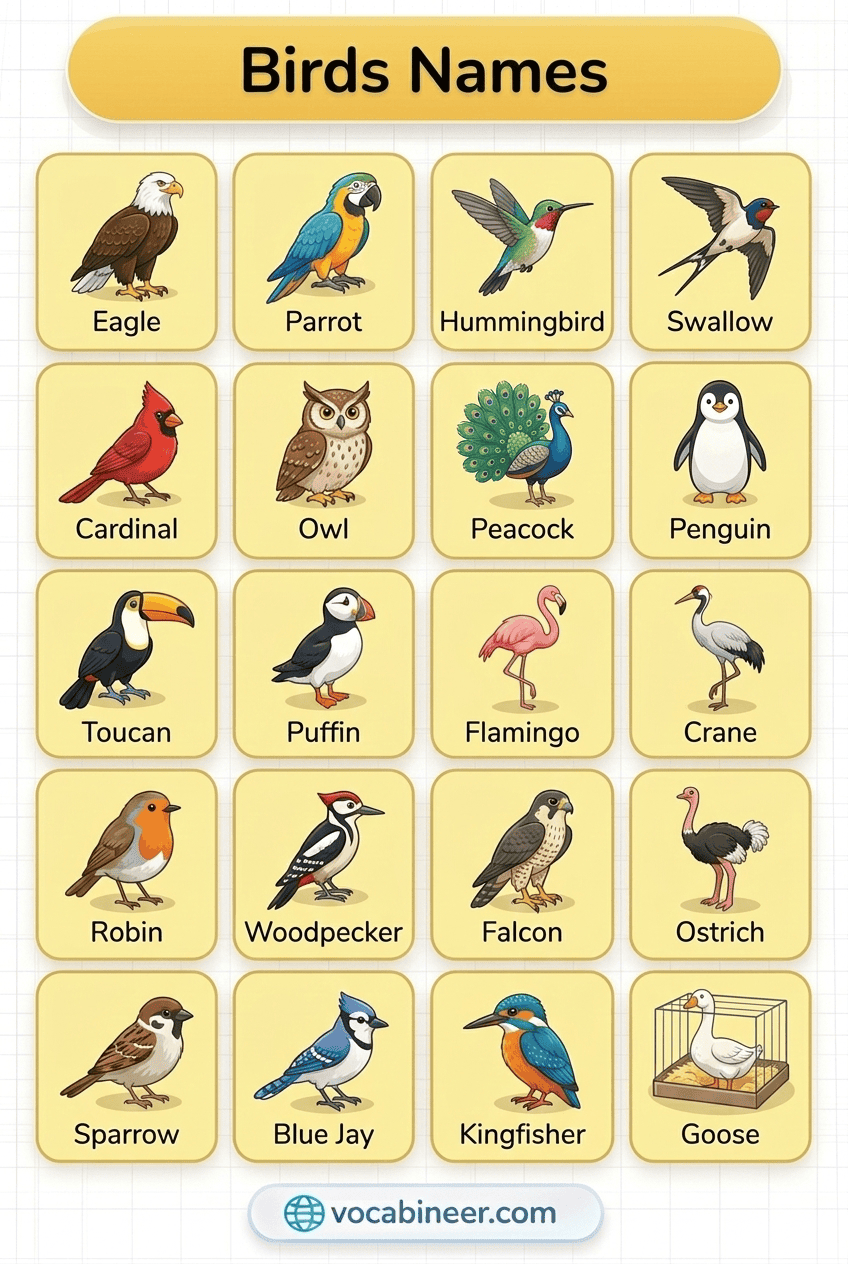
Many birds are easy to recognize because of their size, color, beak shape, or way of flying. Some are kept as pets, some live on farms, and others are seen in cities, gardens, lakes, or wild places. Together, they make bird vocabulary rich and useful for learners.
- Sparrow
- Pigeon
- Crow
- Parrot
- Peacock
- Eagle
- Owl
- Hawk
- Falcon
- Duck
- Goose
- Swan
- Hen
- Rooster
- Turkey
- Penguin
- Ostrich
- Flamingo
- Pelican
- Seagull
- Kingfisher
- Woodpecker
- Robin
- Dove
- Canary
- Macaw
- Toucan
- Vulture
- Crane
- Heron
Farm Birds Names
Farm birds are birds commonly kept on farms for eggs, meat, or general care. Some are large and noisy, while others are smaller and calmer. Because people often see them in daily life, these names are useful for basic English vocabulary.
- Hen: A female chicken commonly kept for eggs.
- Rooster: A male chicken known for its loud crowing.
- Chick: A baby chicken with soft feathers.
- Duck: A water bird often raised on farms.
- Goose: A large farm bird with a long neck.
- Turkey: A heavy farm bird with a broad body.
- Guinea fowl: A spotted farm bird known for its loud call.
- Quail: A small bird that may be raised on farms.
- Pheasant: A colorful bird sometimes kept or raised in farm settings.
- Peafowl: A large bird group that includes the peacock and peahen.
Pet Birds Names
Pet birds are birds people keep at home for company, beauty, or sound. Some are small and gentle, while others are colorful and active. As a result, these bird names are very common in beginner vocabulary lists.
- Parrot: A colorful bird with a curved beak.
- Canary: A small pet bird known for its singing.
- Budgie: A small parrot often kept as a pet.
- Cockatiel: A pet bird with a crest on its head.
- Lovebird: A small bright parrot often kept in pairs.
- Macaw: A large colorful parrot with a long tail.
- Cockatoo: A parrot known for its head crest.
- Finch: A small active bird often kept in cages.
- Mynah bird: A bird known for copying sounds in some cases.
- Dove: A gentle bird that some people keep as a pet.
Garden and City Birds Names
Garden and city birds are birds people often see near homes, parks, streets, trees, and buildings. Some are small songbirds, while others are larger and more familiar in towns and urban areas. Because they are easy to spot, these names are helpful for everyday learning.
- Sparrow: A small common bird often seen near homes and gardens.
- Pigeon: A familiar city bird often seen in groups.
- Crow: A black bird known for intelligence and loud calls.
- Robin: A small bird often seen in gardens and trees.
- Dove: A soft-looking bird often seen in parks and neighborhoods.
- Myna: A common bird in many towns and city areas.
- Blackbird: A dark bird often found in gardens and wooded areas.
- Magpie: A black-and-white bird known for its long tail.
- Starling: A small dark bird often seen in noisy flocks.
- Woodpecker: A bird that pecks tree trunks in parks and gardens.
Birds of Prey Names
Birds of prey are strong hunting birds with sharp beaks, keen eyesight, and powerful claws. They usually catch smaller animals for food, so they are also called hunting birds or raptors. Because of their size and strength, they are some of the most impressive birds in English vocabulary.
- Eagle: A large bird of prey with powerful wings and sharp eyesight.
- Hawk: A hunting bird known for quick flight and strong claws.
- Falcon: A fast bird of prey with pointed wings.
- Owl: A bird of prey known for large eyes and silent flight.
- Vulture: A large bird that feeds on dead animals.
- Kite: A light, graceful bird of prey often seen gliding in the sky.
- Harrier: A bird of prey that flies low while hunting.
- Buzzard: A broad-winged bird of prey found in many regions.
- Osprey: A fish-eating bird of prey often seen near water.
- Condor: A very large soaring bird related to vultures.
Water and Sea Birds Names
Water and sea birds live near rivers, lakes, ponds, wetlands, beaches, or oceans. Some swim well, while others wade through shallow water or fly over the sea. As a result, they form an important group in bird-name learning.
- Duck: A common water bird with a broad beak.
- Goose: A large water bird with a long neck.
- Swan: A graceful water bird with a long neck.
- Pelican: A large bird with a pouch under its beak.
- Seagull: A bird often seen near the sea and beaches.
- Flamingo: A tall bird with long legs and pink feathers.
- Heron: A long-legged bird often seen near rivers and ponds.
- Crane: A tall bird with long legs and a long neck.
- Kingfisher: A bright bird known for catching fish.
- Cormorant: A dark water bird that dives for fish.
Wild and Exotic Birds Names
Wild and exotic birds are birds known for their unusual colors, shapes, habitats, or behaviors. Some live deep in forests, while others are famous for their striking feathers or special beaks. Therefore, this group makes bird vocabulary more colorful and interesting.
- Peacock: A famous bird known for its large colorful tail.
- Toucan: A tropical bird with a large colorful beak.
- Macaw: A large bright parrot with a long tail.
- Cockatoo: A parrot known for its head crest.
- Hornbill: A bird with a long curved bill.
- Flamingo: A striking bird with pink feathers and long legs.
- Parrot: A colorful bird often linked with tropical regions.
- Bird-of-paradise: A bird famous for bright feathers and display behavior.
- Cassowary: A large wild bird with a strong body and helmet-like crest.
- Hoopoe: A bird known for its fan-shaped crest.
Birds Names for Kids
Birds names for kids should be simple, familiar, and easy to remember. So, this section focuses on birds children often see in picture books, school charts, cartoons, farms, gardens, and parks. These names are useful for early vocabulary learning.
- Sparrow
- Pigeon
- Crow
- Parrot
- Peacock
- Duck
- Goose
- Swan
- Hen
- Rooster
- Chick
- Turkey
- Owl
- Eagle
- Penguin
- Ostrich
- Flamingo
- Dove
- Robin
- Woodpecker
- Canary
- Macaw
- Toucan
- Seagull
- Pelican
- Crane
- Heron
- Kingfisher
- Falcon
- Hawk
Big and Small Birds Names
Birds come in different sizes. Some are very large and strong, while others are tiny and light. This grouping makes birds names easier to compare and remember.
Big Birds Names
- Ostrich: One of the largest birds in the world.
- Emu: A large bird with long legs and a strong body.
- Cassowary: A heavy wild bird with a powerful body.
- Turkey: A large farm bird with a broad body.
- Peacock: A large bird known for its colorful tail.
- Swan: A large water bird with a long neck.
- Pelican: A big bird with a large beak pouch.
- Crane: A tall bird with long legs and a long neck.
- Heron: A long-legged bird often seen near water.
- Eagle: A large bird of prey with wide wings.
Small Birds Names
- Sparrow: A very common small bird.
- Canary: A small singing bird often kept as a pet.
- Finch: A tiny active bird with a short beak.
- Robin: A small bird often seen in gardens.
- Budgie: A small pet parrot.
- Lovebird: A small colorful parrot.
- Myna: A small to medium bird often seen in towns.
- Kingfisher: A small bright bird with a pointed beak.
- Starling: A small dark bird often seen in flocks.
- Dove: A smaller gentle bird often seen near people.
Flightless Birds Names
Most birds can fly, but some birds cannot. These birds are called flightless birds. Even though they do not fly, many of them run fast, swim well, or have strong bodies that help them survive.
- Ostrich: A very large flightless bird that can run fast.
- Emu: A tall flightless bird from Australia.
- Cassowary: A heavy flightless bird with a strong body.
- Penguin: A bird that cannot fly but swims very well.
- Kiwi: A small flightless bird with a long beak.
- Rhea: A large flightless bird found in South America.
- Tinamou: A ground bird with weak flight ability, often grouped close to flightless birds in simple learning content.
Birds and Their Babies
Birds and their babies are useful to learn together because many young birds have simple names that are easy to remember. In most cases, baby birds are called chicks, although some birds also have more specific names in everyday English.
- Hen — Chick
- Duck — Duckling
- Goose — Gosling
- Swan — Cygnet
- Turkey — Poult
- Pigeon — Squab
- Dove — Squab
- Owl — Owlet
- Eagle — Eaglet
- Falcon — Chick
- Hawk — Chick
- Parrot — Chick
- Canary — Chick
- Penguin — Chick
- Ostrich — Chick
- Peacock — Peachick
- Pelican — Chick
- Seagull — Chick
- Woodpecker — Chick
- Robin — Chick
Most Popular Birds Names
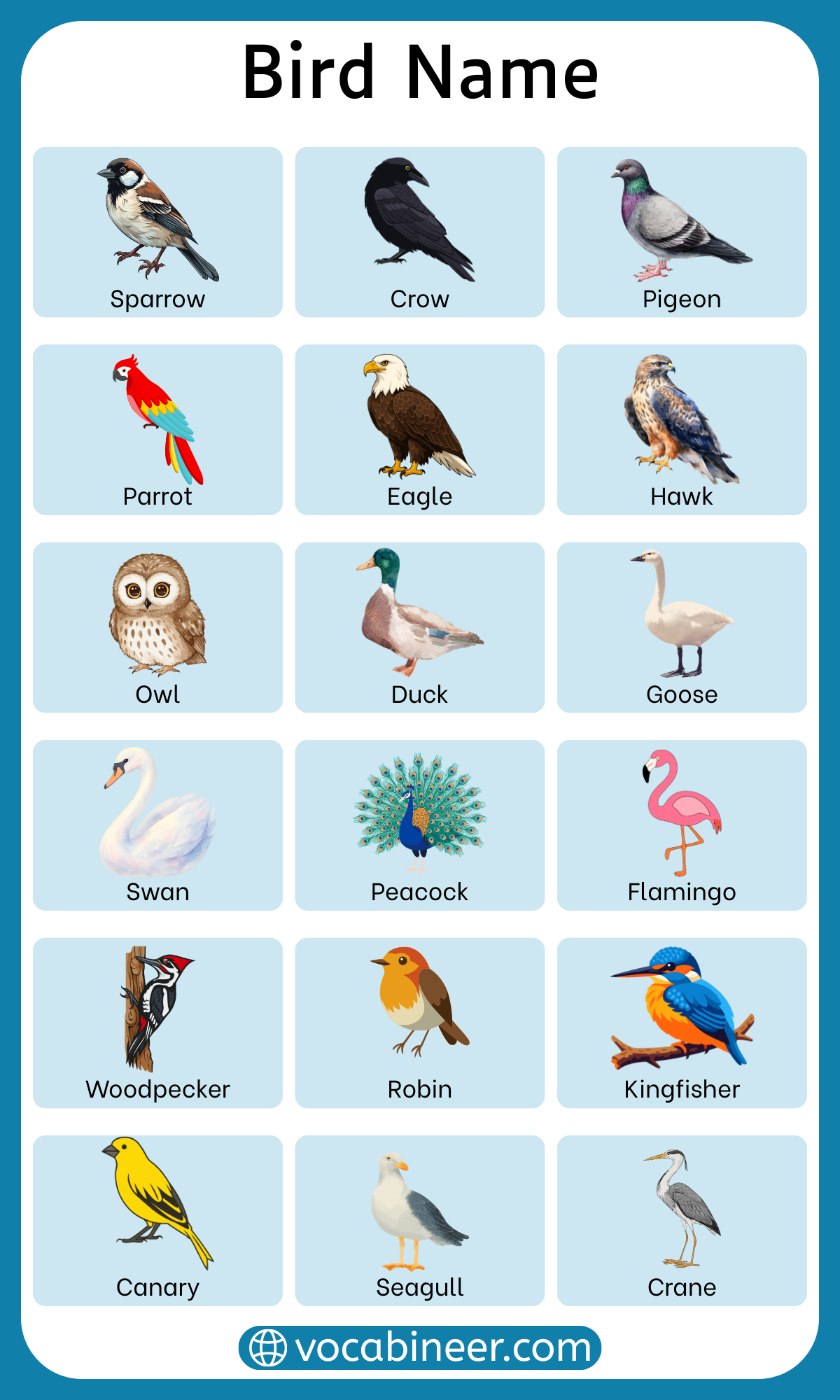
Some birds are more popular than others because people see them often in daily life, on farms, in parks, near water, or in storybooks and learning charts. As a result, these are usually the first bird names learners remember.
- Sparrow: A very common bird seen near homes and gardens.
- Pigeon: A familiar city bird often seen in groups.
- Crow: A well-known black bird with a loud call.
- Parrot: A popular colorful bird often kept as a pet.
- Peacock: A famous bird known for its bright tail feathers.
- Eagle: A strong bird of prey that many learners know.
- Owl: A popular bird known for its large eyes and night activity.
- Duck: A common water bird seen on farms and ponds.
- Swan: A graceful bird that is easy to recognize.
- Penguin: A very famous bird because of its walk and swimming style.
- Ostrich: A well-known large flightless bird.
- Flamingo: A popular bird because of its pink color and long legs.
- Woodpecker: A bird many people know because it pecks trees.
- Robin: A familiar small garden bird.
- Canary: A popular small singing pet bird.
Bird Names A to Z
Here are some bird names from A to Z:
- A – Albatross
- B – Bulbul
- C – Crow
- D – Dove
- E – Eagle
- F – Falcon
- G – Goose
- H – Heron
- I – Ibis
- J – Jay
- K – Kingfisher
- L – Lovebird
- M – Myna
- N – Nightjar
- O – Owl
- P – Parrot
- Q – Quail
- R – Robin
- S – Sparrow
- T – Toucan
- U – Umbrellabird
- V – Vulture
- W – Woodpecker
- X – Xantus’s hummingbird
- Y – Yellowhammer
- Z – Zebra finch
Pet Birds vs Wild Birds
Pet birds and wild birds are both birds, but they live in different conditions. Unlike pet birds, which usually live with people in homes or cages, wild birds live freely in nature. This contrast helps learners understand bird names more clearly.
Here is a simple table showing the difference between pet birds and wild birds.
| Feature | Pet Birds | Wild Birds |
|---|---|---|
| Meaning | Birds kept by people at home | Birds that live freely in nature |
| Living place | Homes, cages, aviaries | Forests, gardens, cities, rivers, seas, and fields |
| Human care | Depend on people for food and care | Find their own food and shelter |
| Common examples | Parrot, canary, budgie, cockatiel, lovebird | Sparrow, crow, eagle, owl, hawk, heron |
| Behavior | Often trained or used to humans | Usually live and survive on their own |
| Main use in learning | Common in pet and home vocabulary | Common in nature and wildlife vocabulary |
FAQs
Birds are animals with feathers, wings, and beaks. Most birds can fly, and they lay eggs in nests or other safe places.
Common birds names are sparrow, pigeon, crow, parrot, peacock, eagle, owl, duck, swan, and robin.
Common pet birds include parrot, canary, budgie, cockatiel, lovebird, macaw, cockatoo, finch, and dove.
Pet birds live with people and receive human care, while wild birds live freely in natural habitats and find their own food.
Easy birds names for kids include sparrow, pigeon, parrot, duck, goose, swan, hen, owl, eagle, and penguin.
Conclusion
Birds names help readers learn many common birds seen in daily life, on farms, near water, in cities, and in the wild. These names become easier to understand when they are grouped into clear categories such as pet birds, water birds, birds of prey, and flightless birds.
At the same time, sections like birds for kids, baby bird names, and the pet birds vs wild birds table make the topic more complete and easier to remember. This kind of organized learning is especially useful for kids, beginners, and ESL learners.
Read More