

Fruits that start with M range from familiar favorites such as mango, mandarin, mulberry, and muskmelon to tropical fruits with very different colors, shapes, and textures. Some have smooth skins and juicy flesh, while others develop thick rinds, clustered berries, or large central seeds.
This article covers 34 carefully selected M fruit names with concise descriptions, visual details, alternative names, and clearly labeled varieties. It also explains commonly confused names such as mamey sapote and mammee apple, as well as mango and mangosteen.
In This Page
Tropical and Unusual Fruits That Start With M
Fruits that start with the letter M include tropical varieties, berries, melons, and regional fruits with unusual shapes, flavors, and textures. Learning these M fruit names helps children and English learners expand food vocabulary and recognize less familiar fruits more easily.
Mangosteen
Mangosteen has a thick purple rind and soft white segmented flesh. Its juicy pulp tastes sweet, slightly tangy, and delicately floral.
Marang
Marang is a tropical fruit related to jackfruit and breadfruit. Its soft white flesh surrounds the seeds and has a sweet, creamy aroma.
Mammee Apple
Mammee apple is a large tropical fruit with thick brown skin and firm orange flesh. Its flavor can taste sweet, aromatic, and slightly tangy.
Mamey Sapote
Mamey sapote has rough brown skin and dense orange-red flesh. Its smooth texture and sweet flavor often resemble pumpkin, sweet potato, or caramel.
Miracle Fruit
Miracle fruit is a small red berry known for temporarily changing how sour foods taste. After eating it, acidic foods can seem noticeably sweeter.
Monstera Fruit
Monstera deliciosa produces a long green fruit covered with small scales. Fully ripe flesh tastes sweet and often reminds people of pineapple and banana.
Malay Apple
Malay apple is a bell-shaped tropical fruit with glossy red, pink, or white skin. Its crisp juicy flesh has a mild, refreshing sweetness.
Mountain Apple
Mountain apple is another name used for certain Syzygium fruits with shiny red skin and crisp flesh. The fruit has a light floral aroma and mildly sweet taste.
Marionberry
Marionberry is a dark purple blackberry cultivar with soft juicy flesh. Its rich flavor combines sweetness with noticeable tartness.
Maqui Berry
Maqui berries are small dark purple fruits from South America. Their juicy flesh has a tart flavor and intense natural coloring.
Maypop
Maypop is a passion fruit with green to yellow skin and aromatic pulp surrounding many seeds. Its flavor is tangy, tropical, and mildly sweet.
Medlar
Medlar is a small brown fruit that becomes soft and edible after ripening fully or undergoing bletting. Its mature flesh has a sweet, spiced flavor.
Melon Pear
Melon pear, also called pepino, has pale yellow skin with purple streaks and soft juicy flesh. Its flavor often combines melon and cucumber notes.
Mexican Plum
Mexican plum is a small round fruit that turns red, purple, or dark blue as it ripens. Its juicy flesh ranges from tart to sweet.
Mexican Sour Gherkin
Mexican sour gherkin is a tiny fruit that resembles a miniature watermelon. Its crisp flesh tastes like cucumber with a mild citrus-like tang.
Muscadine Grape
Muscadine grapes have thick skins and juicy flesh with a strong, distinctive aroma. They can appear bronze, red, purple, or nearly black.
Moro Blood Orange
Moro blood orange has orange skin and deep red to burgundy flesh. Its juicy interior combines citrus sweetness with berry-like notes.
Murcott Mandarin
Murcott mandarin has thin orange skin and richly flavored juicy segments. Its taste is very sweet with noticeable citrus acidity.
Makrut Lime
Makrut lime has rough, wrinkled green skin and strongly aromatic oils. People mainly use its peel and leaves for flavoring rather than eating the fruit fresh.
Mango Plum
Mango plum is a regional name used for certain fruits with plum-like shape and tropical flavor. Depending on the variety, the flesh can taste sweet, tart, or mildly aromatic.
M Fruits and Their Key Features
M includes tropical tree fruits, berries, citrus, melons, and several regional fruits from Africa, Asia, Australia, and the Americas. The descriptions below focus on appearance, flavor, texture, or naming details that help distinguish each fruit.
Mabolo
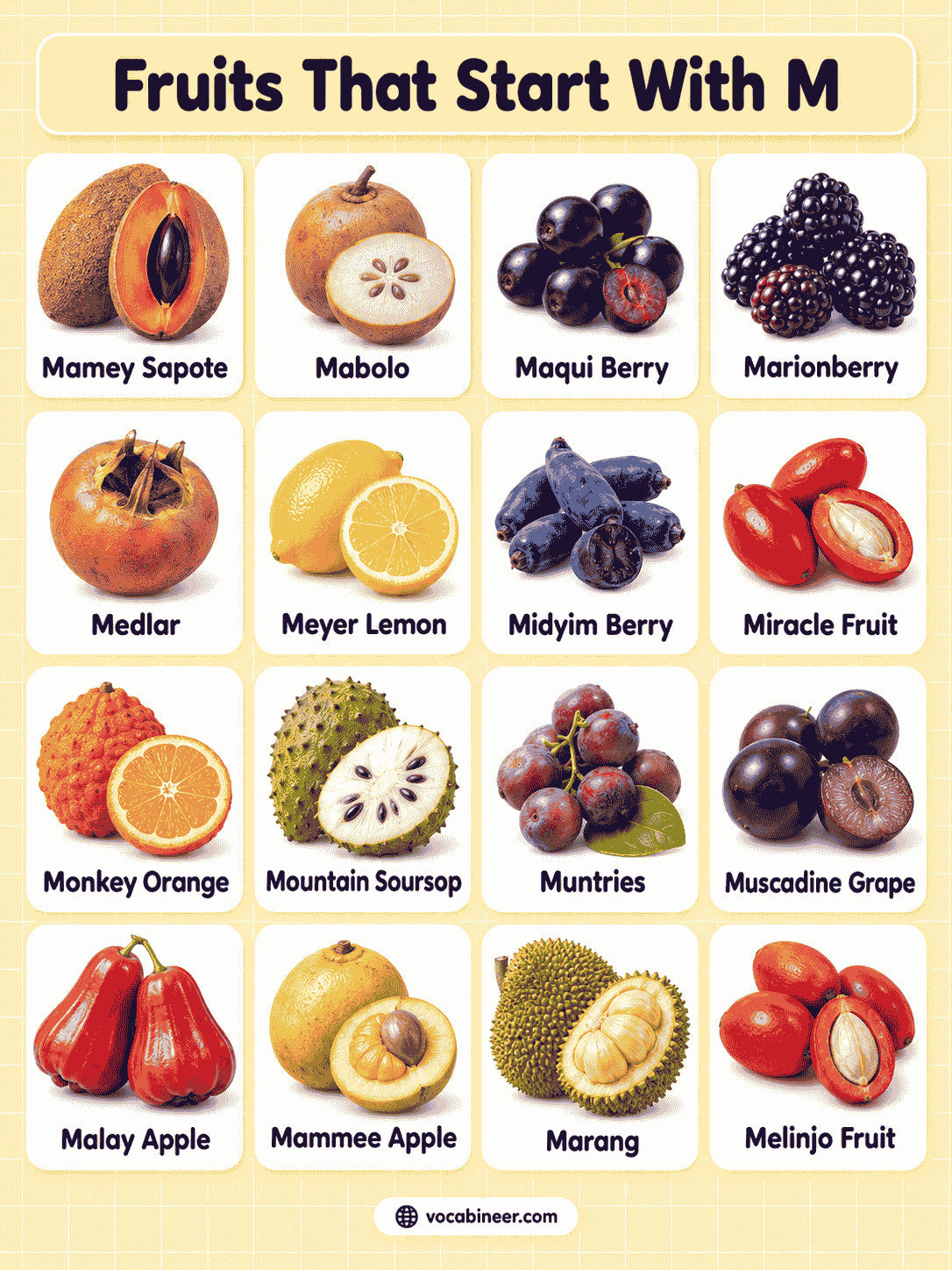
Mabolo, also called velvet apple, develops reddish-brown skin with a noticeably velvety surface. The pale flesh inside has a soft texture, while Kew treats Diospyros mabolo as a synonym of the accepted Diospyros blancoi.
Malay Apple
Malay apple produces smooth bell-shaped or pear-like fruits that may appear deep red, pink, pale yellow, or whitish. Crisp, watery flesh gives the fruit a refreshing texture.
Mamey Sapote
Mamey sapote has rough brown skin surrounding dense orange to reddish flesh and a large dark seed. Kew records mamey sapote among the common names for Pouteria sapota, an edible tropical American fruit.
Mammee Apple
Mammee apple develops a large round to oval fruit with rough russet-brown skin and firm yellowish flesh. It belongs to Mammea americana, not the same species or family as mamey sapote.
Mamoncillo
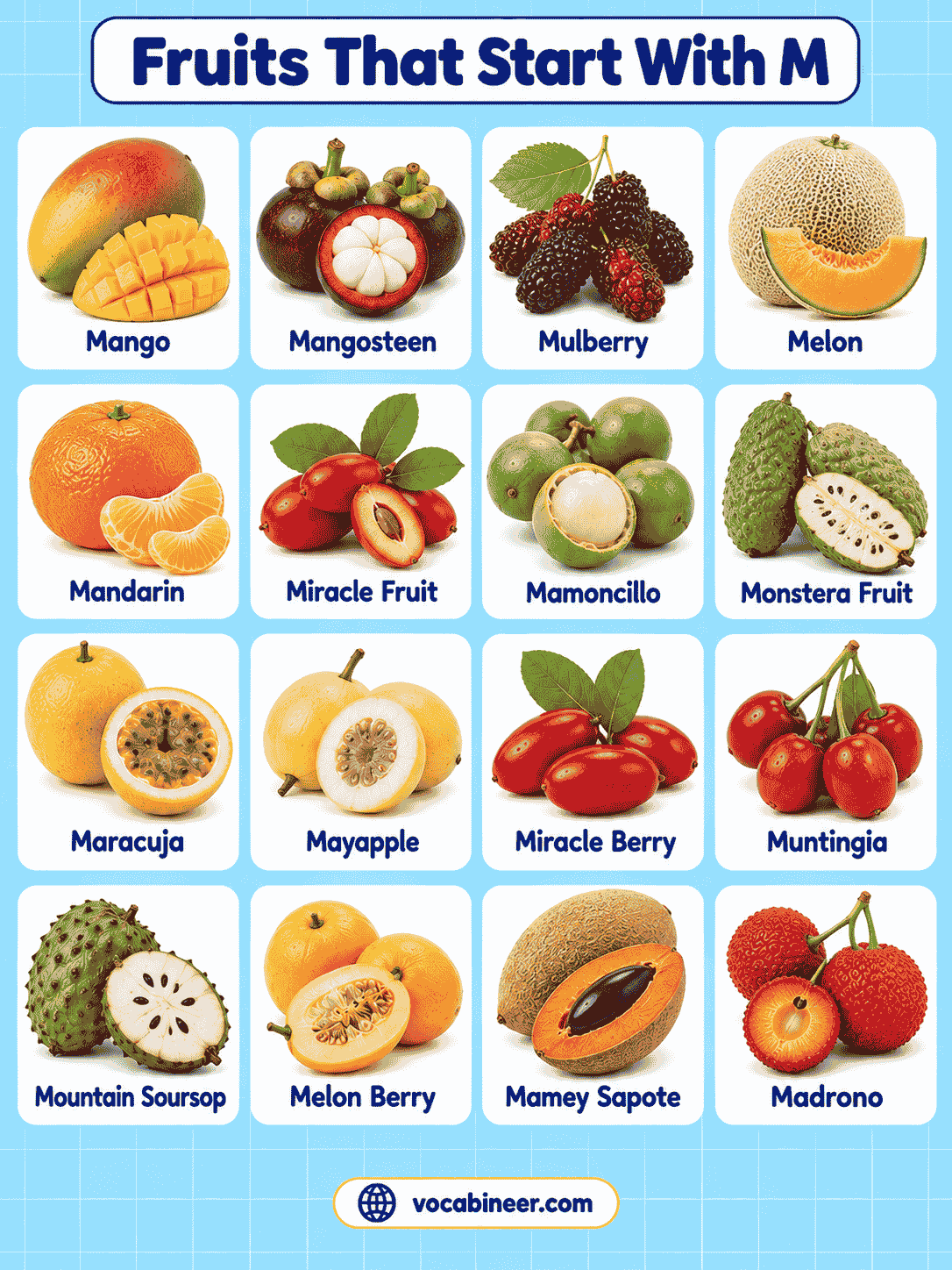
Mamoncillo produces small green fruits with pale, juicy pulp surrounding a large seed. Many regions also use names such as quenepa or genip for the same fruit.
Mandarin Orange
Mandarin orange has an easy-to-peel rind, flattened round shape, and sweet juicy segments. Depending on the type, its skin ranges from yellow-orange to deep orange.
Mangaba
Mangaba is a South American fruit from Hancornia speciosa. The fruit develops soft edible flesh, while Kew records mangaba among the species’ common names.
Mango
Mango varies greatly in size, shape, and skin color, with green, yellow, orange, and red forms all common. Most fruits contain juicy yellow-orange flesh around one large flat stone.
Mangosteen
Mangosteen has a thick purple rind that opens to reveal soft white segments. Its appearance differs completely from mango despite the similarity between the two English names.
Maqui Berry
Maqui berry is a small dark-purple fruit associated with southern South America. Its deep color and round berry-like form make it easy to distinguish from larger M fruits.
Marang
Marang grows on an Artocarpus tree related to jackfruit and breadfruit. Its greenish rind has a rough, spiny-looking texture, while the interior contains soft pale edible sections.
Marula
Marula produces yellow round or egg-shaped fruits with juicy flesh around a hard stone. Kew describes the African fruit as yellow and about 2.5–5 centimeters across.
Mayhaw
Mayhaw is a small red hawthorn fruit associated particularly with the southern United States. The round fruits have tart flesh and often resemble tiny crabapples.
Maypop
Maypop is an edible passionfruit relative with a rounded green to yellowish fruit. Inside, many seeds sit within juicy pulp, much like other passionfruits.
Medlar
Medlar develops a brown fruit with a wide, open calyx that creates a distinctive star-like end. The firm fruit softens significantly as it reaches the stage traditionally used for eating.
Mexican Plum
Mexican plum produces small round to oval fruits that mature from yellow or red toward darker purple shades. A thin skin surrounds juicy flesh and a central stone.
Midgen Berry
Midgen berry is a small Australian native fruit with pale whitish berries marked by tiny darker spots. The Australian National Botanic Gardens identifies Austromyrtus dulcis as Midgen Berry and describes its small edible fruits.
Miracle Fruit
Miracle fruit produces small red berries on a West African shrub. The fruit contains a compound that temporarily changes the way sour foods taste, which explains its unusual common name. Kew recognizes miracle fruit for Synsepalum dulcificum.
Monkey Orange
Monkey orange refers to edible fruits from African Strychnos trees. The fruits typically have a firm yellow to orange shell that protects soft pulp and numerous seeds inside.
Mora de Castilla
Mora de Castilla is an Andean blackberry-type fruit with clustered drupelets that deepen from red toward dark purple. Kew records mora de Castilla among regional names associated with Rubus glaucus.
Moriche Palm Fruit
The moriche palm, Mauritia flexuosa, produces reddish-brown fruits with a scale-like exterior. People in tropical South America use the fruit for food, and Kew records moriche among regional names for the palm.
Mortiño
Mortiño is a small Andean fruit associated with Vaccinium floribundum. The dark berry-like fruits resemble small blueberries, and Kew records mortiño among regional names for the species.
Mountain Papaya
Mountain papaya is a papaya relative that grows naturally in Andean regions. Its elongated yellow fruit contains edible flesh and numerous seeds; Kew records mountain papaya as an English common name for Vasconcellea pubescens.
Mountain Soursop
Mountain soursop, Annona montana, produces green fruits with soft pulp and belongs to the same broader group as other Annona fruits. Kew records mountain soursop as an English common name and confirms food use.
Mulberry
Mulberries form elongated clusters of many small drupelets and may ripen to red, purple, black, or pale colors depending on the species. Their shape often resembles a stretched blackberry.
Muscadine Grape
Muscadine grapes are large round grapes with relatively thick skins. Cultivars can produce bronze, purple, or nearly black fruit, and North Carolina Extension recognizes Muscadine Grape as a common name for Vitis rotundifolia.
Muskmelon
Muskmelon includes fragrant Cucumis melo fruits with sweet, juicy flesh. Depending on the type, the rind may appear smooth, ribbed, or heavily netted.
Named Fruit Varieties Beginning With M
The next seven names identify established cultivars or named fruit varieties rather than seven independent fruit species. Separating them keeps the 34-name total transparent.
Marionberry
Marionberry is the common name for the Marion trailing blackberry cultivar developed in Oregon. Its dark-purple fruits have an elongated blackberry form; Oregon State identifies Marion specifically as a blackberry cultivar.
Macoun Apple
Macoun is an apple cultivar with deep red coloring over a green background and crisp, juicy flesh. The fruit typically combines sweetness with noticeable acidity.
McIntosh Apple
McIntosh produces round apples with green skin heavily flushed or covered with red. Its tender white flesh has a juicy, aromatic character.
Meyer Lemon
Meyer lemon is a named citrus type with a rounder shape, smoother yellow-orange skin, and a generally less sharply acidic flavor than many standard lemons.
Minneola Tangelo
Minneola tangelo develops bright orange skin and a characteristic raised neck near the stem. Its juicy flesh combines sweet and tart citrus flavors.
Moro Blood Orange
Moro is a blood orange cultivar whose flesh can develop deep red to burgundy pigmentation. The outer rind may also show reddish coloring as the fruit matures.
Merlot Grape
Merlot is a dark-skinned wine-grape cultivar that produces compact clusters of small blue-black grapes. It belongs in the variety section rather than the main species-level list.
Mamey Sapote vs. Mammee Apple
Their similar names often cause confusion, but mamey sapote and mammee apple are unrelated fruits from different plant families.
| Feature | Mamey Sapote | Mammee Apple |
|---|---|---|
| Scientific name | Pouteria sapota | Mammea americana |
| Shape | Oval to elongated | Round to oval |
| Skin | Rough brown | Thick, rough, russet-brown |
| Flesh | Orange to reddish | Yellow to orange |
| Texture | Dense and creamy | Firm and juicy |
| Same fruit? | No | No |
Kew places mamey sapote in the Sapotaceae family and mammee apple in Calophyllaceae, confirming that the similar names do not indicate a close relationship.
Mango vs. Mangosteen
Mango and mangosteen sound similar, but they differ completely in appearance, internal structure, and botanical relationship.
| Feature | Mango | Mangosteen |
|---|---|---|
| Outer skin | Green, yellow, orange, or red | Thick deep-purple rind |
| Flesh | Yellow to orange | White segmented flesh |
| Main seed structure | Usually one large stone | Several fleshy segments around seeds |
| Typical shape | Oval, round, or kidney-shaped | Round |
| Closely related? | No | No |
The simplest visual clue comes from the interior: mango has solid yellow-orange flesh around a large stone, while mangosteen contains separate white segments inside a purple shell.
Small and Berry-Like Fruits Beginning With M
Several M fruits have small berry-like forms, although they do not all share the same botanical fruit type. Their colors and growth habits make a compact comparison useful.
| Fruit | Recognition Clue |
|---|---|
| Maqui Berry | Small, round, deep-purple fruit |
| Mayhaw | Small red hawthorn fruit |
| Midgen Berry | Pale berry with tiny darker markings |
| Miracle Fruit | Small bright-red berry |
| Mora de Castilla | Clustered dark blackberry-like fruit |
| Mortiño | Small dark Andean berry |
| Mulberry | Elongated clustered fruit |
| Muscadine Grape | Large round grape with thick skin |
Marionberry also fits this visual group, but it appears separately among the named varieties because it is a specific blackberry cultivar. Oregon State identifies Marion as the cultivar behind the name marionberry.
M Fruit Names That Need Clarification
Several M fruit names overlap with alternative names or sound more closely related than they actually are.
| Main Name | Naming Detail |
|---|---|
| Mamey Sapote | Different fruit from Mammee Apple |
| Mammee Apple | Mammea americana, not mamey sapote |
| Mamoncillo | Also widely known as quenepa or genip |
| Mango | Do not count Mangifera indica separately |
| Maqui Berry | Often shortened simply to maqui |
| Marionberry | Marion blackberry cultivar |
| Mulberry | Do not count the genus name Morus as another fruit |
| Mountain Papaya | Papaya relative rather than ordinary papaya |
These distinctions help prevent the duplicate counting that often appears in long alphabetical fruit lists.
FAQs
What are some familiar fruits that start with M?
Mango, mandarin orange, mulberry, muskmelon, mangosteen, medlar, muscadine grape, and miracle fruit are useful examples of M fruit names.
Is mangosteen related to mango?
No. Mango and mangosteen belong to different plant families and look very different. Mango has yellow-orange flesh around a large stone, while mangosteen has white segments inside a thick purple rind.
What is the difference between mamey sapote and mammee apple?
Mamey sapote is Pouteria sapota and typically has rough brown skin with orange-red flesh. Mammee apple is Mammea americana and produces a rounder fruit with yellowish to orange flesh.
Are mamoncillo and quenepa the same fruit?
Yes. Mamoncillo and quenepa are regional names commonly used for the same fruit rather than separate species.
Which small or berry-like fruits start with M?
Maqui berry, mayhaw, Midgen berry, miracle fruit, Mora de Castilla, mortiño, mulberry, and muscadine grape are useful examples.
Read More