Fruits that start with H include familiar choices such as honeydew melon, huckleberry, and hardy kiwi, along with less familiar fruits from Asia, the Pacific, and the Americas. Learning these names with pictures makes it easier to recognize each fruit by its color, shape, skin, and other visible features.
Below, you will find 24 fruit names beginning with H, including melons, berries, citrus fruits, and several well-known cultivars. You will also learn which names overlap, how similar fruits differ, and which H fruits are especially useful to recognize.
In This Page
H Fruits You May Already Know
Fruits that start with the letter H include berries, melons, citrus fruits, tropical varieties, and well-known cultivars from different regions. Learning these H fruit names helps children and English learners expand food vocabulary and recognize both familiar and unusual fruits more easily.
Honeydew Melon
Honeydew melon has smooth pale skin and juicy green flesh with a mild, sweet flavor. People commonly eat it fresh or add it to fruit salads and desserts.
Huckleberry
Huckleberries are small round berries that can appear blue, purple, red, or black. Their juicy flesh usually offers a sweet-tart flavor.
Honeyberry
Honeyberries are elongated blue fruits that resemble stretched blueberries. Their soft flesh combines sweet, tart, and berry-like flavors.
Hackberry
Hackberries are small round fruits that mature to orange, red, or dark purple. A thin layer of sweet edible flesh surrounds a hard seed.
Hawthorn Berry
Hawthorn berries are small red fruits that grow in clusters on hawthorn trees. Their flavor ranges from mildly sweet to tart depending on the species.
Hardy Kiwi
Hardy kiwi is a small smooth-skinned relative of the common kiwifruit. People can eat the thin skin along with its sweet green flesh.
Hala Fruit
Hala fruit grows in large segmented clusters on pandanus trees. Its orange-red sections contain fibrous edible pulp when mature.
Hog Plum
Hog plum is a small tropical fruit with green to yellow skin and juicy flesh. Its flavor can range from sharply sour to pleasantly sweet when ripe.
Horned Melon
Horned melon, also called kiwano, has orange spiny skin and green jelly-like flesh. Its mild flavor carries notes that can resemble cucumber, lime, and melon.
Hami Melon
Hami melon is an elongated melon with firm, crisp flesh and a sweet aroma. Its skin may appear yellow, green, or netted depending on the variety.
Huito
Huito, also called genipap in some regions, is a tropical fruit with brownish skin and aromatic flesh. People use ripe fruits in drinks, preserves, and traditional foods.
Hass Avocado
Hass avocado has dark, pebbled skin and rich creamy flesh. Its smooth texture makes it popular in salads, sandwiches, spreads, and guacamole.
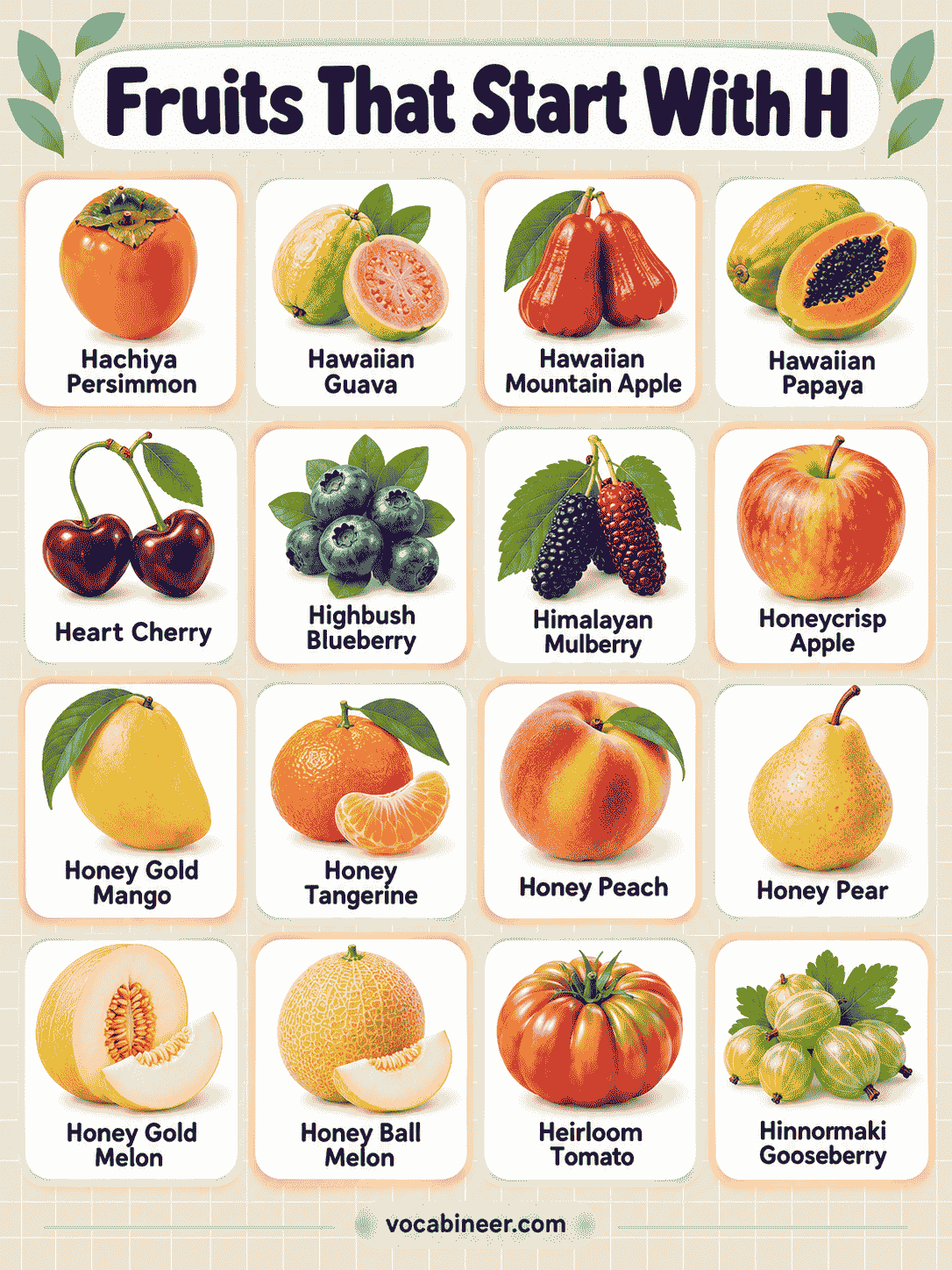
Honeycrisp Apple
Honeycrisp is an apple variety with crisp, juicy flesh and a balanced sweet-tart flavor. Its skin usually shows red coloring over a yellow-green background.
Hachiya Persimmon
Hachiya persimmon has an acorn-like shape and bright or
Complete List of Fruits That Start With H
The H fruit list includes ordinary fruit names, regional names, and a few clearly identified cultivars. Some names refer to groups of related plants, so the descriptions below clarify those cases instead of treating every term as a separate species.
Hackberry
Hackberry trees produce small round fruits that turn orange, red, purple, or dark brown when ripe and contain a hard seed surrounded by a thin layer of sweet pulp.
Hala Fruit
Hala fruit grows on the hala or pandanus tree and forms a large segmented fruit made up of many orange-red fibrous sections.
Hami Melon
Named after Hami in Xinjiang, China, this muskmelon often has an oval shape, a patterned rind, and firm, crisp, sweet flesh.
Hardy Kiwi
Hardy kiwi produces grape-sized fruits with smooth skin and green flesh, unlike the larger fuzzy kiwifruit commonly sold in stores.
Haruka Citrus
Haruka is a Japanese citrus cultivar with yellow skin, mild sweetness, low acidity, and edible white pith around the flesh. It developed from Hyuganatsu-related citrus material and was registered as a cultivar in Japan.
Hassaku
Hassaku is a Japanese citrus fruit with a thick yellow-orange rind, juicy segments, and a sweet-tart flavor that can include slight bitterness.
Hawthorn Fruit
Also called haws, hawthorn fruits are small pome fruits that commonly ripen to red, orange, or dark shades and often have a firm or slightly mealy texture.
Hawaiian Mountain Apple
Hawaiian mountain apple is a bell-shaped fruit with smooth red or deep pink skin and crisp, watery flesh.
Hawaiian Raspberry
Hawaiian raspberry is a raspberry species associated with the Hawaiian Islands and produces edible clustered fruits similar in general form to other raspberries.
Hebesu
Hebesu is a small Japanese citrus commonly harvested while green and valued for its sharp, aromatic juice.
Highbush Blueberry
Highbush blueberry plants produce the familiar round blue fruits commonly grown commercially and eaten fresh, frozen, or dried.
Highbush Cranberry
Highbush cranberry produces clusters of bright red fruits, but despite its common name, it belongs to Viburnum rather than the true cranberry genus Vaccinium.
Himalayan Mulberry
Himalayan mulberry, Morus serrata, produces edible compound fruits that become red as they ripen. The species occurs naturally in Himalayan and nearby mountain regions.
Hog Plum
Hog plum is a common name used for fruits of several Spondias species, which typically produce oval yellow, orange, red, or purple fruits with tart flesh around a large stone.
Honeyberry (Haskap)
Honeyberry, widely known as haskap, is an elongated blue-purple fruit with soft flesh and a sweet-tart flavor.
Honeydew Melon
Honeydew melon has a smooth, pale outer rind and juicy flesh that is most often light green, although some varieties differ in color.
Horned Melon
Also called kiwano, horned melon is easy to identify by its pointed orange skin and green gelatinous interior.
Huckleberry
Huckleberry is a common name for fruits from several plants in genera such as Vaccinium and Gaylussacia, so size, color, and flavor can vary.
Huito
Huito is a regional name for the edible fruit of Genipa americana, also known as genipap or jagua. The thick-skinned fruit grows in tropical parts of the Americas and is used in foods and drinks.
Husk Cherry
Husk cherry is a small yellow or orange fruit enclosed in a thin papery husk and has a sweet-tart flavor when fully ripe.
Hyuganatsu
Hyuganatsu is a Japanese yellow citrus fruit with juicy, mildly sweet-tart flesh and a thick white pith that can also be eaten.
Named Fruit Varieties Beginning With H
A few familiar H names are cultivars rather than completely separate fruit species. Keeping them clearly labeled avoids inflating the list or confusing varieties with broader fruit types.
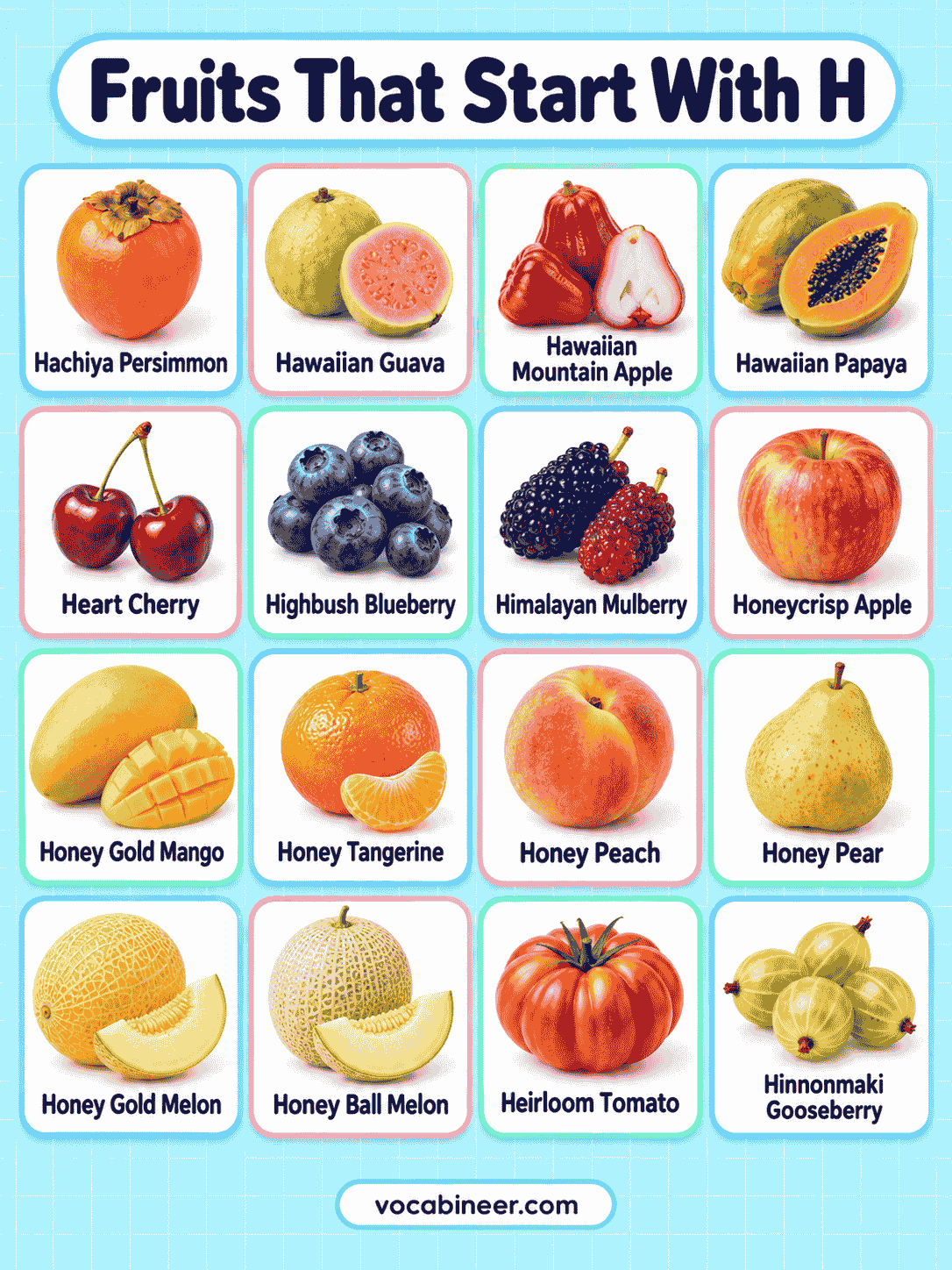
Hachiya Persimmon
Hachiya is an astringent persimmon cultivar with orange skin and a pointed or acorn-like shape; its flesh becomes very soft when fully ripe.
Hass Avocado
Hass is a widely grown avocado cultivar recognized by its pebbled skin, which usually darkens from green toward deep purple or nearly black as the fruit matures.
Honeycrisp Apple
Honeycrisp is an apple cultivar with red-and-yellow skin, crisp juicy flesh, and a balanced sweet-tart flavor.
Melons Beginning With H
H has an unusually useful group of melon names. Hami melon and honeydew belong to the broader muskmelon group, while horned melon belongs to a different species and looks noticeably different.
Hami Melon
Hami melon generally has firmer, crisper flesh than honeydew, and many types have a patterned or netted rind.
Honeydew Melon
Honeydew usually has smooth pale skin and tender, juicy flesh, most commonly pale green.
Horned Melon
Horned melon differs strongly from both because it has a spiny orange rind and green, seed-filled pulp.
Hami Melon vs. Honeydew Melon
Hami melon and honeydew can look similar in a fruit display, but several visible and textural features make them easier to distinguish.
| Feature | Hami Melon | Honeydew Melon |
|---|---|---|
| Shape | Often oval or elongated | Usually round to oval |
| Rind | May be netted, patterned, or yellowish | Usually smooth and pale |
| Flesh | Often orange, pale yellow, or green | Commonly pale green |
| Texture | Firm and crisp | Soft, tender, and juicy |
| Flavor | Sweet and often strongly aromatic | Mild and sweet |
Berries and Small Fruits Beginning With H
Several H fruit names refer to small berry-like or clustered fruits. They do not all belong to the same botanical fruit category, so it is better to group them by everyday appearance rather than assume they are closely related.
Hackberry produces small stone-containing fruits rather than true berries.
Huckleberry refers to several small fruits that often resemble blueberries.
Honeyberry has an elongated shape instead of the round form typical of blueberries.
Highbush Blueberry produces familiar round blue fruits covered with a light waxy bloom.
Highbush Cranberry bears bright red fruits in clusters, although it is not closely related to true cranberries.
Hawaiian Raspberry produces clustered fruits with the familiar raspberry structure.
Honeyberry and Haskap: Are They the Same Fruit?
Honeyberry and haskap usually refer to fruits of Lonicera caerulea, a species of edible blue honeysuckle. Because the two terms overlap extensively in gardening, farming, and food usage, counting them as two completely separate fruits would be misleading.
More precise horticultural usage can distinguish different geographic breeding groups or plant material under the names haskap and honeyberry. However, for an English fruit-name list, Honeyberry (Haskap) is the clearest way to present the fruit without creating a duplicate entry.
Its appearance also helps distinguish it from blueberry. Honeyberries are usually elongated or irregularly oval rather than nearly round.
Japanese Citrus Fruits That Start With H
Japanese citrus contributes several distinctive H fruit names. Hassaku, Hebesu, Haruka, and Hyuganatsu differ in size, sweetness, acidity, and common culinary use.
| Fruit | Typical Appearance | General Flavor |
|---|---|---|
| Hassaku | Medium to large, yellow-orange citrus | Sweet-tart with mild bitterness |
| Hebesu | Small green citrus | Sharp and acidic |
| Haruka | Yellow, orange-sized fruit | Mild and notably sweet |
| Hyuganatsu | Round, pale-yellow citrus | Juicy and sweet-tart |
Haruka is particularly interesting because its yellow rind can suggest a sour fruit, yet Japanese descriptions characterize it as mild and sweet rather than strongly acidic.
Other H Fruit Names That Can Cause Confusion
A few H names need extra context because their common names can suggest the wrong relationship.
Highbush Cranberry
The word cranberry is part of its common name, but the plant belongs to Viburnum. True cranberries belong to Vaccinium.
Horned Melon
Horned melon and kiwano are names commonly used for the same fruit, so they should not be counted separately in an H list.
Honeyberry and Haskap
These names overlap substantially and are best treated as one entry unless an article specifically discusses horticultural breeding groups.
Hog Plum
This common name can apply to more than one Spondias species, so its exact fruit appearance may vary by region and species.
Huckleberry
Huckleberry is not one single species. The name applies to fruits from several related plants, which explains differences in color, size, and taste.
Fruits Beginning With H by Type
Grouping the names by familiar fruit type makes the 24 H fruits easier to remember without treating every group as a strict botanical classification.
| Type | H Fruit Examples |
|---|---|
| Melons | Hami Melon, Honeydew Melon, Horned Melon |
| Citrus fruits | Hassaku, Hebesu, Haruka, Hyuganatsu |
| Small or berry-like fruits | Huckleberry, Honeyberry, Hackberry, Hawaiian Raspberry |
| Tree fruits | Hala Fruit, Hawthorn Fruit, Himalayan Mulberry, Hog Plum |
| Kiwi relatives | Hardy Kiwi |
| Physalis fruits | Husk Cherry |
| Named cultivars | Hachiya Persimmon, Hass Avocado, Honeycrisp Apple |
FAQs
Honeydew melon, huckleberry, hardy kiwi, horned melon, hawthorn fruit, and Hami melon are useful examples of fruits beginning with H.
The names commonly overlap and generally refer to edible fruits of Lonicera caerulea. More specialized horticultural usage may distinguish particular plant groups, but they should not normally be counted as two unrelated fruits.
No. Highbush cranberry belongs to Viburnum, while true cranberries belong to the genus Vaccinium.
Hami melon, honeydew melon, and horned melon all begin with H, although horned melon belongs to a different species and has a very different spiny appearance.
Hassaku, Hebesu, Haruka, and Hyuganatsu are notable H citrus names associated with Japan.
Read More