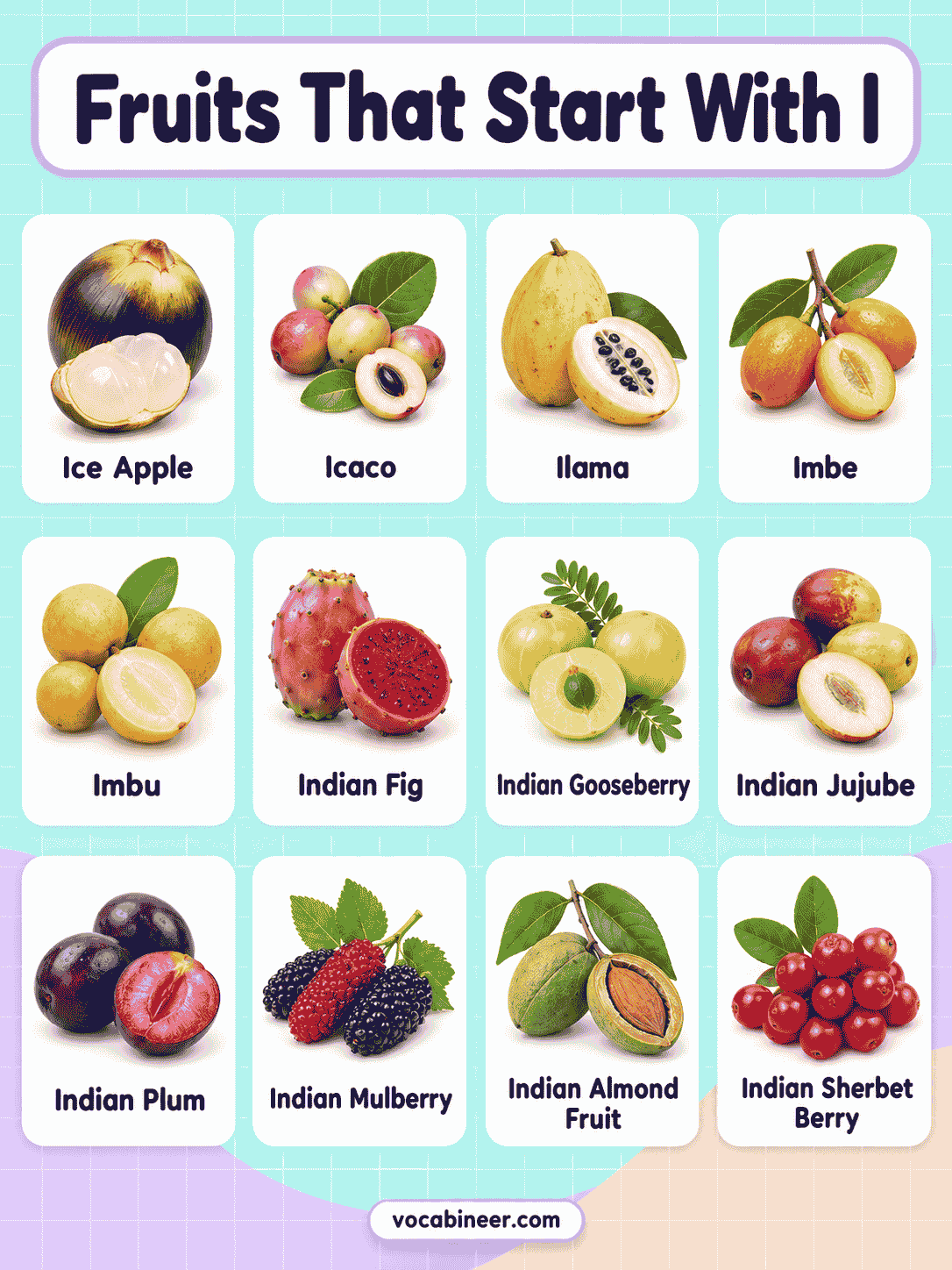
Fruits beginning with I are less common than fruit names that start with many other letters, but the group still includes tropical fruits, citrus, berries, cactus fruits, and several well-known cultivars. Pictures make unfamiliar names such as ice apple, ilama, imbe, and Ichang papeda easier to identify.
This article presents 17 carefully selected I fruit names with concise details about their appearance, flavor, and alternative names. It also explains confusing terms such as Indian fig, Indian gooseberry, Incaberry, and Illawarra plum.
In This Page
Notable Fruits Beginning With I
Fruits beginning with the letter I are relatively uncommon, but several tropical, citrus, and regional varieties offer distinctive flavors, textures, and appearances. Learning these names expands fruit vocabulary and introduces less familiar foods from different parts of the world.
Indian Fig
Indian fig, also called prickly pear, grows on cactus plants and has colorful skin with juicy flesh. Its flavor is mildly sweet and refreshing.
Indian Gooseberry
Indian gooseberry, or amla, is a small green fruit with a sharply sour and astringent taste. People commonly use it in drinks, preserves, chutneys, and traditional foods.
Ice Apple
Ice apple is the soft, translucent fruit found inside the palmyra palm. Its jelly-like texture and mild sweetness make it especially refreshing in hot weather.
Ilama
Ilama is a tropical fruit with green or pinkish skin and soft, creamy flesh. Its pulp has a sweet, rich flavor.
Imbe
Imbe is a small orange tropical fruit related to mangosteen. Its juicy flesh combines sweet and tart notes.
Icaco
Icaco, also called cocoplum, is a small round fruit that can ripen to white, pink, red, or dark purple. Its flesh has a mild, slightly sweet taste.
Illawarra Plum
Illawarra plum is a dark blue-purple Australian fruit with juicy flesh. Its mildly sweet flavor works well in sauces, jams, and preserves.
Indian Jujube
Indian jujube is a small round or oval fruit that becomes yellow, orange, or reddish-brown as it ripens. Its crisp flesh grows sweeter with maturity.
Indian Sherbet Berry
Indian sherbet berry, also called phalsa, is a small purple to black fruit with juicy sweet-tart flesh. People often use it in refreshing summer drinks.
Irwin Mango
Irwin mango is a mango variety with red to purple-red skin and smooth yellow flesh. Its flavor is sweet, aromatic, and mildly tangy.
Ichang Papeda
Ichang papeda is a hardy citrus fruit with green to yellow skin and strongly sour pulp. People mainly value it for flavoring and citrus breeding.
Iyokan
Iyokan is a Japanese citrus fruit with thick orange skin and juicy flesh. Its flavor combines sweetness with noticeable acidity.
Inga Fruit
Inga fruit grows in long pods and contains soft white pulp around large seeds. The pulp tastes sweet and slightly vanilla-like.
Inga Bean
Inga bean, also called ice-cream bean, contains fluffy white edible pulp inside long green pods. Its sweet flavor often resembles vanilla ice cream.
Ita Palm Fruit
Ita palm fruit grows on tropical palms and has scaly reddish-brown skin with edible pulp inside. People use it in drinks, snacks, and regional dishes.
Indian Almond Fruit
Indian almond fruit changes from green to yellow, red, or purple as it ripens. Its flesh surrounds a seed that people can also eat.
Indian Mulberry
Indian mulberry is another name for noni in some regions. The fruit has pale green to yellowish skin and a strong aroma when fully ripe.
Indian Persimmon
Indian persimmon refers to certain regional Diospyros fruits with soft, sweet pulp when ripe. Their color can range from yellow-orange to dark brown.
Indian Prune
Indian prune is a regional name used for several plum-like fruits with edible flesh. Their flavor can range from tart to mildly sweet.
Indonesian Lime
Indonesian lime refers to regional citrus fruits with green or yellow skin and strongly acidic juice. People often use them in drinks, sauces, marinades, and savory dishes.
Fruits Beginning With I: Complete Guide
Most names below are established common fruit names. The final four are recognized cultivars, so this article lists them separately from the broader fruit names to keep the classification clear.
Icaco
Icaco, also called cocoplum, is a round or oval edible fruit that may ripen to white, pink, red, purple, or nearly black. Kew records both icaco and coco plum as common names associated with Chrysobalanus icaco.
Ice Apple
Ice apple comes from the palmyra palm and contains soft, translucent, jelly-like kernels with a mild, watery sweetness. Its pale edible portions develop inside a much darker palm fruit.
Ice Cream Bean
Ice cream bean grows in a long pod filled with large seeds surrounded by sweet, soft white pulp. The name is well established for Inga edulis, although other Inga species can also produce similar edible pulp.
Ichang Papeda
Ichang papeda is a small citrus fruit with a rough peel and large seeds. The University of California Riverside Citrus Variety Collection identifies Ichang papeda as the common name for Citrus cavaleriei and describes its fruits as small with a rough peel.
Ilama
Ilama is an Annona fruit with green to pinkish skin and soft edible flesh that may be pale or pink, depending on the type. Its creamy texture resembles that of other custard-type Annona fruits.
Illawarra Plum
Illawarra plum is the common name for the dark fleshy structure associated with the seed of Podocarpus elatus, an Australian conifer. Despite its plum-like appearance and everyday name, it is not a true plum from the genus Prunus.
Imbe
Imbe is the edible fruit of Garcinia livingstonei, also known as African mangosteen. The small fruits ripen to yellowish-orange or orange and contain juicy flesh with a pleasantly tart flavor.
Incaberry
Incaberry is a name used for Physalis peruviana, the fruit also widely known as Cape gooseberry or goldenberry. It has smooth golden-orange skin and develops inside a thin, papery husk.
Indian Fig
Indian fig is a recognized common name for Opuntia ficus-indica, better known as prickly pear or cactus pear. Its oval fruits may mature to green, yellow, orange, red, or purple depending on the variety. UPOV lists Indian Fig, Cactus Pear, and Prickly Pear among the English common names for the species.
Indian Gooseberry
Indian gooseberry, also called amla, is a small round fruit with pale green to yellow-green skin and noticeable vertical segments. Kew recognizes Indian gooseberry as a common name for Phyllanthus emblica.
Indian Jujube
Indian jujube, also known as ber, is the edible fruit of Ziziphus mauritiana. Its smooth fruits are generally round to oval and change from green toward yellow or reddish-brown as they mature. Botanical references recognize Indian Jujube as an established common name for this species.
Indian Sherbet Berry
Indian sherbet berry, commonly known as phalsa, produces small fruits that deepen toward purple as they ripen. The ripe fruits have a sweet-tart taste and are usually much smaller than common tree fruits.
Iyokan
Iyokan is a Japanese citrus fruit with orange-colored skin and juicy flesh. It resembles a large mandarin in appearance and became particularly associated with Ehime Prefecture in Japan.
Named Fruit Varieties Beginning With I
These four names begin with I but represent cultivars of familiar fruits. Separating them from the main common-name entries keeps the list accurate and makes their status clear.
Ingrid Marie Apple
Ingrid Marie is a Danish apple cultivar that typically develops substantial red coloring over its skin and has firm, juicy flesh. The cultivar originated in Denmark in the early twentieth century.
Interdonato Lemon
Interdonato is an early-season lemon cultivar associated with Sicily. Its mature fruits are yellow, elongated, thin-skinned, juicy, and strongly acidic; UC Riverside describes it as a lemon-citron hybrid.
Irwin Mango
Irwin is a mango cultivar developed in Florida and recognized for attractive red coloring and juicy, sweet flesh. It is now cultivated in several countries beyond the United States.
Italia Grape
Italia is a seeded white table grape cultivar with large pale-green to golden berries. It was developed from Bican and Muscat Hamburg and is known particularly as a table grape.
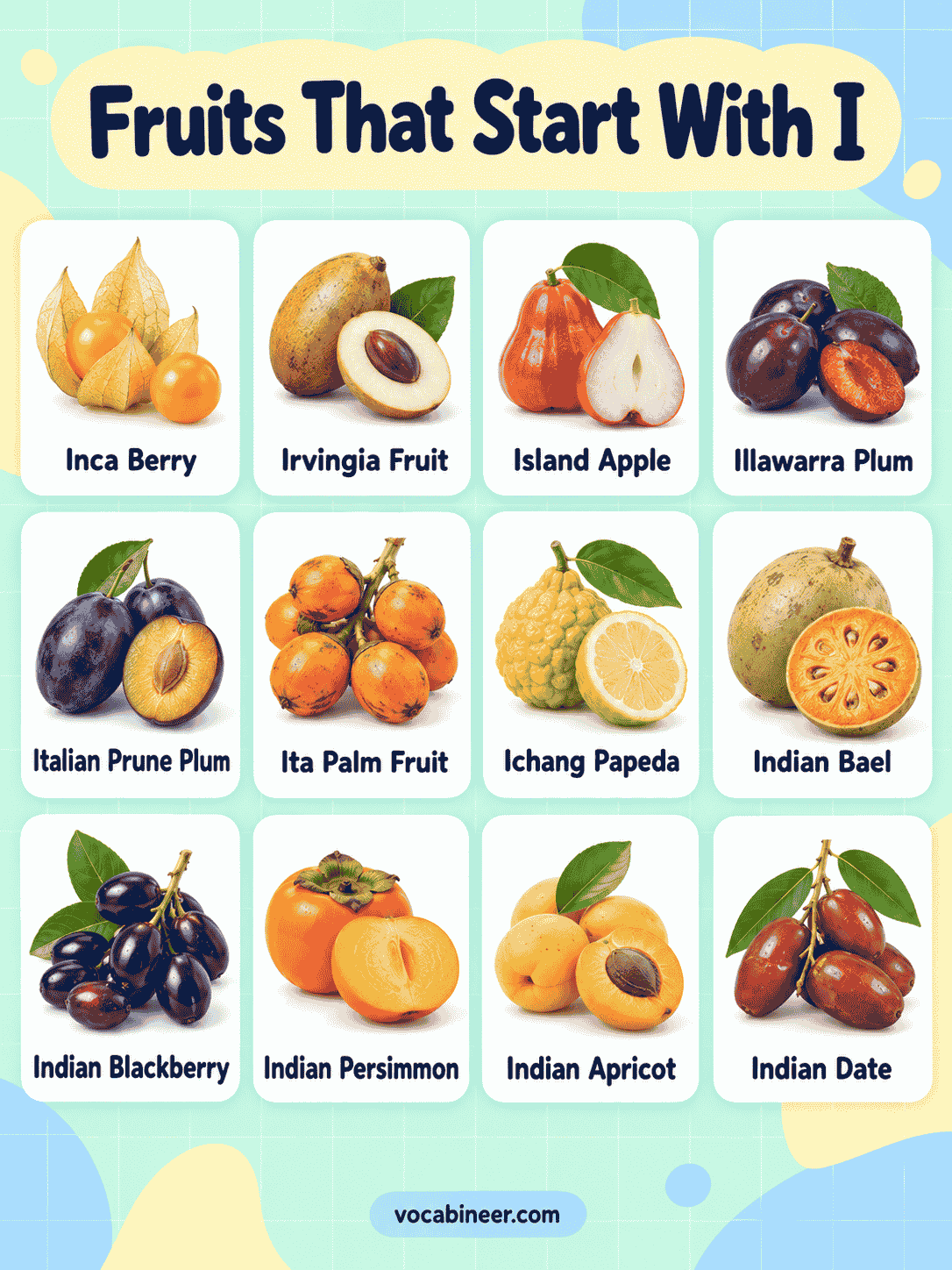
Easy-to-Recognize I Fruits
Several I fruits have distinctive visible features that make them particularly useful for picture-based vocabulary learning. Rather than repeating their full descriptions, these quick clues focus on what you can look for in an image.
| Fruit | Quick Visual Clue |
|---|---|
| Ice Apple | Translucent, jelly-like edible kernels |
| Ice Cream Bean | Long pod with soft white pulp around large seeds |
| Indian Gooseberry | Pale-green round fruit with vertical segments |
| Indian Fig | Oval cactus fruit growing from prickly pear pads |
| Incaberry | Golden-orange fruit inside a papery husk |
| Imbe | Small round yellow-orange or orange fruit |
| Iyokan | Round orange-colored citrus fruit |
Ice cream bean is especially distinctive because the edible pulp surrounds the seeds inside a long pod rather than forming a conventional juicy fruit. Kew notes that Inga fruits are collected for their sweet fleshy pulp.
I Fruit Names That Need Clarification
Some I fruit names use familiar terms such as fig, gooseberry, or plum, even though the fruits do not share a close botanical relationship. Knowing these naming differences helps readers identify each fruit more accurately.
Indian Fig
Indian fig is a common name for prickly pear, particularly Opuntia ficus-indica. It belongs to the cactus family and is therefore quite different from ordinary figs produced by Ficus trees.
Indian Gooseberry
Indian gooseberry refers to Phyllanthus emblica, also called amla. It is not simply a regional variety of the familiar gooseberries that belong to the genus Ribes.
Incaberry
Incaberry is an alternative market or common name associated with Physalis peruviana, the species commonly called Cape gooseberry or goldenberry. It should therefore not be counted as a completely separate fruit from Cape gooseberry.
Illawarra Plum
Although the name contains plum, Illawarra plum comes from a conifer rather than a true plum tree. The edible fleshy structure is associated with its seed, making the name botanical rather than taxonomic evidence of a relationship to common plums.
Ice Cream Bean
The name refers to the sweet, soft pulp surrounding the seeds inside an Inga pod. It is a legume fruit rather than a dessert product or an ordinary green bean. NCBI recognizes ice cream bean as a common name for Inga edulis.
Indian Gooseberry vs. Gooseberry
Indian gooseberry and the familiar gooseberry share part of their common names, but they belong to different plant groups and look noticeably different.
| Feature | Indian Gooseberry | Common Gooseberry |
|---|---|---|
| Common name | Indian gooseberry or amla | Gooseberry |
| Plant group | Phyllanthus | Ribes |
| Appearance | Pale green, round, with visible segments | Round berry that may be green, yellow, red, or purple |
| Flavor | Strongly tart and astringent | Tart to sweet depending on variety |
| Relationship | Separate fruit group | Separate fruit group |
Kew identifies Phyllanthus emblica as Indian gooseberry, while the shared word gooseberry does not make it a type of Ribes gooseberry.
Why Incaberry and Cape Gooseberry Are Not Two Separate Fruits
Incaberry, Cape gooseberry, and goldenberry all refer to Physalis peruviana. This small golden-orange fruit develops inside a thin, papery calyx.
For an alphabetical fruit list, Incaberry belongs under the letter I. However, listing Cape gooseberry separately would duplicate the same fruit rather than add a new species.
Which I Fruit Names Begin With “Indian”?
Several established fruit names genuinely begin with Indian, so they fit naturally in an I fruit list. However, simply adding “Indian” before a familiar fruit such as mango or banana does not create a separate fruit name.
Indian Fig
Also known as prickly pear, Indian fig is a recognized name for the fruit of Opuntia ficus-indica.
Indian Gooseberry
Commonly called amla, Phyllanthus emblica produces the fruit known in English as Indian gooseberry.
Indian Jujube
The name Indian jujube refers to Ziziphus mauritiana, a fruit also widely known as ber.
Indian Sherbet Berry
Phalsa is another common name for Indian sherbet berry, a small fruit with a sweet-tart flavor.
These established names belong naturally in an I fruit list, while arbitrary geographic labels should not increase the total artificially.
FAQs
Ice apple, ice cream bean, Icaco, Ichang papeda, ilama, imbe, Incaberry, Indian fig, Indian gooseberry, Indian jujube, and Iyokan are examples of fruit names that begin with I.
No. Indian gooseberry is Phyllanthus emblica, commonly called amla, while familiar gooseberries belong to the genus Ribes. The shared common-name word does not make them the same fruit group.
Indian fig is a recognized common name for prickly pear or cactus pear, particularly Opuntia ficus-indica. It is a cactus fruit rather than an ordinary fig.
Yes, Incaberry is a name associated with Physalis peruviana, the same species widely known as Cape gooseberry or goldenberry. The names should not be counted as separate fruit species.
Examples include ice apple, ice cream bean, Icaco, ilama, imbe, Indian fig, Indian gooseberry, Indian jujube, and Indian sherbet berry. Their natural ranges and cultivated regions differ, so they are not all native to the same part of the world.
Read More