Fruits that start with K include citrus fruits, melons, berries, tropical tree fruits, and several distinctive regional varieties. Their appearances range from the fuzzy brown skin of kiwi to the orange horns of kiwano and the tiny oval shape of kumquat.
This article covers 28 carefully selected K fruit names with useful identification details, alternative names, and clear variety labels where necessary. It also explains the differences between kiwi, kiwi berry, and kiwano and highlights the unusually rich group of citrus fruits beginning with K.
In This Page
K Fruits With Distinctive Shapes and Flavors
K Fruits With Distinctive Shapes and Flavors
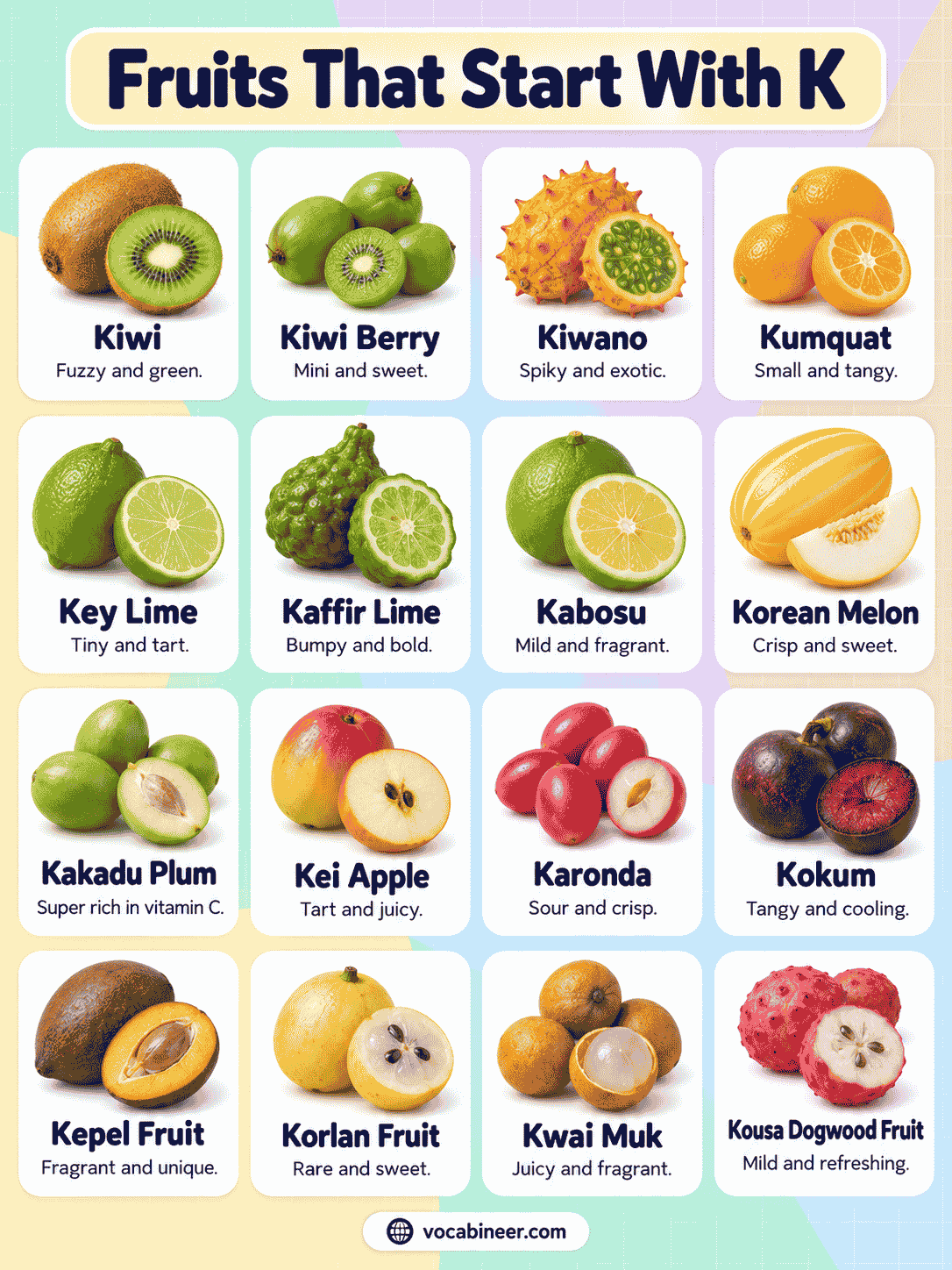
Some fruits that start with the letter K stand out because of their unusual shapes, textures, colors, or flavors. From fuzzy kiwis and horned kiwanos to spiky keitt mangoes and jelly-like kabosu segments, these fruits offer plenty of variety.
Kiwi
Kiwi has a small oval shape, fuzzy brown skin, and bright green or golden flesh. Its flavor combines sweetness with a refreshing tartness.
Kiwano
Kiwano, also called horned melon, has bright orange skin covered with pointed horns. Inside, green jelly-like flesh surrounds many edible seeds and tastes mildly sweet and cucumber-like.
Kumquat
Kumquat is a small oval citrus fruit with an edible orange peel. The peel tastes sweet, while the juicy flesh adds a sharp tart contrast.
Kabosu
Kabosu is a small green citrus fruit from Japan with a round shape and fragrant juice. Its flavor is tart, fresh, and slightly floral.
Kaffir Lime
Kaffir lime has rough, bumpy green skin and a strongly aromatic citrus scent. Its juice tastes intensely sour, while the peel and leaves add bold fragrance to cooking.
Keitt Mango
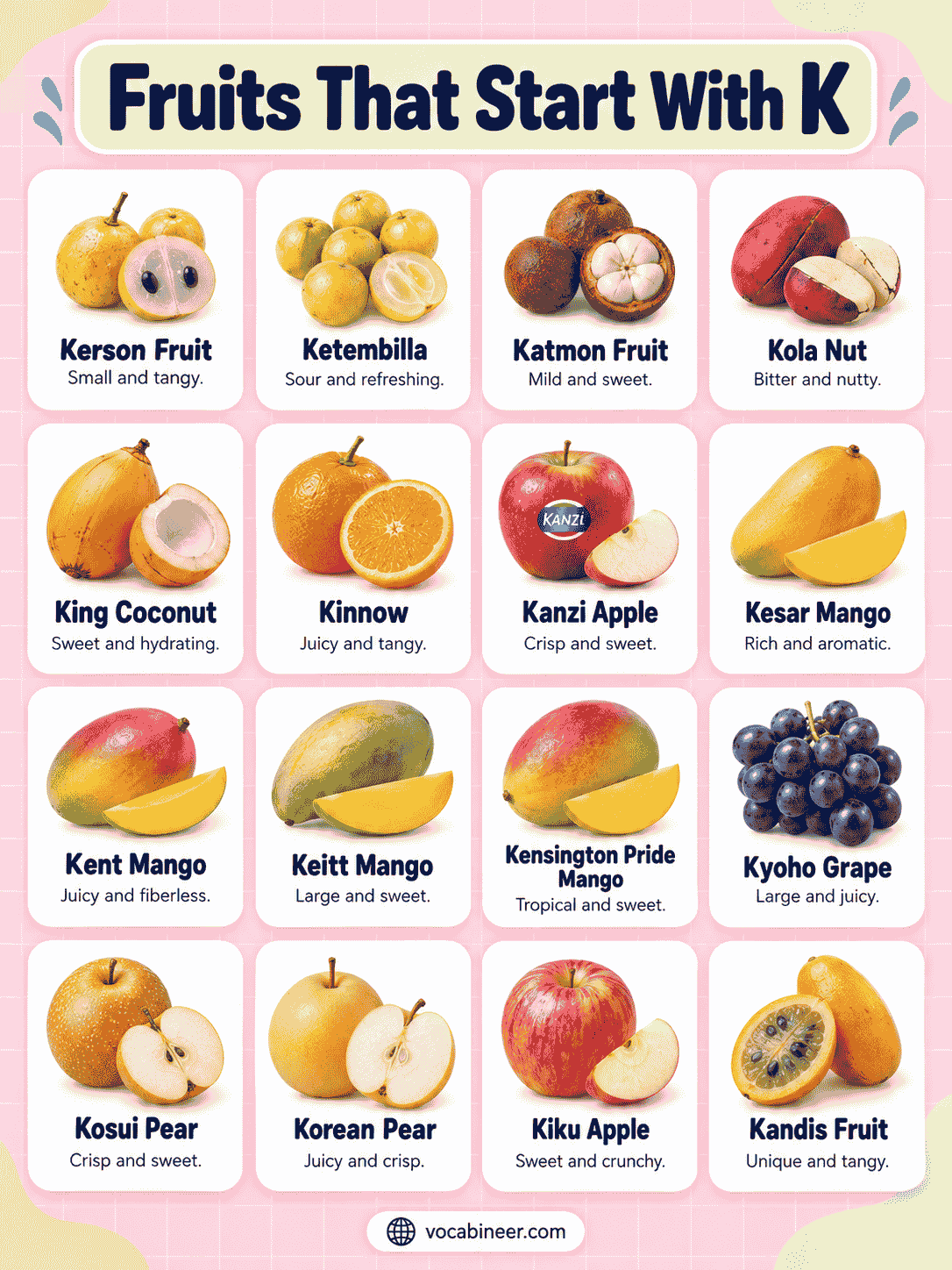
Keitt mango is a large oval mango that often stays green even when ripe. Its firm, juicy flesh has a sweet flavor with only mild acidity.
Kent Mango
Kent mango has a broad oval shape with green skin that may develop red blushes. The flesh is smooth, juicy, and richly sweet.
Kesar Mango
Kesar mango has a rounded to oval shape and yellow-orange flesh. Its strong aroma, deep color, and sweet flavor make it easy to recognize.
Korean Melon
Korean melon has a small oval shape with bright yellow skin and pale white stripes. Its crisp flesh tastes mildly sweet and refreshing.
Kaki Persimmon
Kaki persimmon has a round or slightly flattened shape with smooth orange skin. Depending on the variety, its flesh can feel crisp or soft and taste richly sweet.
Kepel Fruit
Kepel fruit is a round brown fruit from Southeast Asia with soft yellow-orange flesh. Its flavor is sweet, mild, and slightly aromatic.
Kundang
Kundang, also called Marian plum, has a small oval shape with yellow to orange skin. The juicy flesh tastes sweet to mildly tart.
Korlan
Korlan is a small round tropical fruit related to rambutan and lychee. Its translucent flesh has a sweet flavor with light acidity.
Kei Apple
Kei apple has a round yellow-orange shape and firm juicy flesh. Its flavor is strongly tart, so people often use it in jams, sauces, and preserves.
Karonda
Karonda is a small oval berry that changes from green to pink, red, or dark purple as it ripens. Its taste ranges from sharply sour to mildly sweet.
Kakadu Plum
Kakadu plum is a small green fruit with an oval shape and fibrous flesh. Its flavor is tart and slightly bitter.
Kwai Muk
Kwai muk is a small round to oval fruit with orange-brown skin and soft pulp. Its flavor combines sweetness with a mild tang.
Kiwiberry
Kiwiberry is a small smooth-skinned relative of kiwifruit. It has an oval shape, green flesh, tiny seeds, and a sweet-tart flavor.
Karkalla Fruit
Karkalla produces small fleshy fruits on a coastal succulent plant. The fruit has a simple rounded shape and a mildly salty-sweet taste.
Kutjera Fruit
Kutjera, also known as bush tomato, is a small desert fruit that dries naturally as it matures. Its flavor is strong, earthy, tangy, and slightly caramel-like.
Fruits That Start With K: Complete Guide
K fruit names include familiar supermarket fruits, regional specialties, citrus hybrids, and several less familiar tropical fruits. The descriptions below focus on the features that make each one easier to recognize.
Kabosu
Japanese cooks often use kabosu while the small citrus is still green because its juice has a sharp, aromatic flavor. The round fruit resembles a small lime but has its own citrus identity.
Kakadu Plum
Small and oval, Kakadu plum develops green to yellow-green skin around a large central stone. Australians also use the name gubinge for this native fruit. CSIRO recognizes Kakadu plum as Terminalia ferdinandiana.
Kaki Persimmon
English speakers also use kaki for Diospyros kaki, the species commonly known as Japanese or Chinese persimmon. Its fruits usually develop orange skin and may stay firm or become very soft depending on the cultivar and ripeness. Kew lists kaki among the common names for the species.
Karonda
Karonda, sometimes written karaunda, produces small oval fruits that change from green through pink and red toward dark purple as they mature. The firm flesh tastes especially tart before full ripeness.
Kawachi Bankan
Kawachi Bankan is a large Japanese citrus with yellow skin and juicy flesh. Its mild sweet-tart character differs from the sharper flavor of smaller K citrus fruits such as kabosu and key lime. Japanese agricultural research recognizes Kawachi bankan as a citrus variety.
Kei Apple
Kei apple produces round, fleshy fruits that mature to an apricot-yellow color. Kew records kei apple as an English common name for Dovyalis afra and describes its fruit as fleshy and apricot-colored.
Keledang (Kledang)
Keledang grows on Artocarpus lanceifolius, a tropical tree related to jackfruit. Kew records kledang as a common name and places the species naturally from Thailand through western Malesia.
Kepel
Kepel produces round brown fruits with juicy orange pulp and several large seeds. Singapore NParks lists Kepel and Kepel Apple as common names for Stelechocarpus burahol and describes the ripe pulp as edible.
Key Lime
Key lime is a small round citrus that changes from green toward yellow as it fully ripens. Thin skin, aromatic juice, and strong acidity help distinguish it from sweeter citrus fruits.
Kinnow
Kinnow produces bright orange fruits with juicy flesh and a strong mandarin character. Breeders created this mandarin hybrid from King and Willowleaf parents, so it represents a named hybrid rather than a separate citrus species.
Kiwi
Kiwi, or kiwifruit, usually has fuzzy brown skin surrounding juicy green or golden flesh. Tiny black seeds form a ring around the pale center and create the familiar pattern visible in a cut fruit.
Kiwi Berry
Much smaller than ordinary kiwi, kiwi berry has smooth edible skin and soft green flesh. It belongs to the same Actinidia fruit group as kiwifruit, although its grape-sized form makes it look quite different.
Kiwano
Kiwano has an orange-yellow rind covered with pointed horns and green gelatinous flesh filled with edible seeds. People also know it as horned melon, and it has no close botanical relationship to kiwi.
Kiyomi
Japanese breeders created Kiyomi by crossing Satsuma mandarin with Trovita orange. The resulting tangor produces medium-to-large orange fruits with juicy flesh and a noticeable citrus aroma.
Kokum
Kokum produces rounded fruits that deepen from red toward dark purple as they ripen. The fruit comes from Garcinia indica, a species native to western and southwestern India; Kew records kokum-related common names for the species.
Korean Melon
Korean melon has bright yellow skin marked by pale vertical stripes. Its oblong shape, crisp pale flesh, and small central seed cavity make it one of the easiest K fruits to identify in pictures.
Korean Pear
Korean pear belongs to the broader Asian pear group and typically develops a round shape with bronze or golden-brown skin. Its flesh stays crisp, watery, and juicy when ripe.
Korean Raspberry
Korean raspberry forms clustered fruits that deepen from red toward dark purple or black as they mature. International crop references recognize Korean raspberry names within the Rubus group.
Korlan
Korlan is a Southeast Asian fruit from the Nephelium group, which also includes rambutan and longan relatives. The small fruits develop reddish skin and pale edible flesh around the seed.
Kumquat
Kumquat is a tiny round or oval citrus with bright orange skin. Because the peel tastes sweet while the interior tastes tart, people commonly eat the entire fruit.
Kwai Muk
Kwai muk grows on Artocarpus hypargyreus and produces small yellowish fruits with orange to reddish flesh. The Royal Horticultural Society lists kwai muk among the common names for the species.
Named Fruit Varieties Beginning With K
The next seven names represent recognized cultivars, hybrids, or named fruit varieties rather than completely separate fruit species. Keeping them together makes the 28-name list transparent and avoids presenting every variety as a different species.
King Coconut
King coconut is an orange-fruited coconut form strongly associated with Sri Lanka and grown especially for its sweet nut water. Sri Lankan coconut research recognizes king coconut as a distinct coconut form, while the country’s Coconut Development Authority handles it as a commercial product.
Kelsey Plum
Kelsey is a Japanese plum cultivar with greenish-yellow skin, firm flesh, and a distinctive shape that can appear somewhat heart-like. Fruit-variety collections recognize Kelsey as a named plum cultivar.
Kyoho Grape
Kyoho produces exceptionally large dark-purple table grapes. UC Davis Foundation Plant Services identifies Kyoho as a Japanese interspecific grape variety and notes its large purple berries.
Keitt Mango
Keitt is a large late-season mango cultivar that often keeps substantial green color even as the fruit matures. University of Florida sources list Keitt among important mango cultivars and describe it as a late-season selection with large fruit.
Kent Mango
Kent mango produces large fruits with green, yellow, and red skin tones and soft, sweet flesh. University of Florida guidance lists Kent among major mango varieties and notes its value for fresh-cut processing because of its low fiber content.
Kesar Mango
Kesar is an important Indian mango variety known for orange-yellow to saffron-colored flesh and a strong aroma. Indian government sources list Kesar among major commercial mango varieties and recognize regional Kesar mango production.
Kyo Savoy Mango
Kyo Savoy is a named mango cultivar grown in warm climates. University of Florida mango guidance lists Kyo Savoy among recognized cultivars and notes that people may also eat its fruit at the green-firm stage.
Citrus Fruits Beginning With K
K has an unusually strong group of citrus names. Some represent traditional fruit types, while others are named hybrids or cultivars, so their appearances and flavor profiles vary considerably.
| K Citrus | Main Identification Feature |
|---|---|
| Kabosu | Small green Japanese citrus with tart aromatic juice |
| Kawachi Bankan | Larger yellow Japanese citrus with juicy flesh |
| Key Lime | Small green-to-yellow lime with strongly acidic juice |
| Kinnow | Bright orange mandarin hybrid |
| Kiyomi | Medium-to-large orange tangor |
| Kumquat | Tiny orange citrus commonly eaten with its peel |
Kabosu and key lime work mainly as sour citrus fruits, while Kinnow and Kiyomi have stronger mandarin or orange characteristics. Kumquat differs further because its edible peel contributes much of its sweetness.
Kiwi vs. Kiwi Berry vs. Kiwano
The similar names can make these fruits sound closely related, but only kiwi and kiwi berry belong to the same general fruit group. Kiwano belongs to the melon family.
| Feature | Kiwi | Kiwi Berry | Kiwano |
|---|---|---|---|
| Typical size | Medium | Small, often grape-sized | Medium |
| Shape | Oval | Small oval | Oval with horns |
| Skin | Brown and fuzzy | Smooth and thin | Yellow-orange and spiny |
| Flesh | Green or golden | Usually green | Green and jelly-like |
| Plant group | Actinidia | Actinidia | Melon |
| Closely related? | Yes, to kiwi berry | Yes, to kiwi | No |
The skin provides the quickest visual clue. Kiwi has noticeable fuzz, kiwi berry has smooth edible skin, and kiwano has prominent horns.
K Fruit Names That Need Clarification
Several K names overlap with alternative spellings, regional terminology, or familiar fruit groups. A few simple distinctions prevent duplicate entries and inaccurate classifications.
Kaki and Persimmon
Kaki commonly refers to Diospyros kaki, the species that also carries names such as Japanese persimmon and Chinese persimmon. These terms should not create separate species entries.
Karonda and Karaunda
Karonda and karaunda represent spelling or transliteration variations for the same fruit name rather than two separate fruits.
Keledang and Kledang
Both forms occur in references for Artocarpus lanceifolius. Kew records kledang, while other regional sources use keledang, so a clean list should combine them.
Kiwi and Kiwifruit
Kiwi and kiwifruit describe the same familiar fruit group. Using both as separate list entries would duplicate the fruit.
Kiwano and Horned Melon
Horned melon is another common name for kiwano. The similar spelling of kiwano and kiwi does not indicate a botanical relationship.
Korean Pear and Asian Pear
Korean pear belongs within the broader Asian pear group. The regional name helps identify a familiar type rather than a completely unrelated pear species.
Kinnow and Kiyomi
Both names identify citrus hybrids. Kinnow has mandarin parentage, while Kiyomi combines mandarin and orange ancestry, so neither name represents a separate wild citrus species.
FAQs
Kiwi, kumquat, key lime, kiwano, Korean melon, Kakadu plum, kokum, and karonda are useful examples of fruits beginning with K.
No. Kiwano belongs to the melon family, while kiwi belongs to Actinidia. Their similar names do not indicate a close botanical relationship.
Kiwi berry belongs to the same general Actinidia group as kiwi, but it produces much smaller fruits with smooth edible skin. Ordinary kiwifruit usually has fuzzy brown skin and a larger oval shape.
Kabosu, Kawachi Bankan, Key Lime, Kinnow, Kiyomi, and Kumquat are notable citrus names beginning with K.
Yes. Kaki commonly refers to Diospyros kaki, the species widely known as Japanese or Chinese persimmon. Kew lists kaki among its common names.
Read More