

Fruits that start with P include familiar favorites such as papaya, peach, pear, pineapple, plum, and pomegranate, along with tropical fruits, cactus fruits, berries, and regional specialties. Their appearances range from the leafy crown of pineapple to the jewel-like seeds of pomegranate and the bright scaled rind of pitaya.
This article covers 34 carefully selected P fruit names with concise descriptions, visual clues, alternative names, and clearly identified varieties. It also explains commonly confused names such as papaya and pawpaw, pomelo and pummelo, and plum, plumcot, and pluot.
In This Page
P Fruits With Distinctive Shapes and Flavors
Fruits that start with the letter P include tropical varieties, berries, stone fruits, citrus fruits, and melons with distinctive shapes, colors, and flavors. Learning these P fruit names helps children and English learners expand food vocabulary and recognize both familiar and unusual fruits more easily.
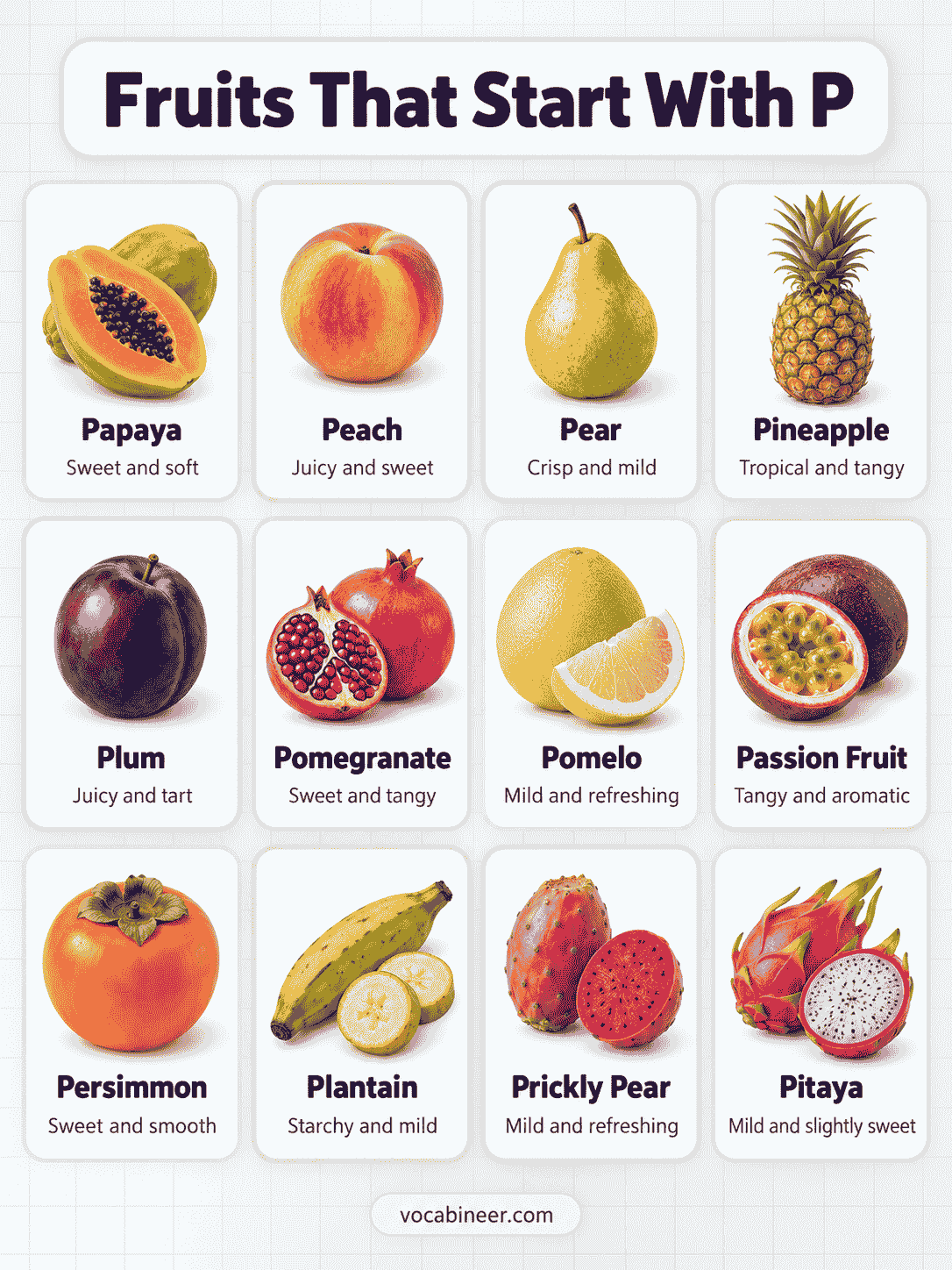
Papaya
Papaya has an oval to elongated shape with green skin that turns yellow or orange as it ripens. Its soft orange flesh tastes sweet and surrounds many small black seeds.
Pineapple
Pineapple has a rough patterned rind, a crown of stiff leaves, and bright yellow flesh. Its juicy texture combines strong sweetness with refreshing acidity.
Pomegranate
Pomegranate has a round shape and thick red skin filled with hundreds of juicy seeds. Each seed offers a crisp texture and sweet-tart flavor.
Passion Fruit
Passion fruit has a round or oval shape with purple, yellow, or orange skin. Inside, aromatic jelly-like pulp surrounds many crunchy edible seeds.
Peach
Peach has soft fuzzy skin and juicy flesh surrounding a hard central stone. Its flavor ranges from mildly sweet to rich and fragrant.
Pear
Pears often have a rounded base that narrows toward the stem. Their juicy flesh can feel crisp or soft and usually tastes mild and sweet.
Plum
Plums are round or oval stone fruits with smooth skin in red, purple, yellow, or green shades. Their flesh ranges from sweet to pleasantly tart.
Persimmon
Persimmon has smooth orange skin and a round to slightly flattened shape. Depending on the variety, its flesh may stay crisp or become soft and very sweet.
Pomelo
Pomelo is a very large citrus fruit with thick green or yellow skin. Its segmented flesh tastes mildly sweet and less bitter than grapefruit.
Prickly Pear
Prickly pear grows on cactus plants and has oval fruit with thick colorful skin. Its juicy interior contains many small hard seeds and has a mild sweet flavor.
Pitaya
Pitaya, another name for dragon fruit, has bright pink or yellow skin with scale-like bracts. Its white, red, or magenta flesh contains many tiny black seeds.
Plantain
Plantain looks similar to a banana but usually has firmer, starchier flesh. People commonly cook it by frying, boiling, baking, or roasting.
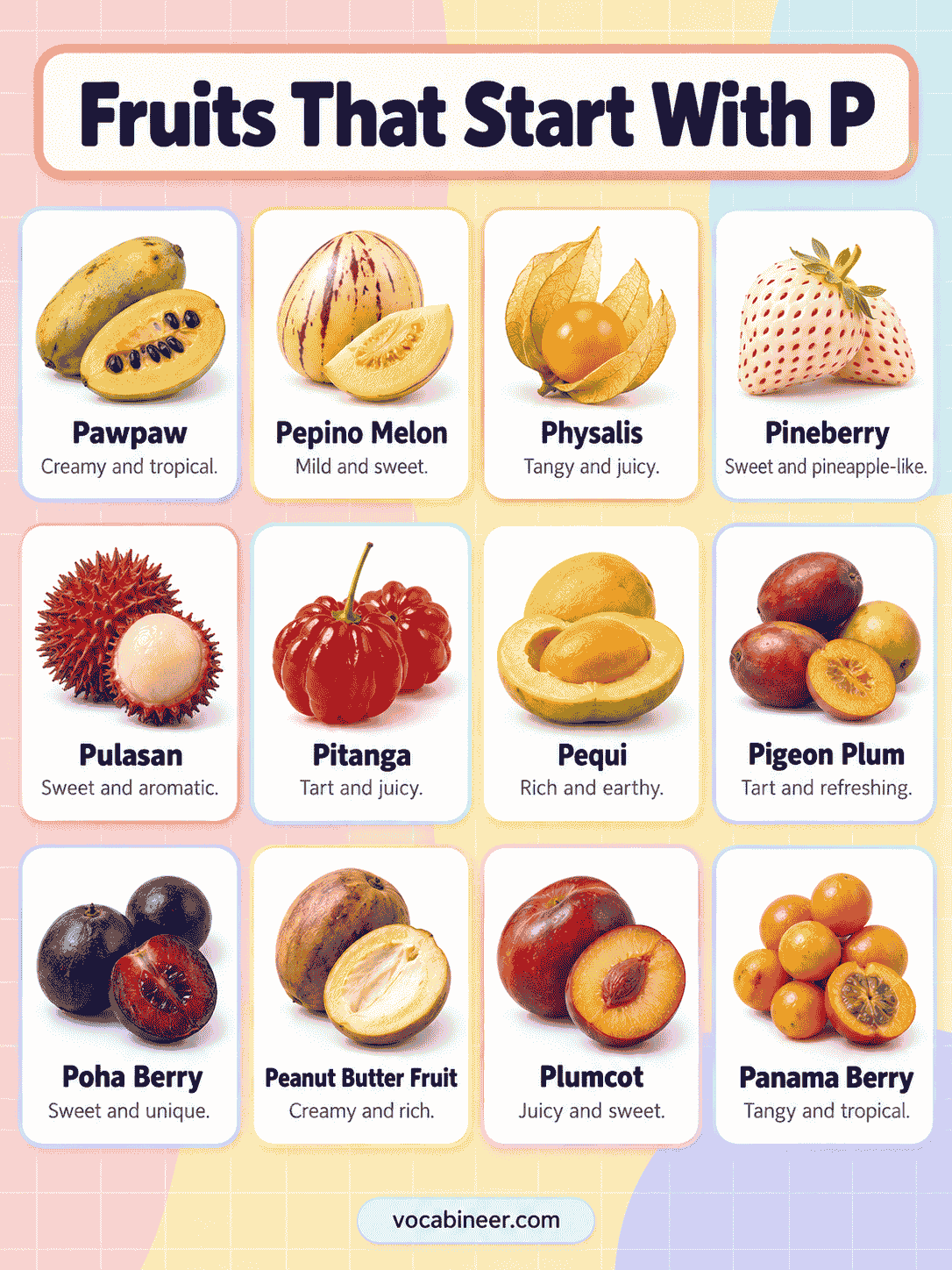
Pawpaw
Pawpaw is an oblong green fruit with soft yellow flesh and several large dark seeds. Its creamy flavor often resembles banana, mango, and vanilla.
Pepino Melon
Pepino melon has smooth pale yellow skin marked with purple stripes. Its juicy flesh tastes mildly sweet with flavors that resemble melon and cucumber.
Physalis
Physalis produces small orange fruits enclosed in thin papery husks. The juicy flesh has a bright sweet-tart taste.
Pineberry
Pineberry resembles a strawberry but develops pale white or pinkish flesh with red seeds. Its flavor often has mild pineapple-like notes.
Pitanga
Pitanga, also called Surinam cherry, has a small ribbed shape and ripens to red, orange, or dark purple. Its flavor ranges from sweet to tart.
Pulasan
Pulasan has thick red or dark purple skin covered with short blunt spines. Inside, translucent white flesh surrounds a seed and tastes sweet and juicy.
Pummelo
Pummelo is another spelling of pomelo, a large citrus fruit with thick rind and mild segmented flesh. Its taste is usually sweet with gentle acidity.
Pequi
Pequi is a round green fruit from South America with yellow aromatic pulp around a hard, spiny seed. Its strong flavor makes it distinctive in regional cooking.
Recognizing Fruits That Start With P
P includes familiar orchard fruits, tropical specialties, cactus fruits, berries, and unusual regional names. The descriptions below focus on shape, color, flesh, flavor, or naming details that help readers distinguish each fruit.
Papaya
Papaya develops a large oval or elongated shape with green skin that turns yellow-orange as it ripens. Inside, soft orange flesh surrounds a central cavity filled with many small black seeds.
Partridgeberry
Partridgeberry produces small round red fruits on a low-growing evergreen plant. The berries often persist into winter and have a subtle flavor.
Passion Fruit
A round purple or yellow rind encloses fragrant pulp packed with dark edible seeds. The juicy interior gives passion fruit one of the most recognizable cross-sections among P fruits.
Pawpaw
North American pawpaw produces green to yellow-brown fruits with soft, custard-like yellow flesh and several large brown seeds. In this article, pawpaw refers to Asimina triloba, not papaya.
Peach
Peach has soft fuzzy skin that may show yellow, cream, pink, or red tones. Juicy flesh surrounds one hard stone at the center.
Peach Palm Fruit
Peach palm produces clusters of red, orange, or yellow fruits with firm, starchy pulp. People traditionally cook the fruits before eating them. FAO records peach palm as an important edible fruit crop of tropical America.
Peanut Butter Fruit
Peanut butter fruit is a small red-orange tropical fruit with soft pulp and an aroma often compared with peanut butter. Kew confirms that Bunchosia argentea, the species associated with this fruit, has documented food use.
Pear
Pear usually develops a rounded base that narrows toward the stem, although shapes vary among cultivars. Its flesh may feel crisp, tender, or melting depending on the variety and ripeness.
Pequi
Pequi has green outer skin surrounding bright yellow-orange edible pulp. A hard inner stone carries sharp spines, so people eat the outer pulp carefully rather than biting into the pit.
Persimmon
Persimmons usually develop smooth orange to reddish-orange skin. Depending on the variety, the ripe flesh may stay firm and crisp or become very soft and jelly-like.
Peumo
Peumo is a small South American fruit that matures to red or dark reddish-purple. It grows on a Chilean native tree and contains a relatively large seed beneath its thin skin.
Phalsa (Falsa)
Phalsa produces small round fruits that change from red toward deep purple as they ripen. The juicy flesh has a sweet-tart flavor, while falsa is simply an alternative spelling of the same fruit name.
Pigeon Plum
Pigeon plum develops small oval fruits that darken as they mature. University of Florida identifies Coccoloba diversifolia by the common name pigeon plum and describes its single-seeded fruits as somewhat edible.
Pigface Fruit
Pigface plants produce fleshy fruits that ripen to reddish or purple tones. The fruit comes from coastal succulent plants and contains soft pulp with many small seeds.
Pineapple
Pineapple has a rough patterned rind topped by a crown of stiff green leaves. Yellow flesh inside combines sweetness with noticeable acidity.
Pineapple Guava
Pineapple guava, also known as feijoa, produces green oval fruits with pale aromatic flesh. Its common name reflects its tropical fragrance rather than a close relationship with pineapple.
Pineberry
Pineberry looks like a pale or white strawberry dotted with red seeds. Despite the name and pineapple-like aroma, it is a strawberry type rather than a strawberry–pineapple hybrid.
Pitaya (Dragon Fruit)
Pitaya has a striking pink, red, or yellow rind with scale-like projections. White, red, or purple flesh inside contains many tiny black seeds. Dragon fruit is another widely used name for pitaya.
Pitomba
Pitomba is a small round Brazilian fruit that typically develops yellow to orange skin. Its soft aromatic pulp surrounds one or more seeds.
Plantain
Plantain is a starchier banana type that people usually cook before eating. Green plantains have firm, starchy flesh, while ripe fruits develop yellow to darkened skin and a sweeter taste.
Plum
Plums come in round or oval forms with smooth skin that may appear green, yellow, red, purple, or almost black. Juicy flesh surrounds a single hard stone.
Plumcot / Pluot
Plumcots and pluots come from plum–apricot breeding. Plumcots traditionally describe more balanced plum-and-apricot crosses, while pluots generally show stronger plum ancestry.
Pomegranate
Pomegranate has a firm red or reddish-yellow rind that encloses many juicy arils. Each translucent aril surrounds a seed and gives the cut fruit its jewel-like appearance.
Pomelo (Pummelo)
Pomelo is a very large citrus fruit with a thick rind and substantial white pith. Pomelo and pummelo are spelling variants for the same fruit rather than separate entries.
Pond Apple
Pond apple is an Annona fruit with green to yellowish skin and soft pulp surrounding numerous seeds. The fruit often develops an irregular or segmented-looking surface.
Prickly Pear
Prickly pear grows on cactus pads and develops oval fruits in shades of green, yellow, orange, red, or purple. Its juicy pulp contains many small hard seeds.
Pulasan
Pulasan is a Southeast Asian relative of rambutan with red to dark-red skin covered in short, thick projections. Pale edible flesh surrounds the seed. Kew recognizes Nephelium ramboutan-ake and records regional names related to pulasan.
Named Fruit Varieties Beginning With P
The next seven entries are established cultivars or named fruit types rather than seven unrelated fruit species. Keeping them together makes the 34-name total transparent.
Pacific Rose Apple
Pacific Rose is an apple cultivar with attractive pinkish-red skin and crisp, sweet flesh.
Persian Lime
Persian lime is a widely cultivated lime type with smooth green skin, juicy acidic flesh, and relatively few seeds compared with some other limes.
Pink Lady Apple
Bright pink-red coloring over a yellow-green background gives Pink Lady apples their familiar appearance. The flesh stays crisp and combines sweetness with noticeable acidity.
Pinot Noir Grape
Pinot Noir produces small dark-purple wine grapes in compact clusters. The cultivar belongs in the named-variety section rather than the main list of independent fruits.
Ponderosa Lemon
Ponderosa lemon produces exceptionally large yellow citrus fruits with thick rind and strongly acidic flesh.
Ponkan Mandarin
Ponkan is a mandarin variety with a loose orange rind and sweet, juicy segments. Its easy-peeling skin makes it visually similar to other mandarins.
Pickering Mango
Pickering is a mango cultivar that produces relatively compact fruits with yellow-orange flesh and a rich sweet flavor.
Papaya vs. Pawpaw
Papaya and pawpaw sometimes share names regionally, but in North American fruit terminology they refer to very different fruits.
| Feature | Papaya | Pawpaw |
|---|---|---|
| Main fruit type | Tropical papaya | North American native fruit |
| Typical shape | Large oval or elongated | Oval to oblong |
| Skin when ripe | Yellow to orange | Green to yellow-brown |
| Flesh | Orange | Yellow to cream |
| Seeds | Many small black seeds | Several large brown seeds |
| Texture | Soft and juicy | Soft and custard-like |
| Same fruit? | No | No |
The seed structure provides one of the easiest clues: papaya contains many small black seeds, while pawpaw contains several much larger brown seeds.
Plum, Plumcot, Pluot, and Prune Explained
Several P terms relate to plums, but they do not all describe separate fresh fruits.
| Name | What It Means |
|---|---|
| Plum | Standard stone fruit |
| Plumcot | Plum–apricot hybrid, traditionally with a more balanced ancestry |
| Pluot | Plum–apricot hybrid that usually has stronger plum ancestry |
| Prune | A dried plum, not a separate fresh fruit |
For this reason, prune does not appear as an additional fruit in the 34-name count.
Alternative Names for P Fruits
Several P fruits appear under another spelling or widely used common name. These alternatives should not increase the total.
| Main Name | Alternative Name |
|---|---|
| Pitaya | Dragon Fruit |
| Phalsa | Falsa |
| Pomelo | Pummelo |
| Pineapple Guava | Feijoa |
| Mamoncillo-style duplicates | Not applicable to this P list |
The most important rule is simple: alternative names describe the same fruit unless reliable botanical evidence shows otherwise.
P Fruit Names That Can Cause Confusion
Some P names sound related even when the fruits differ substantially.
Papaya and Pawpaw
Regional usage sometimes overlaps, but North American pawpaw is a different fruit from tropical papaya.
Pineberry and Pineapple
Pineberry is a pale strawberry type with a pineapple-like aroma. It is not a hybrid between strawberry and pineapple.
Pomelo and Pummelo
These spellings refer to the same large citrus fruit.
Pitaya and Dragon Fruit
Both names describe the same group of colorful cactus fruits.
Plantain and Banana
Plantain belongs to the banana group but generally has starchier flesh and is commonly cooked before eating.
FAQs
Papaya, passion fruit, peach, pear, persimmon, pineapple, plum, pomegranate, pomelo, and prickly pear are familiar examples of fruits beginning with P.
Not in North American usage. Papaya has orange flesh with many small black seeds, while North American pawpaw has soft yellow flesh with several large brown seeds.
Yes. Pomelo and pummelo are spelling variants for the same large citrus fruit.
Plum is a standard stone fruit. Plumcot and pluot both come from plum–apricot breeding, although pluots generally show stronger plum ancestry.
No. Pineberry is a pale strawberry type with red seeds and a pineapple-like aroma, not a hybrid between pineapple and strawberry.
Read More