

Cold milk pours smoothly into a glass, while yogurt holds its shape on a spoon and cheddar breaks into firm slices. Although these foods look and taste different, each one belongs to the dairy family because it comes from animal milk.
Learning dairy product names helps readers recognize milk types, cultured foods, cream products, butter, cheese, and frozen desserts. It also clears up common confusion about eggs, plant-based drinks, lactose-free milk, paneer, cottage cheese, and other similar terms.
In This Page
What Counts as a Dairy Product?
A dairy product is a food or ingredient that comes from the milk of a mammal. Cows provide most commercial milk in the United States, but goats, sheep, buffalo, and other milk-producing animals also supply dairy foods.
Milk can remain a liquid or change into many other forms. Producers culture it to make yogurt, separate its fat to make cream, churn cream into butter, remove water to create milk powder, or coagulate milk proteins to produce cheese.
Common dairy families include:
- fluid milk
- cultured dairy products
- cream products
- butter and milk-fat products
- cheese
- concentrated and powdered milk
- frozen dairy desserts
However, not every food that contains milk counts as a basic dairy product. Cheesecake, custard, pudding, creamy soup, and milk chocolate use dairy ingredients, but they belong to broader food or dessert categories.
Common Milk Types
Milk names may describe the animal source, fat content, heat treatment, added flavor, or another processing method. One carton can carry several descriptions at the same time, such as pasteurized lactose-free whole milk.
Milk by Animal Source
The animal source can affect the milk’s flavor, richness, color, and common uses. Product labels usually name the source when the milk does not come from cows.
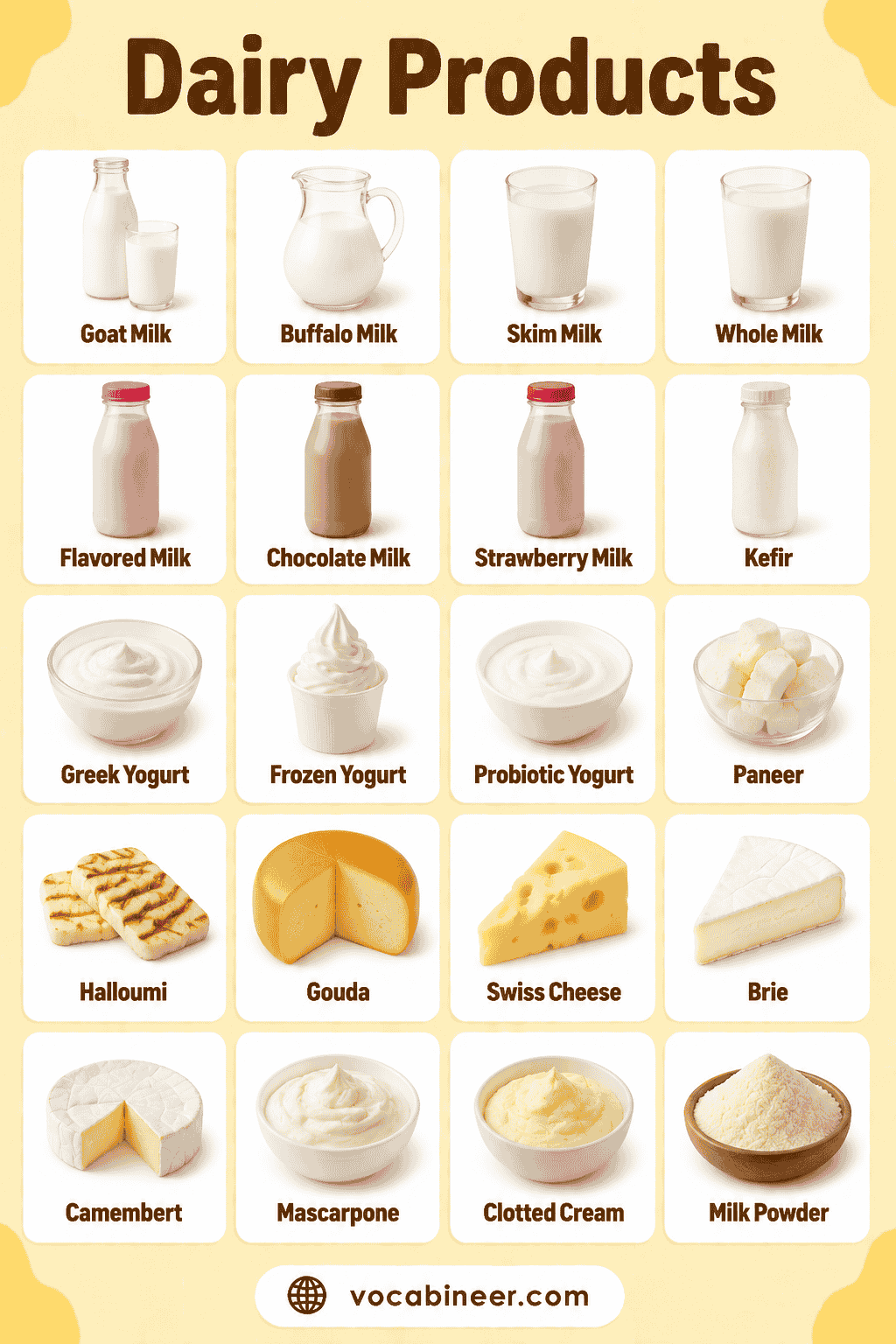
Cow’s milk is the most widely sold dairy milk in the United States. It has a mild flavor and appears in drinks, cereal, sauces, baking, yogurt, butter, cream, and cheese.
Goat milk comes from goats and often has a distinctive tangy or earthy flavor. People drink it directly or use it to make yogurt, soft cheese, and aged cheese.
Sheep milk has a rich texture and contains more solids than many common fluid milks. Cheesemakers often use it for cheeses such as Pecorino Romano and some varieties of feta.
Buffalo milk comes from water buffalo and has a rich, creamy character. Producers commonly use it for traditional mozzarella and several South Asian dairy products.
Milk by Fat Content
American milk labels often identify fat content with a percentage or familiar product name. These labels describe the amount of milk fat, not the animal source or heat treatment.
Whole milk contains the standard level of milk fat found in regular commercial milk. It has a creamy mouthfeel and commonly appears in drinking, cereal, sauces, and baking.
Reduced-fat milk usually carries a 2% milk label in the United States. It tastes lighter than whole milk but retains more richness than low-fat or skim milk.
Low-fat milk commonly carries a 1% milk label. Its thinner texture makes it easy to distinguish from whole milk when tasted, although both look similar in a glass.
Skim milk contains little or no milk fat and may also appear as fat-free milk or nonfat milk. It has a lighter body and a less creamy taste than higher-fat milk.
Milk Processing and Treatment Terms
Processing terms explain how producers handle milk before sale. These names do not replace fat-content labels because one product may fit several processing categories.
Raw milk has not undergone pasteurization. Because raw milk can carry harmful microorganisms, food-safety authorities recommend pasteurized milk for safer everyday use.
Pasteurized milk undergoes controlled heating that reduces harmful microorganisms. Most refrigerated milk sold in American grocery stores uses pasteurization.
Ultra-pasteurized milk receives a higher heat treatment than traditionally pasteurized milk. This process gives unopened milk a longer refrigerated shelf life.
UHT milk undergoes ultra-high-temperature processing and usually comes in shelf-stable packaging. An unopened carton can remain at room temperature until the date shown on the package.
Homogenized milk goes through a process that breaks milk-fat globules into smaller particles. As a result, the cream stays evenly distributed instead of forming a layer at the top.
Lactose-free milk remains a dairy product because it still comes from animal milk. Producers remove lactose or use an enzyme to break it into simpler sugars.
Chocolate milk combines dairy milk with cocoa and sweetener. It describes a flavored milk rather than a separate processing method.
Concentrated and Dry Milk Products
Producers can remove some or nearly all of milk’s water to create products with longer shelf lives and different textures. Evaporated milk, sweetened condensed milk, and powdered milk may begin with liquid milk, but each product serves a different purpose.
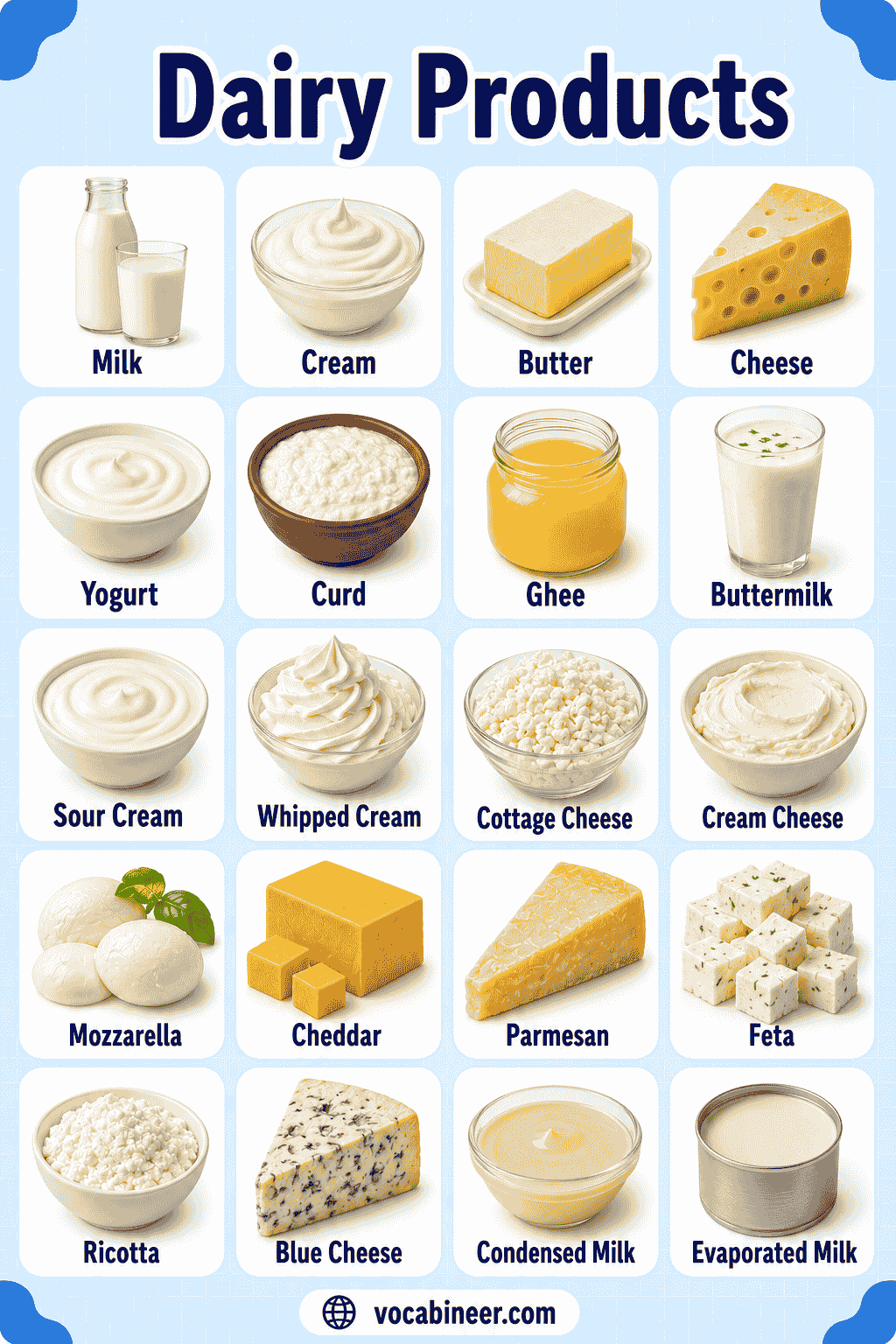
Evaporated milk is concentrated liquid milk with much of its water removed. It usually comes in a can and has a creamy texture without the intense sweetness of sweetened condensed milk.
Sweetened condensed milk combines concentrated milk with added sugar. Its thick, sticky consistency works well in desserts, coffee drinks, sauces, and sweet fillings.
Powdered milk, also called milk powder, contains dry milk solids after producers remove most of the water. People can mix it with water or use the powder directly in baking and packaged foods.
| Product | Main difference | Visual clue |
|---|---|---|
| Evaporated milk | Concentrated liquid milk without heavy added sweetness | Pourable creamy liquid in a can |
| Sweetened condensed milk | Concentrated milk with added sugar | Thick, sticky pale liquid |
| Powdered milk | Milk with most water removed | Fine pale powder |
Do not count milk powder, powdered milk, and dry milk as three completely separate basic products. These names often describe the same general dairy form, although specialized labels may identify whole milk powder or nonfat dry milk.
Cultured Dairy Products
Cultured dairy develops when helpful microorganisms transform milk or cream. These products may taste mild, tangy, sour, creamy, or slightly fermented, depending on the ingredients and process.
Yogurt is a cultured dairy food with a smooth or lightly set texture. It may come plain, sweetened, flavored, spoonable, or drinkable.
Greek yogurt is a thick, concentrated style of yogurt. Producers may create its dense texture through straining or other concentration methods.
Kefir /kəˈfɪr/ or /ˈkɛfɪr/ 🔊 is a fermented milk drink with a pourable consistency and tangy flavor. Although it may resemble drinkable yogurt, kefir uses a distinct fermentation culture.
Buttermilk is a tangy dairy liquid commonly sold in cultured form in the United States. Bakers use it in pancakes, biscuits, cakes, marinades, and dressings.
Sour cream comes from cultured cream rather than ordinary fluid milk. Its thick texture and tangy taste suit baked potatoes, dips, tacos, sauces, and baking recipes.
Skyr /skɪr/ 🔊 is an Icelandic cultured dairy food with a thick, smooth texture. It resembles strained yogurt visually, although its traditional production and classification differ.
| Product | Texture | Familiar form |
|---|---|---|
| Yogurt | Smooth and spoonable or drinkable | Cup, tub, or bottle |
| Greek yogurt | Thick and concentrated | Dense spoonable yogurt |
| Kefir | Thin and pourable | Fermented dairy drink |
| Buttermilk | Thin and tangy | Carton or bottle |
| Sour cream | Thick and creamy | Tub or bowl |
| Skyr | Very thick and smooth | Single cup or larger tub |
Common Cream Products
Cream contains a higher concentration of milk fat than ordinary milk. Different cream names describe fat level, texture, culturing, preparation, or common culinary use.
Half-and-half combines milk and cream to create a light, pourable dairy product. People commonly add it to coffee, soups, sauces, and breakfast dishes.
Heavy cream, also called heavy whipping cream on many U.S. labels, is a rich liquid cream. Cooks use it in sauces, soups, desserts, and whipped toppings.
Whipping cream is liquid cream suitable for whipping. It remains pourable until beating or whisking adds air.
Whipped cream is the fluffy result produced when someone whips cream and incorporates air. It forms soft or firm peaks and commonly tops pies, cakes, fruit, drinks, and ice cream.
Clotted cream is an exceptionally thick cream with a dense, rich texture and a pale yellow surface. People often serve it with scones, jam, and baked goods.
Crème fraîche /ˌkrɛm ˈfrɛʃ/ 🔊 is a smooth cultured cream with a mild tangy flavor. Its rich texture works in sauces, soups, desserts, and toppings.
The words whipping cream and whipped cream do not describe the same stage. Whipping cream remains liquid, while whipped cream becomes light and aerated after beating.
Butter, Clarified Butter, and Ghee
Butter begins with cream. Churning separates and gathers the milk fat, creating a solid product that people use for spreading, cooking, frying, and baking.
Salted and Unsalted Butter
Butter is a solid dairy fat with a pale yellow or creamy color. It usually comes in sticks, blocks, tubs, or wrapped portions.
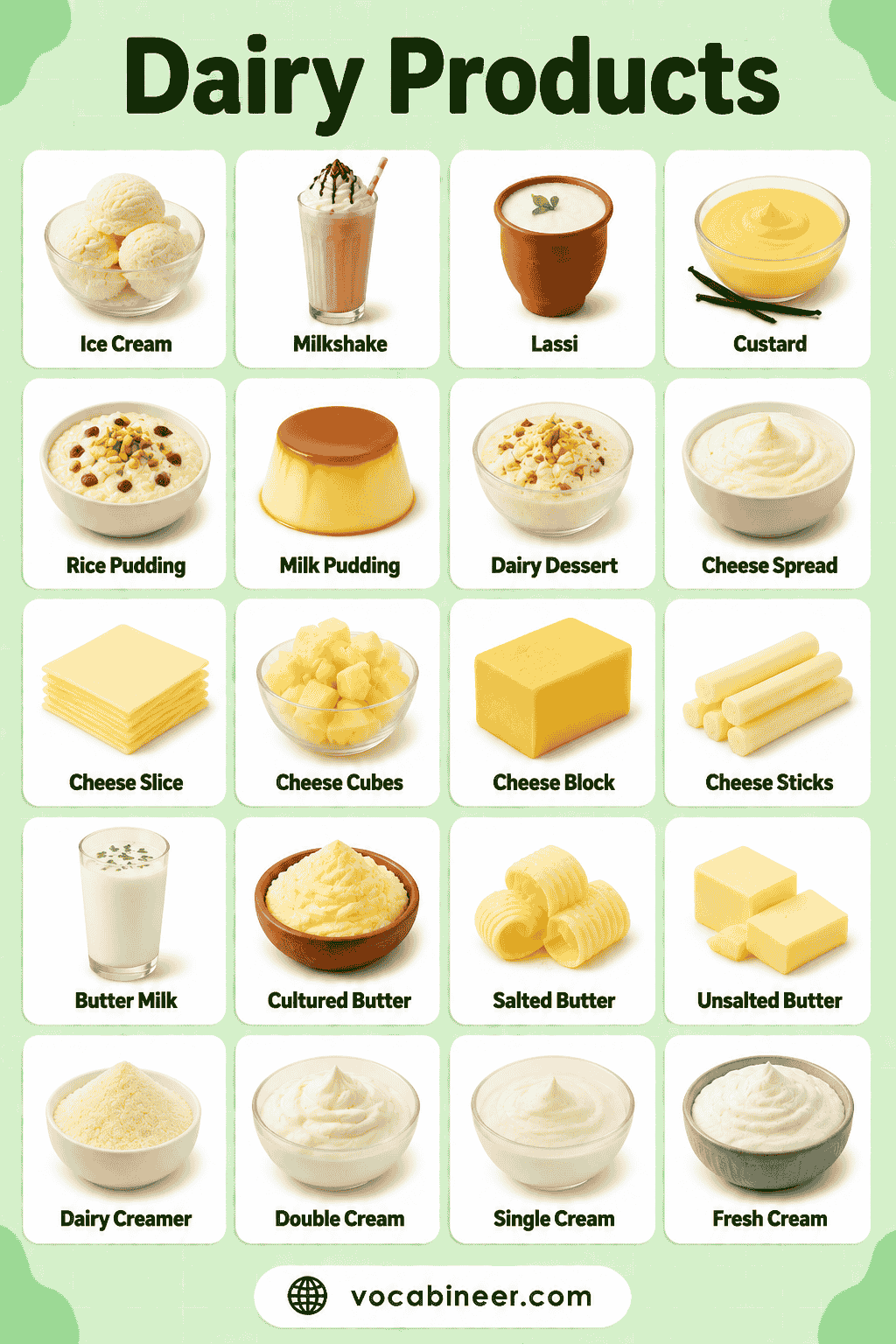
Salted butter contains added salt, which gives it a more savory flavor. People commonly spread it on bread or use it in everyday cooking.
Unsalted butter contains no added salt. Bakers often choose it because they can control the amount of salt in a recipe more precisely.
Salted and unsalted butter share the same basic form. However, the added salt changes flavor and may affect how cooks season the finished dish.
Clarified Butter and Ghee
Clarified butter forms when cooks melt butter and separate the clear fat from water and milk solids. The resulting golden fat handles higher cooking temperatures than ordinary butter.
Ghee /ɡiː/ 🔊 belongs to the clarified-butter family. Cooks usually heat it longer, which develops a deeper aroma, golden color, and lightly toasted flavor.
Although people sometimes use the terms interchangeably, ghee and basic clarified butter may differ in heating time and flavor development. Neither product should appear as ghee butter, because ghee already names the product.
Common Cheese Names
Cheese forms when cheesemakers coagulate milk proteins and separate curds from liquid whey. Moisture level, aging, milk source, cultures, molds, and production methods create hundreds of different cheeses.
A general dairy-products guide should introduce representative cheeses rather than duplicate a complete cheese article.
Fresh, Soft, and Brined Cheeses
Cottage cheese contains loose, moist white curds, often mixed with a creamy dressing. People eat it plain or add it to fruit, salads, breakfast bowls, and cooked dishes.
Cream cheese is a smooth, spreadable fresh cheese with a mild, slightly tangy taste. It commonly appears on bagels, in dips, and in cheesecake fillings.
Ricotta /rɪˈkɑːtə/ 🔊 is a soft, moist cheese with a fine, slightly grainy texture. Cooks often use it in lasagna, stuffed pasta, pastries, and desserts.
Mozzarella /ˌmɑːtsəˈrɛlə/ 🔊 is a mild cheese known for its soft texture and melting ability. Fresh mozzarella commonly appears as white balls, while low-moisture mozzarella often comes in blocks or shreds.
Paneer /pəˈnɪr/ 🔊 is a firm fresh cheese that usually appears as a white block or cubes. It holds its shape during cooking and commonly appears in South Asian dishes.
Feta is a crumbly white cheese commonly associated with brining. Its tangy, salty flavor works well in salads, pastries, grain bowls, and vegetable dishes.
Firm, Aged, and Blue Cheeses
Cheddar is a firm cheese that ranges from pale yellow to deep orange. Its flavor may remain mild in younger varieties or become sharper with aging.
Parmesan is a hard aged cheese with a granular texture and strong umami flavor. People often grate it over pasta, soup, salads, and roasted vegetables.
Swiss cheese is a pale firm cheese commonly recognized by its round holes. It has a mild, nutty flavor and melts well in sandwiches and baked dishes.
Gouda /ˈɡaʊdə/ or /ˈɡuːdə/ 🔊 is a Dutch cheese that may range from smooth and mild to firm and deeply flavored. Aging changes its texture, color, and intensity.
Blue cheese contains blue or green veins created by selected molds. Depending on the variety, it may feel soft, crumbly, creamy, or firm and may taste sharp, tangy, salty, or earthy.
Frozen Dairy Products
Frozen dairy products combine milk, cream, yogurt, or other dairy ingredients with sweeteners and flavorings. Texture, air content, fat, culturing, and egg ingredients help distinguish one frozen product from another.
Ice cream is a frozen dairy dessert with a creamy texture. It commonly contains milk, cream, sugar, and flavorings.
Gelato /dʒəˈlɑːtoʊ/ 🔊 is an Italian-style frozen dairy dessert with a dense, smooth texture. It usually contains less incorporated air than many conventional ice creams.
Frozen yogurt is a frozen dessert made with yogurt or cultured dairy ingredients. It may taste tangier than ice cream and can come in scoops or soft swirls.
Frozen custard combines dairy ingredients with egg yolk ingredients. This combination gives it a rich, smooth texture.
Dairy soft serve is a soft frozen dessert dispensed from a machine. The word dairy matters because some soft-serve products use plant-based or non-dairy formulas.
Dairy Terms Learners Often Confuse
Dairy vocabulary can cause confusion when products share a color, shape, package, or familiar everyday use. The following distinctions correct several common English-learning mistakes.
Why Eggs Are Not Dairy Products
Eggs are not dairy products because birds produce eggs, while mammals produce milk. Grocery stores may display eggs near milk, butter, and cheese, but shelf location does not determine the food category.
Egg whites, egg yolks, boiled eggs, omelets, and mayonnaise also stay outside the dairy family. A dish such as custard may contain both milk and eggs, but the egg ingredient does not become dairy.
Dairy Milk and Plant-Based Milk Alternatives
Dairy milk comes from mammals such as cows, goats, sheep, or buffalo. Plant-based alternatives come from soybeans, oats, almonds, rice, coconut, or other plant ingredients.
Common plant-based alternatives include:
- soy milk
- almond milk
- oat milk
- rice milk
- coconut milk beverage
These drinks may use the word milk on everyday labels, but they do not become animal-derived dairy products. Fortified soy beverages may fit some nutritional food-group systems because of their nutrient profile, yet soy remains a plant source.
Lactose-Free Does Not Mean Dairy-Free
Lactose-free milk still comes from animal milk. Producers remove lactose or break it down, but milk proteins and other dairy components may remain.
Dairy-free describes a product that contains no dairy ingredients. Therefore, someone who avoids milk proteins should not assume that lactose-free milk also counts as dairy-free.
A plant-based label identifies the ingredient source, but readers should still check the full ingredient and allergen information when dairy avoidance matters.
Yogurt, Curd, and Cheese Curds in American English
In South Asian English, people may use curd to mean dahi or yogurt. In American English, yogurt provides the clearest name for the cultured spoonable food.
The plural word curds usually refers to solid pieces that form when milk coagulates. Cottage cheese contains visible soft curds, and cheesemakers separate curds from liquid whey during production.
Therefore, curd and yogurt may overlap regionally, but cheese curds describe a different dairy form.
Paneer and Cottage Cheese Are Not the Same
Paneer and cottage cheese both belong to the fresh-cheese family, but they differ in appearance, texture, and cooking behavior.
Usually sold as a firm white block, paneer can be cut into cubes and keeps its shape during frying, simmering, or grilling.
By contrast, cottage cheese contains loose, moist curds in a creamy dressing. It typically comes in a tub and works as a spoonable food rather than a firm cheese for cooking.
Treating cottage cheese as a direct American English replacement for paneer can lead to inaccurate pictures and descriptions.
Dairy Products and Dairy-Based Foods
Basic dairy products come directly from milk processing. Examples include milk, yogurt, butter, cream, cheese, and milk powder.
Dairy-based foods combine dairy with ingredients from other categories. Common examples include:
- cheesecake
- custard
- pudding
- milkshakes
- creamy soups
- cheese sauces
- milk chocolate
- cakes made with butter or milk
A cheesecake contains cheese, sugar, eggs, and a crust, so it belongs to desserts rather than the core dairy-product list. Similarly, a milkshake uses dairy ingredients but functions as a prepared drink.
FAQs
The main dairy products include milk, yogurt, cream, butter, cheese, evaporated milk, sweetened condensed milk, powdered milk, and dairy-based frozen desserts.
No. Birds produce eggs, while dairy products come from the milk of mammals. Eggs and milk belong to separate food categories.
Yes, lactose-free cow’s milk, goat milk, or other animal milk remains dairy. Producers change or remove the lactose, but the product still comes from animal milk.
No. Almond milk and oat milk are plant-based milk alternatives. They may resemble dairy milk in appearance or use, but they do not come from animal milk.
Paneer is a firm fresh cheese that usually appears as a block or cubes. Cottage cheese contains loose, moist curds and usually comes in a creamy, spoonable form.
Read More
- Baking Tools Name
- Healthy Foods Name
- Bakery Items Names
- Sour Food Names
- Sweet Food Names
- Salty Food Names