Mattresses are soft or supportive sleeping surfaces placed on beds, frames, platforms, floors, or adjustable bases. Different types of mattresses use different materials, layers, springs, foam, latex, air chambers, or special support systems.
In this guide, you will learn common types of mattresses with names, simple meanings, best uses, materials, foam types, spring and hybrid types, firmness levels, specialty mattresses, mattress sizes, confusing terms, and picture chart ideas.
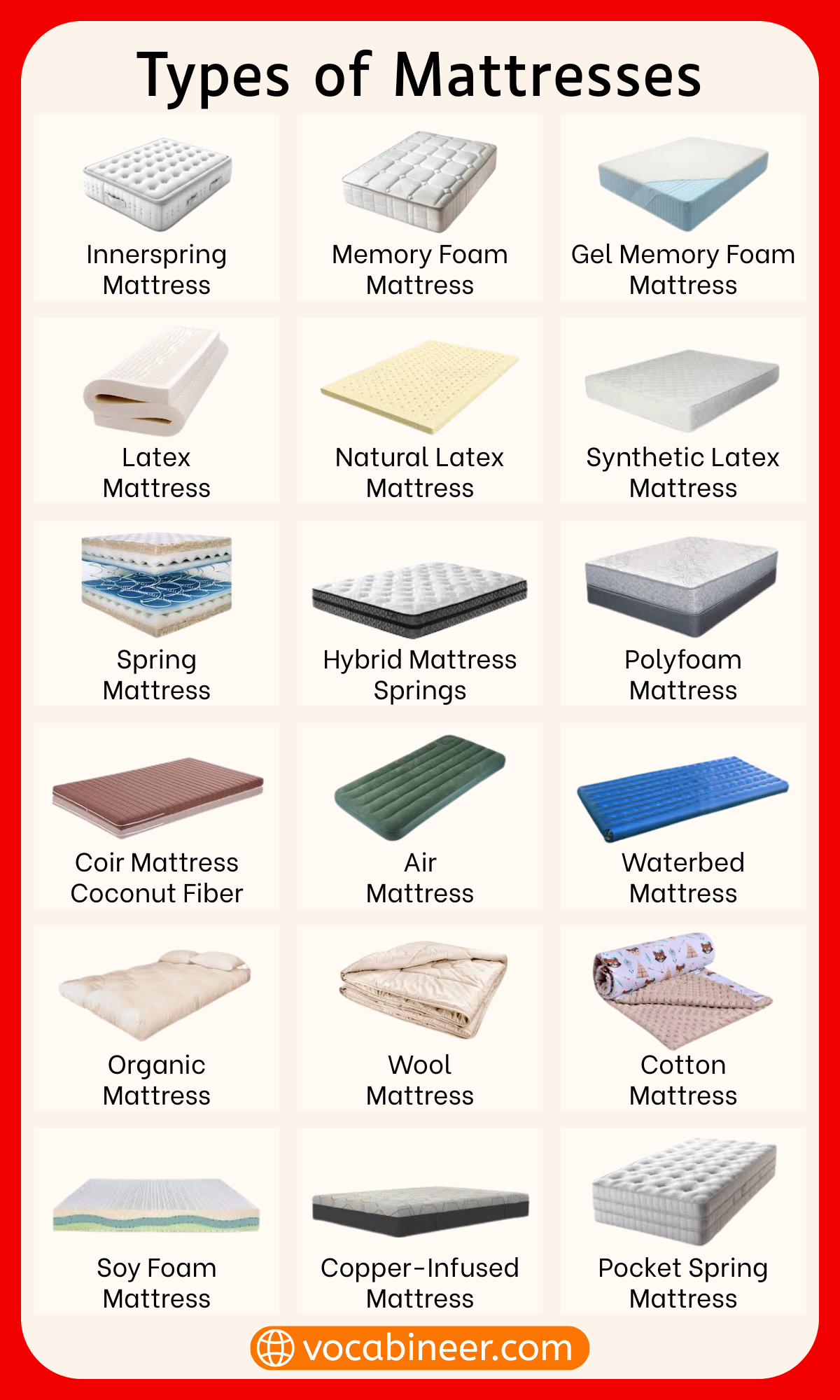
In This Page
Common Types of Mattresses
Mattresses come in different materials, firmness levels, and support systems to suit different sleeping preferences. Common mattress types include foam, spring, latex, hybrid, and air-based designs, each with its own feel, structure, and level of support.
Innerspring Mattress
An innerspring mattress uses a system of metal coils for support and usually has a cushioned comfort layer on top.
Memory Foam Mattress
A memory foam mattress uses pressure-sensitive foam that molds to the body and provides a soft, contouring feel.
Latex Mattress
A latex mattress is made from natural, synthetic, or blended latex and is known for its responsive and supportive surface.
Hybrid Mattress
A hybrid mattress combines coils with foam or latex layers to provide both support and cushioning.
Foam Mattress
A foam mattress is made mainly from layers of polyurethane or other foams and does not use traditional metal springs.
Gel Memory Foam Mattress
A gel memory foam mattress contains gel-infused foam designed to provide the contouring feel of memory foam with improved heat distribution.
Pocket Spring Mattress
A pocket spring mattress uses individually wrapped coils that move separately and help reduce motion transfer across the bed.
Continuous Coil Mattress
A continuous coil mattress uses a single connected wire system shaped into multiple coils for support.
Pillow-Top Mattress
A pillow-top mattress has an extra soft layer sewn onto the top surface to provide additional cushioning.
Euro-Top Mattress
A Euro-top mattress has an additional padded comfort layer that is stitched flush with the edges for a more uniform appearance.
Air Mattress
An air mattress uses inflatable air chambers instead of foam or springs as its main support system.
Adjustable Air Mattress
An adjustable air mattress uses air chambers that can be inflated or deflated to change the firmness level.
Futon Mattress
A futon mattress is a flexible mattress designed for a futon frame that can often be used as both a bed and a sofa.
Waterbed Mattress
A waterbed mattress uses water-filled chambers to create a flexible sleeping surface.
Orthopedic Mattress
An orthopedic mattress is designed to provide firm, even support and is commonly marketed for improved body alignment and pressure distribution.
Plush Mattress
A plush mattress has a softer comfort surface with extra cushioning for people who prefer a gentler feel.
Firm Mattress
A firm mattress has a harder sleeping surface with less sinkage and stronger resistance under the body.
Natural Mattress
A natural mattress is made with materials such as natural latex, wool, cotton, or other plant- and animal-based fibers.
Cooling Mattress
A cooling mattress uses breathable materials, cooling foams, or temperature-regulating layers to reduce heat buildup during sleep.
Foldable Mattress
A foldable mattress is made in sections that can be folded for storage, travel, guests, or temporary sleeping arrangements.
Mattress Types and Their Simple Meanings
Simple meanings help readers understand mattress names before comparing comfort, support, or price.
| Mattress Type | Simple Meaning |
|---|---|
| Memory Foam Mattress | A foam mattress that shapes around the body. |
| Innerspring Mattress | A mattress with metal coils inside for support. |
| Hybrid Mattress | A mattress that combines springs with foam or latex layers. |
| Latex Mattress | A mattress made from latex for a bouncy and supportive feel. |
| Gel Mattress | A mattress with gel material for cooler comfort. |
| Foam Mattress | A mattress made mostly from foam layers. |
| Pillow-Top Mattress | A mattress with an extra soft cushion layer on top. |
| Euro-Top Mattress | A mattress with a padded top layer that looks flat and smooth. |
| Air Mattress | A mattress filled with air. |
| Smart Mattress | A mattress with advanced features like tracking or adjustable comfort. |
| Futon Mattress | A flexible mattress used on a futon frame or floor. |
| Crib Mattress | A small mattress made for a baby crib. |
Mattress Types and Best Uses
Different mattress types suit different sleeping styles, rooms, budgets, and comfort needs.
| Mattress Type | Best Use |
|---|---|
| Memory Foam Mattress | Pressure relief and body-hugging comfort. |
| Innerspring Mattress | Strong bounce, airflow, and traditional support. |
| Hybrid Mattress | Balanced comfort, support, and motion control. |
| Latex Mattress | Responsive support and long-lasting comfort. |
| Gel Mattress | Cooler sleep and softer foam comfort. |
| Foam Mattress | Lightweight, affordable, and simple bedding. |
| Pillow-Top Mattress | Extra softness on the surface. |
| Air Mattress | Guests, travel, camping, or temporary sleep. |
| Futon Mattress | Small rooms, floor sleeping, and sofa beds. |
| Crib Mattress | Safe and firm support for baby cribs. |
Mattress Materials and Construction Types
Mattress construction affects support, comfort, breathability, motion transfer, durability, and overall sleep feel.
- Foam Mattress — uses foam layers for comfort and support.
- Memory Foam Mattress — uses body-hugging foam that responds to pressure.
- Latex Mattress — uses natural or synthetic latex for bounce and support.
- Innerspring Mattress — uses a coil system as the main support layer.
- Hybrid Mattress — combines coils with foam, latex, or gel layers.
- Gel Memory Foam Mattress — includes gel foam for a cooler feel.
- Pillow-Top Mattress — adds a soft cushioned layer above the main mattress.
- Euro-Top Mattress — adds padding that sits flush with the mattress edges.
- Pocket Coil Mattress — uses individually wrapped coils for targeted support.
- Zoned Support Mattress — gives different support levels to different body areas.
- High-Density Foam Mattress — uses firmer foam for stronger support.
- Natural Latex Mattress — uses latex made from rubber tree sap.
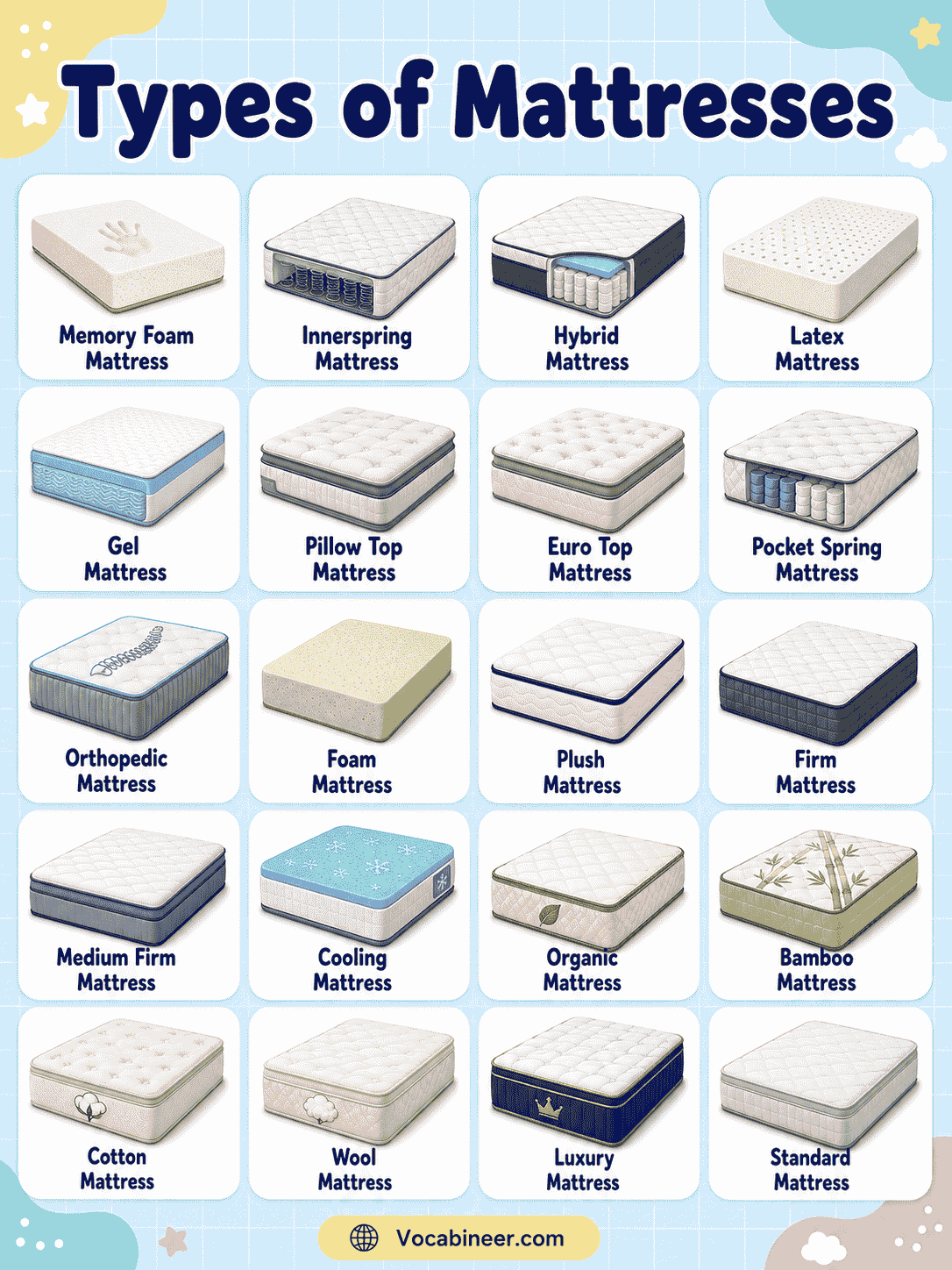
Foam Mattress Types Explained
Foam mattresses are popular because they can feel soft, supportive, quiet, and pressure-relieving.
- Memory Foam Mattress — molds closely to the body and reduces pressure points.
- Gel Memory Foam Mattress — adds gel material to help reduce heat.
- Polyfoam Mattress — uses polyurethane foam for comfort or support.
- High-Density Foam Mattress — feels firmer and more supportive.
- Open-Cell Foam Mattress — allows better airflow than dense foam.
- Reflex Foam Mattress — gives firmer support and quicker response.
- Convoluted Foam Mattress — has an egg-crate surface that improves airflow and cushioning.
- Foam Mattress in a Box — compressed and rolled for easier delivery.
- Cooling Foam Mattress — uses foam designed to reduce heat buildup.
- Pressure-Relief Foam Mattress — cushions shoulders, hips, and other pressure points.
Spring, Coil, and Hybrid Mattress Types
Spring and coil mattresses use metal support systems, while hybrid mattresses combine coils with comfort layers.
- Innerspring Mattress — traditional mattress with metal coils inside.
- Pocket Coil Mattress — uses individually wrapped coils that move separately.
- Bonnell Coil Mattress — uses hourglass-shaped coils for basic support.
- Offset Coil Mattress — uses hinged coils that respond to body movement.
- Continuous Coil Mattress — uses coils made from one continuous wire system.
- Zoned Coil Mattress — gives different support to areas like shoulders, back, and hips.
- Hybrid Mattress — combines coils with foam, latex, or gel layers.
- Latex Hybrid Mattress — combines latex comfort layers with a coil support core.
- Memory Foam Hybrid Mattress — combines memory foam with pocket coils.
- Pillow-Top Innerspring Mattress — adds a soft top layer to a spring mattress.
Mattresses for Different Sleeping Positions
Your sleeping position can affect which mattress type feels most comfortable and supportive.
- Mattress for Side Sleepers — usually needs pressure relief around the shoulders and hips.
- Mattress for Back Sleepers — often needs balanced support for the lower back.
- Mattress for Stomach Sleepers — usually needs a firmer surface to reduce sinking.
- Mattress for Combination Sleepers — should feel responsive and easy to move on.
- Mattress for Hot Sleepers — may need breathable coils, latex, gel foam, or cooling layers.
- Mattress for Heavy Sleepers — often needs stronger support and durable materials.
- Mattress for Couples — should reduce motion transfer and offer good edge support.
- Mattress for Light Sleepers — may need motion isolation and quiet materials.
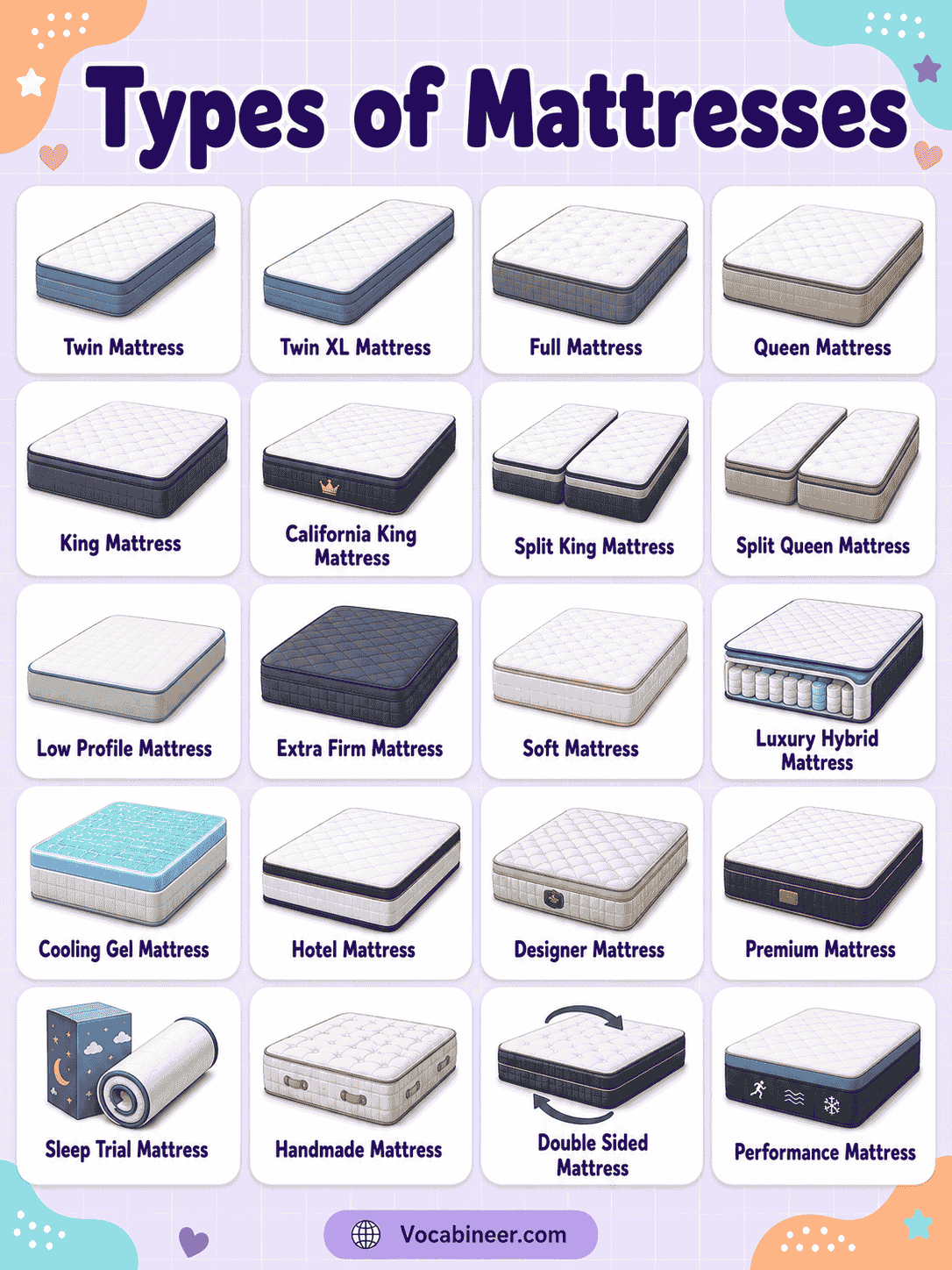
Mattress Firmness Types
Firmness describes how soft or hard a mattress feels when you lie on it.
- Soft Mattress — gives more cushioning and a plush feel.
- Medium Mattress — offers a balance of softness and support.
- Medium-Firm Mattress — gives balanced comfort and stronger support.
- Firm Mattress — feels harder and supports the body with less sinking.
- Extra-Firm Mattress — gives very strong support with minimal softness.
- Plush Mattress — feels soft, cushioned, and cozy on top.
- Responsive Mattress — quickly moves back when pressure changes.
- Pressure-Relieving Mattress — cushions pressure points like shoulders and hips.
- Motion-Isolating Mattress — reduces movement transfer across the bed.
- Supportive Mattress — keeps the body more stable during sleep.
Specialty Mattress Types
Specialty mattresses are designed for specific spaces, health needs, travel, babies, or modern comfort features.
- Orthopedic Mattress — offers firm support for the back and body.
- Adjustable Air Mattress — lets users change firmness with air chambers.
- Smart Mattress — includes features such as sleep tracking or adjustable settings.
- Waterbed Mattress — uses water as the main support system.
- Futon Mattress — works on a futon frame or floor.
- Floor Mattress — designed for sleeping directly on the floor.
- Roll-Up Mattress — rolls up for storage or transport.
- Mattress in a Box — compressed mattress shipped in a box.
- Crib Mattress — small and firm mattress for a baby crib.
- RV Mattress — sized for recreational vehicles.
- Hospital Mattress — made for medical beds and patient support.
- Sofa Bed Mattress — used inside a sleeper sofa.
Mattress Sizes and Where They Are Used
Mattress size matters because each size fits a different bed frame, room size, sleeper type, or age group.
- Twin Mattress — used for children, single sleepers, small rooms, and bunk beds.
- Twin XL Mattress — longer than a twin and common in dorm rooms.
- Full Mattress — wider than a twin and useful for teens or single adults.
- Queen Mattress — popular for couples and main bedrooms.
- King Mattress — wide mattress for couples who want more space.
- California King Mattress — longer mattress for taller sleepers.
- Crib Mattress — small mattress for baby cribs.
- Toddler Mattress — small mattress for toddler beds.
- RV Mattress — designed for campers and recreational vehicles.
- Split King Mattress — two separate mattresses used together on adjustable bases.
Confusing Mattress Terms Explained
Some mattress terms sound similar, but they describe different products, layers, or comfort features.
| Mattress Terms | Difference |
|---|---|
| Mattress vs Bed | A mattress is the cushioned sleep surface, while a bed includes the frame and mattress. |
| Mattress vs Mattress Topper | A mattress is the main sleep surface, while a topper adds extra comfort on top. |
| Memory Foam vs Latex Mattress | Memory foam hugs the body more, while latex feels bouncier and more responsive. |
| Innerspring vs Hybrid Mattress | Innerspring mattresses focus on coils, while hybrids combine coils with foam or latex comfort layers. |
| Pillow Top vs Euro Top Mattress | A pillow top has an extra sewn-on layer, while a Euro top looks more flush with the mattress edges. |
| Soft vs Firm Mattress | A soft mattress gives more cushioning, while a firm mattress gives stronger support. |
| Air Mattress vs Adjustable Air Mattress | A basic air mattress is usually temporary, while an adjustable air mattress lets users change firmness. |
Types of Mattresses Chart with Pictures
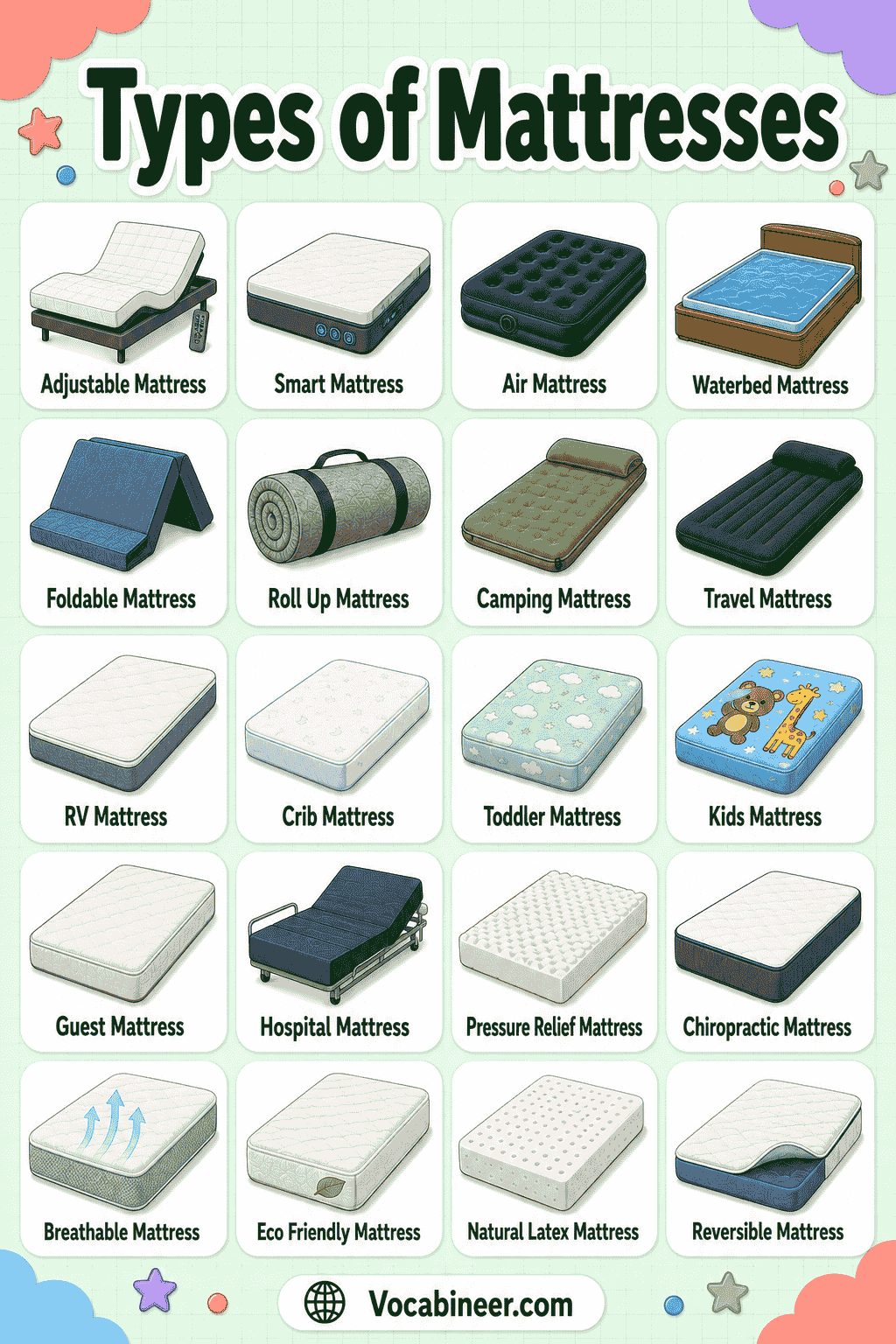
A mattress chart helps readers compare mattress groups quickly by purpose, comfort, and examples.
| Mattress Group | Details |
|---|---|
| Foam Mattresses | Best for: pressure relief and body contouringExamples: memory foam mattress, gel foam mattress, polyfoam mattress |
| Spring Mattresses | Best for: bounce, airflow, and traditional supportExamples: innerspring mattress, Bonnell coil mattress, pocket coil mattress |
| Hybrid Mattresses | Best for: balanced comfort and supportExamples: memory foam hybrid, latex hybrid, pillow-top hybrid |
| Latex Mattresses | Best for: responsive support and durabilityExamples: natural latex mattress, synthetic latex mattress, latex hybrid |
| Firmness Types | Best for: matching comfort preferenceExamples: soft mattress, medium-firm mattress, firm mattress |
| Specialty Mattresses | Best for: specific spaces or needsExamples: crib mattress, RV mattress, hospital mattress |
| Temporary Mattresses | Best for: guests, travel, and small spacesExamples: air mattress, futon mattress, roll-up mattress |
How to Choose the Right Type of Mattress
Choosing the right mattress depends on sleeping position, body support, firmness, material, room size, budget, and how long you plan to use it. Side sleepers often need pressure relief around the shoulders and hips, while stomach sleepers usually need a firmer surface. Back sleepers may feel comfortable on a medium-firm mattress because it supports the spine without feeling too hard.
Material also matters. Memory foam is useful for body contouring, latex feels more responsive, innerspring mattresses offer bounce, and hybrids combine support with comfort layers. For hot sleepers, breathable coils, latex, or gel foam may feel better. For guest rooms, travel, or small spaces, an air mattress, futon mattress, or roll-up mattress may be more practical.
FAQs
The main types of mattresses include memory foam mattresses, innerspring mattresses, hybrid mattresses, latex mattresses, gel mattresses, foam mattresses, pillow-top mattresses, air mattresses, and smart mattresses.
A medium-firm mattress, latex mattress, memory foam mattress, hybrid mattress, or orthopedic mattress may help support the back better. However, the best choice depends on body weight, sleeping position, and personal comfort.
A memory foam mattress uses foam layers that mold around the body, while a hybrid mattress combines coils with foam, latex, or gel comfort layers.
Side sleepers often prefer memory foam, latex, hybrid, or medium-soft mattresses because these options can cushion the shoulders and hips.
Latex mattresses and high-quality hybrid mattresses often last longer than many basic foam or innerspring mattresses because they use durable support materials.
Read More
- Decoration Items Names
- Household Items Names
- Different Types of Blankets
- Baby Care Items Names
- First Aid Kit Items Names
- Living Room Items Names