

Since and for help learners describe time accurately by showing either when a period began or how long it lasted. Using the correct word makes sentences about duration, ongoing situations, past periods, and continuing actions much clearer.
The main difference is simple: since identifies a starting point, while for identifies a duration. This article explains how both forms work with Present Perfect, Present Perfect Continuous, Past Simple, Past Perfect, and future time, along with common mistakes and useful comparisons.
In This Page
Since vs For: What Is the Difference?
The core difference is:
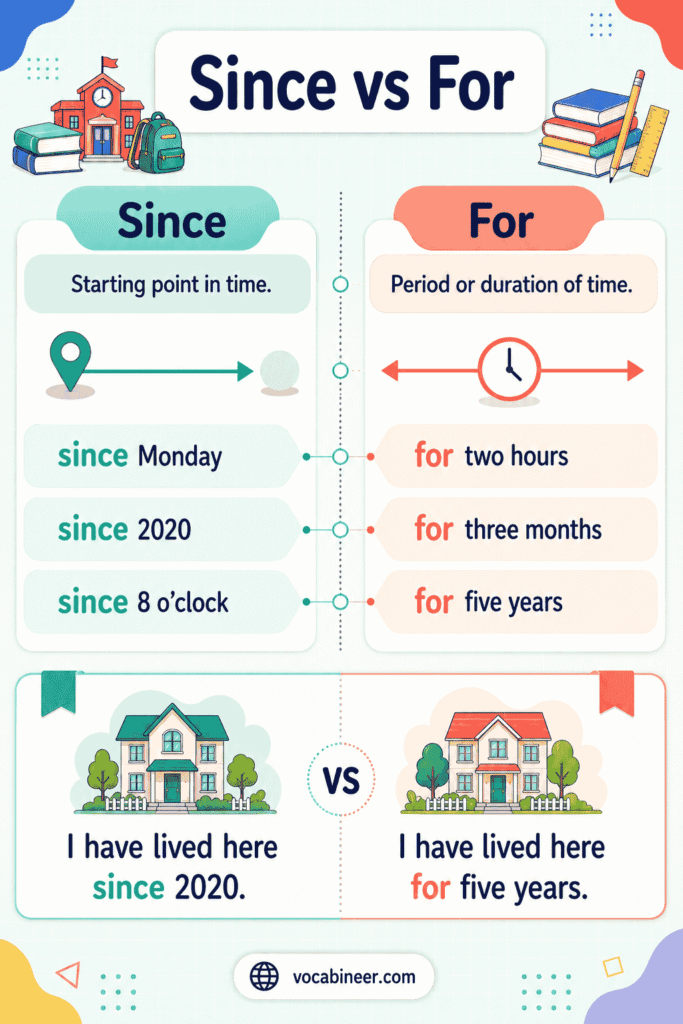
| Since | For |
|---|---|
| identifies a starting point | identifies a duration |
| answers From when? | answers How long? |
| since Monday | for three days |
| since 2020 | for five years |
| since six o’clock | for two hours |
| since I arrived | for a long time |
A useful rule is:
Since tells us when a period began; for tells us how long the period lasted or has lasted.
Since vs For at a Glance
| Time Meaning | Since | For |
|---|---|---|
| day | since Monday | for three days |
| year | since 2020 | for five years |
| clock time | since 8 o’clock | for two hours |
| event | since I arrived | for several months |
| vague period | since childhood | for a long time |
| recent point | since yesterday | for a day |
The distinction stays the same even when the tense changes.
Use Since for a Starting Point
Since identifies the point at which an activity, state, or period began.
Common patterns include:
- since Monday
- since yesterday
- since last week
- since 2020
- since noon
- since six o’clock
- since childhood
- since breakfast
- since I arrived
- since she moved here
Examples:
- I have lived here since 2020.
- She has been waiting since six o’clock.
- We have known each other since school.
- He had worked there since 2015 before the company closed.
Use this principle:
Since points back to the beginning of a time period.
Use For for a Duration
For measures the length of time.
Common patterns include:
- for five minutes
- for two hours
- for three days
- for six months
- for ten years
- for a long time
- for ages
- for several weeks
- for a short while
Examples:
- I have lived here for five years.
- She has been waiting for two hours.
- We worked there for three years.
- They are staying for a week.
Use this principle:
For measures the length of time; it does not identify the exact starting point.
Starting Point vs Duration
This is the main comparison.
| Starting Point | Duration |
|---|---|
| since Monday | for three days |
| since 2019 | for seven years |
| since breakfast | for two hours |
| since I arrived | for a long time |
| since last summer | for several months |
A simple decision rule is:
Choose since when you can name the beginning; choose for when you can measure the length.
Since and For with Present Perfect
Present Perfect is one of the most common contexts for since and for.
Examples:
- I have lived here since 2020.
- I have lived here for six years.
- She has known him since school.
- They have been married for twenty years.
With Present Perfect, both expressions connect a past starting period with the present.
Use this principle:
Since gives the starting point, while for gives the duration leading up to the present.
Since and For with Present Perfect Continuous
Both expressions also work naturally with Present Perfect Continuous.
Examples:
- I have been waiting since eight.
- I have been waiting for two hours.
- She has been studying since breakfast.
- They have been working for three hours.
The meaning of since and for does not change.
Since = starting point; for = duration.
Present Perfect vs Present Perfect Continuous with Since and For
Since and for can occur with both perfect forms.
| Present Perfect | Present Perfect Continuous |
|---|---|
| I have known her for ten years. | I have been working here for ten years. |
| She has owned the house since 2015. | She has been living there since 2015. |
| often describes a state or established situation | often emphasizes an ongoing activity |
The choice between the two tenses depends on verb meaning and emphasis.
Use this principle:
Since and for do not choose between Present Perfect Simple and Present Perfect Continuous by themselves.
Are Since and For Only Used with Present Perfect?
No.
Since and for express time relationships, so they can appear in several tense contexts.
| Tense | Example |
|---|---|
| Past Simple | I lived there for three years. |
| Present Perfect | I have lived there for three years. |
| Past Perfect | I had lived there for three years before moving. |
| Future | I will stay there for three years. |
Since also works in earlier-past perfect contexts:
- She had lived there since 2012 before moving.
- They had been waiting since noon.
Use this core correction:
Since and for are time expressions, not Present Perfect-only signal words.
For with Past Simple
For can describe a completed duration in the past.
Examples:
- I lived in New York for three years.
- She worked there for six months.
- We waited for an hour.
- They stayed with us for a week.
Compare:
| Past Simple | Present Perfect |
|---|---|
| I lived there for five years. | I have lived there for five years. |
| finished duration | duration connected to the present |
Use this principle:
For can describe either a finished duration or a duration connected to the present; the tense determines the wider meaning.
Since and For with Past Perfect
With Past Perfect, since and for measure time leading up to another point in the past.
Examples:
- He had worked there for ten years before the factory closed.
- She had lived there since 2012 before moving abroad.
- They had been waiting for hours when the bus arrived.
- I had been studying since noon.
Use this principle:
In Past Perfect contexts, since and for measure time up to another past reference point rather than up to now.
For with Future Time
For can also describe future duration.
Examples:
- I will stay there for a week.
- We are travelling for ten days.
- She is going to work there for six months.
- They will be away for two weeks.
Use this teaching point:
For can measure duration in past, present, or future time.
Since with a Clause
Since can introduce a clause that identifies the event marking the beginning of a period.
Examples:
- I have lived here since I left school.
- She has felt better since she changed jobs.
- We have been meeting regularly since the course started.
- He has worked remotely since he moved abroad.
Use this principle:
A since-clause identifies the event that marks the starting point.
Since + Past Simple Clause
A very common structure is:
Present Perfect + since + Past Simple
Examples:
- I have known her since we were children.
- He has worked here since he graduated.
- She has been happier since she moved house.
- We have stayed in touch since we left university.
The main clause describes the period from the starting event onward, while the Past Simple clause identifies that event.
How Long with Since and For
Both expressions commonly answer How long…?
Examples:
- How long have you lived here?
- For six years.
- Since 2020.
Another example:
- How long have you been waiting?
- For two hours.
- Since eight o’clock.
Use this teaching point:
For answers How long? with a duration, while since answers with a starting point.
Since vs For with the Same Situation
Both expressions can describe the same real period from different perspectives.
| Since | For |
|---|---|
| I have lived here since 2020. | I have lived here for six years. |
| starting point | duration |
| She has worked here since Monday. | She has worked here for five days. |
| beginning | length |
Use this principle:
Since and for can describe the same period, but they measure it differently.
Since vs From
Since and from both refer to beginnings, but they are used differently.
| Since | From |
|---|---|
| starting point connected to a later reference time | beginning of a bounded period |
| I have lived here since 2020. | I lived there from 2020 to 2024. |
| She has worked here since Monday. | She worked from Monday to Friday. |
Incorrect:
- I worked there since 2015 to 2020.
Correct:
- I worked there from 2015 to 2020.
Use this principle:
Use since for a starting point extending to a later reference point; use from for the beginning of a bounded period, often with to or until.
Since vs Ago
Since and ago express time differently.
| Since | Ago |
|---|---|
| identifies a starting point | locates a past point by counting backward from now |
| since 2024 | two years ago |
| connects a beginning to a later reference point | commonly describes when a past event happened |
Compare:
- I have lived here since 2024.
- I moved here two years ago.
The forms for two years and since 2024 are usually simpler ways to describe the continuing duration.
Since vs For with Yesterday, Last, and Ago
These expressions often create confusion.
Correct with since:
- since yesterday
- since last week
- since last year
Correct with for:
- for two days
- for three weeks
- for five years
Without since, expressions such as yesterday, last year, and ago can identify finished past time:
- I worked yesterday.
- She lived there last year.
- We moved two years ago.
The complete time relationship determines the tense and meaning.
Common Since Expressions
Common starting-point expressions include:
- since Monday
- since yesterday
- since last week
- since last month
- since 2020
- since childhood
- since breakfast
- since noon
- since six o’clock
- since I arrived
Common For Expressions
Common duration expressions include:
- for five minutes
- for two hours
- for three days
- for six months
- for ten years
- for a long time
- for ages
- for several weeks
- for the whole day
- for a short while
These are common time patterns rather than tense-specific rules.
Common Since vs For Mistakes
Learners often make mistakes when they confuse a starting point with a duration or treat since and for as fixed tense signals.
Using since with a duration
Incorrect:
- I have lived here since five years.
Correct:
- I have lived here for five years.
Using for with a starting point
Incorrect:
- I have lived here for 2020.
Correct:
- I have lived here since 2020.
Using since with a length of time
Incorrect:
- She has been waiting since three hours.
Correct:
- She has been waiting for three hours.
Using for with a clock time
Incorrect:
- She has been waiting for eight o’clock.
Correct:
- She has been waiting since eight o’clock.
Assuming for requires Present Perfect
Incorrect rule:
for = Present Perfect
Compare:
- I lived there for three years.
- I have lived there for three years.
- I will stay there for three years.
Use this principle:
For gives the duration; the tense gives the wider time frame.
Assuming since and for mean the situation still continues
That depends on the tense.
| Finished | Connected to the Present |
|---|---|
| I lived there for five years. | I have lived there for five years. |
| finished duration | duration extending to the present |
For alone does not say whether the situation continues.
Confusing since with from
Incorrect:
- I worked there since 2015 to 2020.
Correct:
- I worked there from 2015 to 2020.
Assuming since must be followed by a date or clock time
Incorrect rule:
Since can only be followed by a time expression.
Correct:
- since I arrived
- since she left
- since we met
- since the course started
Treating since and for as tense triggers
Incorrect rule:
since / for = Present Perfect
Better principle:
Since and for describe time relationships; the tense comes from the wider meaning of the sentence.
Confusing time since with since meaning because
Compare:
- I have lived here since 2020.
Here, since marks time. - Since you are here, we can start.
Here, since means approximately because.
The second meaning is separate from the time comparison between since and for.
Frequently Asked Questions
What is the main difference between since and for?
Since identifies the starting point of a period, while for identifies its duration.
Is it since five years or for five years?
The correct form is for five years because five years is a duration. Use since with a starting point, such as since 2021.
Can since and for be used with tenses other than Present Perfect?
Yes. For can appear with past, present, and future forms, while since can also occur with other perfect-time relationships, including Past Perfect.
Can since be followed by a clause?
Yes. A clause can identify the starting event, as in I have lived here since I left school.
What is the difference between since and from?
Since connects a starting point to a later reference time, while from commonly marks the beginning of a bounded period, often with to or until.
/