Present tenses describe situations connected with the present, but they do not all express the same grammatical meaning. Present Simple commonly marks general or repeated situations, Present Continuous marks ongoing or temporary activity, Present Perfect relates an earlier situation to the present, and Present Perfect Continuous marks earlier ongoing activity or duration in relation to the present.
English learner grammar commonly uses four present tense forms: Present Simple, Present Continuous, Present Perfect, and Present Perfect Continuous. Understanding the differences among these forms makes tense choice more accurate in everyday speaking and writing.
In This Page
What Are the Present Tenses?
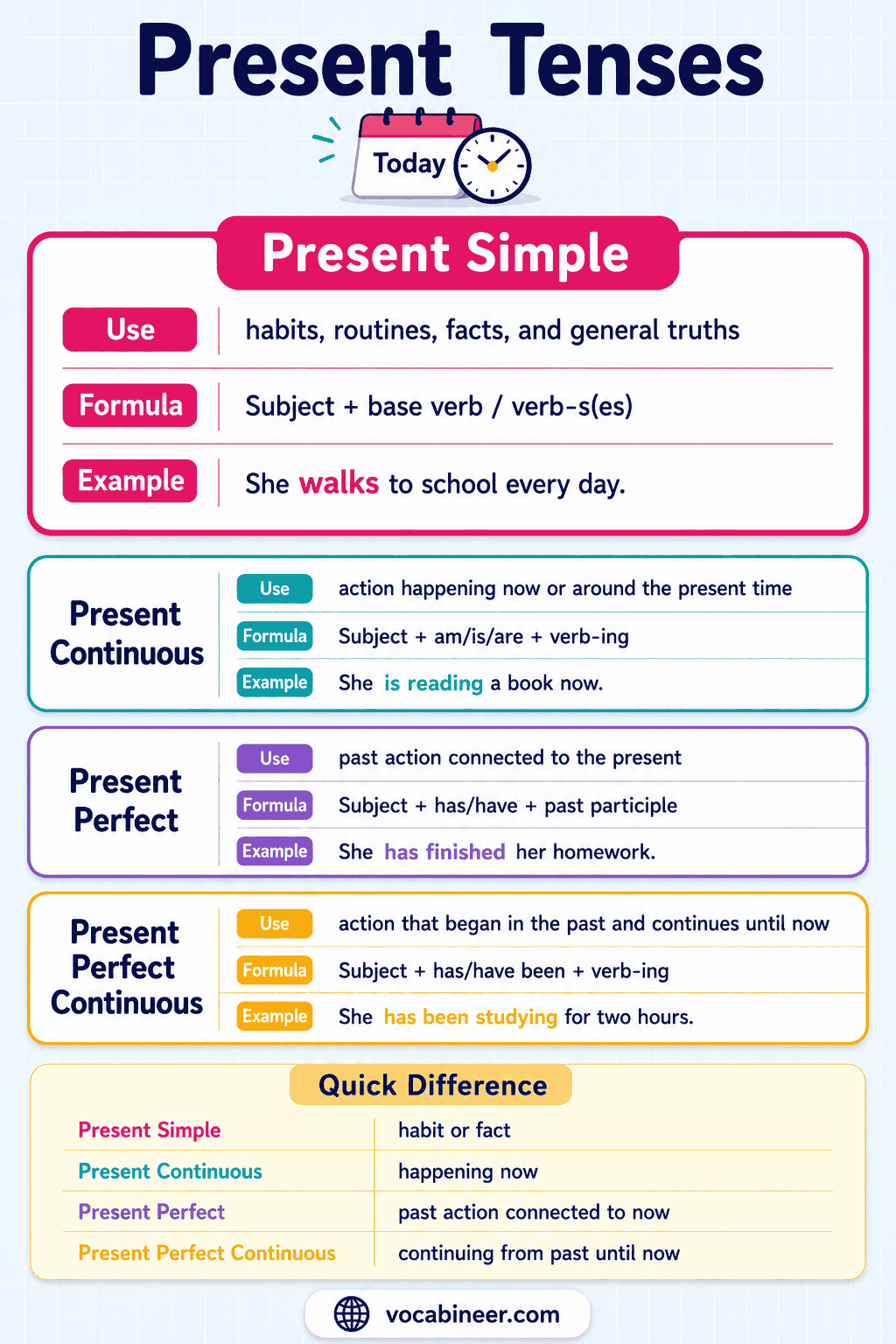
The present tense system commonly includes four forms:
- Present Simple
- Present Continuous
- Present Perfect
- Present Perfect Continuous
Each form marks a different grammatical relationship.
Present Simple commonly describes general, repeated, or stative situations. Present Continuous marks activity in progress or temporary situations. Present Perfect relates an earlier event or state to the present, whereas Present Perfect Continuous relates earlier ongoing activity or duration to the present.
Four Present Tenses at a Glance
The following table summarizes the basic structure and main function of each present tense.
| Present Tense | Basic Structure | Main Function | Example |
|---|---|---|---|
| Present Simple | S + V1 / V1+s | general, repeated, or stative situation | She works here. |
| Present Continuous | S + am/is/are + V-ing | ongoing, temporary, or developing activity | She is working now. |
| Present Perfect | S + have/has + V3 | earlier situation related to the present | She has worked here before. |
| Present Perfect Continuous | S + have/has + been + V-ing | earlier ongoing activity or duration related to the present | She has been working since morning. |
Here, S means subject, V1 means the base form of the verb, and V3 means the past participle.
Present Simple
Present Simple commonly marks habits, routines, repeated actions, facts, states, and scheduled events.
Structure: S + V1 / V1+s
Examples:
- Mia walks to school every morning.
- We visit our grandparents on Sundays.
- Water boils at 100°C at sea level.
- I prefer tea without sugar.
- The train leaves at 8:15 tomorrow.
The first two examples describe repeated situations. The third states a general fact, while the fourth contains a stative verb. The final example uses Present Simple for a fixed schedule with future reference.
Present Simple with He, She, and It
With he, she, and it, an ordinary verb usually takes -s or -es in an affirmative sentence.
- work → works
- read → reads
- go → goes
- watch → watches
- study → studies
For example:
She works at a bank.
Negative and question forms use does + V1.
She does not work on Sundays.
Does she work here?
After does, the main verb remains in its base form.
Correct:
Does he play tennis?
Incorrect:
Does he plays tennis?
Present Simple with Be
The verb be uses its own Present Simple forms:
- I → am
- he/she/it → is
- you/we/they → are
Examples:
I am ready.
She is tired.
They are at school.
The basic negative and question forms do not require do or does:
She is not tired.
Is she tired?
Present Continuous
Present Continuous, also called Present Progressive, marks activity in progress, temporary situations, changing conditions, and arranged future events.
Structure: S + am/is/are + V-ing
Examples:
- Daniel is studying now.
- We are staying with friends this week.
- The weather is getting warmer.
- Prices are rising quickly.
- I am meeting my dentist tomorrow.
The first example marks activity in progress. The second describes a temporary situation, while the third and fourth mark changing conditions. The final example uses Present Continuous for a future arrangement.
Present Continuous and Stative Verbs
Many stative verbs normally use Present Simple when they express states rather than activities.
Common examples include:
- know
- believe
- own
- need
- prefer
- understand
Correct:
I know the answer.
Not normally:
I am knowing the answer.
Similarly:
She owns that house.
is normally more appropriate than:
She is owning that house.
Some stative verbs can occur in continuous forms when their meaning changes, so the restriction is not absolute.
Present Perfect
Present Perfect relates an earlier event, experience, result, or state to the present reference point.
Structure: S + have/has + V3
Examples:
- I have visited London twice.
- Emma has lost her keys.
- We have completed three tasks today.
- They have lived here for ten years.
- Have you ever tried sushi?
The first example marks experience. The second relates an earlier event to a present result, while the third occurs within the unfinished period today. The fourth describes a state that began earlier and may continue at present.
Have and Has
Use:
- has with he, she, it
- have with I, you, we, they
Examples:
She has finished her homework.
They have finished their homework.
Present Perfect requires V3 after have or has.
Examples:
- go → gone
- write → written
- eat → eaten
- see → seen
- work → worked
Present Perfect and Finished Past Time
Present Perfect normally does not occur with a clearly finished past-time reference such as yesterday, last week, or in 2020 when that expression identifies when the event occurred.
Incorrect:
I have seen him yesterday.
Correct:
I saw him yesterday.
However:
I have seen him before.
is correct because the sentence relates past experience to the present without identifying a finished past time.
Present Perfect Continuous
Present Perfect Continuous marks earlier ongoing activity or duration in relation to the present.
Structure: S + have/has + been + V-ing
Examples:
- Noah has been studying for two hours.
- It has been raining all morning.
- We have been waiting since 9 a.m.
- She has been working on the report all day.
- Have you been sleeping well lately?
These examples contain activity that began before the present reference point. The form commonly marks duration, continued activity, or recent activity with present relevance.
The element been is required:
Correct:
She has been working since morning.
Incorrect:
She has working since morning.
How to Choose the Right Present Tense
The intended meaning should determine the tense choice. Signal words can provide clues, but they should not replace grammatical analysis.
Use Present Simple for a general, habitual, repeated, or stative situation.
I work from home.
Use Present Continuous for activity that is ongoing, temporary, or developing.
I am working from home this week.
Use Present Perfect when an earlier event or state has a grammatical relationship with the present.
I have worked from home before.
Use Present Perfect Continuous when earlier ongoing activity or duration has a relationship with the present.
I have been working from home since Monday.
A compact decision guide is:
| Intended Meaning | Present Tense |
|---|---|
| general, repeated, habitual, or stative | Present Simple |
| ongoing, temporary, or developing | Present Continuous |
| earlier event or state related to now | Present Perfect |
| earlier ongoing activity or duration related to now | Present Perfect Continuous |
Present Tenses for Future Meaning
Present grammatical forms can sometimes refer to future time. Therefore, present tense and present-time meaning are not identical concepts.
Present Simple for Schedules
Present Simple commonly marks fixed schedules and timetables.
The flight leaves at 6:30 tomorrow morning.
School starts next Monday.
The grammatical form is Present Simple, but the time reference is future.
Present Continuous for Arrangements
Present Continuous commonly marks personal arrangements that have already been organized.
We are meeting Sarah tonight.
I am seeing the dentist tomorrow.
The future reference comes from the context and time expression, while the verb phrase retains Present Continuous structure.
Present Tenses Learners Often Confuse
Several present tense pairs express closely related meanings. Direct comparison clarifies the grammatical distinction.
| Tense Pair | Examples | Main Difference |
|---|---|---|
| Present Simple vs Present Continuous | I work from home. / I am working from home this week. | general situation vs temporary activity |
| Present Simple vs Present Perfect | I live here. / I have lived here for five years. | present state vs earlier beginning related to the present |
| Present Continuous vs Present Perfect Continuous | I am working on the report. / I have been working on it since 9 a.m. | current activity vs earlier ongoing activity related to now |
| Present Perfect vs Present Perfect Continuous | She has written five pages. / She has been writing for two hours. | result or amount vs activity or duration |
Present Simple vs Present Continuous
Compare:
She lives with her parents.
She is living with her parents this month.
The first marks a general situation. The second marks a temporary situation.
Present Perfect vs Present Perfect Continuous
Compare:
Maya has written six emails.
Maya has been writing emails all morning.
The Present Perfect form marks the completed amount directly. The Present Perfect Continuous form marks the ongoing activity and its duration.
The distinction is not always absolute.
For example:
I have lived here for five years.
I have been living here for five years.
Both forms can be natural. The first can mark the situation as an established state, while the second can mark its ongoing duration more explicitly.
Common Present-Tense Mistakes
Present-tense mistakes often result from incorrect verb formation or from choosing a form that does not match the intended meaning.
Missing -s or -es with he, she, or it
Incorrect:
He work at a hospital.
Correct:
He works at a hospital.
Present Simple affirmative forms normally require -s/-es with third-person singular subjects.
Keeping -s after does
Incorrect:
Does she works here?
Correct:
Does she work here?
After does, the main verb uses V1.
Using Present Continuous with an ordinary stative meaning
Incorrect in the usual meaning:
I am knowing the answer.
Correct:
I know the answer.
The stative meaning of know normally requires Present Simple.
Using Present Perfect with a finished past time
Incorrect:
We have visited them yesterday.
Correct:
We visited them yesterday.
The finished past-time expression yesterday requires Past Simple in this context.
Omitting been in Present Perfect Continuous
Incorrect:
She has working since 8 a.m.
Correct:
She has been working since 8 a.m.
Present Perfect Continuous requires have/has + been + V-ing.
FAQs
The four commonly taught present forms are Present Simple, Present Continuous, Present Perfect, and Present Perfect Continuous. They differ in how they mark general situations, ongoing activity, earlier situations related to the present, and earlier ongoing activity or duration.
Present Simple commonly marks general, habitual, repeated, or stative situations. Present Continuous commonly marks ongoing, temporary, or developing activity. Compare I work here with I am working here this week.
Present Perfect commonly marks a result, amount, experience, or state related to the present. Present Perfect Continuous commonly marks ongoing activity or duration related to the present. Compare She has written five pages with She has been writing for two hours.
Identify the intended grammatical meaning. Use Present Simple for general or stative situations, Present Continuous for ongoing or temporary activity, Present Perfect for an earlier situation related to now, and Present Perfect Continuous for earlier ongoing activity or duration related to now.
Yes. Present Simple can mark fixed schedules, as in The train leaves tomorrow, while Present Continuous can mark arrangements, as in We are meeting them tonight. The tense form is present, but the context establishes future reference.
Read More
- 12 English Tenses Chart
- All Tenses Rules and Formula
- English Tenses with Examples
- Indefinite Tense (Simple Tense)