Tense consistency helps readers understand when actions happen and how different events relate in time. Clear tense choices make sentences, paragraphs, stories, and academic writing easier to follow because the time frame remains logical throughout the text.
The main rule is simple: keep the same tense when the time frame stays the same, and change tense only when chronology, meaning, or writing function genuinely changes. Tense consistency does not mean that every verb must always use the same tense.
In This Page
What Is Tense Consistency?
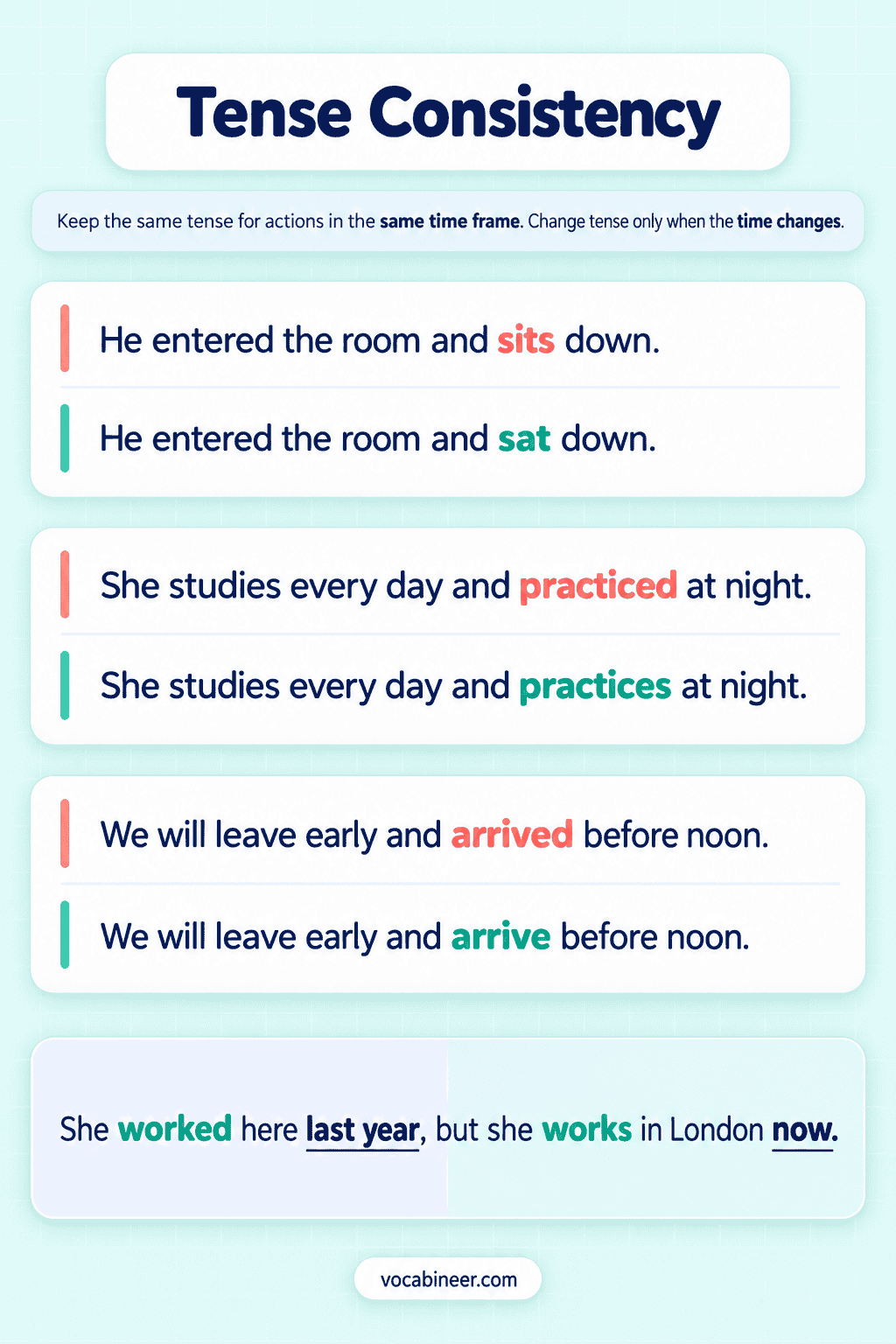
Tense consistency means using verb tenses in a way that keeps time relationships clear and logically connected throughout a sentence, paragraph, or larger piece of writing.
For example:
Incorrect:
- Mark finished his essay, tidies his room, and went outside.
Correct:
- Mark finished his essay, tidied his room, and went outside.
All three actions belong to the same past time frame, so the verbs remain in Past Simple.
Use this principle:
Keep the tense stable when the time frame stays the same, and change it only when the time relationship changes.
Tense Consistency at a Glance
| Situation | Best Approach |
|---|---|
| same present time frame | keep present forms consistent |
| same past time frame | keep past forms consistent |
| real shift from past to present | change tense |
| earlier event before another past event | Past Perfect may clarify the relationship |
| later event viewed from a past point | use an appropriate future-in-the-past form |
| general truth inside a past context | Present Simple may remain |
| academic general claim | Present Simple often fits |
| completed study or event | Past Simple often fits |
The goal is not identical verb forms everywhere. The goal is logical time reference.
Keep the Same Tense When the Time Frame Stays the Same
When several actions belong to the same time period, their tenses should normally remain consistent.
Incorrect:
- She opened the door, looks inside, and called his name.
Correct:
- She opened the door, looked inside, and called his name.
Another example:
Incorrect:
- The machine works well and produced very little noise.
Correct:
- The machine works well and produces very little noise.
Use this principle:
Actions in the same time frame normally use tenses that match that time frame.
Present Tense Consistency
Present Simple commonly creates a stable time frame for:
- general facts
- habits
- routines
- current states
- explanations
Examples:
- The sun rises in the east and sets in the west.
- Maya works from home and starts at eight every morning.
- This machine uses less power and produces less noise.
Incorrect:
- Maya works from home and started at eight every morning.
Correct:
- Maya works from home and starts at eight every morning.
Use this principle:
If the meaning remains in the present, keep the verb tense aligned with that present time frame.
Past Tense Consistency
Past Simple commonly carries a sequence of completed actions in the same past time frame.
Examples:
- She opened the door, walked inside, and looked around.
- We arrived early, found our seats, and waited for the show.
- He finished the report, checked the figures, and sent the email.
Incorrect:
- He finished the report, checks the figures, and sent the email.
Correct:
- He finished the report, checked the figures, and sent the email.
Use this principle:
Past Simple normally keeps a sequence of completed past events on the same timeline.
Tense Consistency Across Clauses
Different clauses can use different tenses when they refer to different times.
Example:
- I am reading the book that you gave me yesterday.
The tenses differ because the actions happen at different times:
- am reading = present activity
- gave = past event
Another example:
- She works in London now, but she lived in Paris five years ago.
This is not inconsistent because the time frame changes clearly.
Use this principle:
Different tenses are correct when different clauses refer to different times.
Unnecessary vs Necessary Tense Shifts
A tense shift is wrong only when there is no clear reason for it.
| Unnecessary Shift | Necessary Shift |
|---|---|
| time frame stays the same | time frame changes |
| She walked home and sees a dog. | She worked there in 2020, but now she works from home. |
| change creates confusion | change expresses a real time difference |
| no context supports the shift | meaning or time marker supports the shift |
Use this principle:
A tense shift is correct when it reflects a genuine change in time, chronology, or function.
Time Markers That Justify Tense Changes
Time expressions often make a tense shift clear.
Common examples include:
- now
- today
- currently
- yesterday
- last year
- in 2020
- before
- after
- since then
- later
- by that time
Examples:
- She worked there in 2020, but now she works from home.
- The company was small at first, but today it is much larger.
- I lived abroad for five years, and now I teach online.
- He finished school last year and currently works in a bank.
Use this principle:
Time markers can justify a tense change by showing that the reference time has changed.
They do not automatically determine the tense by themselves.
Earlier Events Inside a Past Time Frame
Tense consistency does not mean using Past Simple for every past event.
When one action happened before another past event, Past Perfect can make the relationship clearer.
Example:
- She realized she had left her keys at home.
The actions belong to different points in the past:
- had left = earlier event
- realized = later past event
Another example:
- When we arrived, the train had already left.
Use this principle:
Past Perfect can clarify an earlier event within an overall past time frame.
Later Events from a Past Viewpoint
A tense change may also be necessary for an event that was future from a past reference point.
Example:
- He said he would call later.
- She promised she would return the next day.
The forms are different because the events occupy different time positions.
Use this principle:
Changing tense is correct when it accurately marks a later event relative to an earlier past point.
General Truths Inside Past Contexts
Present Simple can remain correct inside a past context when a clause expresses a general or continuing truth.
Example:
- The teacher explained that water boils at 100°C.
- The scientist stated that gravity affects all objects with mass.
The tenses differ because:
- explained / stated = past events
- boils / affects = general truths
Use this principle:
Different tenses can coexist when each tense accurately represents its own time meaning.
Tense Consistency in Narratives
A narrative usually establishes a main timeline and maintains it.
Example:
- Maya opened the window, looked outside, and noticed a car.
A tense shift becomes appropriate when the story function changes:
- Maya was looking outside when she noticed the car.
- She realized someone had parked it there earlier.
The forms perform different jobs:
- Past Simple = main events
- Past Continuous = background or ongoing activity
- Past Perfect = earlier event
Use this principle:
Keep the main narrative timeline stable and shift tense only when the story moves to another time relationship.
Tense Consistency Across a Paragraph
Tense consistency applies across sentences, not only within one sentence.
Weak paragraph:
The company expanded rapidly in 2020. It opens three new offices and hired more staff.
Better:
The company expanded rapidly in 2020. It opened three new offices and hired more staff.
A shift can be correct when the time frame changes:
The company expanded rapidly in 2020. Today, it operates in ten countries.
Use this principle:
A paragraph may contain different tenses, but each shift should have a clear reason.
Tense Consistency Across a Longer Text
Longer pieces of writing usually establish a dominant time frame.
Common patterns include:
- narratives often use Past Simple as the main timeline
- explanations often use Present Simple
- research writing may use several tenses for different functions
A useful editing question is:
What is the main time frame of this section, and why does each tense change occur?
A new sentence or paragraph does not automatically create a new time frame.
Tense Consistency in Academic Writing
Academic writing can use several tenses correctly when each tense serves a different function.
| Academic Function | Common Tense |
|---|---|
| general claim | Present Simple |
| accepted idea | Present Simple |
| completed study | Past Simple |
| earlier research connected to the current discussion | Present Perfect |
| future implication | suitable future form |
Examples:
- Smith argues that language changes over time.
- Smith conducted the study in 2021.
- Researchers have identified several related patterns.
- Future studies will examine the remaining questions.
Use this principle:
Academic tense consistency means matching tense to function, not forcing every sentence into the same tense.
Tense Consistency in Literary Analysis
Literary analysis commonly uses Present Simple when discussing what happens in a text.
Examples:
- The narrator reveals the truth gradually.
- Hamlet questions the motives of those around him.
- The novel examines the effects of social pressure.
Past tense may be appropriate when discussing:
- historical context
- publication
- the author’s life
- completed research
For example:
- Shakespeare wrote Hamlet around the beginning of the seventeenth century.
- The play explores revenge, uncertainty, and mortality.
The tense changes because the writer shifts from historical information to discussion of the text.
Tense Consistency vs Sequence of Tenses
These concepts are related but different.
| Tense Consistency | Sequence of Tenses |
|---|---|
| broad writing principle | specific tense relationship between clauses |
| keeps time reference logical | explains how connected clause tenses relate |
| prevents accidental shifts | includes systematic patterns such as backshift |
| applies across sentences and paragraphs | often focuses on main and subordinate clauses |
Examples:
Tense consistency error:
- She walked home and sees a dog.
Sequence of tenses:
- She said she was tired.
Use this principle:
Tense consistency controls time reference across writing, while sequence of tenses explains specific grammatical relationships between connected clauses.
Tense Consistency vs Subject-Verb Agreement
These are different grammar concepts.
| Tense Consistency | Subject-Verb Agreement |
|---|---|
| concerns time reference | concerns person and number |
| walked vs walks | he walks vs they walk |
| checks whether tense shifts are logical | checks whether subject and verb agree |
For example:
- He walks to school every day.
Subject-verb agreement is correct. - He walked to school yesterday and plays football afterward.
The problem is tense consistency if both actions happened yesterday.
Parallel Verbs and Tense Consistency
Coordinated verbs often need consistent tense when they belong to the same time frame.
Incorrect:
- She opened the door, looks inside, and called his name.
Correct:
- She opened the door, looked inside, and called his name.
Another example:
Incorrect:
- He writes the email, checked the attachment, and sends it.
Correct for present routine:
- He writes the email, checks the attachment, and sends it.
Use this principle:
Parallel actions in the same time frame normally use matching tense forms.
Tense Consistency in Questions and Negatives
Changing a statement into a question or negative does not change its intended time frame.
Past:
- She worked there last year.
- Did she work there last year?
- She did not work there last year.
Present:
- He works here.
- Does he work here?
- He does not work here.
The auxiliary changes the structure, but the time reference remains consistent.
Common Tense Consistency Mistakes
Learners often create tense inconsistency by changing tense without changing the time reference.
Switching from past to present without a reason
Incorrect:
- She walked into the room and sees everyone looking at her.
Correct:
- She walked into the room and saw everyone looking at her.
Switching from present to past without a reason
Incorrect:
- The machine works well and produced very little noise.
Correct:
- The machine works well and produces very little noise.
Forcing every verb into the same tense
Incorrect rule:
All verbs in a sentence must use the same tense.
Correct:
- I am reading the book that you gave me yesterday.
The tenses differ because the actions occur at different times.
Ignoring an earlier-past relationship
Potentially unclear:
- She realized she left her keys at home.
Clearer:
- She realized she had left her keys at home.
Keeping past tense for a general truth
Less suitable when the fact remains generally true:
- The teacher explained that water boiled at 100°C.
Better:
- The teacher explained that water boils at 100°C.
Changing tense because a new sentence begins
A sentence boundary does not automatically change the time frame.
Incorrect:
- We arrived early. Everyone waits outside.
Correct if both events belong to the same past period:
- We arrived early. Everyone waited outside.
Changing tense because a new paragraph begins
A paragraph break also does not automatically reset the time frame.
The tense should change only when the meaning changes.
Ignoring time markers
Incorrect:
- She works there in 2018.
Correct:
- She worked there in 2018.
Mixing tenses in a parallel series
Incorrect:
- He finished the report, checks the figures, and sent the email.
Correct:
- He finished the report, checked the figures, and sent the email.
Changing tense without establishing the new time
Weak:
- She lived in Paris. She works in London.
Clearer:
- She lived in Paris, but now she works in London.
The phrase but now makes the tense shift logical.
How to Check Tense Consistency
A simple editing process can help identify unnecessary tense shifts.
- Identify the main time frame of the passage.
- Locate the main verbs.
- Check each tense change.
- Ask whether the time reference actually changes.
- Look for time markers such as now, yesterday, in 2020, or since then.
- Check earlier and later events separately.
- Review parallel verbs and coordinated actions.
- Check tense consistency across sentence and paragraph boundaries.
- Confirm that general truths and current facts use appropriate forms.
- Read the passage again and look for abrupt or unexplained tense changes.
The most useful final question is:
Does every tense change have a clear grammatical or time-related reason?
If the answer is no, the shift may be inconsistent.
FAQs
Tense consistency means keeping verb tenses logically connected to the intended time frame. The tense normally stays the same when the time frame stays the same and changes when the time relationship changes.
No. Different tenses can appear in the same sentence when the actions happen at different times. For example, I am reading the book that you gave me yesterday correctly uses present and past forms.
A tense change is correct when the sentence moves to another time, marks an earlier or later event, states a general truth, or serves a different grammatical or writing function.
Yes. A paragraph can contain several tenses when each one has a clear purpose. For example, a paragraph may discuss a completed study in Past Simple and then explain its current importance in Present Simple.
Identify the main time frame, check every main verb, and ask whether each tense change reflects a genuine change in time or meaning. Unexplained shifts usually need correction.
Read More
- 12 English Tenses Chart
- All Tenses Rules and Formula
- English Tenses with Examples
- Present Tenses in English
- Past Tenses in English
- Future Tenses in English
- Be Going To in English