

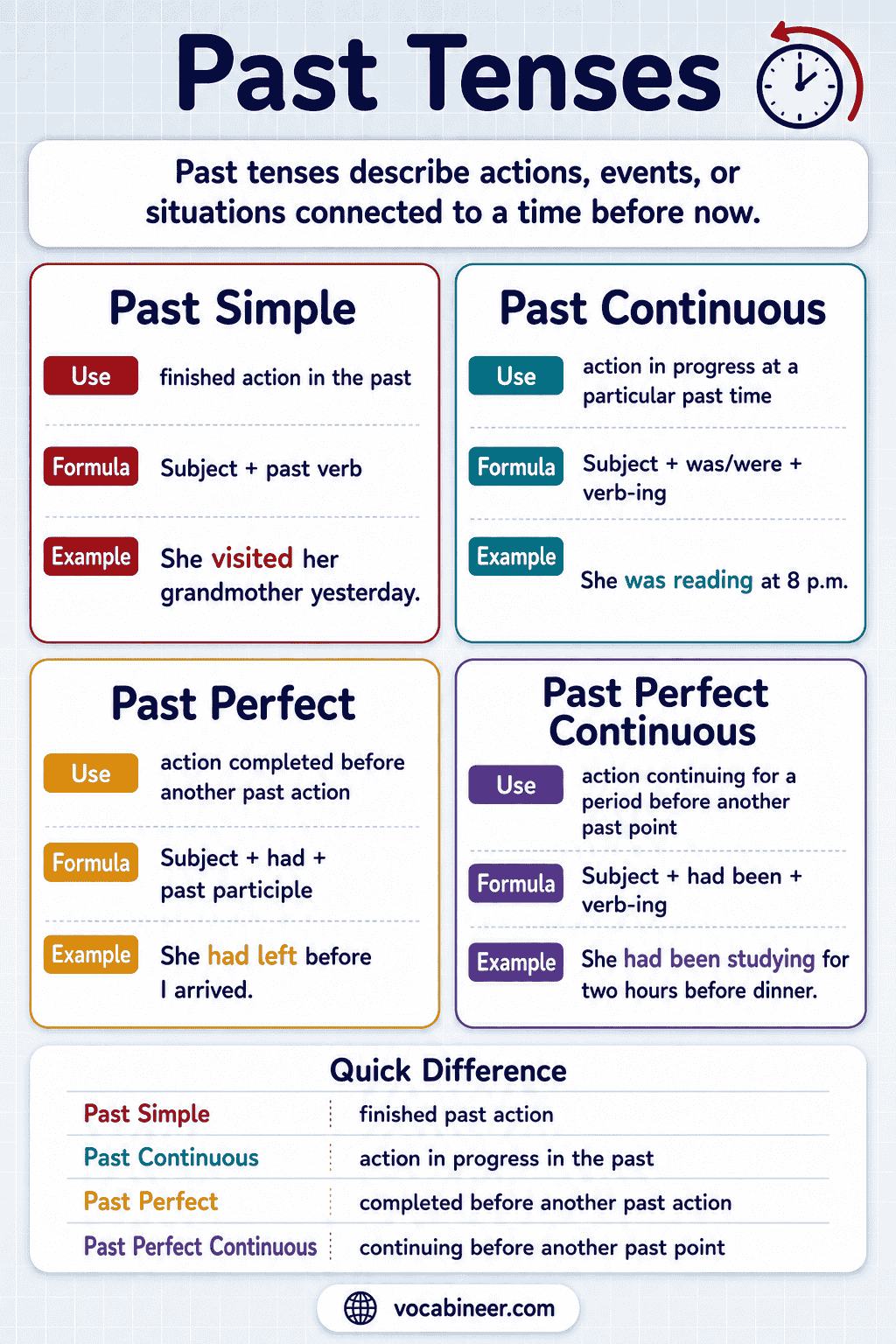
Past tenses describe completed events, ongoing past activity, earlier past situations, and duration before another past point. English learner grammar commonly groups four main past forms: Past Simple, Past Continuous, Past Perfect, and Past Perfect Continuous.
Each form marks a different time relationship. Past Simple locates a situation in a completed past context, Past Continuous marks activity in progress around a past point, Past Perfect relates an earlier event to a later past point, and Past Perfect Continuous relates earlier ongoing activity or duration to a later past point.
In This Page
What Are the Past Tenses?
The four main past tense forms are:
- Past Simple
- Past Continuous
- Past Perfect
- Past Perfect Continuous
These forms do not simply represent four versions of the same past meaning. Each one marks a different relationship between an event, activity, state, or duration and a past reference point.
Four Past Tenses at a Glance
| Past Tense | Basic Structure | Core Function | Example |
|---|---|---|---|
| Past Simple | V2 | completed event, state, or repeated situation in the past | She worked yesterday. |
| Past Continuous | was/were + V-ing | activity in progress around a past point | She was working at eight. |
| Past Perfect | had + V3 | earlier event related to a later past point | She had worked there before she moved. |
| Past Perfect Continuous | had + been + V-ing | earlier ongoing activity or duration related to a later past point | She had been working for three hours when I arrived. |
Past Simple
Past Simple marks events, states, and repeated situations located in a completed past context.
Common uses include:
- completed past actions
- past states
- repeated past actions
- sequences of completed events
- events within finished past periods
Examples:
- Maya visited her grandmother yesterday.
- We lived in that apartment for five years.
- Daniel played soccer every weekend as a child.
- She opened the door, walked inside, and sat down.
- They traveled to Turkey last summer.
Past Simple commonly uses the V2 form of the verb.
Regular verbs often form V2 with -ed:
- work → worked
- clean → cleaned
- play → played
- visit → visited
Irregular verbs use different forms:
- go → went
- see → saw
- write → wrote
- take → took
- eat → ate
The form depends on the verb, but the grammatical function remains the same: the situation is located in a past context.
Past Continuous
Past Continuous marks activity in progress around a past reference point.
Its basic structure is:
S + was/were + V-ing
Use was with:
- I
- he
- she
- it
Use were with:
- you
- we
- they
Examples:
- I was studying at 8 p.m.
- She was cooking when the phone rang.
- We were waiting outside.
- They were talking while the children were playing.
Past Continuous has several common uses.
Activity in Progress at a Past Time
Past Continuous can mark an activity that was already in progress at a specified past time.
- At nine, I was reading.
- She was driving home at six.
- They were sleeping when I checked.
The tense does not mark the activity as a completed whole. It marks the activity as ongoing around that past point.
Background Activity
Past Continuous often marks an ongoing situation that forms the background for another event.
- The wind was blowing.
- People were hurrying home.
- Children were playing in the street.
A completed event can then occur within that background:
- The wind was blowing when the lights went out.
Ongoing Activity with a Shorter Event
A common combination uses Past Continuous for the ongoing activity and Past Simple for the completed event that occurred during it.
- I was walking home when I saw Sarah.
- She was sleeping when the alarm rang.
- We were eating dinner when the power went out.
The interruption is not the definition of Past Continuous. The tense marks the ongoing activity; the second event establishes what happened during it.
Two Simultaneous Ongoing Activities
Past Continuous can mark two activities in progress during the same past period.
- While I was reading, she was cooking.
- The children were playing while their parents were talking.
- He was studying while I was working.
Past Perfect
Past Perfect relates an earlier event or state to a later past reference point.
Its basic structure is:
S + had + V3
The auxiliary had is the same for all subjects.
Examples:
- She had left before I arrived.
- We had finished dinner when the guests came.
- Daniel had seen the film before.
- They had lived there for ten years before they moved.
Past Perfect does not simply mean “the first action.” Its main function is to mark one situation as earlier than another relevant past point.
Compare:
- When I arrived, she left.
- When I arrived, she had left.
In the first sentence, the leaving belongs to the main sequence around the arrival.
In the second sentence, Past Perfect marks the leaving as earlier than the arrival.
Earlier Past Events
Past Perfect is especially useful when the order of past events needs grammatical marking.
- By the time we arrived, the train had departed.
- He had completed the work before the manager checked it.
- They had already eaten when we reached the restaurant.
The later event establishes the past reference point, while Past Perfect marks an earlier event relative to it.
Past Perfect Continuous
Past Perfect Continuous relates earlier ongoing activity or duration to a later past reference point.
Its basic structure is:
S + had + been + V-ing
Examples:
- She had been working for three hours when I arrived.
- They had been traveling all night before they reached the hotel.
- I had been waiting for an hour when the bus finally came.
- He had been studying before the lights went out.
Activity Continuing Up to a Past Point
Past Perfect Continuous can mark activity that began earlier and continued up to another past point.
- We had been driving for two hours when the car broke down.
- She had been living there for six years when she moved.
- They had been discussing the problem before the meeting ended.
Duration Before Another Past Event
Duration is one of the strongest functions of this form.
- He had been working for five hours before he took a break.
- We had been waiting since noon when the doors opened.
- Maya had been practicing all morning before the competition began.
Earlier Activity Related to a Later Past Condition
Past Perfect Continuous can also relate an earlier activity to a later past result or condition.
- He was tired because he had been running.
- The ground was wet because it had been raining.
- Her eyes were red because she had been crying.
The activity may have stopped before the later past point, but the later condition remains related to it.
How to Choose the Right Past Tense
The intended time relationship should determine the past tense.
| Intended Meaning | Past Tense |
|---|---|
| completed event, state, or repeated situation in a finished past context | Past Simple |
| activity in progress around a past point | Past Continuous |
| earlier event related to a later past point | Past Perfect |
| earlier ongoing activity or duration related to a later past point | Past Perfect Continuous |
A simple decision process is:
Use Past Simple when the event itself belongs to a completed past context.
- I visited her yesterday.
Use Past Continuous when the activity was in progress around a past point.
- I was visiting her when you called.
Use Past Perfect when one event occurred earlier than another relevant past event or point.
- I had visited her before I moved away.
Use Past Perfect Continuous when the earlier activity was ongoing or its duration matters.
- I had been visiting her regularly before I moved away.
Meaning and context are more reliable than memorized signal words.
How Past Tenses Work Together in a Story
Past tenses often occur together because a narrative can contain background activity, main events, earlier events, and duration before later events.
Consider:
- I was walking home when I noticed that someone had left a bag near the gate.
Each form has a different function:
- was walking → ongoing background activity
- noticed → completed main event
- had left → event earlier than the noticing
Another example:
- I had been waiting for an hour when the bus finally arrived.
Here:
- had been waiting → earlier ongoing activity and duration
- arrived → later completed event
A longer example can combine several forms:
- The rain was falling heavily when we reached the station. The train had already left, and several passengers had been waiting for the next one for nearly an hour.
The forms establish different past relationships:
- was falling → background activity
- reached → main completed event
- had left → earlier completed event
- had been waiting → earlier ongoing activity and duration
This interaction is one of the most important reasons to learn the past forms as a system.
Past Tenses Learners Often Confuse
Past Simple vs Past Continuous
Past Simple marks a completed event or situation in a past context. Past Continuous marks activity in progress around a past point.
Compare:
- I walked home.
- I was walking home at eight.
The first sentence represents the walk as a completed past event. The second marks the activity as in progress at eight.
Now compare:
- I was walking home when I saw Sarah.
Past Continuous marks the ongoing activity, while Past Simple marks the completed event that occurred during it.
Past Simple vs Past Perfect
Past Simple locates an event in the past. Past Perfect marks an event as earlier than another relevant past point.
Compare:
- When I arrived, she left.
- When I arrived, she had left.
The second sentence marks the departure as earlier than the arrival.
Another pair:
- We ate before the meeting.
- We had eaten before the meeting began.
Both can be grammatical depending on context. Past Perfect becomes especially useful when the earlier relationship needs explicit grammatical marking.
Past Perfect vs Past Perfect Continuous
Past Perfect commonly marks an earlier event, result, amount, or state. Past Perfect Continuous commonly marks earlier ongoing activity or duration.
Compare:
- She had written five pages before lunch.
- She had been writing for two hours before lunch.
The first sentence specifies a completed amount. The second specifies activity and duration.
Another pair:
- They had painted three rooms.
- They had been painting all morning.
The distinction is not always absolute. Context determines whether the completed result or the ongoing activity is more relevant to the intended meaning.
V2 and V3 in Past Tenses
Past Simple commonly requires V2, while Past Perfect requires V3 after had.
| Base Form | V2 | V3 |
|---|---|---|
| go | went | gone |
| see | saw | seen |
| write | wrote | written |
| take | took | taken |
| eat | ate | eaten |
| speak | spoke | spoken |
| break | broke | broken |
Compare:
- She went home. — Past Simple
- She had gone home. — Past Perfect
Another example:
- He wrote the report. — Past Simple
- He had written the report before the meeting. — Past Perfect
Using V2 where V3 is required creates an incorrect Past Perfect form.
Incorrect:
- She had went home.
Correct:
- She had gone home.
When, While, Before, and After with Past Tenses
These words establish time relationships, but they do not mechanically determine the tense.
When
When can introduce a completed event or establish the time of another activity.
- I was reading when she called.
- When I arrived, they were eating.
While
While commonly occurs with ongoing activities.
- While I was reading, she was cooking.
- He was driving while we were talking.
However, the meaning of the clause determines the tense, not the word while by itself.
Before
Past Perfect can occur with before when an earlier-past relationship needs marking.
- She had left before I arrived.
However:
- She left before I arrived.
is also grammatical because before already establishes the sequence.
After
The same principle applies to after.
- After we had finished dinner, we went home.
- After we finished dinner, we went home.
Both forms can be correct. Past Perfect adds explicit earlier-past marking, but it is not automatically required.
Continuous Past Forms and Stative Verbs
Many ordinary stative meanings normally occur in simple or perfect forms rather than continuous forms.
Common stative verbs include:
- know
- believe
- own
- understand
- need
- want
- like
- belong
Use:
- I knew the answer.
rather than normally:
- I was knowing the answer.
Likewise:
- I had known her for years.
is normally more appropriate than:
- I had been knowing her for years.
The restriction applies to ordinary stative meanings, not necessarily every possible use of the verb.
Common Past-Tense Mistakes
Past-tense mistakes often involve irregular verb forms, auxiliary structure, continuous forms, or incorrect earlier-past marking.
Using the wrong irregular Past Simple form
Incorrect:
- She goed home.
Correct:
- She went home.
Irregular verbs do not always form V2 with -ed.
Using V2 after did
Incorrect:
- Did she went home?
Correct:
- Did she go home?
The auxiliary did carries the past marking, so the main verb remains in its base form.
Omitting was or were
Incorrect:
- She working when I called.
Correct:
- She was working when I called.
Past Continuous requires was/were + V-ing.
Using V2 instead of V3 after had
Incorrect:
- She had went home.
Correct:
- She had gone home.
Past Perfect requires had + V3.
Omitting been in Past Perfect Continuous
Incorrect:
- She had working all day.
Correct:
- She had been working all day.
Past Perfect Continuous requires had + been + V-ing.
Using Past Perfect unnecessarily
Past Perfect is not required simply because an event happened first.
For example:
- After I finished dinner, I went home.
The sequence is already clear.
Past Perfect becomes useful when the earlier relationship needs grammatical marking:
- I realized that I had left my keys at work.
The leaving occurred before the later realization, and Past Perfect establishes that earlier relationship.
FAQs
The four commonly taught past forms are Past Simple, Past Continuous, Past Perfect, and Past Perfect Continuous. They mark completed past situations, ongoing past activity, earlier past events, and earlier ongoing activity or duration.
Past Simple commonly marks completed events in a past context, while Past Continuous marks activity in progress around a past point. Compare I walked home with I was walking home at eight.
Use Past Perfect when an earlier event or state needs to be related grammatically to a later past reference point. Past Simple is sufficient when the event simply belongs to the past and no earlier-past relationship needs explicit marking.
Past Perfect commonly marks an earlier completed event, amount, result, or state, while Past Perfect Continuous commonly marks earlier ongoing activity or duration. Compare She had written five pages with She had been writing for two hours.
Use Past Simple for completed past situations, Past Continuous for activity in progress around a past point, Past Perfect for an earlier event related to a later past point, and Past Perfect Continuous for earlier ongoing activity or duration related to a later past point.
Read More
- 12 English Tenses Chart
- All Tenses Rules and Formula
- English Tenses with Examples
- Indefinite Tense (Simple Tense)