The Present Perfect Continuous Tense relates earlier ongoing activity to the present reference point. It commonly marks activity that is still continuing, duration up to the present, repeated activity over a recent period, or an activity that has recently stopped but still has a present result.
Present Perfect Continuous uses have/has + been + V-ing. Correct use depends on subject agreement, the role of been, duration expressions such as since and for, stative-verb restrictions, and the distinction between Present Perfect Continuous, Present Perfect, and Present Continuous.
In This Page
What Is the Present Perfect Continuous Tense?
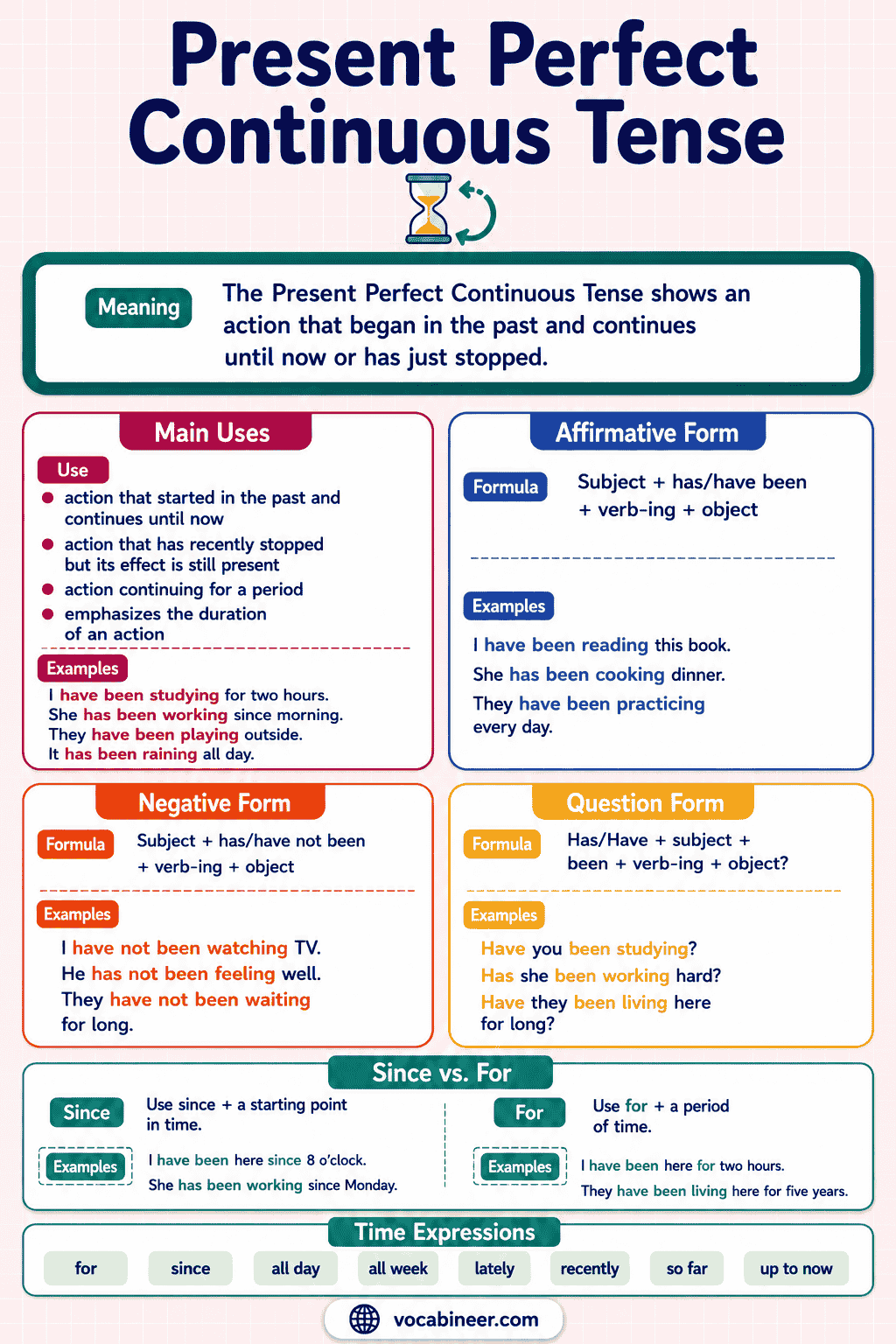
The Present Perfect Continuous Tense is formed with have or has, followed by been and the -ing form of the main verb.
Basic structure:
S + have/has + been + V-ing
Examples:
- I have been reading.
- She has been studying.
- We have been waiting.
- Daniel has been working all morning.
Present Perfect Continuous is also called Present Perfect Progressive. Both terms identify the same grammatical construction.
The activity does not always need to continue at the present moment.
For example:
- I have been studying for two hours.
The studying began earlier and may still be continuing.
- She is tired because she has been running.
The running may have stopped recently, but the present condition relates to that earlier activity.
How Present Perfect Continuous Relates Earlier Activity to the Present
Present Perfect Continuous establishes a grammatical relationship between earlier ongoing activity and the present reference point.
Consider these examples:
- We have been waiting since 9 a.m.
- I have been working all morning.
- The ground is wet because it has been raining.
The first example marks an activity that began earlier and continues now. The second marks duration up to the present. The third relates a recently stopped or possibly continuing activity to a present result.
Present Perfect Continuous therefore commonly represents three core relationships:
- activity continuing to the present
- duration extending up to the present
- recently stopped activity with a present result
The exact interpretation depends on context.
How to Form the Present Perfect Continuous
Every Present Perfect Continuous construction requires three grammatical elements:
- have or has
- been
- a main verb in -ing form
Have and Has
The subject determines whether the tense uses have or has.
| Subject | Auxiliary |
|---|---|
| I | have |
| you | have |
| we | have |
| they | have |
| he | has |
| she | has |
| it | has |
Examples:
- I have been working.
- You have been working.
- They have been working.
- He has been working.
- She has been working.
Why Been Is Required
Present Perfect Continuous requires:
have/has + been + V-ing
The word been is the past participle of be and forms part of the perfect continuous structure.
Correct:
- She has been studying all morning.
Incorrect:
- She has studying all morning.
Another correct example:
- They have been waiting for an hour.
Without been, the Present Perfect Continuous structure is incomplete.
Affirmative Sentences
The affirmative structure is:
S + have/has + been + V-ing
Examples:
- I have been reading for an hour.
- Maya has been working since eight.
- We have been learning English this year.
- Daniel has been exercising regularly.
- They have been waiting outside.
Common contractions include:
- I have → I’ve
- you have → you’ve
- we have → we’ve
- they have → they’ve
- he has → he’s
- she has → she’s
- it has → it’s
Examples:
- I’ve been studying all afternoon.
- She’s been working from home this week.
Context determines whether forms such as she’s mean she is or she has.
Negative Sentences
The negative structure is:
S + have/has + not + been + V-ing
Examples:
- I have not been sleeping well.
- We have not been using the car lately.
- She has not been working this week.
- Daniel has not been attending class regularly.
Common contractions are:
- have not → haven’t
- has not → hasn’t
Examples:
- I haven’t been sleeping well.
- She hasn’t been feeling well lately.
Questions and Short Answers
The question structure is:
Have/Has + S + been + V-ing?
Examples:
- Have you been waiting long?
- Have they been working today?
- Has she been studying?
- Has Daniel been exercising regularly?
Short answers repeat have or has without repeating the full verb phrase.
- Have you been waiting long?
Yes, I have. / No, I haven’t. - Has she been studying?
Yes, she has. / No, she hasn’t.
Wh-Questions
Wh-questions commonly use:
Wh-word + have/has + S + been + V-ing?
Examples:
- What have you been doing?
- Why has she been crying?
- Where have they been working?
- Who has he been talking to?
- How long have you been waiting?
Questions with how long occur frequently because the tense commonly marks duration.
When to Use the Present Perfect Continuous
Present Perfect Continuous has several related uses. Each use involves earlier ongoing activity and a relationship to the present.
Activity Continuing to the Present
Use Present Perfect Continuous when an activity began earlier and continues at the present reference point.
Examples:
- I have been studying since 7 p.m.
- She has been living here since May.
- They have been waiting for the bus.
- We have been working on this project since Monday.
- Daniel has been learning Spanish this year.
The activity begins before now and remains in progress at the present reference point.
Duration Up to the Present
Present Perfect Continuous can also mark how long an activity has continued.
Examples:
- I have been reading for forty minutes.
- We have been working all morning.
- She has been practicing for three hours.
- He has been learning English for five years.
- They have been traveling for several weeks.
Here, duration is an important part of the grammatical meaning.
Compare:
- She has been working since 9 a.m.
- She has been working for four hours.
The first sentence specifies the starting point. The second specifies the duration.
Recently Stopped Activity with a Present Result
Present Perfect Continuous can mark an activity that stopped recently when a present condition relates to that activity.
Examples:
- She is tired because she has been running.
- Your hands are dirty. Have you been painting?
- The ground is wet because it has been raining.
- His eyes are red because he has been crying.
The activity does not need to continue at the present moment. The present condition establishes the relationship with the earlier activity.
Repeated Activity Over a Recent Period
Present Perfect Continuous can mark repeated activity within a recent or limited period.
Examples:
- I have been going to the gym regularly lately.
- She has been calling me every evening this week.
- They have been working late these days.
- We have been eating at home more often recently.
- Daniel has been practicing the piano every day this month.
This use differs from a general long-term habit because the repeated activity belongs to a recent or temporary period.
Since and For with Present Perfect Continuous
Since and for commonly occur with Present Perfect Continuous when the sentence marks a starting point or duration.
Since
Since marks a starting point.
Examples:
- since Monday
- since January
- since 8 a.m.
- since breakfast
- since I moved here
Sentence examples:
- I have been working here since January.
- She has been studying since 7 p.m.
For
For marks duration.
Examples:
- for three hours
- for six months
- for two weeks
- for a long time
Sentence examples:
- I have been working here for six months.
- They have been waiting for an hour.
| Word | Function | Example |
|---|---|---|
| since | starting point | since Monday |
| for | duration | for three hours |
Compare:
- Maya has been living here since 2022.
- Maya has been living here for four years.
The first sentence identifies the starting point. The second identifies the duration.
Since and for do not determine the tense automatically. The intended grammatical meaning and context determine whether Present Perfect Continuous fits the sentence.
How Long with Present Perfect Continuous
Questions with how long ask about the duration of an activity.
The basic structure is:
How long + have/has + S + been + V-ing?
Examples:
- How long have you been studying English?
- How long has Maya been working here?
- How long have they been waiting?
- How long has it been raining?
Answers often contain for or since.
- I have been studying English for three years.
- Maya has been working here since 2024.
- They have been waiting for thirty minutes.
The question asks about duration, while the answer can state either a duration or a starting point.
Present Perfect Continuous vs Present Perfect
Present Perfect and Present Perfect Continuous both relate earlier situations to the present, but their structures and common meanings differ.
| Present Perfect | Present Perfect Continuous |
|---|---|
| have/has + V3 | have/has + been + V-ing |
| commonly marks result, amount, experience, or state | commonly marks activity, process, or duration |
| She has written five pages. | She has been writing for two hours. |
| They have painted three rooms. | They have been painting all day. |
Compare:
- She has written five pages.
- She has been writing for two hours.
Present Perfect marks the completed amount directly. Present Perfect Continuous marks the activity and its duration directly.
Another pair:
- We have cleaned three rooms.
- We have been cleaning all morning.
The first sentence specifies the completed amount. The second specifies the activity and duration.
When Both Forms Are Possible
The distinction is not always absolute.
Compare:
- I have lived here for five years.
- I have been living here for five years.
Both can be natural.
Present Perfect can represent the situation as an established state or fact. Present Perfect Continuous can represent the ongoing activity or duration more explicitly.
Another example:
- She has worked here since 2020.
- She has been working here since 2020.
Again, both forms can occur depending on the intended grammatical meaning.
Tense choice should therefore depend on meaning and context rather than a rigid result-versus-duration rule.
Present Perfect Continuous and Stative Verbs
Many stative verbs normally occur in Present Perfect rather than Present Perfect Continuous when they retain an ordinary stative meaning.
Common examples include:
- know
- believe
- own
- understand
- like
- love
- need
- want
- belong
Correct:
- I have known her for ten years.
Not normally:
- I have been knowing her for ten years.
Another example:
- We have owned this house since 2019.
Not normally:
- We have been owning this house since 2019.
Likewise:
- She has believed that for years.
is more natural than:
- She has been believing that for years.
The restriction applies to the stative meaning rather than every possible use of the verb. Some verbs can occur in continuous forms when their meaning changes.
Present Perfect Continuous vs Present Continuous
Present Continuous and Present Perfect Continuous both contain an -ing form, but they establish different time relationships.
Present Continuous:
am/is/are + V-ing
Present Perfect Continuous:
have/has + been + V-ing
Compare:
- I am working on the report.
- I have been working on the report since 9 a.m.
Present Continuous marks activity in progress around the present. Present Perfect Continuous relates the activity to an earlier starting point and the present.
Another contrast:
- She is studying now.
- She has been studying for three hours.
The first sentence marks current activity. The second marks activity that began earlier and includes duration up to the present.
The distinction is therefore not simply whether the activity is ongoing. Present Perfect Continuous also establishes an earlier-to-present time relationship.
Common Present Perfect Continuous Mistakes
Present Perfect Continuous mistakes commonly involve have/has, been, the -ing form, question order, duration expressions, or stative meanings.
Missing been
Incorrect:
- She has working all day.
Correct:
- She has been working all day.
Present Perfect Continuous requires have/has + been + V-ing.
Using the wrong auxiliary
Incorrect:
- He have been studying.
Correct:
- He has been studying.
Use has with he, she, and it.
Omitting have or has
Incorrect:
- She been studying all morning.
Correct:
- She has been studying all morning.
Both have/has and been are required.
Using the wrong main-verb form
Incorrect:
- She has been work here.
Correct:
- She has been working here.
Another example:
Incorrect:
- They have been wait for an hour.
Correct:
- They have been waiting for an hour.
The main verb requires the -ing form.
Using incorrect question order
Incorrect:
- She has been working?
Correct:
- Has she been working?
Questions place have or has before the subject.
Confusing since and for
Incorrect:
- I have been working here since three years.
Correct:
- I have been working here for three years.
Use for with duration and since with a starting point.
Using an ordinary stative meaning
Incorrect:
- I have been knowing him for years.
Correct:
- I have known him for years.
The ordinary stative meaning of know normally uses Present Perfect rather than Present Perfect Continuous.
FAQs
Present Perfect Continuous is an English tense form built with have/has + been + V-ing. It relates earlier ongoing activity to the present and commonly marks continuation, duration, repeated recent activity, or recently stopped activity with a present result.
Been is the past participle of be and forms part of the perfect continuous structure. Present Perfect Continuous therefore requires have/has + been + V-ing.
Since marks a starting point, such as since Monday or since 2022. For marks duration, such as for three hours or for five years.
Yes. The activity can have stopped recently if a present condition relates to it. For example, The ground is wet because it has been raining does not require the rain to still be falling.
Present Perfect commonly marks result, amount, experience, or state more directly, while Present Perfect Continuous commonly marks ongoing activity, process, or duration more directly. Some continuing situations allow both forms depending on the intended meaning.
Read More
- 12 English Tenses Chart
- All Tenses Rules and Formula
- English Tenses with Examples
- Indefinite Tense (Simple Tense)
- Simple Present Tense in English
- Present Continuous Tense in English
- Present Perfect Tense in English