

Indefinite tense, also called simple tense, helps describe habits, facts, completed past actions, and future events without using continuous or perfect patterns. Learning these three basic tense forms makes it easier to build clear everyday sentences and understand how verbs change across present, past, and future time.
The simple tense family includes Present Simple, Past Simple, and Future Simple. Each form has its own uses, formulas, helping verbs, and sentence patterns. The sections below explain all three with natural examples, important rules, common mistakes, and clear comparisons.
In This Page
What Is Indefinite Tense?
Indefinite tense is a traditional grammar term for what modern English-learning materials usually call the simple tense. It includes three main forms:
- Present Indefinite, or Present Simple
- Past Indefinite, or Past Simple
- Future Indefinite, or Future Simple
These forms do not use continuous structures such as be + V-ing or perfect structures such as have + V3 as part of their basic tense pattern.
For example:
- Emma works at a hospital. — Present Simple
- Emma worked yesterday. — Past Simple
- Emma will work tomorrow. — Future Simple
The word indefinite does not mean that the action is uncertain or unclear. Instead, it is a traditional grammar label used to distinguish these forms from continuous, perfect, and perfect continuous patterns.
Likewise, the word simple describes the grammatical form rather than the difficulty level. Present Simple, for example, still has important rules for third-person subjects, while Past Simple contains many irregular verb forms.
Indefinite Tense and Simple Tense
In practical English grammar, the following names refer to the same forms:
| Traditional Name | Common Modern Name |
|---|---|
| Present Indefinite | Present Simple |
| Past Indefinite | Past Simple |
| Future Indefinite | Future Simple |
You may see Present Indefinite in some school books or regional grammar courses, while other learning materials use Present Simple. The grammar being described is generally the same.
For consistency, this article uses both terms in the main section headings, then mainly uses Present Simple, Past Simple, and Future Simple in the explanations.
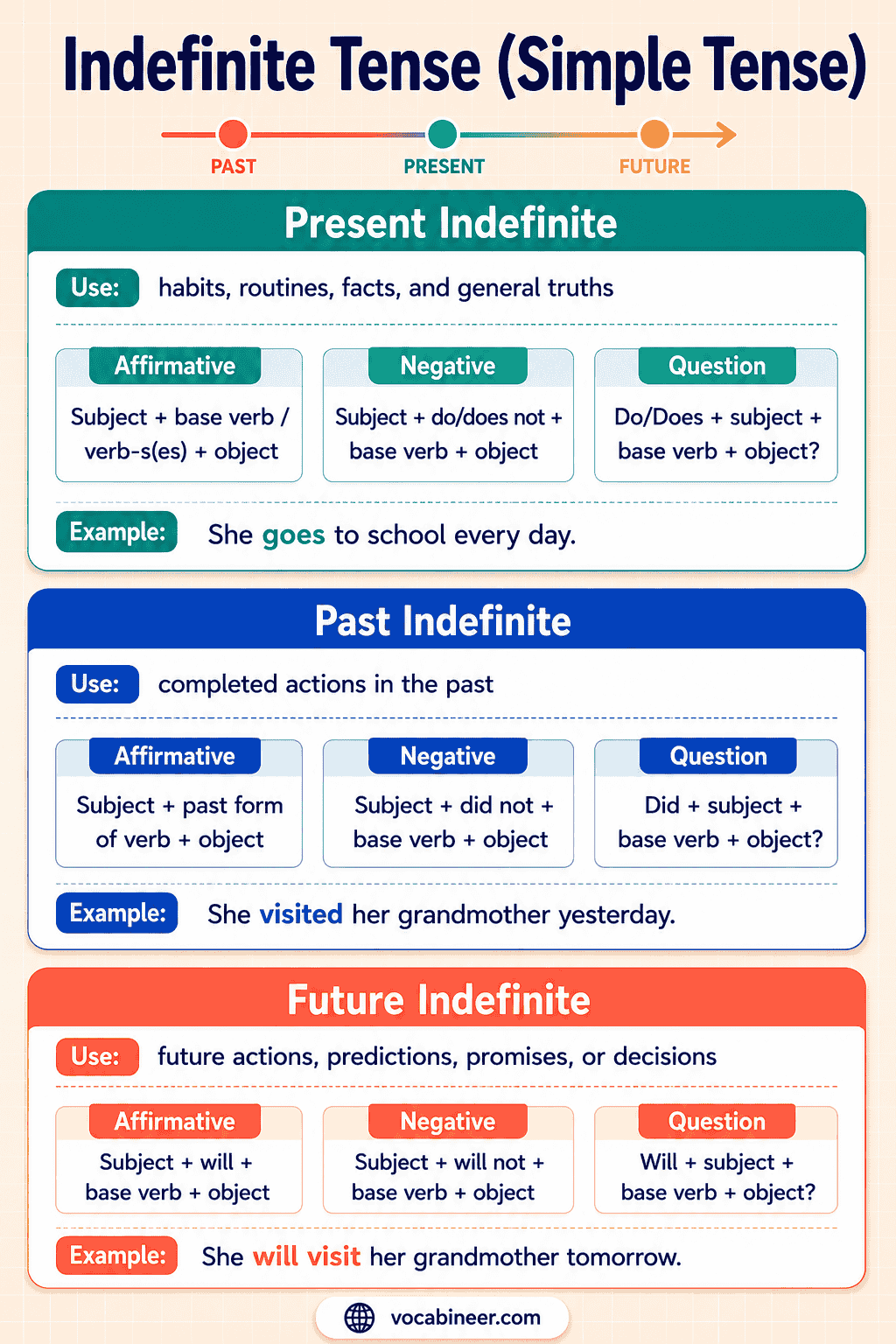
Three Simple Tenses at a Glance
The three simple tenses show different basic time relationships. Present Simple commonly describes routines, facts, and states; Past Simple focuses on completed past situations; meanwhile, Future Simple commonly uses will for predictions, promises, offers, and immediate decisions.
| Tense | Main Structure | Main Use | Example |
|---|---|---|---|
| Present Simple | S + V1 / V1+s | habits, facts, states | She works here. |
| Past Simple | S + V2 | completed past actions | She worked yesterday. |
| Future Simple | S + will + V1 | predictions, promises, decisions | She will work tomorrow. |
Here, S means subject, V1 means the base form of the verb, and V2 means the past form.
For example:
- work → work → worked
- go → go → went
- write → write → wrote
The exact form changes according to the tense and, in Present Simple, sometimes according to the subject.
Present Indefinite (Present Simple)
Present Indefinite, more commonly called Present Simple, describes routines, repeated actions, general truths, states, and some scheduled events.
Main Uses
Present Simple has several common everyday uses.
Habits and routines
Use it for actions that happen regularly.
- Maya walks to school every morning.
- I drink coffee after breakfast.
- We visit our grandparents on Sundays.
Repeated actions
It also works for actions that happen again and again.
- The teacher checks our homework every Friday.
- They play basketball after school.
Facts and general truths
Present Simple commonly expresses facts that are generally true.
- Water freezes at 32°F.
- The Earth moves around the Sun.
- Birds have feathers.
States
Many verbs describing thoughts, feelings, possession, and preferences normally use simple forms.
- I know the answer.
- She likes classical music.
- They own a small house.
Schedules
Present Simple can also refer to fixed timetables and schedules, even when the event happens in the future.
- The train leaves at 8:15 tomorrow.
- School starts next Monday.
Present Simple Formula
The basic formulas are:
| Form | Formula |
|---|---|
| Affirmative | S + V1 / V1+s |
| Negative | S + do/does + not + V1 |
| Question | Do/Does + S + V1? |
Present Simple Examples
Affirmative
- I work from home.
- She works at a bank.
- They study English every evening.
- Daniel watches the news after dinner.
Negative
- I do not eat meat.
- She does not drive to work.
- We do not open the store on Sundays.
Questions
- Do you live nearby?
- Does he play tennis?
- Do they know the answer?
Important Present Simple Rules
With he, she, and it, an ordinary verb usually takes -s or -es in affirmative sentences.
Examples:
- work → works
- read → reads
- go → goes
- watch → watches
If a verb ends in a consonant + y, the spelling often changes:
- study → studies
- try → tries
However, after does, use V1.
Correct:
Does she work here?
Incorrect:
Does she works here?
The third-person marker already appears in does, so the main verb returns to its base form.
The verb be follows a different pattern:
- I am ready.
- She is ready.
- They are ready.
Its negative and question forms also work differently:
- She is not ready.
- Is she ready?
Therefore, do not use does with be in this basic structure.
Past Indefinite (Past Simple)
Past Indefinite, more commonly called Past Simple, describes actions, events, and states that finished in the past.
Main Uses
Completed past actions
Use Past Simple when an action started and finished before now.
- Olivia called me last night.
- We visited the museum yesterday.
- Marcus finished the report this morning.
Definite past times
Past Simple commonly appears when the sentence gives a finished past time.
- She moved to Chicago in 2023.
- I saw him last Friday.
- They graduated two years ago.
Past states
It can also describe situations that were true in the past.
- I lived in Boston when I was a child.
- She liked that restaurant.
- They had a small apartment downtown.
Sequences of completed events
Past Simple works naturally when several completed actions happen one after another.
- He opened the door, walked inside, and sat down.
- She picked up the phone and called her mother.
Past Simple Formula
| Form | Formula |
|---|---|
| Affirmative | S + V2 |
| Negative | S + did + not + V1 |
| Question | Did + S + V1? |
Past Simple Examples
Affirmative
- We played soccer yesterday.
- Emma wrote an email last night.
- They went home early.
Negative
- We did not play soccer yesterday.
- Emma did not write an email.
- They did not go home early.
Questions
- Did you play soccer?
- Did Emma write the email?
- Did they go home?
Important Past Simple Rules
One of the most important rules is:
did + V1
After did, use the base form.
Correct:
Did he go home?
Incorrect:
Did he went home?
Similarly:
She did not write the letter.
not:
She did not wrote the letter.
Regular and Irregular Past Forms
Regular verbs usually form Past Simple with -ed.
| V1 | V2 |
|---|---|
| work | worked |
| play | played |
| open | opened |
| clean | cleaned |
Some regular verbs need spelling changes:
- live → lived
- stop → stopped
- study → studied
Irregular verbs do not follow one fixed -ed rule.
| V1 | V2 |
|---|---|
| go | went |
| see | saw |
| write | wrote |
| eat | ate |
| take | took |
These forms must usually be learned individually.
The verb be also has special Past Simple forms:
- I/he/she/it → was
- you/we/they → were
Examples:
- She was tired.
- They were busy.
- He was not at home.
- Were they ready?
Again, be does not use did in these basic negative and question forms.
Future Indefinite (Future Simple)
Future Indefinite, usually called Future Simple, commonly uses will + V1. It can express predictions, promises, offers, and decisions made at the moment of speaking.
Main Uses
Predictions
Use will when predicting what you think may happen.
- I think it will rain tonight.
- The team will win the game.
- Prices will rise next year.
Promises
Future Simple often expresses promises.
- I will call you tonight.
- We will help you.
- I will not forget your birthday.
Offers
It can also show willingness or an offer to help.
- I will carry that box for you.
- We will drive you home.
Immediate decisions
A speaker may use will when making a decision at the moment of speaking.
“The phone is ringing.”
“I will answer it.”
Future Simple Formula
| Form | Formula |
|---|---|
| Affirmative | S + will + V1 |
| Negative | S + will + not + V1 |
| Question | Will + S + V1? |
Future Simple Examples
Affirmative
- She will arrive tomorrow.
- I will send the file tonight.
- They will visit us next week.
Negative
- She will not arrive early.
- I will not forget the meeting.
- They will not stay long.
Questions
- Will she arrive tomorrow?
- Will you help me?
- Will they join us for dinner?
Important Future Simple Rules
After will, always use V1.
Correct:
She will go tomorrow.
Incorrect:
She will goes tomorrow.
The same form of will works with every subject:
- I will
- you will
- he will
- she will
- we will
- they will
The negative form will not commonly contracts to won’t:
I won’t be late.
Although the traditional simple-tense system uses will for Future Simple, English can express future meaning in other ways too.
For example:
- I am going to study tonight.
- We are meeting our friends tomorrow.
- The train leaves at six.
Therefore, will is an important future construction, but it is not the only way to refer to future time.
Affirmative, Negative, and Question Forms
Comparing the same verb across all three simple tenses makes the structural differences easy to see.
| Tense | Affirmative | Negative | Question |
|---|---|---|---|
| Present Simple | She works. | She does not work. | Does she work? |
| Past Simple | She worked. | She did not work. | Did she work? |
| Future Simple | She will work. | She will not work. | Will she work? |
Notice what happens to the main verb.
In Present Simple affirmative sentences, she takes works. However, after does, the verb becomes work.
Past Simple affirmative uses worked, while negative and question forms use did + work.
Future Simple is more regular because will + V1 remains the central pattern in affirmative, negative, and question forms.
Special Rules for the Verb Be
The verb be behaves differently from ordinary verbs in Present Simple and Past Simple. Because of this, learners should treat it as a special case.
Present Simple with Be
The forms are:
- I am
- he/she/it is
- you/we/they are
| Form | Example |
|---|---|
| Affirmative | She is happy. |
| Negative | She is not happy. |
| Question | Is she happy? |
Another example:
They are ready.
They are not ready.
Are they ready?
Do not use do or does in these basic structures.
Incorrect:
Does she be happy?
Correct:
Is she happy?
Past Simple with Be
The forms are:
- I/he/she/it was
- you/we/they were
| Form | Example |
|---|---|
| Affirmative | He was tired. |
| Negative | He was not tired. |
| Question | Was he tired? |
With plural subjects:
They were at school.
They were not at school.
Were they at school?
Again, basic Past Simple forms of be do not use did.
Common Simple Tense Mistakes
Simple tense errors often happen because learners use the correct time but the wrong verb form.
Forgetting -s or -es with he, she, or it
Incorrect:
He go to school every day.
Correct:
He goes to school every day.
Keeping -s after does
Incorrect:
Does she works here?
Correct:
Does she work here?
Because does carries the third-person information, use V1 afterward.
Using V2 after did
Incorrect:
Did they went home?
Correct:
Did they go home?
The past meaning already appears in did.
Using a third-person form after will
Incorrect:
She will goes tomorrow.
Correct:
She will go tomorrow.
Use V1 after will.
Using do or does with be
Incorrect:
Does he be tired?
Correct:
Is he tired?
Using did with Past Simple be
Incorrect:
Did she be at home?
Correct:
Was she at home?
Choosing Present Simple for a temporary current activity
Compare:
I work from home. — usual situation
I am working from home this week. — temporary situation
The first uses Present Simple, while the second needs Present Continuous because the situation is temporary.
FAQs
Indefinite tense is a traditional term for the simple tense family. It usually includes Present Indefinite, Past Indefinite, and Future Indefinite, which are more commonly called Present Simple, Past Simple, and Future Simple.
Yes, in traditional ESL terminology, indefinite tense generally refers to simple tense. For example, Present Indefinite and Present Simple describe the same basic tense form.
The three forms are Present Indefinite or Present Simple, Past Indefinite or Past Simple, and Future Indefinite or Future Simple.
Present Simple commonly describes routines, facts, and states. Past Simple describes completed past situations, while Future Simple commonly uses will for predictions, promises, offers, and immediate decisions.
The traditional term distinguishes these forms from Continuous and Perfect patterns. It does not mean that the action is uncertain. Modern English-learning materials more commonly use the term simple tense.
Read More