

The Present Perfect Tense relates an earlier event, experience, result, or state to the present reference point. It can mark completed events that remain relevant now, experiences before now, situations that continue to the present, and events within an unfinished time period.
Present Perfect requires have or has + the past participle (V3). Correct use also depends on the time context, especially with expressions such as since, for, just, already, yet, ever, and never, and on the distinction between Present Perfect, Past Simple, and Present Perfect Continuous.
In This Page
What Is the Present Perfect Tense?
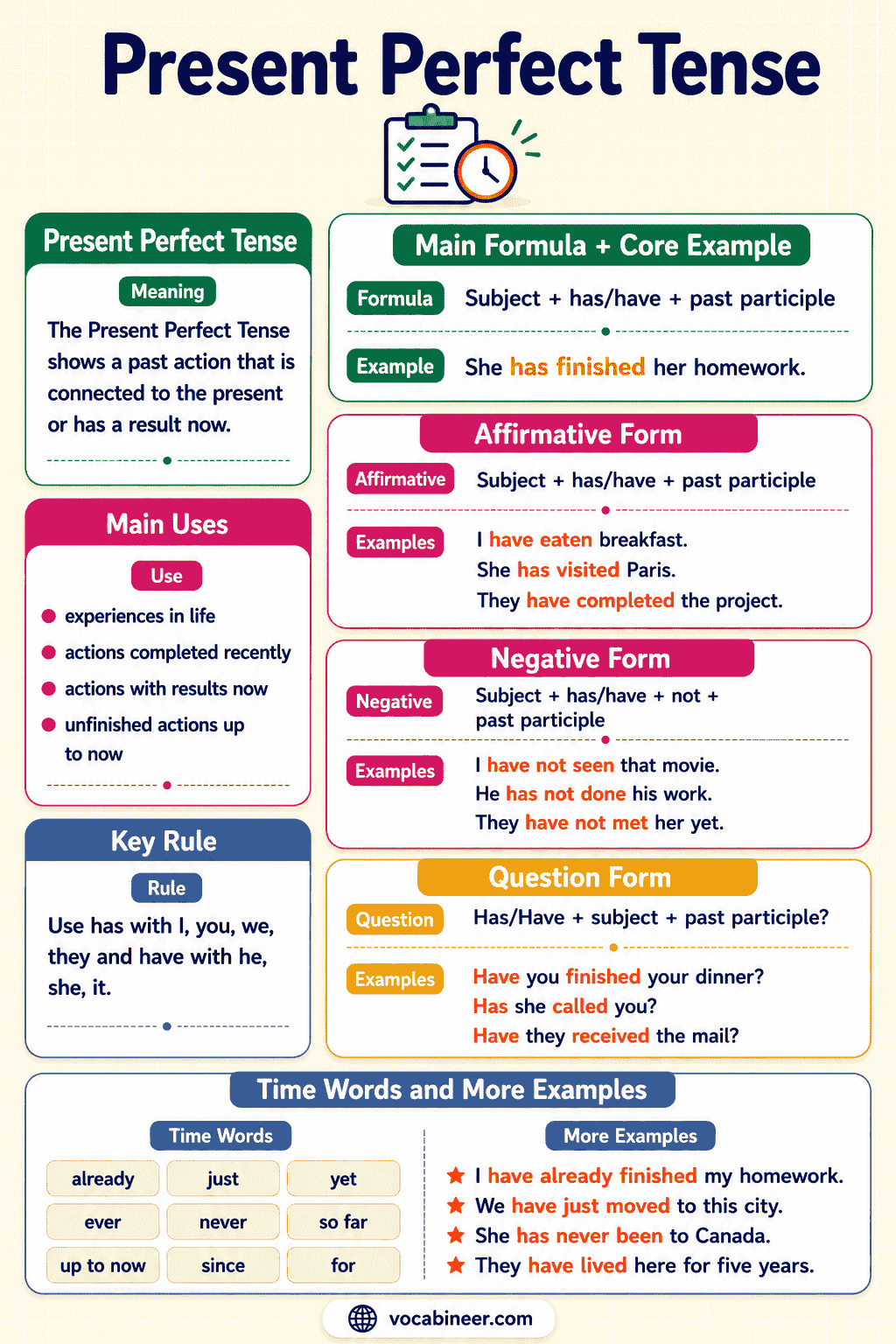
The Present Perfect Tense is formed with a present form of have followed by the past participle (V3) of the main verb.
Basic structure:
S + have/has + V3
Examples:
- I have finished my work.
- Maya has lost her keys.
- We have visited Rome twice.
- Daniel has lived here for five years.
Present Perfect can represent both completed and continuing situations.
For example:
Maya has lost her keys.
The loss occurred earlier, but the result remains relevant at the present reference point.
By contrast:
Daniel has lived here for five years.
The state began earlier and continues at present.
Therefore, Present Perfect should not be defined only as a tense for completed past actions.
How the Present Perfect Connects Past and Present
Present Perfect establishes a grammatical relationship between an earlier situation and the present reference point.
Consider these examples:
I have visited London twice.
The visits occurred before now. No specific finished past time is stated, and the sentence marks the visits as part of the speaker’s experience up to the present.
Emma has broken her glasses.
The breaking occurred earlier, while the resulting condition remains relevant now.
We have known each other for ten years.
The relationship began ten years ago and continues at the present reference point.
These examples show three major Present Perfect relationships:
- earlier experience related to now
- earlier event with a current result
- earlier beginning of a state that continues now
The exact interpretation comes from the grammatical form together with the context.
How to Form the Present Perfect
Present Perfect requires:
- have or has
- the past participle V3
Have and Has
The subject determines whether the auxiliary is have or has.
| Subject | Auxiliary |
|---|---|
| I | have |
| you | have |
| we | have |
| they | have |
| he | has |
| she | has |
| it | has |
Examples:
- I have finished.
- You have finished.
- They have finished.
- He has finished.
- She has finished.
Affirmative Sentences
The affirmative structure is:
S + have/has + V3
Examples:
- I have completed the report.
- We have cleaned the kitchen.
- Sarah has written the email.
- He has taken the bus.
- The children have finished their homework.
Common contractions include:
- I have → I’ve
- you have → you’ve
- we have → we’ve
- they have → they’ve
- he has → he’s
- she has → she’s
- it has → it’s
Examples:
I’ve finished my work.
She’s written the email.
Context determines whether forms such as he’s mean he is or he has.
Negative Sentences
The negative structure is:
S + have/has + not + V3
Examples:
- I have not finished.
- We have not received the message.
- She has not arrived.
- Daniel has not completed the task.
Common contractions are:
- have not → haven’t
- has not → hasn’t
Examples:
I haven’t finished yet.
She hasn’t arrived yet.
Questions and Short Answers
The question structure is:
Have/Has + S + V3?
Examples:
- Have you finished?
- Have they arrived?
- Has she called?
- Has Daniel completed the report?
Short answers use the auxiliary without repeating the past participle.
Have you finished?
Yes, I have. / No, I haven’t.
Has she arrived?
Yes, she has. / No, she hasn’t.
Wh-Questions
Wh-questions normally use:
Wh-word + have/has + S + V3?
Examples:
- What have you done?
- Where has she gone?
- Why have they left?
- How many books have you read this month?
- How long has he lived here?
Past Participles
Present Perfect requires the past participle, often called V3.
Regular verbs usually form the past participle with -ed.
| Base Form | Past Participle |
|---|---|
| work | worked |
| play | played |
| clean | cleaned |
| finish | finished |
| open | opened |
Irregular verbs use different forms.
| Base Form | Past Participle |
|---|---|
| go | gone |
| see | seen |
| write | written |
| eat | eaten |
| take | taken |
| speak | spoken |
| break | broken |
| do | done |
Correct:
She has written the email.
Incorrect:
She has wrote the email.
The verb after have or has must be V3, not the Past Simple form unless both forms happen to be identical.
When to Use the Present Perfect
Present Perfect has several major uses. Each use maintains a grammatical relationship with the present reference point.
Life Experience
Present Perfect marks experiences that occurred before now when no specific finished past time is given.
Examples:
- I have visited London twice.
- Maya has traveled abroad several times.
- We have tried Korean food.
- Have you ever ridden a horse?
- Daniel has never flown in a helicopter.
The sentence identifies whether the experience has occurred before the present.
Compare:
I have visited Paris.
No finished past time is stated.
I visited Paris in 2023.
The finished past time in 2023 requires Past Simple in standard learner grammar.
Earlier Events with a Present Result
Present Perfect can relate an earlier event to a result that remains relevant now.
Examples:
- Maya has lost her keys.
- I have broken my glasses.
- Someone has opened the window.
- Daniel has forgotten his password.
In:
Maya has lost her keys.
the earlier event results in the keys being unavailable now.
In:
I have broken my glasses.
the broken condition remains relevant at the present reference point.
Situations Continuing to the Present
Present Perfect can mark a state or situation that began earlier and continues now.
Examples:
- I have lived here for six years.
- She has known him since high school.
- We have owned this house since 2019.
- Daniel has worked at the company for a decade.
- They have been friends for many years.
Stative verbs commonly occur in this use because they can represent continuing states.
Examples:
- know
- own
- believe
- like
- love
- understand
Present Perfect therefore does not always indicate that the situation has ended.
Unfinished Time Periods
Present Perfect can mark events within a time period that remains open in the intended context.
Examples:
- I have answered six emails today.
- We have had three meetings this week.
- She has read two books this month.
- Daniel has called me twice this morning.
The interpretation depends on whether the stated period remains unfinished.
Compare:
I have answered six emails today.
The period today is still relevant and unfinished.
I answered six emails yesterday.
The period yesterday is finished, so Past Simple is required.
Recent Events with Present Relevance
Present Perfect can also mark recent events that remain relevant at the present reference point.
Examples:
- The bus has arrived.
- I have just finished dinner.
- She has already sent the file.
- The meeting has started.
- Our guests have arrived.
The defining factor is not recency alone. The event must have a grammatical relationship with the present context.
Time Expressions with the Present Perfect
Several time expressions commonly occur with Present Perfect because they can mark duration, experience, an unfinished period, or present relevance.
They do not determine the tense automatically. Context and grammatical meaning remain necessary.
Since and For
Since marks a starting point.
Examples:
- since Monday
- since 2020
- since breakfast
- since I moved here
I have lived here since 2020.
For marks duration.
Examples:
- for three days
- for six years
- for two hours
- for a long time
I have lived here for six years.
| Word | Function | Example |
|---|---|---|
| since | starting point | since Monday |
| for | duration | for three days |
Compare:
She has worked here since January.
January identifies the starting point.
She has worked here for eight months.
Eight months identifies the duration.
Just, Already, Yet, and Still
These expressions often occur with events that have a current relationship.
Just normally marks a very recent event.
I have just finished dinner.
She has just arrived.
Already marks completion before the present reference point, sometimes earlier than expected.
Maya has already left.
We have already completed the first stage.
Yet commonly occurs at the end of questions and negative sentences.
Have you finished yet?
I haven’t finished yet.
Still can indicate that an expected event remains incomplete.
She still hasn’t replied.
They still haven’t arrived.
Word position matters:
- have just finished
- has already left
- haven’t finished yet
- still hasn’t replied
Ever and Never
Ever commonly occurs in questions about experience.
Have you ever seen snow?
Has she ever visited Canada?
Never marks the absence of an experience before now.
I have never visited Japan.
Daniel has never tried sushi.
Because never already contains negative meaning, standard forms do not normally add not.
Correct:
I have never seen it.
Not:
I haven’t never seen it.
Recently, Lately, and So Far
These expressions can also occur naturally with Present Perfect.
Recently
She has recently changed jobs.
Lately
I have felt tired lately.
So far
We have completed four tasks so far.
So far marks a period extending from an earlier point to the present reference point.
Present Perfect and Finished Past Time
Present Perfect normally does not occur with a clearly finished past-time expression when that expression identifies when the event happened.
Incorrect in standard learner grammar:
I have seen him yesterday.
Correct:
I saw him yesterday.
Other common finished past expressions include:
- yesterday
- last night
- last week
- last year
- in 2022
- two days ago
- when I was a child
Compare:
I have visited Rome.
No finished past time is specified.
I visited Rome last summer.
The finished past period requires Past Simple.
The distinction concerns the time relationship, not merely the presence or absence of a particular time word.
Present Perfect vs Past Simple
Present Perfect and Past Simple can both refer to earlier events, but they establish different grammatical relationships.
| Present Perfect | Past Simple |
|---|---|
| earlier event related to the present | event located in a finished past context |
| no specified finished past time | specific finished past time can be stated |
| experience up to now | completed event at a past time |
| I have visited Paris. | I visited Paris in 2023. |
Compare:
I have seen that movie.
The sentence marks experience before now.
I saw that movie last night.
The event belongs to the finished time last night.
Another pair:
She has worked here before.
The earlier experience relates to the present.
She worked here from 2020 to 2022.
The employment belongs to a completed past period.
Another contrast:
We have had three meetings this week.
The intended week remains open.
We had three meetings last week.
Last week is finished.
Present Perfect vs Present Perfect Continuous
Present Perfect and Present Perfect Continuous both relate earlier situations to the present, but their structures and common meanings differ.
Present Perfect:
have/has + V3
Present Perfect Continuous:
have/has + been + V-ing
Compare:
She has written five pages.
Present Perfect marks the completed amount directly.
She has been writing for two hours.
Present Perfect Continuous marks the ongoing activity and duration directly.
Another comparison:
We have painted three rooms.
The completed amount is specified.
We have been painting all morning.
The activity and duration are specified.
However, the distinction is not absolute.
Compare:
I have lived here for five years.
and:
I have been living here for five years.
Both can be correct. The first can represent the situation as an established state, while the second can represent its ongoing duration more explicitly.
Many stative verbs commonly occur in Present Perfect rather than Present Perfect Continuous when they retain a stative meaning.
For example:
I have known her for ten years.
is more natural than:
I have been knowing her for ten years.
Gone vs Been
Present Perfect commonly uses gone and been with different meanings.
Sarah has gone to London.
This usually means Sarah went to London and remains away.
Sarah has been to London.
This usually means Sarah visited London and returned.
Compare:
Daniel has gone to the store.
Daniel is normally understood to be at the store or on the way there.
Daniel has been to that store many times.
This marks experience.
The distinction depends on context, but gone commonly indicates movement away from the current location, while been to commonly marks a completed visit or experience.
Common Present Perfect Mistakes
Present Perfect errors commonly involve the auxiliary, past participle, time reference, or duration expressions.
Using the wrong auxiliary
Incorrect:
He have finished.
Correct:
He has finished.
Use has with he, she, and it.
Using the wrong past participle
Incorrect:
She has went home.
Correct:
She has gone home.
Present Perfect requires V3.
Using V1 after have or has
Incorrect:
She has write the email.
Correct:
She has written the email.
The main verb must use the past participle.
Using Present Perfect with a finished past time
Incorrect:
I have seen him yesterday.
Correct:
I saw him yesterday.
The finished time yesterday places the event in a completed past context.
Confusing since and for
Incorrect:
I have lived here since five years.
Correct:
I have lived here for five years.
Use for with duration.
Compare:
I have lived here since 2020.
Use since with a starting point.
Omitting have or has
Incorrect as a Present Perfect construction:
She finished the report.
Correct when Present Perfect meaning is required:
She has finished the report.
The first sentence is Past Simple, not Present Perfect.
Using has with a plural subject
Incorrect:
They has finished.
Correct:
They have finished.
Use have with plural subjects.
Using the Past Simple form instead of V3
Incorrect:
He has wrote three emails.
Correct:
He has written three emails.
Irregular verbs often have different V2 and V3 forms.
FAQs
Present Perfect is an English tense form built with have/has + V3. It relates an earlier event, experience, result, or state to the present reference point.
Use have with I, you, we, and they. Use has with he, she, and it. Both auxiliaries require the past participle of the main verb.
Since marks a starting point, as in since Monday or since 2020. For marks duration, as in for three days or for six years.
Present Perfect relates an earlier event or state to the present, while Past Simple locates an event in a finished past context. Compare I have visited Paris with I visited Paris in 2023.
Present Perfect commonly marks result, amount, experience, or state more directly, while Present Perfect Continuous commonly marks ongoing activity or duration more directly. In some continuing situations, both forms can be natural depending on the intended meaning.
Read More
- 12 English Tenses Chart
- All Tenses Rules and Formula
- English Tenses with Examples
- Indefinite Tense (Simple Tense)
- Simple Present Tense in English
- Present Continuous Tense in English