English tenses help us show when an action happens and how we view it. A sentence may describe something that happens regularly, is happening now, finished in the past, continued for a period, or will finish before a future time. Once you recognize these patterns, choosing the correct tense becomes much easier.
English learners commonly study 12 tense forms arranged into present, past, and future groups. Each group contains simple, continuous, perfect, and perfect continuous forms. Below, you’ll find a complete chart, clear structures, uses, examples, negative and question patterns, common mistakes, and the tense differences learners often find difficult.
In This Page
12 English Tenses Chart
The chart gives a quick reference for all 12 commonly taught English tense forms. Start with the structure, then use the main-use column to understand why a speaker chooses that tense.
| Tense | Structure | Main Use | Example |
|---|---|---|---|
| Present Simple | S + V1 / V1+s | Habits, routines, facts, states | She walks to school every day. |
| Present Continuous | S + am/is/are + V-ing | Actions happening now or temporary situations | She is walking to school now. |
| Present Perfect | S + have/has + V3 | Past actions connected to the present | She has finished her homework. |
| Present Perfect Continuous | S + have/has + been + V-ing | Activities continuing up to now | She has been studying for two hours. |
| Past Simple | S + V2 | Completed past actions | She visited her aunt yesterday. |
| Past Continuous | S + was/were + V-ing | Actions in progress at a past time | She was reading at 8 p.m. |
| Past Perfect | S + had + V3 | Actions completed before another past action | She had left before I arrived. |
| Past Perfect Continuous | S + had + been + V-ing | Ongoing activity before a past point | She had been waiting for an hour. |
| Future Simple | S + will + V1 | Predictions, promises, offers, instant decisions | She will call you tomorrow. |
| Future Continuous | S + will + be + V-ing | Actions in progress at a future time | She will be working at noon. |
| Future Perfect | S + will + have + V3 | Actions completed before a future point | She will have finished by Friday. |
| Future Perfect Continuous | S + will + have + been + V-ing | Duration continuing up to a future point | She will have been working here for five years. |
Formula key
- S = Subject
- V1 = Base form: go, eat, write
- V2 = Past form: went, ate, wrote
- V3 = Past participle: gone, eaten, written
- V-ing = Verb + -ing: going, eating, writing
Helping verbs, also called auxiliary verbs, build many tense forms. Common ones include am, is, are, was, were, have, has, had, been, and will.
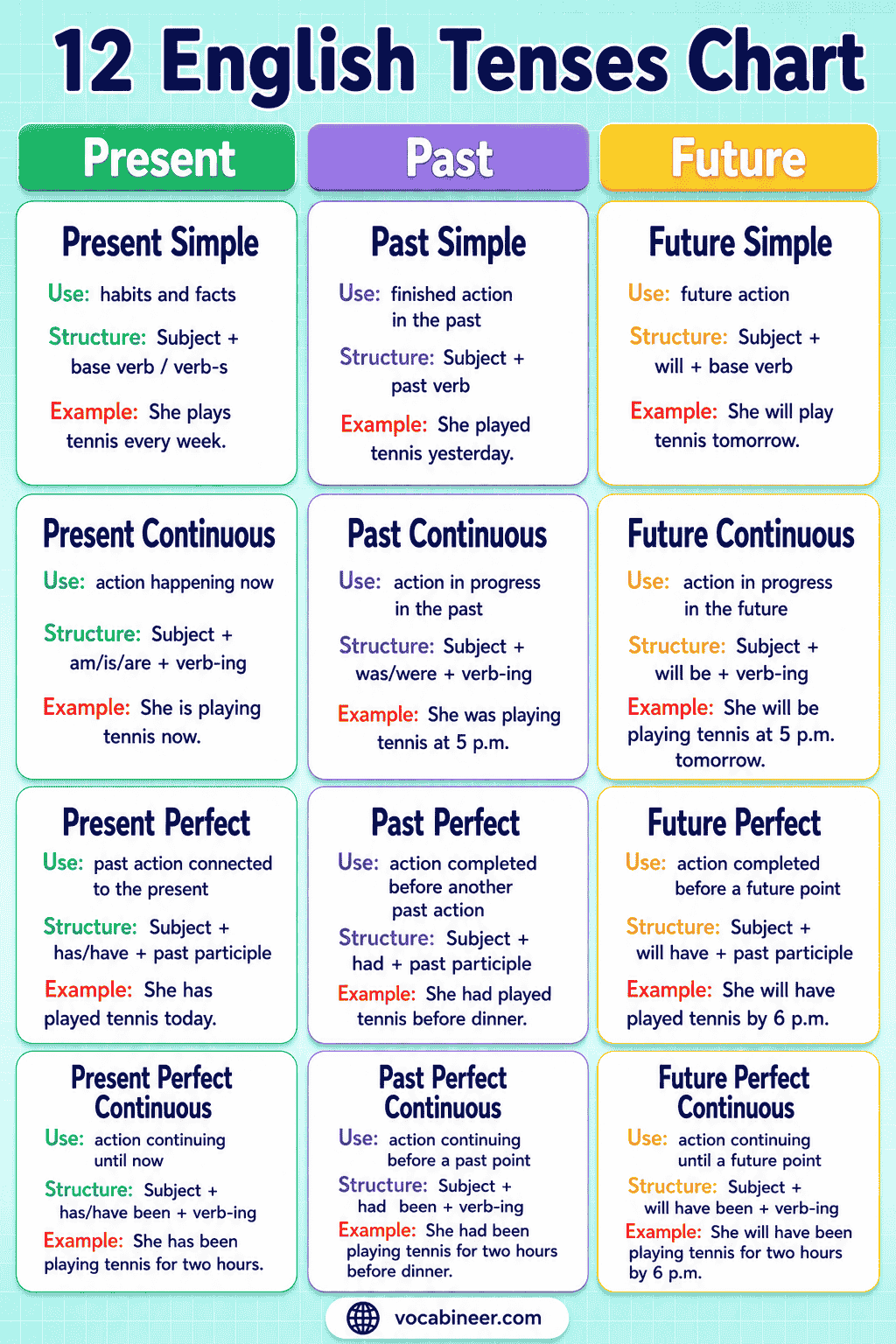
How the 12 Tenses Work
The 12-form system becomes easier when you stop treating each tense as a separate rule. Instead, notice that English learners combine three time groups with four recurring patterns.
- Present connects an action or state with the present.
- Past places an action or state before the present.
- Future describes what speakers expect, predict, plan, or view at a future time.
The four patterns then tell us how to view the action:
- Simple presents a fact, habit, state, or event as a whole.
- Continuous emphasizes an activity in progress or a temporary situation.
- Perfect connects an earlier action with another point in time.
- Perfect Continuous combines that time connection with ongoing activity or duration.
For example, continuous forms follow a recognizable be + V-ing pattern. Perfect forms use have + V3, while perfect continuous forms use have + been + V-ing. As a result, learning these repeated patterns reduces the amount of memorization.
Present Tenses
The four present forms describe routines, current activities, past events connected to now, and actions that continue into the present. Although all four relate to the present, they focus on different aspects of an action.
Present Simple
Use the Present Simple for habits, routines, general facts, repeated actions, and many states. With he, she, and it, the main verb usually takes -s or -es.
Example: Emma reads before bed every night.
Negative: Emma does not read before bed on Fridays.
Question: Does Emma read before bed?
After does, use the base verb: Does she read? rather than Does she reads?
Present Continuous
Use the Present Continuous for something happening now, a temporary situation, or an activity developing around the present time. Build it with am/is/are + V-ing.
Example: Emma is reading in the library now.
Negative: Emma is not reading at home.
Question: Is Emma reading now?
Some verbs that normally describe states, such as know, believe, and own, do not usually take the continuous form in their ordinary meanings. Therefore, I know the answer sounds natural, while I am knowing the answer normally does not.
Present Perfect
Use the Present Perfect when a past action has a connection with the present. It often describes experience, a recent result, an unfinished period, or something that happened before now when the exact finished past time is not the focus.
Example: Emma has finished her assignment.
Negative: Emma has not finished the final page.
Question: Has Emma finished her assignment?
Avoid combining the Present Perfect with a clearly finished past-time expression such as yesterday in a standard sentence. Instead of I have seen him yesterday, say I saw him yesterday.
Present Perfect Continuous
Use the Present Perfect Continuous when an activity began earlier and continues to the present, or when a recent activity has a present result. This tense often emphasizes duration.
Example: Emma has been studying for three hours.
Negative: Emma has not been studying for long.
Question: Has Emma been studying all morning?
The Present Perfect and Present Perfect Continuous sometimes overlap. However, the simple form often emphasizes a result or completed amount, while the continuous form often emphasizes the activity or how long it has continued.
Past Tenses
The past forms help us describe completed events, actions that were in progress, and relationships between two different points in the past. Consequently, they are especially useful when telling stories or explaining sequences of events.
Past Simple
Use the Past Simple for an action, event, or state that finished in the past. Regular verbs usually take -ed, while irregular verbs use forms such as went, saw, and wrote.
Example: Daniel visited his grandparents last weekend.
Negative: Daniel did not visit them on Monday.
Question: Did Daniel visit them last weekend?
After did, use V1. Therefore, Did he go? is correct, while Did he went? is not.
Past Continuous
Use the Past Continuous for an activity that was in progress at a particular past time. It also commonly provides background for a shorter event.
Example: Daniel was driving home at 6 p.m.
Negative: Daniel was not driving at 7 p.m.
Question: Was Daniel driving when you called?
Past Simple and Past Continuous often appear together: I was cooking when the phone rang. Here, cooking was already in progress, while the phone call occurred as a shorter event.
Past Perfect
Use the Past Perfect when you need to show that one action happened before another past action or point. Think of it as the earlier past.
Example: Daniel had left before the meeting started.
Negative: Daniel had not left when I arrived.
Question: Had Daniel left before noon?
You do not need Past Perfect simply because two actions happened in the past. Use it when showing the earlier action makes the sequence clearer.
Past Perfect Continuous
Use the Past Perfect Continuous for an activity that continued for some time before another past event or point. Therefore, duration often matters.
Example: Daniel had been working for three hours before lunch.
Negative: Daniel had not been working there for long.
Question: Had Daniel been working all morning?
This form is especially useful when the earlier activity explains a past result: She was tired because she had been working all day.
Future Tenses
Traditional 12-tense charts commonly use will to build four future forms. These forms help us describe predictions, actions in progress at a future time, completion before a future deadline, and duration up to a future point.
Future Simple
Use will + V1 for many predictions, promises, offers, and decisions made at the moment of speaking.
Example: Mia will help you after class.
Negative: Mia will not help tomorrow.
Question: Will Mia help you later?
For example, if the phone rings and you decide immediately to answer it, you can say, I’ll get it.
Future Continuous
Use the Future Continuous for an action that will be in progress at a particular time in the future.
Example: Mia will be studying at 8 tonight.
Negative: Mia will not be studying at midnight.
Question: Will Mia be studying this evening?
This form focuses on an activity viewed from inside a future period rather than on its completion.
Future Perfect
Use the Future Perfect for an action that will finish before a stated future time or event.
Example: Mia will have completed the course by June.
Negative: Mia will not have completed it by May.
Question: Will Mia have completed it by June?
Time expressions with by often appear with this form because they establish a future deadline.
Future Perfect Continuous
Use the Future Perfect Continuous to emphasize how long an activity will have continued up to a future point.
Example: By June, Mia will have been teaching here for ten years.
Negative: By June, Mia will not have been teaching here for ten years.
Question: Will Mia have been teaching here for ten years by June?
Although learners may use this tense less often than simpler forms, its pattern is logical: will + have + been + V-ing.
English also expresses future meaning in other ways. For instance, be going to can describe intentions or evidence-based predictions, the Present Continuous often describes arrangements, and the Present Simple can describe fixed schedules.
- I am going to study tonight.
- We are meeting Alex tomorrow.
- The train leaves at 7:30.
So, will is an important future form, but it is not the only way English talks about the future.
Choosing the Right Tense
When several tense forms seem possible, focus first on time, then ask whether the action is habitual, ongoing, completed, or connected to another time. This approach works better than memorizing isolated “signal words.”
| Situation | Useful Tense | Example |
|---|---|---|
| Routine or repeated action | Present Simple | I walk to work every day. |
| Happening now | Present Continuous | I am walking to work now. |
| Past action connected to now | Present Perfect | I have finished my work. |
| Activity continuing up to now | Present Perfect Continuous | I have been working since 9 a.m. |
| Completed action at a finished past time | Past Simple | I worked yesterday. |
| Activity in progress at a past time | Past Continuous | I was working at 9 a.m. |
| Action completed before another past action | Past Perfect | I had finished before she arrived. |
| Duration before a past point | Past Perfect Continuous | I had been working for two hours. |
| Prediction, promise, or instant decision | Future Simple | I will call you later. |
| Activity in progress at a future time | Future Continuous | I will be working at noon. |
| Completed before a future point | Future Perfect | I will have finished by Friday. |
| Duration up to a future point | Future Perfect Continuous | I will have been working here for five years. |
Time expressions can provide useful clues, but they do not automatically determine the tense. For example, for can appear in several structures, so always consider the meaning of the sentence as well.
Tenses Learners Often Confuse
Several tense pairs describe closely related situations. However, focusing on the speaker’s viewpoint usually reveals the difference.
| Tense Pair | Main Difference | Examples |
|---|---|---|
| Present Simple vs Present Continuous | Present Simple shows routines or general situations; Present Continuous shows current or temporary activity. | She works at home. / She is working at home today. |
| Past Simple vs Present Perfect | Past Simple refers to a finished past time; Present Perfect connects the past with the present. | I saw him yesterday. / I have seen that movie before. |
| Present Perfect vs Present Perfect Continuous | Present Perfect often emphasizes result or amount; Present Perfect Continuous often emphasizes activity or duration. | She has written five pages. / She has been writing for an hour. |
| Past Simple vs Past Continuous | Past Simple presents a completed event; Past Continuous presents an action in progress. | The bell rang while we were studying. |
| Past Simple vs Past Perfect | Past Perfect identifies an earlier past action when the order needs clarification. | He had eaten before we arrived. |
| Future Simple vs Future Continuous | Future Simple presents a future action or prediction; Future Continuous views an activity as already in progress at a future time. | I will work tomorrow. / I will be working at 10 tomorrow. |
One of the most important distinctions is Past Simple vs Present Perfect. A finished time expression such as yesterday, last week, or in 2024 normally points toward the Past Simple. In contrast, the Present Perfect usually leaves the exact finished past time unstated because the present connection matters more.
Common Mistakes with English Tenses
Many tense mistakes come from incorrect verb forms rather than misunderstanding the entire tense. Fixing a few recurring patterns can therefore improve accuracy quickly.
- Forgetting -s/-es in the Present Simple:
Incorrect: She walk to school.
Correct: She walks to school. - Using V2 after did:
Incorrect: Did you went there?
Correct: Did you go there? - Forgetting a form of be in continuous tenses:
Incorrect: They playing outside.
Correct: They are playing outside. - Using the wrong form after have, has, or had:
Incorrect: She has went home.
Correct: She has gone home. - Forgetting been in perfect continuous forms:
Incorrect: I have working all day.
Correct: I have been working all day. - Using Present Perfect with a finished past-time expression:
Incorrect: I have met him yesterday.
Correct: I met him yesterday. - Using Past Perfect when the sequence is already simple and clear:
Awkward: I had gone to school and had studied English yesterday.
Better: I went to school and studied English yesterday. - Using a continuous tense with a stative verb in its ordinary meaning:
Usually incorrect: I am knowing the answer.
Correct: I know the answer.
The most reliable approach is to check both meaning and structure. First decide what time relationship you want to express; then make sure the helping verb and main verb match the tense pattern.
FAQs
The commonly taught 12 forms are Present Simple, Present Continuous, Present Perfect, Present Perfect Continuous, Past Simple, Past Continuous, Past Perfect, Past Perfect Continuous, Future Simple, Future Continuous, Future Perfect, and Future Perfect Continuous.
Learners usually group them into present, past, and future. Each group then contains simple, continuous, perfect, and perfect continuous forms.
V1 is the base verb, V2 is the past form, and V3 is the past participle. For example, with write: V1 = write, V2 = wrote, and V3 = written.
Simple forms usually present habits, facts, states, or events as wholes. In contrast, continuous forms emphasize an activity in progress, a temporary situation, or an action viewed around a particular time.
English learners commonly study a 12-form system because it provides a practical way to organize present, past, and future forms with simple, continuous, perfect, and perfect continuous patterns. Formal grammar can distinguish tense from aspect more precisely, so “12 tenses” is best understood as a widely used teaching model.
Read More