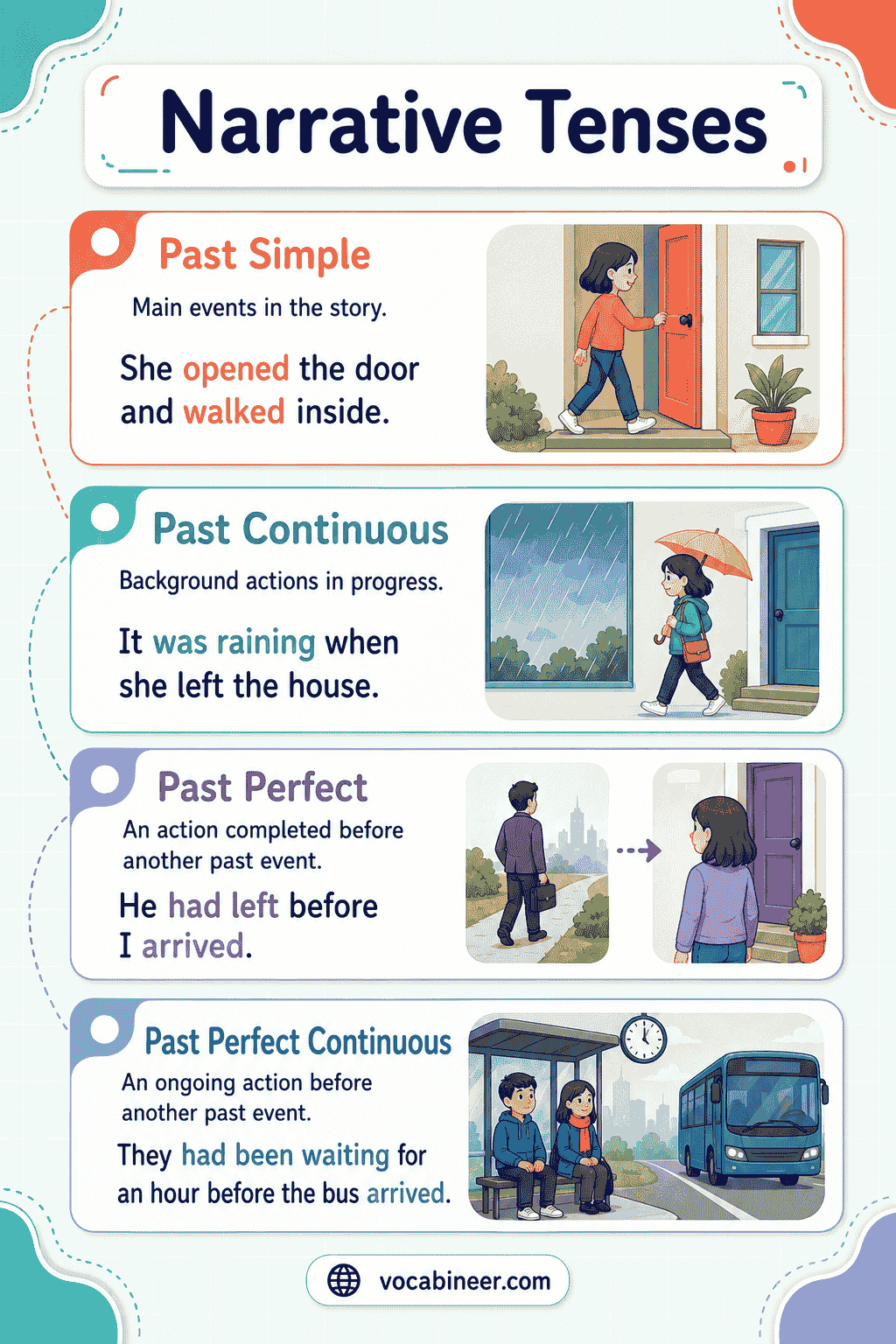
Narrative tenses help writers describe past events clearly by showing which actions form the main story, which actions create the background, which events happened earlier, and which activities continued before another past point. Choosing the right tense makes a story easier to follow and gives each event a clear place in the timeline.
The four main narrative tenses are Past Simple, Past Continuous, Past Perfect, and Past Perfect Continuous. Together, they organize main events, scene-setting, interruptions, earlier actions, duration, causes, and changes in chronology.
In This Page
What Are Narrative Tenses?
Narrative tenses are past-tense forms used together to organize events, background information, duration, and chronology in stories or past accounts.
The four main forms are:
- Past Simple
- Past Continuous
- Past Perfect
- Past Perfect Continuous
A useful principle is:
Narrative tense choice depends on the role an event plays in the story, not only on the fact that it happened in the past.
Narrative Tenses at a Glance
| Tense | Main Narrative Role | Example |
|---|---|---|
| Past Simple | main completed events | I opened the door. |
| Past Continuous | background or action in progress | It was raining outside. |
| Past Perfect | earlier completed event | Someone had broken the window. |
| Past Perfect Continuous | earlier ongoing activity or duration | It had been raining for hours. |
This gives the basic narrative pattern:
Past Simple = main events, Past Continuous = background, Past Perfect = earlier completion, Past Perfect Continuous = earlier process or duration.
Past Simple vs Past Continuous vs Past Perfect vs Past Perfect Continuous
A direct four-way comparison makes the difference clearer.
| Tense | Example | Story Meaning |
|---|---|---|
| Past Simple | Maya walked home. | completed main event |
| Past Continuous | Maya was walking home when it started raining. | action in progress |
| Past Perfect | Maya had forgotten her umbrella. | earlier completed event |
| Past Perfect Continuous | Maya had been working all day. | earlier ongoing activity |
Each form answers a different narrative question:
| Tense | Main Question |
|---|---|
| Past Simple | What happened next? |
| Past Continuous | What was happening around that time? |
| Past Perfect | What had happened earlier? |
| Past Perfect Continuous | What had been happening, and for how long? |
Past Simple for Main Events
Past Simple usually carries the main event line of a story.
Examples:
- I opened the door.
- I walked inside.
- The lights went out.
- Someone shouted my name.
- I ran outside.
These completed events move the narrative forward.
| Narrative Function | Example |
|---|---|
| first event | She entered the room. |
| next event | She looked around. |
| sudden event | The phone rang. |
| result | Everyone stopped talking. |
A chain of Past Simple verbs often creates the main chronological progression:
- She opened the door, walked inside, looked around, and called his name.
Use this principle:
Past Simple commonly advances the story through completed events.
Past Continuous for Background and Scene-Setting
Past Continuous commonly creates the background around the main action.
Examples:
- It was raining heavily.
- The wind was blowing.
- People were hurrying home.
- Music was playing nearby.
Then a main event can enter:
- Suddenly, a car stopped beside me.
Past Continuous can establish:
- weather
- surroundings
- temporary background situations
- actions already in progress
- simultaneous background activity
Use this principle:
Past Continuous commonly describes what was already happening around the main story events.
Past Simple vs Past Continuous for Complete and Ongoing Actions
The distinction is not only “main event vs background.” The forms also differ in how they present an activity.
| Past Simple | Past Continuous |
|---|---|
| presents an activity as complete | presents an activity as in progress |
| I worked in the garden all morning. | I was working in the garden when Maya called. |
| complete past period | activity viewed from inside its duration |
Another example:
- She read for two hours.
The activity is presented as complete. - She was reading when I arrived.
The activity was in progress at that moment.
Use this principle:
Past Simple presents the event as a complete past whole, while Past Continuous presents it as ongoing around a past reference point.
Main Events vs Background Events
This is one of the central narrative contrasts.
| Background | Main Event |
|---|---|
| Past Continuous | Past Simple |
| I was walking home | when I saw Maya. |
| She was sleeping | when the alarm rang. |
| We were driving home | when the storm started. |
| People were talking | when the lights went out. |
The continuous form creates the setting, while the simple form advances or changes the story.
Interrupted Actions in Stories
Past Continuous and Past Simple often work together when an event occurs during an action already in progress.
| Ongoing Action | Interrupting Event |
|---|---|
| Past Continuous | Past Simple |
| I was studying | when the phone rang. |
| They were walking | when it started to rain. |
| She was driving | when she saw the dog. |
Examples:
- I was sleeping when you called.
- We were eating when the lights went out.
- He was taking a shower when someone knocked at the door.
Avoid reducing this pattern to:
long action vs short action
A better principle is:
Past Continuous presents an action as already in progress, while Past Simple commonly marks the event that enters or interrupts that situation.
Two Actions Happening at the Same Time
Past Continuous can describe two simultaneous ongoing activities.
Examples:
- She was cooking while I was cleaning.
- The children were playing while we were talking.
- I was reading while he was watching television.
- They were laughing while the teacher was writing on the board.
Use this principle:
When two actions are presented as ongoing at the same time, Past Continuous can describe both.
When and While with Narrative Tenses
When and while connect past events, but they do not automatically determine the tense.
| Expression | Common Narrative Role |
|---|---|
| when | connects an event to a particular time or another event |
| while | commonly emphasizes overlap or an ongoing period |
Examples:
- I was walking home when I saw Maya.
- While I was walking home, I saw Maya.
- While we were eating, the phone rang.
- When I arrived, everyone was talking.
Avoid this rigid rule:
when = Past Simple
while = Past Continuous
A better principle is:
When and while connect events; tense choice depends on whether each action is presented as completed, ongoing, or background.
Past Perfect for Earlier Events
Past Perfect refers to an event completed before the current past reference point.
Examples:
- I realised I had left my wallet at home.
- She discovered that someone had opened the window.
- When we reached the cinema, the film had already started.
- He recognised the man he had met the previous week.
Past Perfect allows the narrative to step backward from the main timeline.
Use this principle:
Past Perfect moves the story back to an event completed before the current past reference point.
Story Order vs Actual Event Order
Stories do not always mention events in the same order in which they happened.
Consider:
- When I reached the station, the train had left.
The sentence mentions my arrival first, but the train left earlier.
| Story Mentions | Actual Chronology |
|---|---|
| I reached the station. | second |
| The train had left. | first |
Another example:
- I realised I had forgotten my keys.
Actual sequence:
- I forgot the keys.
- I realised it later.
Past Perfect makes the earlier relationship clear.
Use this principle:
Past Perfect allows writers to mention events out of chronological order without confusing the reader.
Chronological vs Non-Chronological Narratives
Narratives can follow time directly or move backward to earlier events.
| Chronological Narrative | Non-Chronological Narrative |
|---|---|
| mostly follows the order events happened | refers back to earlier events |
| She arrived, sat down, and called me. | She arrived and realised she had forgotten her phone. |
| Past Simple often dominates | Past Perfect helps mark the earlier event |
Past Perfect becomes especially useful when the story order differs from the actual chronology.
Past Simple vs Past Perfect in Stories
| Past Simple | Past Perfect |
|---|---|
| stays on the main past timeline | steps back to an earlier event |
| I arrived at the station. | The train had left. |
| She opened the letter. | Someone had sent it the day before. |
| He looked inside. | Someone had removed the documents. |
Use this principle:
Past Simple advances the main story timeline, while Past Perfect refers back to an earlier point.
Is Past Perfect Needed for Every Earlier Event?
No. Past Perfect is most useful when:
- the event order might otherwise be unclear
- the writer steps back from the current narrative timeline
- earlier completion needs emphasis
For example:
- I remembered the summer we had spent in the village.
- We stayed with my grandparents and walked to the river every afternoon.
The first sentence establishes the earlier period with Past Perfect. Once that earlier time frame is clear, Past Simple can describe events within it.
Use this principle:
Past Perfect establishes earlier-past reference; it does not need to continue mechanically through every sentence of an earlier sequence.
Returning from Past Perfect to the Main Timeline
Writers often use Past Perfect to step back briefly and then return to the main Past Simple timeline.
Example:
- I opened the old box.
- My grandfather had given it to me years earlier.
- He bought it during a trip to Italy and kept it for many years.
- I closed the box and put it back on the shelf.
The tense movement works like this:
| Stage | Tense | Function |
|---|---|---|
| main timeline begins | Past Simple | I opened the box. |
| step backward | Past Perfect | My grandfather had given it to me. |
| earlier sequence continues | Past Simple | He bought it and kept it. |
| return to main timeline | Past Simple | I closed the box. |
Use this principle:
Past Perfect can establish the step backward, while Past Simple can continue events within that earlier period and later return to the main narrative line.
Past Perfect for Earlier Causes and Explanations
Past Perfect can explain why a later past situation existed.
Examples:
- She was upset because she had lost her phone.
- He was hungry because he had skipped breakfast.
- The room was empty because everyone had left.
- I was nervous because I had forgotten the address.
The earlier completed event explains the later result.
| Earlier Cause | Later Result |
|---|---|
| She had lost her phone. | She was upset. |
| Everyone had left. | The room was empty. |
| He had skipped breakfast. | He was hungry. |
Use this principle:
Past Perfect can provide an earlier completed cause or explanation for a later past situation.
Past Perfect Continuous for Earlier Ongoing Activity
Past Perfect Continuous describes an activity that had continued before another past point.
Examples:
- She was tired because she had been working all day.
- The road was wet because it had been raining.
- I had been waiting for an hour when the bus finally arrived.
- They had been travelling all night before they reached the hotel.
This tense is especially useful when duration or ongoing process matters.
Use this principle:
Past Perfect Continuous describes activity that continued before another past point, especially when duration or process is important.
Past Continuous vs Past Perfect Continuous
These two continuous forms refer to different time relationships.
| Past Continuous | Past Perfect Continuous |
|---|---|
| action in progress at a past point | action already continuing before a later past point |
| She was waiting when I arrived. | She had been waiting for an hour when I arrived. |
| focuses on what was happening then | looks back at duration leading up to then |
Another comparison:
- It was raining when we left.
The rain was in progress at that time. - It had been raining for hours when we left.
The rain had already continued for hours before that point.
Use this principle:
Past Continuous describes activity in progress at a past point, while Past Perfect Continuous looks back at activity that had already been continuing before that point.
Past Perfect vs Past Perfect Continuous in Narratives
| Past Perfect | Past Perfect Continuous |
|---|---|
| emphasizes completed earlier action or result | emphasizes earlier process or duration |
| She had written the report. | She had been writing the report for hours. |
| They had repaired the road. | They had been repairing the road all morning. |
| completion/result | activity/duration |
Compare:
- He had painted the room.
The completed result matters. - He had been painting the room.
The activity or process matters.
Use this principle:
Past Perfect emphasizes what had been completed, while Past Perfect Continuous emphasizes what had been happening and often for how long.
Earlier Causes: Past Perfect vs Past Perfect Continuous
Both forms can explain a later past result, but they emphasize different kinds of causes.
| Past Perfect | Past Perfect Continuous |
|---|---|
| earlier completed cause | earlier ongoing cause |
| She was upset because she had lost her keys. | She was tired because she had been searching for them. |
| The room was empty because everyone had left. | The floor was wet because someone had been cleaning it. |
| completed event explains result | ongoing process explains result |
This distinction helps learners choose between completion and duration.
How the Four Narrative Tenses Work Together
The four forms become easiest to understand when they appear in the same story.
It was raining heavily when I left the office. I had forgotten my umbrella, and I had been working all day, so I was already exhausted. I ran toward the station, but the last bus left before I reached it.
Each tense performs a different role:
| Story Form | Narrative Role |
|---|---|
| was raining | background |
| left | main event |
| had forgotten | earlier completed event |
| had been working | earlier ongoing activity |
| ran / left | main event sequence |
The system can be summarized as:
Past Simple = main events, Past Continuous = background, Past Perfect = earlier completion, Past Perfect Continuous = earlier process or duration.
Narrative Timeline
A timeline helps show how the forms relate.
Example:
- I had forgotten to set my alarm.
- I was sleeping when my sister called.
- I jumped out of bed and ran downstairs.
| Time Position | Tense | Event |
|---|---|---|
| earliest | Past Perfect | had forgotten |
| background | Past Continuous | was sleeping |
| interrupting event | Past Simple | called |
| following main events | Past Simple | jumped, ran |
Narrative tenses therefore organize events by both relative time and story function.
Keeping Narrative Tenses Consistent
A story normally has a main narrative timeline. Tense changes should reflect a real change in:
- time relationship
- story function
- background vs main event
- earlier vs current past reference
- process vs completion
Avoid unnecessary tense switching.
| Weak or Unclear | Clear |
|---|---|
| I walked home and am seeing a strange car. | I walked home and saw a strange car. |
| She opened the door and was finding nobody there. | She opened the door and found nobody there. |
A tense shift should have a reason.
For example:
- It was raining when I left the house.
Past Continuous → background; Past Simple → main event. - I realised I had forgotten my wallet.
Past Perfect → earlier event.
Use this principle:
Keep the main narrative timeline consistent, and change tense only when the event’s time relationship or story role changes.
How to Start a Story with Narrative Tenses
A story does not have to begin with one particular tense.
| Opening Type | Tense | Example |
|---|---|---|
| immediate action | Past Simple | I opened the door and heard a scream. |
| scene-setting | Past Continuous | It was raining, and the streets were empty. |
| earlier reference | Past Perfect | I had never seen the town so quiet before. |
A Past Simple opening begins directly with action.
With Past Continuous, the writer usually establishes the setting first.
Meanwhile, Past Perfect can introduce an earlier reference or experience.
Use this principle:
A story can begin with action, background, or an earlier reference point depending on its narrative purpose.
Stative Verbs in Narrative Tenses
Not every background or earlier situation should use a continuous form.
Common stative verbs include:
- know
- believe
- understand
- want
- need
- own
- belong
- remember
Compare:
| Less Natural or Incorrect | Natural |
|---|---|
| I was knowing the answer. | I knew the answer. |
| He was wanting to leave. | He wanted to leave. |
| She had been owning the house for years. | She had owned the house for years. |
| I was understanding the problem. | I understood the problem. |
Use this principle:
Background meaning does not automatically require a continuous tense; stative verbs normally use simple or perfect forms instead.
Past Habits in Narratives
Narratives about memories can also include used to and habitual would.
Example:
- We used to live near the sea.
- Every evening, my father would take us to the beach.
Use this distinction:
| Used To | Would |
|---|---|
| can establish a former habit or state | commonly develops repeated past actions |
| We used to live near the sea. | Every evening, we would walk along the beach. |
Keep these forms secondary to the four main narrative tenses.
Common Narrative Time Expressions
Narrative time expressions help organize and connect events.
| Function | Common Expressions |
|---|---|
| simultaneous or overlapping events | while, as, meanwhile |
| event connection | when |
| sequence | before, after, then, afterwards |
| earlier completion | already, by the time, earlier |
| duration | for, since |
| sudden development | suddenly, all of a sudden |
| later development | later, eventually, before long |
| beginning of sequence | at first |
| immediate sequence | as soon as |
Examples:
- While I was walking, it started to rain.
- Meanwhile, everyone was waiting inside.
- Then I heard a strange noise.
- She had already left.
- Eventually, we found the correct road.
These expressions organize the narrative, but they do not automatically determine the tense.
Common Narrative Tense Mistakes
Learners often make mistakes when they use one past tense for every part of a story or switch tenses without a clear narrative reason.
Using Past Simple for every part of the story
Flat:
- It rained. I walked home. People ran. A car stopped.
Better:
- It was raining as I walked home. People were running for shelter when a car suddenly stopped beside me.
The second version distinguishes background from main events.
Using Past Continuous for a sequence of completed events
Incorrect:
- I was opening the door, was walking inside, and was seeing a man.
Correct:
- I opened the door, walked inside, and saw a man.
Past Simple normally carries completed sequential events.
Confusing complete activity with activity in progress
Compare:
| Complete Activity | Ongoing Activity |
|---|---|
| I worked all morning. | I was working when Maya called. |
Using Past Simple when earlier order is unclear
Potentially unclear:
- When I arrived, the train left.
This can suggest the train left at or after my arrival.
Clear earlier event:
- When I arrived, the train had left.
Using Past Perfect for every past action
Incorrect rule:
A past story should use Past Perfect for all earlier actions.
Better principle:
Past Perfect mainly establishes a step back from the current past timeline.
Keeping Past Perfect for too long
Once the earlier period has been established, repeated Past Perfect forms can become unnecessarily heavy.
Use Past Perfect to establish the earlier reference, then use Past Simple where the sequence within that earlier period is already clear.
Confusing Past Continuous and Past Perfect Continuous
| Past Continuous | Past Perfect Continuous |
|---|---|
| She was waiting when I arrived. | She had been waiting for an hour when I arrived. |
| in progress then | duration before then |
Confusing Past Perfect and Past Perfect Continuous
| Completed Earlier Action | Earlier Activity or Duration |
|---|---|
| She had cleaned the room. | She had been cleaning the room for an hour. |
Treating when and while as automatic tense rules
Incorrect rule:
when = Past Simple
while = Past Continuous
Better principle:
When and while connect events; story role and aspect determine the tense.
Changing tense without a narrative reason
Incorrect:
- I walked into the room and see everyone looking at me.
Correct:
- I walked into the room and saw everyone looking at me.
Using continuous forms with stative verbs
Incorrect:
- I was knowing the answer.
- She had been believing him for years.
Better:
- I knew the answer.
- She had believed him for years.
FAQs
The four main narrative tenses are Past Simple, Past Continuous, Past Perfect, and Past Perfect Continuous. They work together to organize main events, background activity, earlier completed events, and earlier ongoing activity.
Past Simple commonly describes the main completed events and moves the story forward.
Past Continuous commonly sets the scene by describing weather, surroundings, temporary situations, or activities already in progress.
Use Past Perfect when referring to an event completed before the current past reference point, especially when the story mentions events out of chronological order or needs to explain an earlier cause.
Past Perfect usually emphasizes earlier completion or result, while Past Perfect Continuous emphasizes an earlier ongoing process or duration.
Read More
- 12 English Tenses Chart
- All Tenses Rules and Formula
- English Tenses with Examples
- Present Tenses in English
- Past Tenses in English
- Future Tenses in English
- Be Going To in English